Most boring LinkedIn posts are not boring because the writer lacks expertise.
They are boring because the post hides the expertise under vague claims, slow openings, polite corporate fog, and a structure that makes the reader work way too hard to find the point.
That is usually the real issue. Not your ideas. Not the algorithm. Not even the platform. Just weak packaging.
If you want to know how to rewrite boring LinkedIn posts, the fix is rarely “make it more inspiring.” It is usually: say something clearer, get there faster, make it more specific, and stop writing like your legal department is standing behind you with a clipboard.
Here’s how to rewrite LinkedIn posts so they sound sharper, feel more human, and actually earn attention from people who might hire you, refer you, or remember you later.
For the main guide behind this topic, visit the parent guide.
Why LinkedIn posts become boring in the first place
Boring posts usually fail in one of five places:
- The opening says nothing
- The point is too vague
- The language sounds generic or robotic
- The post has no tension, contrast, or proof
- The ending fizzles out with a weak CTA or no next step at all
And yes, a lot of this happens because people are trying to sound “professional.” Which on LinkedIn often becomes code for “strangely lifeless.”
A good LinkedIn post does not need to be loud, dramatic, or fake-deep. It just needs a clear idea, a readable structure, and enough specificity that the reader thinks, “Okay, this person actually knows what they’re talking about.”
If you want broader context on what makes posts work in the first place, this guide on how to write better LinkedIn posts is a useful companion. But for now, we’re fixing the stuff that makes decent ideas die quietly.
How to rewrite boring LinkedIn posts: the practical process
You do not need a mystical writing ritual. You need a rewrite filter.
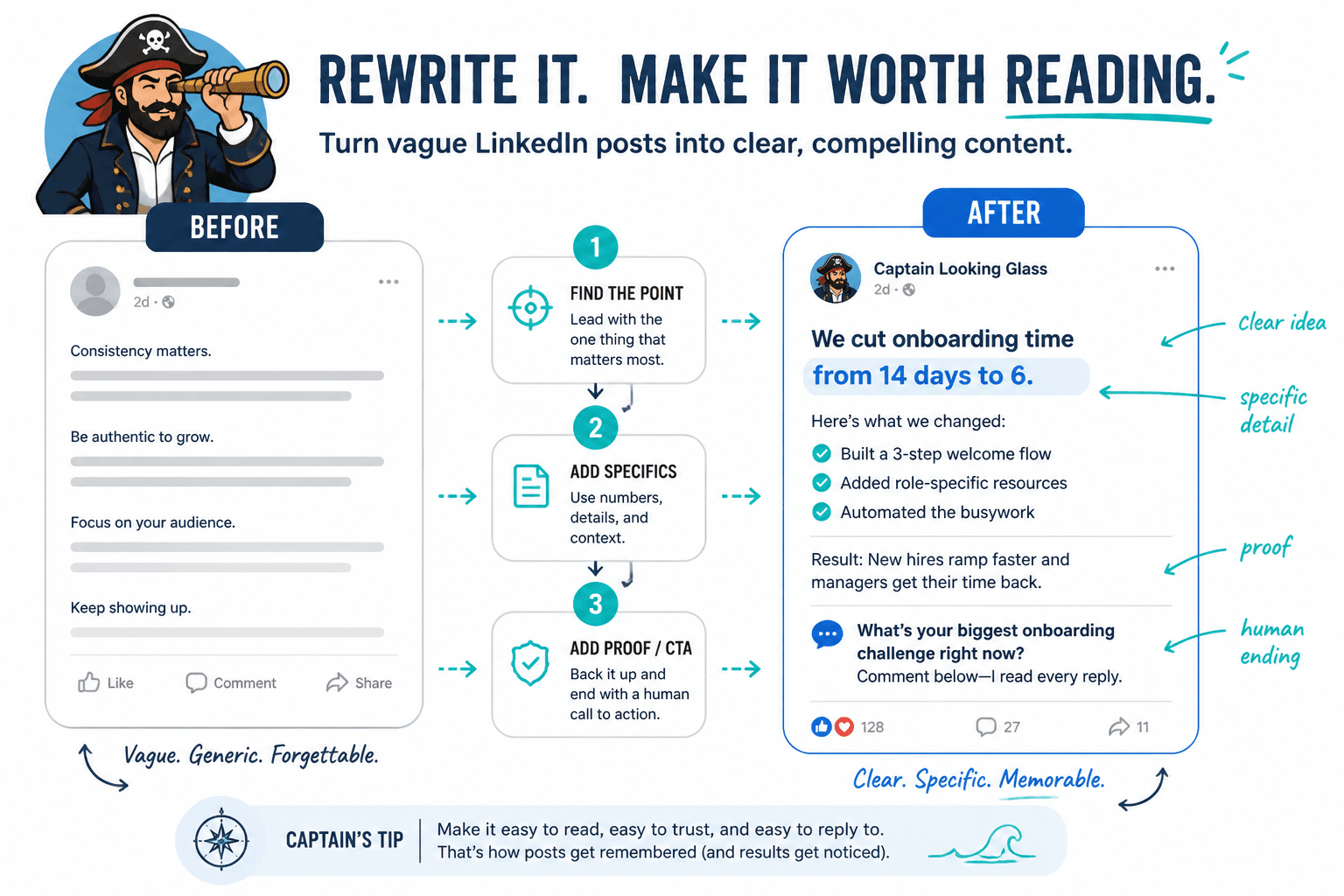
Here is the process:
- Find the actual point
- Cut the slow opening
- Replace vague language with specifics
- Add tension, contrast, or proof
- Tighten the structure
- End with a CTA that sounds like a human
1. Find the actual point
Many bad posts are not badly written. They are badly aimed.
The writer starts with a general theme like consistency, leadership, authenticity, growth, mindset, storytelling, community, or personal brand. Fine. But those are topics, not points.
Before rewriting, ask:
- What am I actually trying to say?
- What do I want the reader to understand, question, or do?
- What is the sharpest version of this idea?
For example:
| Weak topic | Better actual point |
|---|---|
| Consistency matters | Posting consistently does not help if every post says the same safe thing |
| Authenticity is important | On LinkedIn, “authentic” usually fails when it becomes performative oversharing with no useful takeaway |
| Personal branding matters | Your personal brand is mostly the pattern of what you repeatedly make people expect from you |
If the point is fuzzy, the post will be fuzzy. Start there.
2. Cut the throat-clearing opening
This is where a lot of LinkedIn posts go to die.
People open with things like:
- “I’ve been reflecting lately…”
- “In today’s fast-paced world…”
- “Here’s something I’ve learned on my journey…”
- “I used to think…”
- “A thought I wanted to share…”
None of those lines give the reader a reason to care yet. They are setup without payoff.
Start closer to the point. Better yet, start with tension.
Boring openings do not fail because they are short. They fail because they ask for attention before earning it.
Here is a simple before-and-after:
Before: I have been thinking a lot lately about the importance of consistency in content creation.
After: Consistency is not your problem. Posting bland things consistently is.
That second version creates tension immediately. It has a point. It earns the next line.
If weak first lines are a recurring problem, read how to start LinkedIn posts without a weak opening. Your rewrite quality improves fast when your first sentence stops mumbling.
3. Replace vague claims with specifics
Vagueness is one of the biggest reasons a post feels forgettable.
Writers say things like:
- Build relationships
- Provide value
- Be authentic
- Stay consistent
- Focus on your audience
All technically true. Also incredibly easy to ignore.
Specificity makes a post believable. It gives the idea edges. It helps the reader see how it applies in real life instead of just nodding politely and scrolling away.
Try this rewrite pattern:
- Vague claim: Be more authentic on LinkedIn
- Specific rewrite: Stop writing posts that sound like a panel discussion summary and say what you actually think in plain English
Another one:
- Vague claim: Add value to your audience
- Specific rewrite: Give people one useful distinction, one better way to phrase something, or one mistake to stop making today
Specific does not mean complicated. It means concrete.
4. Add tension, contrast, or proof
A lot of boring posts are just flat. Every sentence is on the same emotional and intellectual level. Nothing pushes against anything else.
That is where tension helps. Not fake drama. Real contrast.
You can create that with:
- A common belief versus what actually works
- A mistake versus a better approach
- A weak example versus a stronger rewrite
- A broad idea versus a specific application
- An opinion supported by proof or observation
For example:
Flat version: Storytelling is a powerful way to build connection on LinkedIn.
Better version: Storytelling works on LinkedIn when the story leads somewhere useful. A diary entry with line breaks is not a strategy.
See the difference? The second version has contrast, shape, and a bit of bite. It sounds like a person who has noticed patterns, not a brochure.
Proof helps too. Not fake stats. Just grounded evidence.
Instead of saying:
Weak: Short posts can be very effective.
Try:
Better: Short posts work when the idea is sharp enough to land in one breath. They flop when they are just half-finished thoughts wearing confidence as a disguise.
5. Tighten the structure so the reader can actually follow it
Sometimes the writing is fine. The structure is the real mess.
LinkedIn is not the place for giant blocks of wandering thought. The platform rewards readability. That does not mean every sentence needs its own dramatic line break, like the post is recovering from a sprint. It means the reader should be able to scan the shape and want to continue.
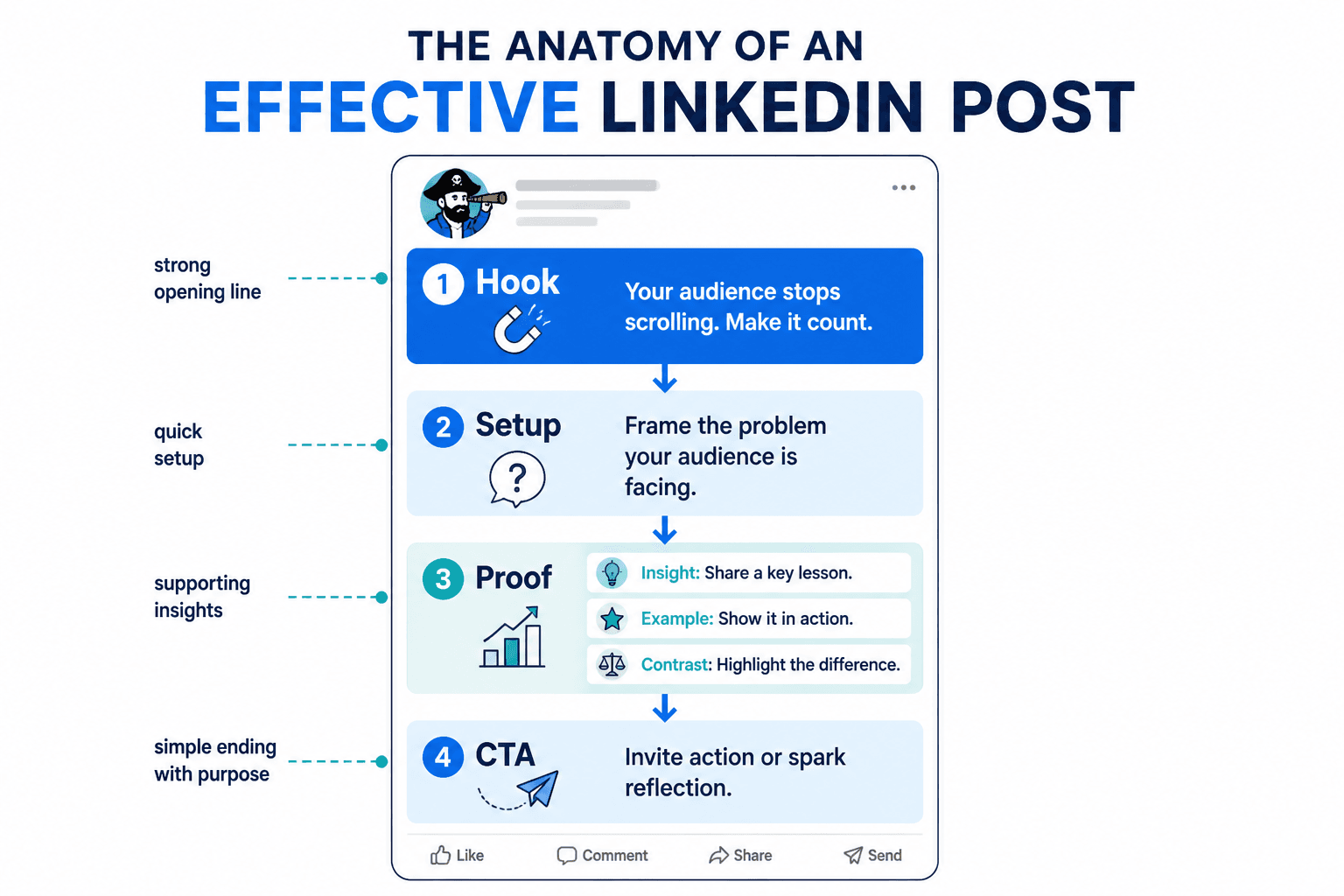
A cleaner structure usually looks like this:
- Strong opening line
- Quick setup of the problem or point
- One to three supporting insights, examples, or contrasts
- A simple ending that gives the post a purpose
If your draft jumps between three separate ideas, pick one. If it takes six lines to reach the point, cut four. If every sentence sounds equally important, some of them are not.
And if you are trying to figure out ideal post length while rewriting, how long LinkedIn posts should be in 2026 gives practical guidance without pretending there is one magic number.
Before-and-after rewrites of boring LinkedIn posts
Let’s make this less theoretical.
Example 1: The generic lesson post
Before:
Over the years, I have learned that success does not happen overnight. It takes hard work, consistency, and the willingness to keep going even when things get difficult. Stay focused on your goals and trust the process.
After:
“Trust the process” is useless advice when the process is not working.
A better rule:
- If your posts are consistent but forgettable, fix the message before you increase the volume
- If your content gets attention but no trust, add proof
- If people like your posts but never inquire, your next step is probably too vague
Consistency helps.
But only after the strategy stops leaking.
Why it works better:
- Starts with tension
- Gets specific
- Offers useful distinctions
- Sounds like an opinion, not a poster in a coworking space kitchen
Example 2: The vague credibility post
Before:
I’m passionate about helping businesses grow through content, branding, and authentic communication. It’s amazing what can happen when you show up with value and consistency.
After:
A lot of “brand content” fails for one simple reason:
It sounds polished before it sounds true.
If your posts are full of phrases like “delivering value” and “building meaningful connections,” people may understand the words while feeling absolutely nothing.
Better content usually sounds more like:
- a clear opinion
- a real example
- a useful distinction
- a next step the reader can actually use
That is what makes expertise feel credible instead of decorative.
Why it works better:
- Drops empty self-description
- Focuses on the reader’s problem
- Uses specificity instead of buzzwords
- Builds authority through clarity
Example 3: The accidental sales robot post
Before:
If you’re looking to elevate your personal brand and maximize your LinkedIn presence, I’d love to connect and explore how we can work together to unlock new opportunities.
After:
If your LinkedIn posts sound polished but do not bring leads, the problem may not be reach.
It may be that your content never makes a clear case for why someone should trust you.
Write posts that show how you think.
Not just posts that remind people you sell something.
If you help clients with this, say so plainly. No need to wrap it in webinar syrup.
Why it works better:
- Removes sales fluff
- Sounds more human
- Leads with insight instead of self-promotion
- Keeps the commercial point without sounding needy
The bigger point is simple: clearer structure and clearer writing make the piece more useful. That is usually what makes the ending land better too.