
Most creator funnels do not sound robotic because the writer used a tool.
They sound robotic because the funnel was built backwards. Instead of starting with a real person, a real problem, and a believable next step, people start with “conversion strategy” and end up writing copy that sounds like a brochure trying to flirt.
That is how you get posts that pretend to help but clearly want the click, lead magnets that feel like bait, emails that read like stitched-together templates, and CTAs with all the warmth of a parking meter.
If you want to learn How to Write Creator Funnels Without Sounding Salesy or Robotic, the fix is not making everything softer, longer, or “more authentic” in some vague brand-strategy way. The fix is writing a funnel that makes sense to the reader at every step. Clear promise. Relevant proof. Low-friction next move. No weird personality transplant into webinar-speak halfway through.
Here is how to build and write creator funnels that actually convert without sounding like you hired a chatbot to do sales cosplay.
For the main guide behind this topic, visit the parent guide.
Why so many creator funnels sound fake
A lot of funnels sound bad for the same reason bad networking sounds bad: the intent is obvious and the delivery is clumsy.
The reader can feel when every sentence is secretly pushing them toward a sale before trust has been earned. They can also feel when the copy has been stripped of any actual personhood in the name of “professionalism.” What remains is usually a pile of polished nothing.
Here are the usual problems:
- The funnel starts pitching before it has built relevance
- The copy uses stock urgency instead of real stakes
- The writer is trying to sound like a marketer instead of sounding clear
- The lead magnet solves a vague problem for a vague audience
- The emails repeat claims instead of deepening trust
- The CTA asks for too much, too soon
A creator funnel should feel like a guided path. Not a trap door under a helpful post.
That means every step has to answer one quiet question in the reader’s head: “Why should I care about this, and why should I trust you enough to take the next step?”
What a good creator funnel actually sounds like
A good creator funnel does not hide that it is leading somewhere. That part matters. The goal is not to pretend you are not selling. The goal is to make the progression feel useful, relevant, and earned.
Good funnel copy usually sounds like this:
- Specific about who it is for
- Honest about what it helps with
- Calm about the next step
- Grounded in real problems and outcomes
- Written in the same voice from content to CTA to sales page
- Confident without sounding inflated
Bad funnel copy tends to overcompensate. It tries to force authority, force urgency, force enthusiasm, force certainty. That is why it gets weird so fast.
If your content sounds human but your funnel sounds like it was assembled by a business coach trapped in a pop-up form, the problem is not your audience. It is the transition.
Start with the path, not the pitch
Before you write a single CTA, map the reader journey.
Not the fantasy version where strangers instantly become buyers because your thread was “valuable.” The real version. The slower version. The version where people need context, trust, examples, and a reason to keep going.
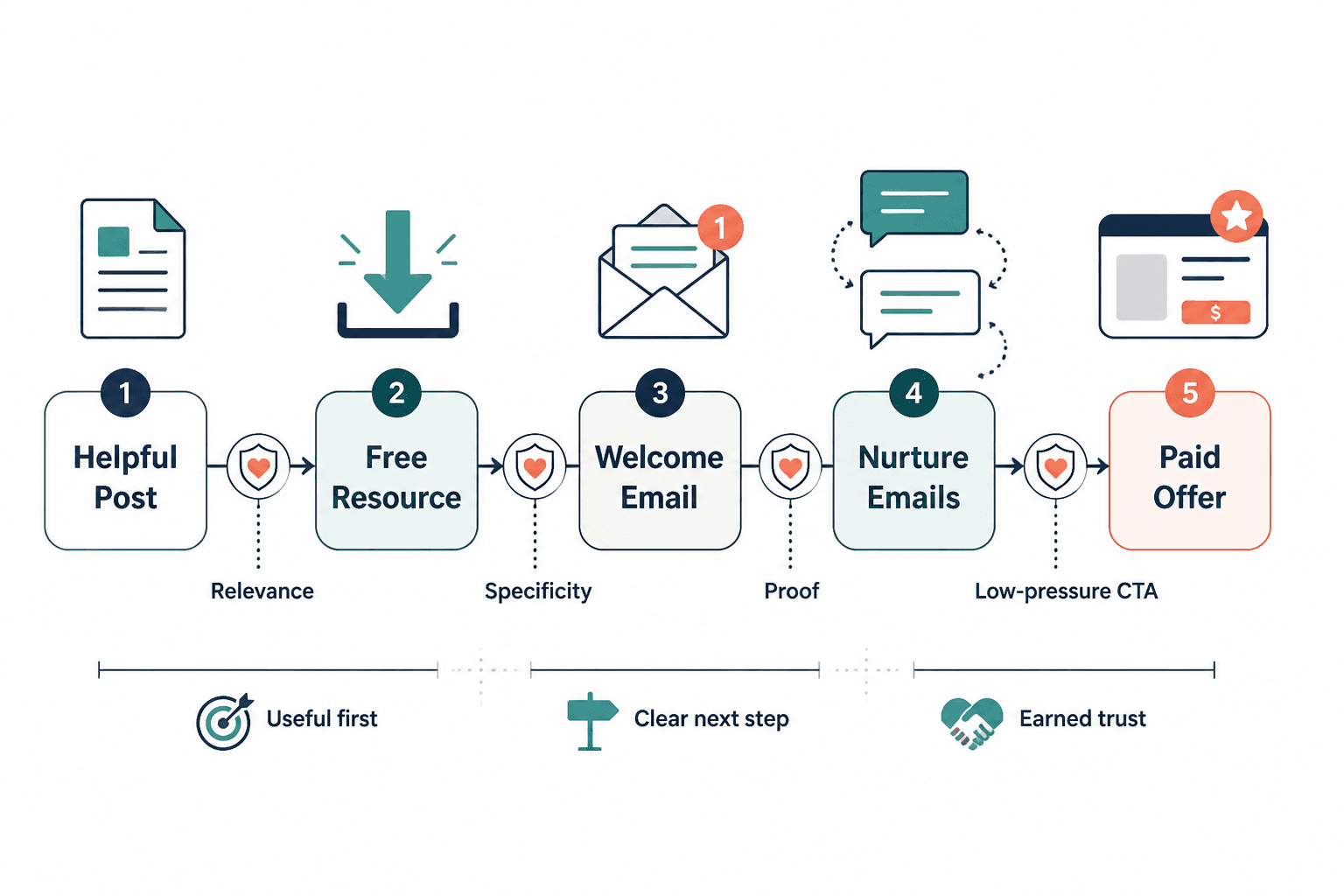
A simple creator funnel might look like this:
- A post gets attention with a sharp, relevant idea
- The profile makes the positioning clear
- A lead magnet offers a practical next step
- An email sequence deepens trust and shows how you think
- A soft offer invites the right people forward
That is enough. You do not need twelve pages, three countdown timers, and a “secret method” with an acronym that sounds like a vitamin deficiency.
If your path is muddy, your writing will get pushy because the copy will be trying to do too much heavy lifting. Structure first. Then copy.
If you need help tightening the structure itself, read how to write better creator funnels and the broader creator funnels guide.
Write each funnel step like it has one job
One reason funnels get robotic is that people stuff every stage with too many goals.
Your post is trying to educate, inspire, build authority, collect leads, close a sale, qualify buyers, and prove your life philosophy in 220 words. No wonder it sounds strained.
Each part of the funnel should mainly do one thing.
| Funnel step | Main job | What usually ruins it |
|---|---|---|
| Post | Earn attention and relevance | Overteaching, overpitching, vague hooks |
| Profile or landing page | Clarify who you help and what to do next | Fluffy positioning, no proof, too many options |
| Lead magnet | Offer a quick useful win | Too broad, too long, too generic |
| Email sequence | Build trust and sharpen the problem | Template voice, repeated hype, forced urgency |
| Offer page or CTA | Make the next step clear and credible | Pressure tactics, vague outcomes, bloated copy |
Cleaner role = cleaner writing.
Use real voice all the way through the funnel
A lot of creators sound normal in public content and then completely change dialect when money enters the chat.
Suddenly everything becomes “unlock,” “accelerate,” “high-value,” “transform,” “framework,” and “designed to help you.” It is a little tragic.
If your regular content is direct, your funnel should be direct. If your content is warm and thoughtful, your funnel should still sound warm and thoughtful. You can become more structured in sales copy. You should not become unrecognizable.
A simple voice check
Read your CTA, lead magnet page, and welcome email out loud. Then ask:
- Would I actually say this to a smart prospect?
- Does this sound like me on my best clear day, or me trying to sound “businessy”?
- Is this sentence communicating anything specific, or just posing as competence?
If it sounds like a different person wrote the monetization part, readers will feel that friction instantly.
Be specific enough to feel trustworthy
Robotic copy often hides inside vague claims. Generic language feels safer to the writer, but it feels riskier to the reader because they cannot tell what they are actually getting.
Compare these:
- Weak: Get the tools you need to grow your brand with confidence
- Better: Get the 5-part creator funnel I use to turn posts into email subscribers and consultation calls without stuffing every caption with a sales pitch
The second one works better because it sounds like someone has seen the problem up close. It names the mechanism, the use case, and the desired outcome. Not in a bloated way. Just enough.
Specificity is one of the easiest ways to sound less robotic because robots, marketers, and confused humans all love vague grand claims. Clear operators tend to name the thing.
If your funnel opening is weak, that problem usually shows up everywhere else too. This is worth reading next: how to start creator funnels without a weak opening.
Stop writing CTAs like tiny ambushes
The CTA is where a lot of funnels lose the plot.
Creators write a solid post, build trust, share something useful, and then end with one of these:
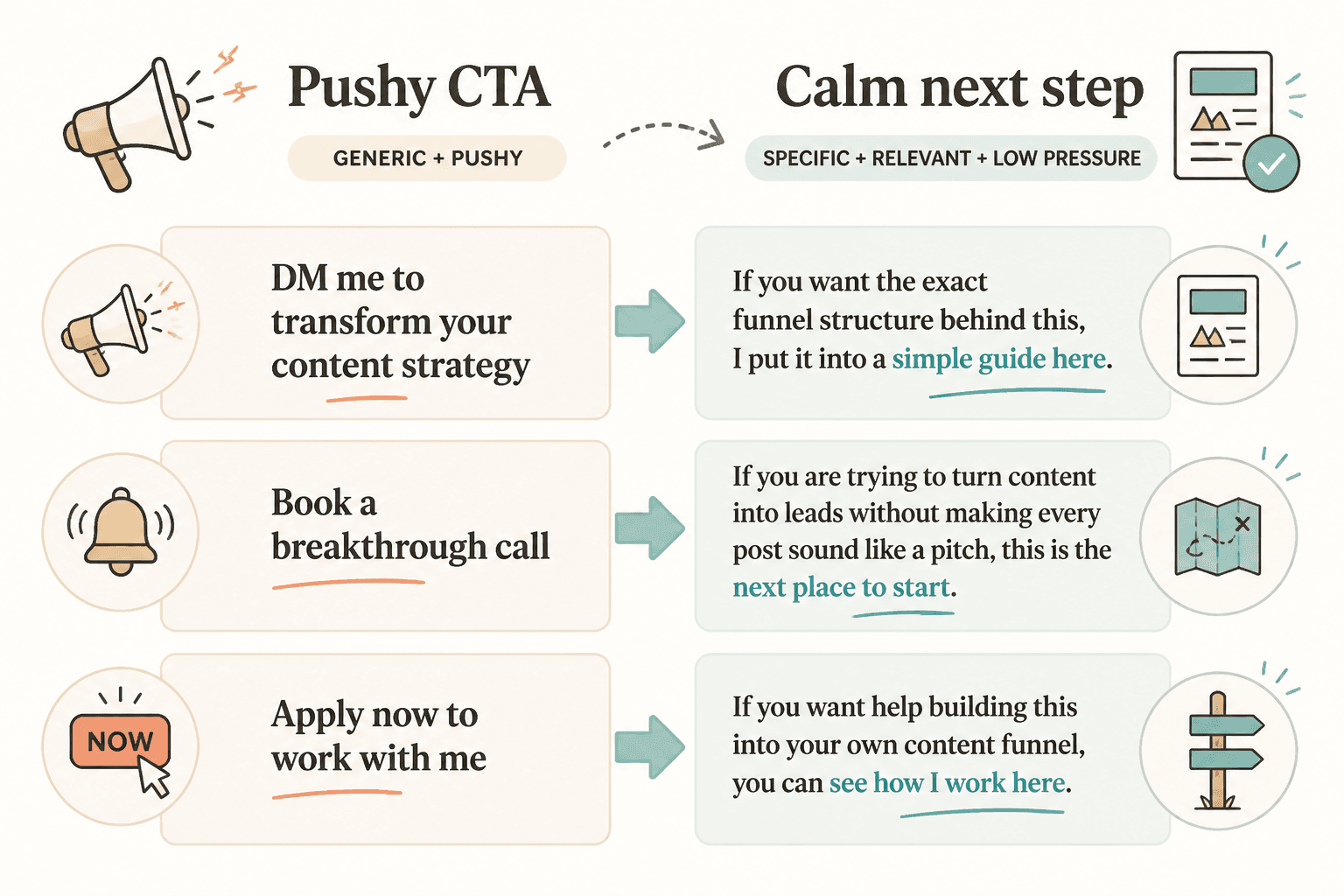
- DM me “READY” to scale your business now
- Book your free breakthrough call today
- Grab this exclusive resource before it is gone
- If you are serious about success, apply now
It is not that every direct CTA is bad. It is that these often feel disconnected from the tone and value that came before them. They sound imported.
What a better CTA usually does
- Matches the temperature of the content
- Offers a relevant next step, not a leap
- Makes the benefit obvious
- Keeps the language plain
Examples:
- Instead of: DM me to transform your content strategy
Try: If you want the exact funnel structure behind this, I put it into a simple guide here. - Instead of: Book a breakthrough call
Try: If you are trying to turn content into leads without making every post sound like a pitch, this is the next place to start. - Instead of: Apply now to work with me
Try: If you want help building this into your own content funnel, you can see how I work here.
A CTA should feel like an invitation with a reason, not a lunging hand at the end of a “value” post.
Make your lead magnet useful fast
If the free thing in your funnel feels generic, the rest of the funnel inherits that smell.
A good lead magnet does not need to be giant. In fact, giant is often worse. It should help the right person get a quick win, a clearer diagnosis, or a better starting point.
Good creator lead magnets often include:
- A checklist for a narrow use case
- A template with a filled-in example
- A teardown of what works and what fails
- A short guide with a clear method
- A swipe file with commentary, not just screenshots
What does not help much:
- Thirty-page ebooks nobody asked for
- Vague “starter kits” for everyone
- Generic prompt bundles with no strategic context
- Resources that create more questions than they solve
The lead magnet is not there to prove how much you know. It is there to make the next step feel sensible.
Write emails like a person continuing the conversation
Email is where many creator funnels become visibly synthetic.
You can almost feel the switch flip: “Thanks for downloading. Here is my origin story. Here are three mindset shifts. Here is an offer. Here is fake urgency. Here is a testimonial dropped from orbit.”
A better email sequence sounds like one coherent conversation. Each message should move the reader one step further in understanding the problem, seeing your method, or deciding whether your offer fits.
A simple 5-email trust-first sequence
- Delivery email: Give them the thing, explain how to use it, keep it clean
- Problem email: Name the mistake or friction point the resource is meant to solve
- Perspective email: Explain your approach and why common advice falls short
- Proof email: Share an example, case pattern, or before/after
- Offer email: Invite the right reader to take the next step
Notice what is missing: melodrama, chest-thumping, and the assumption that downloading one PDF means they are spiritually ready for your premium offer by Thursday.
Also worth noting: not every email has to be a sales setup in disguise. Sometimes trust grows because one email is simply useful, clarifying, or well-argued.
Use proof without turning into a walking testimonial wall
Proof matters because readers are not irrational for being skeptical. There is a lot of loud nonsense online. A healthy amount of doubt is frankly a sign of life.
But proof does not mean carpet-bombing the funnel with vague praise.
Stronger proof usually looks like this:
- A concrete before/after shift
- A short example of how your process changed something
- A pattern you have seen across clients or projects
- A useful mini case study
- A direct quote tied to a real result or decision
Weak proof usually looks like this:
- “This was amazing”
- “So much value”
- “Highly recommend”
- Revenue claims with no context
- Random logos with no explanation
Specific proof makes your writing calmer because you do not have to keep insisting that the offer is valuable. The evidence can do some of that work.
Do not hide the sale. Just earn it properly.
Some creators swing too far the other way. They are so afraid of sounding salesy that their funnel never actually asks for anything. The content is good. The freebie is decent. The emails are thoughtful. Then the offer arrives like a vague apology.
You do not need to be slippery to sell well. You just need the sale to feel proportionate to the trust built before it.
That means:
- Make the offer explicit
- Name who it is for
- Explain what it helps them do
- Show why your approach is different or useful
- Give a clean next action
There is a big difference between “Here is the next logical step if you want help” and “BUY NOW BEFORE YOUR DREAMS EXPIRE AT MIDNIGHT.” One builds trust. The other makes people close tabs.
If monetization is where your funnel gets awkward, this is the companion read: how to monetize creator funnels without wrecking trust.
A practical rewrite: robotic funnel copy vs human funnel copy
Here is what this looks like in practice.
Example: lead magnet CTA
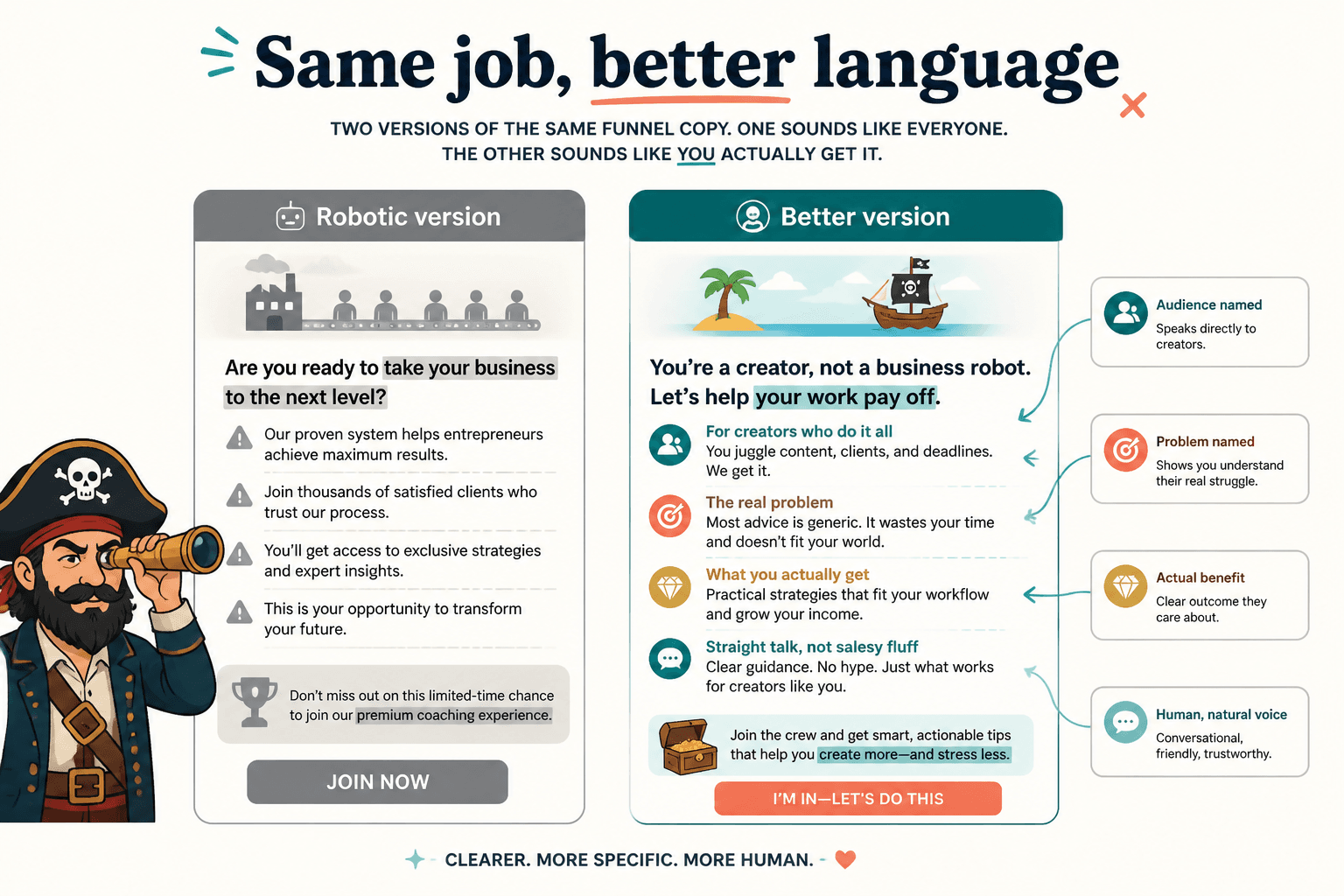
Robotic version:
Download my free creator growth framework to unlock more leads, authority, and impact across your content ecosystem.
Better version:
I put together a simple creator funnel guide for people who are getting attention from content but not enough subscribers, inquiries, or sales from it. It shows you what to write at each step without making your posts sound like mini sales pages.
Why it works better:
- It names the audience
- It names the problem
- It describes the actual benefit
- It sounds like a person wrote it
Example: email offer transition
Robotic version:
If you are ready to take your business to the next level, I invite you to apply for my premium coaching experience.
Better version:
If this has helped you see where your funnel is losing people, and you want help fixing the messaging from top to bottom, you can check out my offer here. It is built for creators and consultants who want a cleaner path from content to client without sounding overproduced.
Again, same job. Better language. Fewer fumes.
Match the funnel to the platform, not just the offer
A funnel that starts on LinkedIn should not sound exactly like one that starts on X or Facebook.
The trust mechanics are slightly different. Reader expectations are different. How much context people tolerate is different. So the writing should adapt.
- LinkedIn: More proof, more professional clarity, stronger positioning, cleaner transitions from post to profile to offer
- X: Tighter copy, sharper payoff, faster movement from idea to resource
- Facebook: More conversational tone, more story and personality, softer transitions into offers
The principle stays the same though: do not abruptly switch from useful human to conversion goblin because a link is involved.
For platform-specific adjustments, read how to improve creator funnels platform funnels without sounding generic.
A simple checklist for writing creator funnels without sounding salesy or robotic
- Start with a real reader problem, not a funnel template
- Give each step one main job
- Keep your voice consistent from post to page to email
- Use specific language instead of inflated promises
- Make CTAs feel like logical next steps
- Offer lead magnets that solve something narrow and useful
- Use proof that actually proves something
- Ask for the sale clearly, but only after earning enough trust
- Adapt the writing to the platform where the funnel begins
- Cut any sentence that sounds like AI oatmeal in a blazer
If you want the broader category context, you can also browse monetization funnels and funnel systems.
FAQ
How do I know if my funnel sounds too salesy?
If the copy pushes for action before it has built enough relevance or trust, it will usually feel salesy. Read it in order and notice where the ask starts feeling ahead of the relationship.
Can a creator funnel be direct and still feel natural?
Creator funnels get better when the path feels simpler and the writing makes each next step obvious. A cleaner message usually fixes more than extra funnel complexity ever will.
Creator funnels get better when the path feels simpler and the writing makes each next step obvious. A cleaner message usually fixes more than extra funnel complexity ever will.