
A creator funnel does not usually fail because it needs more automation, more jargon, or a louder CTA doing cartwheels in the margins. It fails because the writing asks for trust before it has earned any, or because each step sounds like it was drafted by a different committee. The fix is less glamorous and more useful: make the path clear, make the promise specific, and give every step one job.
That is the practical frame. Better creator funnels are not “more salesy.” They are easier to follow, easier to believe, and easier to act on.
What “better” actually means in a creator funnel
When a funnel works well, it does three things at once:
- It reduces confusion. The reader understands what this is, who it is for, and why it matters.
- It builds trust. The language feels grounded instead of inflated.
- It moves the reader forward. Each step leads naturally to the next one.
If a funnel is getting attention but not action, the problem is usually not “weak audience energy.” It is usually the wording, the sequence, or the handoff. A good funnel makes the next step feel obvious, not forced.
If you want the broader system behind this guide, start with the creator funnels guide and the parent section on creator funnel systems.
Start with the path, not the pitch
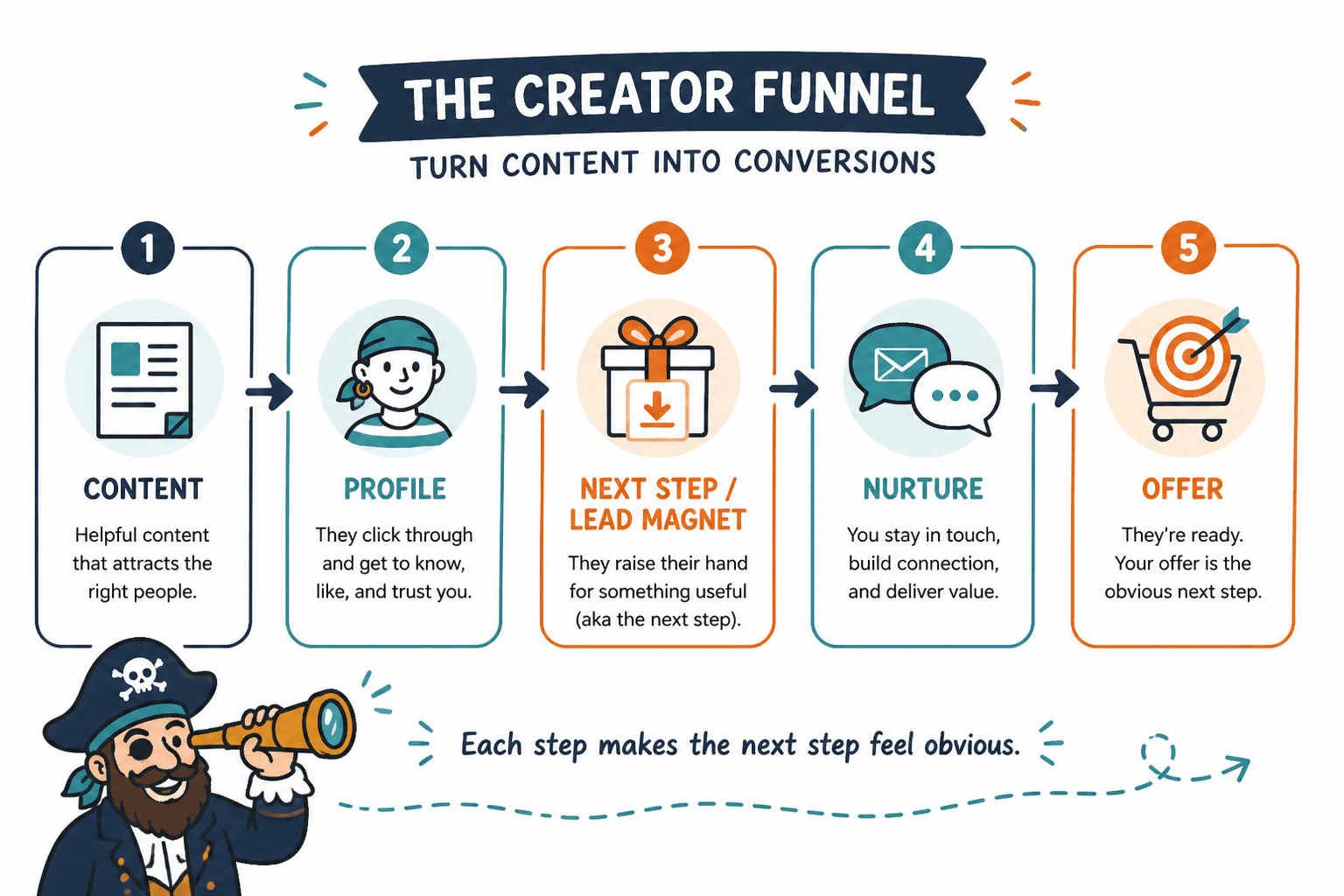
One of the fastest ways to write a weak funnel is to start by trying to sound convincing. That tends to produce copy that is polished in the wrong places. The better move is to map the route first:
- Content earns attention.
- Profile or landing page clarifies the next step.
- Lead magnet or signup captures intent.
- Nurture deepens trust.
- Offer gives the reader a decision worth making.
That sequence matters because the writing at each step should match the reader’s level of readiness. A cold reader does not need a grand manifesto. A warm reader does not need another vague brand paragraph pretending to be a strategy.
Shorter funnels often win when the offer is simple, the trust already exists, or the audience is highly relevant. Longer funnels make more sense when the offer is more complex or needs more proof. For a deeper look at that tradeoff, see when short creator funnels beat long ones and how long creator funnels should be in 2026.
Write each step like it has one job
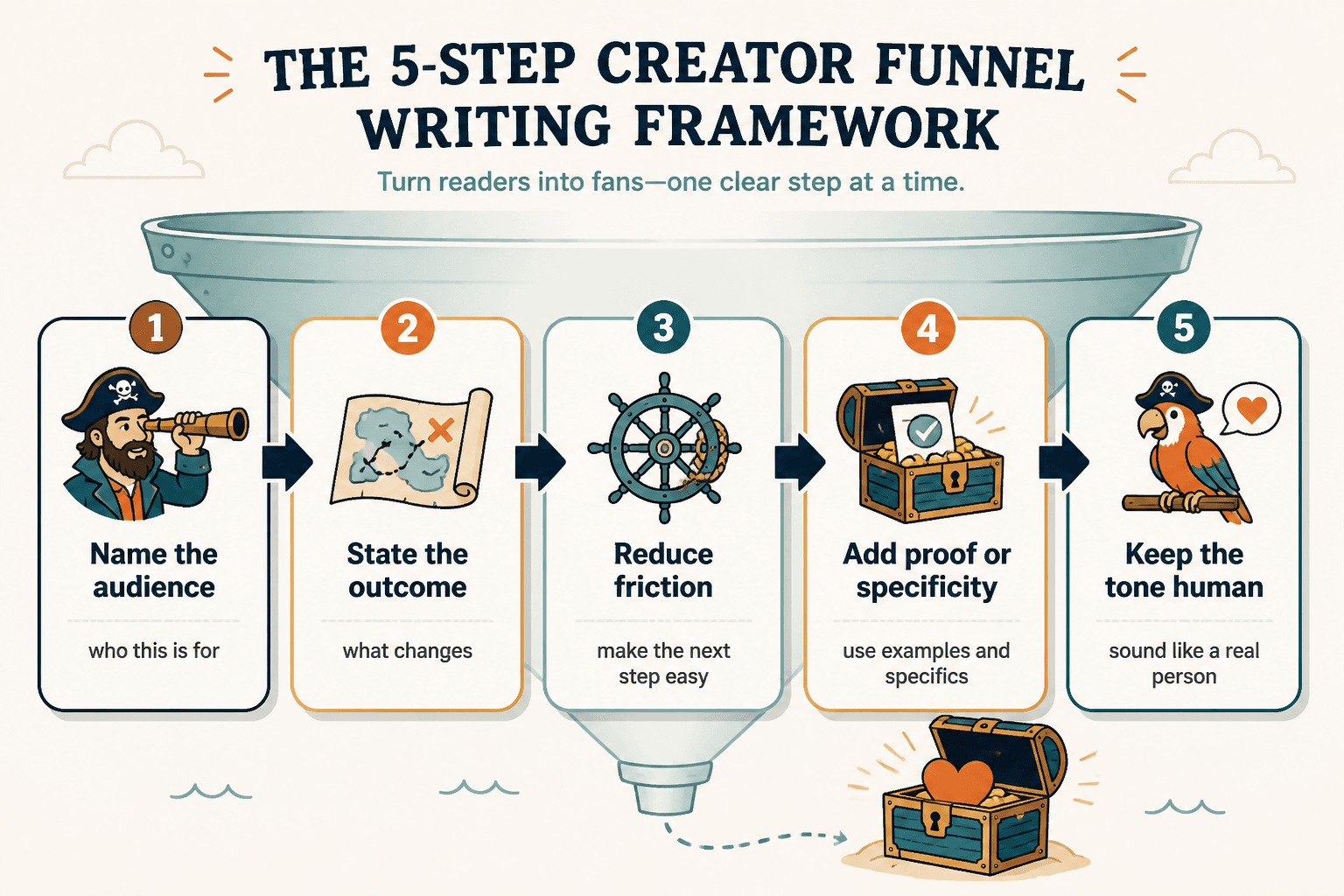
Creator funnels get messy when every page tries to do everything. A good funnel is focused. Each step should have one clear task.
The content step
The content’s job is not to close the sale. It is to attract the right reader and create enough interest that the next step feels reasonable. Keep it specific. Broad content pulls in broad attention, which is a polite way of saying “a lot of unhelpful traffic.”
If the content is meant to route readers into a funnel, it should signal the problem clearly and avoid promising six transformations in one post.
The landing page or profile step
This step should answer three questions fast:
- What is this?
- Who is it for?
- What happens next?
If the reader has to work to find those answers, the page is already losing. Good creator funnel writing is not poetic here. It is directional.
The lead magnet step
The lead magnet should solve one obvious problem or move one obvious decision forward. A generic checklist or “ultimate guide” often creates less momentum than a smaller, sharper asset.
That does not mean the lead magnet has to be tiny for the sake of trend compliance. It means it should be useful enough to feel like progress and focused enough to avoid becoming a small museum of adjacent information.
The nurture step
Nurture is where many funnels get weirdly formal. The writing turns into a sequence of “value emails” that read like they were assembled from a compliance handbook and a motivational poster. Better nurture feels human, practical, and cumulative. It should keep answering the reader’s real questions instead of wandering into brand fog.
The offer step
The offer page or booking page should not suddenly become a different personality. Keep the tone consistent, keep the promise grounded, and make the call to action clear. If the earlier steps earned trust, the offer step should spend it carefully, not recklessly.
Fix the opening before you fix everything else
A weak funnel opening usually has one of three problems: it is too vague, too broad, or too eager. It says “I help creators grow” when it should say what kind of growth, for whom, and through what kind of path.
A stronger opening does a few things in a tight sequence:
- Names the real problem. Not the category. The actual friction.
- Makes the audience visible. The reader should recognize themselves quickly.
- Shows the outcome honestly. No inflated promises.
- Gives a reason to believe. Proof, specificity, a credible mechanism, or a simple demonstration.
- Points to the next step. Not as a trap. As a continuation.
That same logic applies whether you are writing a post, a landing page, or the first message in an email sequence. The beginning should orient the reader, not audition for applause.
Make the handoff feel natural
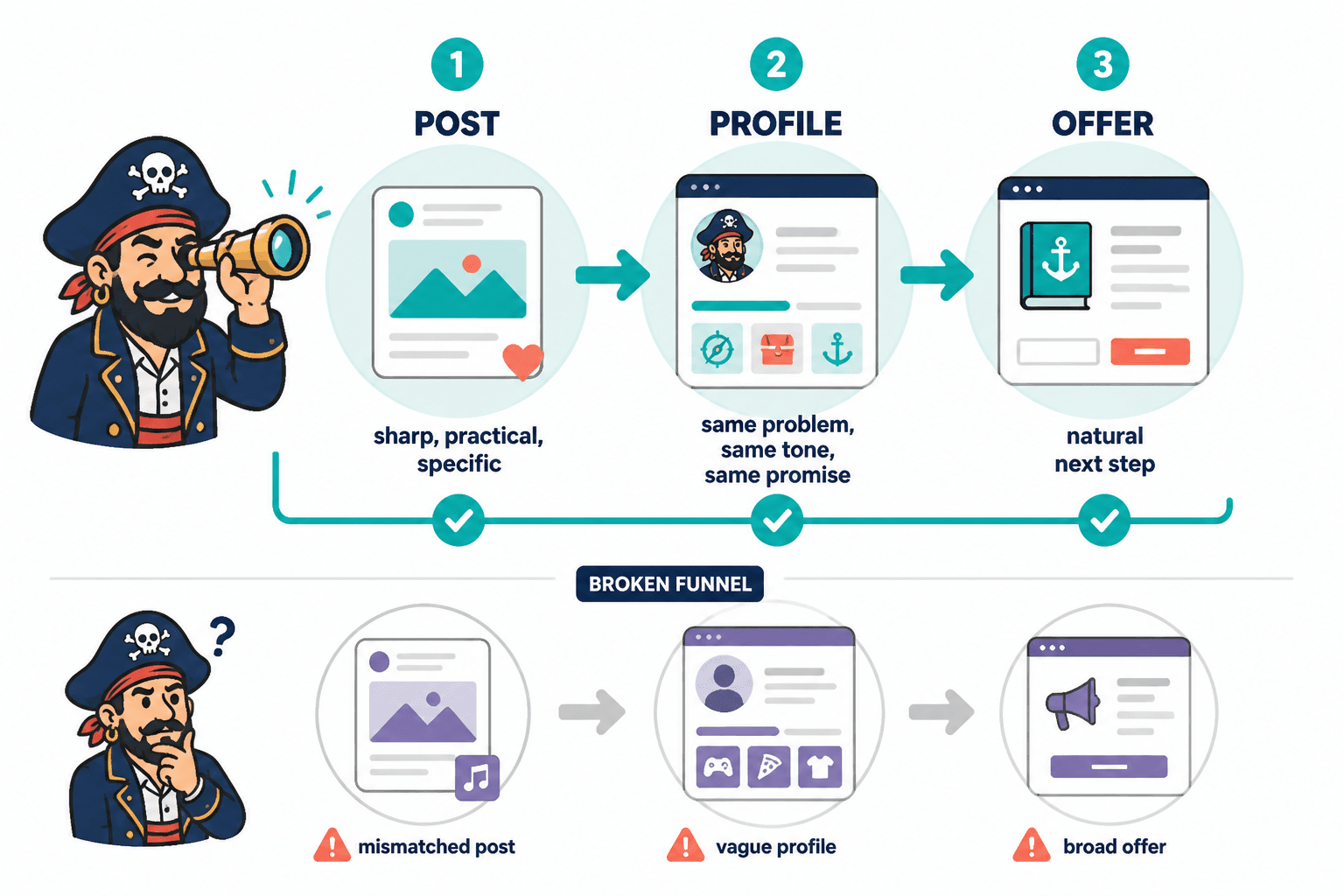
Most funnels lose people at the handoff. The post is useful, then the CTA comes in wearing a fake mustache and asking for an email address like nothing happened.
A better handoff connects the current step to the next one in plain language. The transition should feel earned. For example:
- Use the CTA to continue the same conversation, not start a new one.
- Match the offer to the level of intent the reader has already shown.
- Avoid switching from useful to salesy in one sentence.
- Explain why the next step exists.
If you are tightening signup paths, the best move is usually to remove unnecessary decisions, not to add “clarifying” paragraphs that only clarify how long the reader has to scroll. See also better creator funnel signup paths for personal brands.
Write for trust, not performance theater
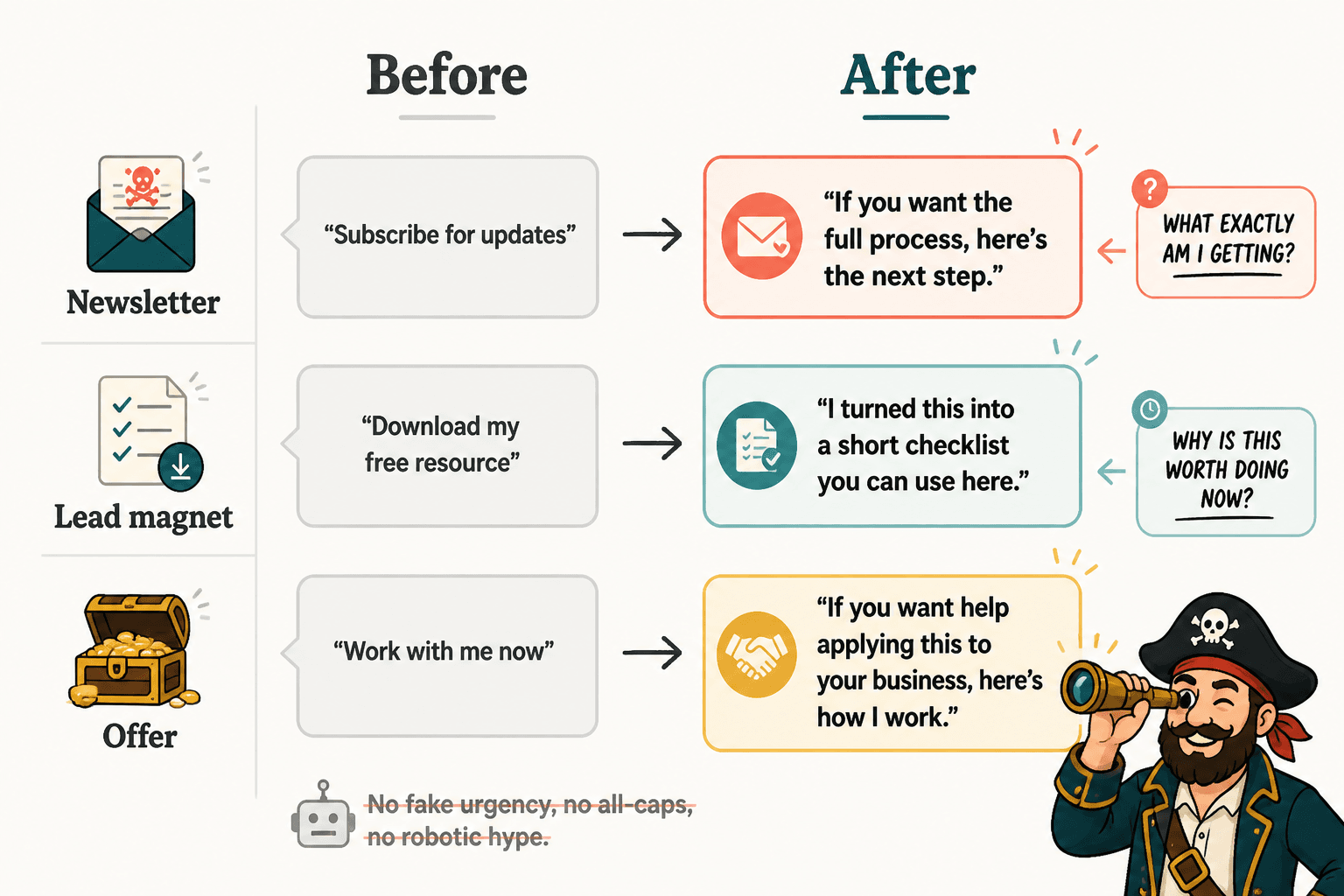
A lot of funnel copy tries to sound confident in the loudest possible way. That can create motion, but not necessarily belief. Trust is built with specificity.
Specific writing answers the reader’s private skepticism before it turns into a hard no. It avoids inflated claims. It names the actual problem. It describes the next step in normal human language.
That is especially important if you are writing for a personal brand, because the reader is not only evaluating the offer. They are evaluating whether the person behind it seems sane enough to listen to.
For a deeper voice-focused pass, see how to write creator funnels without sounding salesy or robotic.
Common writing mistakes that weaken creator funnels
- Generic promises. “Grow faster” is not a strategy. It is a fog machine.
- Too many steps. Every extra click needs a reason to exist.
- Mismatch between content and offer. If the content attracts the wrong reader, the funnel starts behind schedule.
- Lead magnets that are too broad. Broad often means forgettable.
- CTAs that jump too early. Asking for the sale before the reader has context is not bold. It is impatient.
- Robotic transitions. “And now, a special offer” has the emotional freshness of a parking ticket.
If you want the diagnostic version of this problem, the companion piece on creator funnel content funnel mistakes that hurt performance maps the most common failure points.
A simple rewrite process
If a creator funnel feels stale or underperforming, rewrite it in this order:
- Clarify the audience. Write for one specific reader, not a category with a pulse.
- Sharpen the problem. Say what hurts, what stalls, or what keeps repeating.
- Tighten the promise. Make it concrete and believable.
- Check the handoff. Make sure the next step matches the current step.
- Reduce friction. Remove anything that does not earn its place.
- Read it aloud. If it sounds like a brochure with a deadline, keep editing.
For old pages or posts you want to recycle into a better funnel, it helps to audit them by role instead of sentiment. Some content is suited to attention. Some is suited to opt-in. Some belongs near the offer. The routing matters more than the nostalgia.
Quick checklist for better creator funnel writing
- Does the opening name a real problem?
- Is the audience specific enough to recognize themselves?
- Does each step have one clear job?
- Is the handoff natural instead of abrupt?
- Does the lead magnet solve one obvious problem?
- Does the nurture sequence deepen trust instead of repeating the same point?
- Does the offer page stay grounded and clear?
- Would this still make sense if the reader was skeptical, busy, and only half-convinced?
If the answer to any of those is no, the funnel probably does not need a bigger stack. It needs cleaner writing.
Related guides
If you are building out the broader system, these pages connect naturally:
- best creator funnel ideas and examples for creators
- best AI tools for creator funnels
- creator funnels guide for creators who want better results
- creator funnel systems parent guide
Good creator funnel writing is not about dressing up a mediocre route. It is about making the route honest enough that the reader can actually follow it. That is the whole trick, which is annoying in the same way most good advice is annoying: it works better than the clever version.