
Most weak LinkedIn posts do not fail because the idea is bad.
They fail because the opening line walks in half-asleep, clears its throat, and says something nobody needed to hear.
If your post starts with “I’ve been thinking a lot about this lately” or “One thing I’ve learned on my journey,” you are making the reader do too much work too early. And LinkedIn readers are not exactly famous for their patience.
How to Start LinkedIn Posts Without a Weak Opening comes down to one thing: lead with the actual point, not the warm-up lap. A strong opening gives the reader a reason to care fast. It creates tension, clarity, curiosity, or recognition in the first line or two.
Here’s how to write LinkedIn openings that feel sharp, relevant, and worth reading, without sounding like a copywriting intern trying to manufacture suspense in a shared coworking kitchen.
For the main guide behind this topic, visit the parent guide.
What a weak LinkedIn opening actually looks like
Weak openings usually have one of three problems:
- They are vague
- They are slow
- They say something the reader has seen 4,000 times already
That is why so many posts die before the second line. Not because they lacked “engagement strategy.” Because the first sentence had no edge, no point, and no reason to continue.
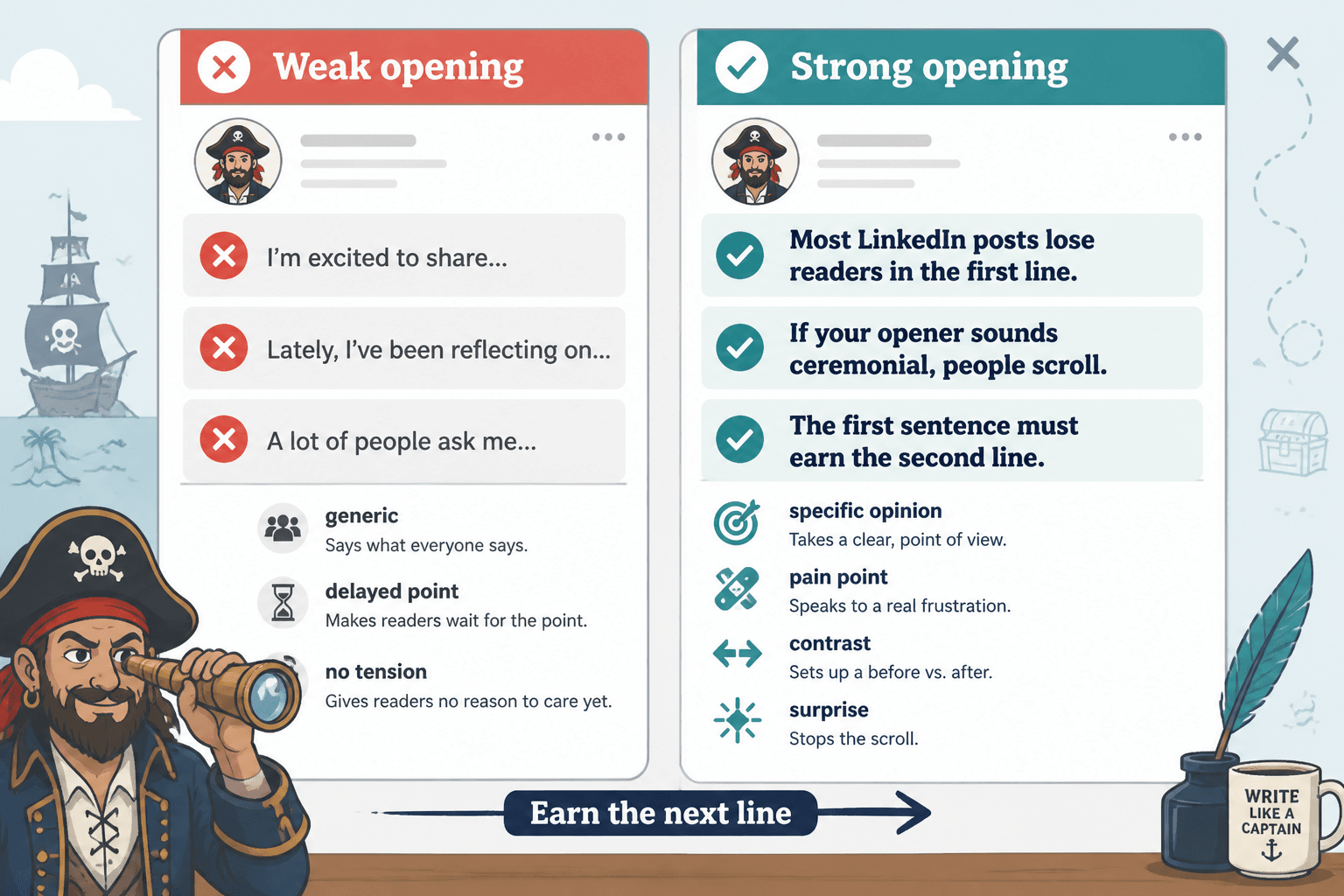
Here are a few common weak-openers-in-the-wild:
- “I’m excited to share…”
- “Lately, I’ve been reflecting on…”
- “There’s something important we need to talk about…”
- “A lot of people ask me…”
- “I used to think X, but then I realized Y”
Can any of these work sometimes? Sure. Almost anything can work sometimes. But most of the time, they are filler disguised as an opening.
A strong opening does not merely begin the post. It earns the next line.
What strong LinkedIn openings do instead
A good opening usually does at least one of these things immediately:
- States a specific opinion
- Calls out a mistake
- Names a painful problem
- Creates contrast
- Shows a surprising truth
- Makes the right reader feel seen
Notice what is missing from that list: dramatic fluff, mystery for the sake of mystery, and those weirdly ceremonial introductions people use when they are about to say something painfully ordinary.
On LinkedIn, readers are scanning. They are deciding in seconds whether this post is going to help them, teach them, challenge them, or waste their time. Your opening has one job: make that decision easy.
The fastest test for your first line
Ask this:
If someone read only my first line, would they get a clear reason to care?
If the answer is no, the opening probably needs work.
6 ways to start LinkedIn posts without a weak opening
You do not need one magic formula. You need a few reliable opening moves that fit your idea.
1. Start with a sharp opinion
This works well when your post is about industry nonsense, content advice, positioning, client work, or common bad habits.
Weak: “I’ve been thinking about personal branding a lot recently.”
Stronger: “Most personal branding advice makes people sound less like experts and more like laminated motivational posters.”
Why it works:
- There is a clear stance
- The reader instantly knows the topic
- It creates tension without fake drama
2. Start with the mistake people keep making
This is one of the easiest ways to write a useful post opening. People pay attention when they suspect they may be doing something wrong.
Weak: “If you want better reach on LinkedIn, here are some thoughts.”
Stronger: “Most LinkedIn posts do not flop because the algorithm buried them. They flop because the opening says nothing worth stopping for.”
That line has an argument inside it. Good. Arguments pull people forward.
3. Start with a specific problem your reader recognizes instantly
If your audience is creators, consultants, coaches, or service businesses, recognition is powerful. The right person should read the first line and think, yes, that is exactly the annoying thing.
Weak: “Writing content can be challenging sometimes.”
Stronger: “If your LinkedIn posts get polite likes but no leads, your content probably sounds informed but forgettable.”
Now we have a real problem. Better still, it hints at a diagnosis.
4. Start with contrast
Contrast is incredibly useful because it creates movement in one line. This, not that. What people assume versus what is actually happening. What seems smart versus what works.
Examples:
- “Being good at your work is not the same as being clear about your work.”
- “Long LinkedIn posts do not fail because they are long. They fail because they stay boring for too long.”
- “The problem is not that your niche is too small. It is that your message is too foggy.”
That kind of opening gives the reader a mental shift immediately. That is what makes them continue.
5. Start with proof or a concrete observation
If you have a pattern you have noticed from client work, audits, writing projects, content reviews, or running your own platform, use it.
Just do not fake authority with vague “I’ve seen this a lot” language. Be concrete.
Weak: “A lot of people struggle with hooks.”
Stronger: “After rewriting dozens of LinkedIn posts, the same problem keeps showing up: the first line is trying to sound thoughtful instead of trying to be clear.”
This works because it sounds observed, not borrowed.
6. Start mid-problem, not before it
A lot of writers waste the opening on setup. They explain what they are about to explain. They introduce the topic before saying anything useful about it.
Skip that.
Instead of: “I wanted to share some thoughts on why your LinkedIn posts may not be performing as expected.”
Try: “If your post needs three lines to arrive at the point, most people will not stick around long enough to find it.”
That is where the real post starts. So start there.
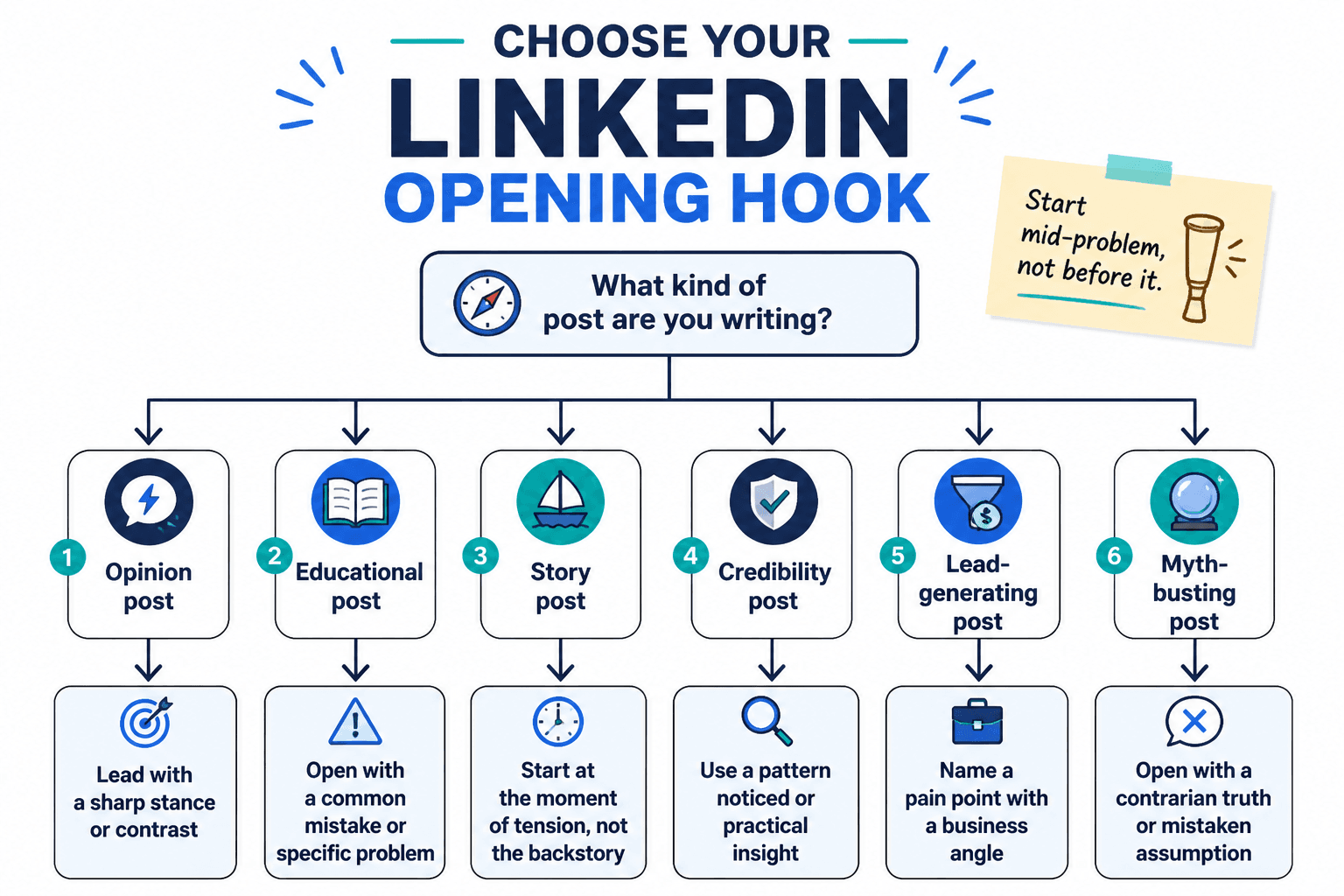
How to choose the right opening for the kind of LinkedIn post you are writing
Not every opening style fits every post. The best first line depends on what the rest of the post is trying to do.
| Post type | Best opening style |
|---|---|
| Opinion post | Sharp stance or contrast |
| Educational post | Common mistake or specific problem |
| Story post | Moment of tension, not backstory |
| Credibility post | Pattern noticed or practical insight |
| Lead-generating post | Pain point with a clear business angle |
| Myth-busting post | Contrarian truth or mistaken assumption |
This matters because the opening is not decoration. It is the front door to the structure underneath. If the first line promises one kind of post and the body delivers another, the whole thing feels sloppy.
For example, if you open with a dramatic story line but the post is really just three generic tips, readers feel tricked. Not deeply tricked. Just enough to stop trusting your posts. Which is not ideal.
Before and after: weak LinkedIn openings rewritten
Here is what this looks like in practice.
Example 1
Before: “I’ve been reflecting on content strategy recently and wanted to share a few thoughts.”
After: “Most content strategy problems are not strategy problems. They are clarity problems wearing strategy glasses.”
Why it is better: stronger voice, clearer angle, more memorable phrasing, less throat-clearing.
Example 2
Before: “A lot of people ask me how to improve their LinkedIn posts.”
After: “If your LinkedIn posts sound professional but get ignored, the problem usually starts in the first line.”
Why it is better: it centers the reader’s problem instead of the writer’s existence.
Example 3
Before: “Here’s what nobody tells you about writing online.”
After: “Writing online gets easier when you stop trying to sound smart before you sound clear.”
Why it is better: less fake suspense, more immediate value.
Example 4
Before: “I used to think long posts were the answer.”
After: “Long LinkedIn posts can work beautifully. But only when the extra length adds proof, tension, or usefulness instead of extra wallpaper.”
Why it is better: more specific, more useful, less tired.
If you want more practical rewrites, this guide to rewriting boring LinkedIn posts pairs well with this one.
A simple 4-step process for writing a better first line
If you keep freezing at the opening, use this process.
- Find the actual point. What is the real thing you are trying to say, warn against, or help with?
- Find the tension. What is being misunderstood, done badly, overhyped, or missed?
- Compress it. Write the idea in one sentence without intro fluff.
- Sharpen the wording. Replace vague words with specific ones and remove anything that sounds borrowed.
Here is a quick example.
Messy idea: People are posting often on LinkedIn but not seeing business results because they are too generic.
Compressed point: Posting consistently is not enough if the content says the same thing as everyone else.
Sharper first line: “Consistency does not help much when your posts sound like 20 other people in your niche before lunch.”
That is the move. Not perfection. Compression plus clarity.
What to cut from your LinkedIn openings immediately
If you want stronger openings fast, start by removing the stuff that weakens them on contact.
- Throat-clearing: “I wanted to share,” “just some thoughts,” “I think that maybe”
- Generic setup: “Content is important,” “branding matters,” “leadership is about people”
- Fake suspense: “Nobody talks about this,” “you won’t believe,” “here’s the truth”
- Overused confession frames: “I used to think,” “I never thought I’d say this”
- Announcement energy: “I’m excited to announce,” unless there is actually a meaningful announcement
The bigger point is simple: clearer structure and clearer writing make the piece more useful. That is usually what makes the ending land better too.