
Most advice about LinkedIn posts quietly assumes you already have an audience.
It assumes people are waiting for your take, your story, your “3 lessons,” your soft pitch, your inspirational carousel nobody asked for. That is cute. It is also not the situation most creators are in.
If you have a small audience, LinkedIn works differently. You do not need to “go viral.” You need the right people to understand what you do, trust how you think, and remember your name when they need help. That is a much saner job.
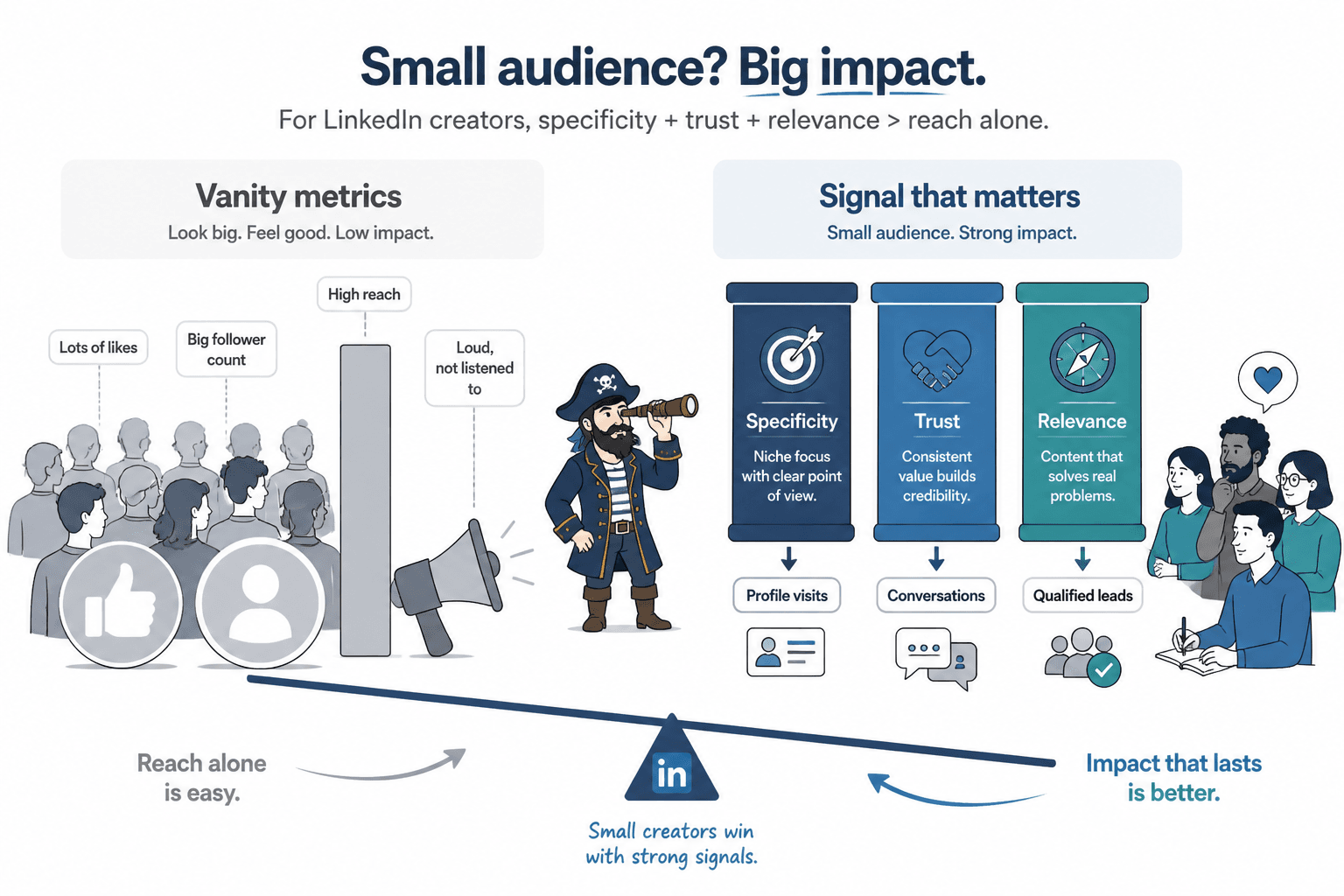
Good LinkedIn Posts for Creators With Small Audiences are not built around popularity. They are built around clarity, specificity, and relevance. A post that gets 12 likes from the right people can beat a post that gets 400 from random spectators who will never buy, refer, reply, or care again.
So this is not a “post more and manifest momentum” article. This is about what actually helps when your audience is still small: what to post, how to structure it, what to stop doing, and how to make your LinkedIn presence useful before it is impressive.
For the main guide behind this topic, visit the parent guide.
Small audiences do not need bigger content. They need sharper content.
A lot of creators with small LinkedIn audiences make one of two mistakes.
- They post ultra-safe content that says nothing memorable.
- They try to imitate large creators and post inflated “thought leadership” that sounds borrowed, polished, and weirdly hollow.
Neither works very well.
When your audience is small, people are not looking for celebrity energy. They are looking for signs that you are useful, credible, and worth following. They want to know if your ideas are clear. If your perspective is fresh. If you understand a real problem better than the average person posting recycled advice into the void.
That means your edge is not scale. It is signal.
A small audience will forgive modest reach. It will not forgive vague content.
What LinkedIn posts should do when your audience is small
Your posts do not need to entertain everybody. They need to do a few practical jobs well.
- Show what you know
- Show how you think
- Attract the right type of reader
- Build familiarity through repeated useful signals
- Create easy paths to profile visits, conversations, and eventual leads
That changes how you write. You stop asking, “How do I get more engagement?” and start asking, “What would make the right person think, okay, this person gets it?”
That question tends to produce much better content.
A better goal than reach
For small creators, a strong LinkedIn post usually earns one or more of these responses:
- “This is exactly the problem I have been dealing with.”
- “This person explains things clearly.”
- “I want to see more of their stuff.”
- “I should check their profile.”
- “I should send this to someone.”
- “I may need their help later.”
Those are much more valuable than shallow applause from people who barely read the post.
The biggest mistakes small creators make on LinkedIn
Before we get into what to post, it helps to clear out the usual junk.
1. Posting broad advice for everybody
“Be consistent.” “Tell your story.” “Add value.” Sure. Thanks. Very alive, very specific.
Broad advice gets polite nods and very little trust. Specific advice gets remembered. Instead of writing for “creators,” write for a type of creator with a specific problem.
Compare these:
- Weak: Consistency matters on LinkedIn.
- Stronger: If you only post when inspiration hits, your audience never gets enough repeated proof to remember what you do.
2. Sounding more polished than human
Small creators often think they need to sound “professional” to be taken seriously. What they usually produce instead is stiff, generic, over-smoothed copy with all the texture sanded off.
Professional does not mean lifeless. It means clear, useful, and in control. You can sound smart without writing like a press release in loafers.
3. Writing posts with no real point
A lot of low-performing posts are not bad because they are short. They are bad because the reader finishes them and still cannot tell what the actual point was.
Every post should have one sharp takeaway. Not six. Not a vague theme. One point.
4. Treating every post like a lead gen trap
If every post angles toward “DM me for details,” people will feel it. And they will back away slowly.
Small audiences need trust before conversion. A clean profile, a useful post history, and a clear next step will usually do more than constant pitching.
What to post instead: 5 LinkedIn post types that work for small creators
You do not need endless variety. You need a few repeatable formats that show expertise and create recognition.
1. Specific opinion posts
Opinion posts work well because they show how you think. That matters when nobody knows you yet.
The trick is to make the opinion specific enough to be useful, not dramatic enough to be embarrassing.
Example:
Hot take: most LinkedIn posts do not fail because the writing is bad.
They fail because the idea is too familiar to interrupt anybody’s scrolling.
Clean sentences cannot save a forgettable point.
If you want help with this format, a related read is simple LinkedIn opinion post templates for busy creators.
2. “What I keep seeing go wrong” posts
This format is excellent for consultants, coaches, writers, marketers, and service providers because it turns your pattern recognition into content.
Example structure:
- Name the repeated mistake
- Explain why it happens
- Show the consequence
- Offer a better way
Example opener:
One mistake I keep seeing from smart creators on LinkedIn:
they write as if the reader already understands why their topic matters.
The reader does not.
You have to create that relevance on the page.
3. Small case study posts
You do not need giant client stories with polished screenshots and dramatic revenue swings. Small case studies are often better because they are faster to read and easier to trust.
Try this structure:
- The situation
- The change you made
- Why it worked
- The lesson others can use
Example:
A creator I worked with kept posting decent advice and getting almost nothing back.
The problem was not the advice.
It was the opening lines.
We stopped leading with generic setup and started opening with sharp, concrete tension.
Profile visits went up first. Conversations came after that.
People usually do not ignore useful content because it is too advanced.
They ignore it because the packaging gives them no reason to enter.
4. Contrarian clarification posts
This is not about being edgy for attention. It is about correcting something oversimplified in your niche.
Example:
“Post every day” is not bad advice.
It is incomplete advice.
If your positioning is fuzzy, posting more just scales the confusion.
These posts can work especially well when your audience is small because they help people sort your perspective quickly.
5. Useful process posts
Show people how you think through a problem. This builds authority without needing huge proof or giant claims.
For example:
- How you choose post topics
- How you rewrite weak hooks
- How you turn client questions into content
- How you decide when a post should educate versus sell
Readers do not just buy solutions. They buy confidence in your process.
For more practical inspiration, you can also point readers to LinkedIn post ideas and examples for creators.
How to structure LinkedIn Posts for Creators With Small Audiences
The structure matters more than people think. If your post meanders, people leave. If it opens weakly, they never begin.
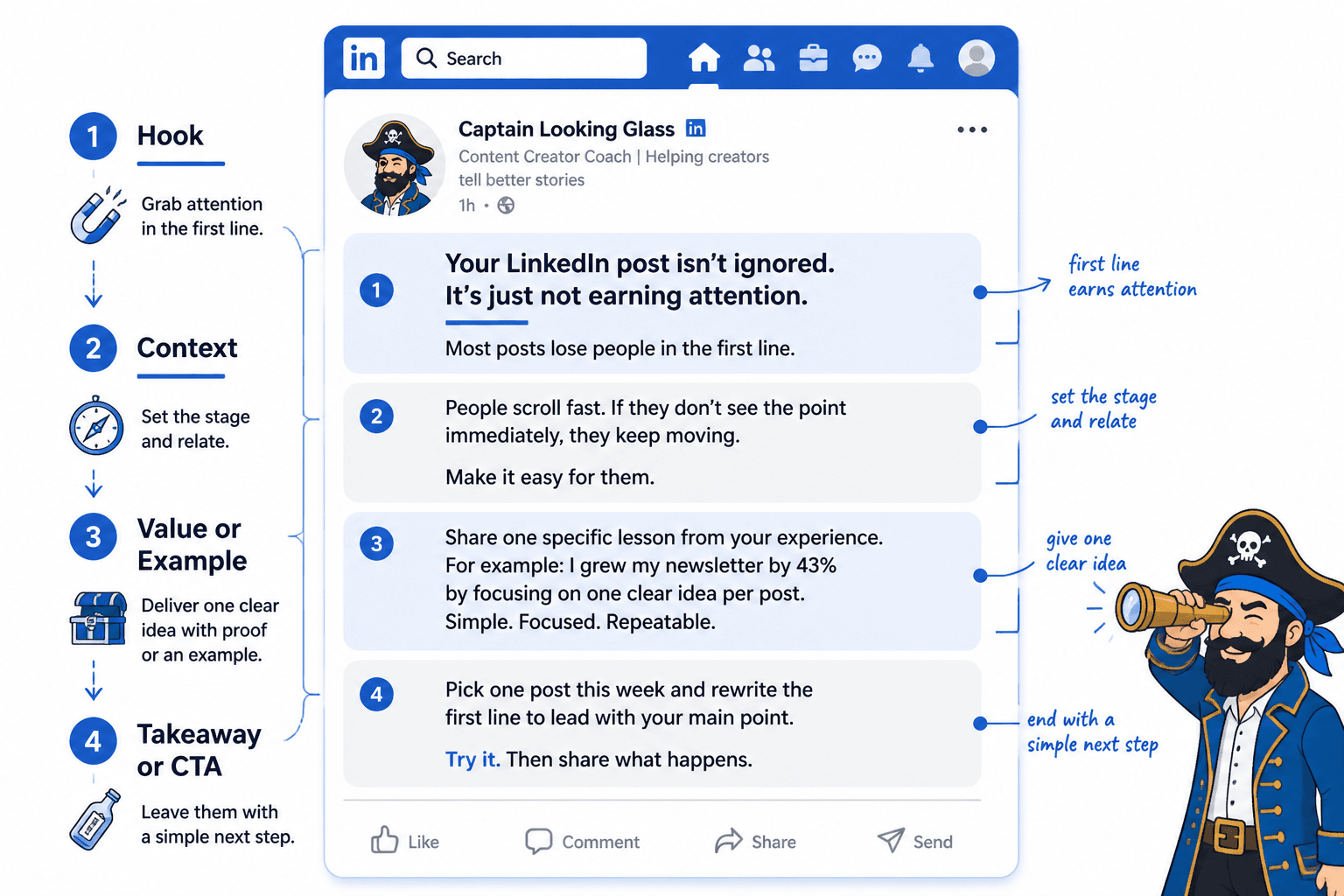
A simple structure works best:
- Hook: Start with a clear tension, mistake, observation, or claim.
- Expansion: Explain why it matters.
- Proof or example: Add a quick example, contrast, or mini-story.
- Takeaway: Land the point cleanly.
- CTA if needed: Keep it light and relevant.
That is enough for most posts.
Example: weak vs stronger
Weak version:
I used to think LinkedIn success was about posting often, but over time I learned it is also about quality, consistency, and understanding your audience. Here are a few lessons I have learned…
This opens like a hostage note written by committee. Nothing here creates urgency, curiosity, or clarity.
Stronger version:
If your LinkedIn posts are useful but invisible, the problem may not be the content.
It may be that your first line gives nobody a reason to care.
Much cleaner. Faster. Sharper. It gets to the point before the reader wanders off to admire somebody else’s faux-vulnerable career pivot story.
For more first-line help, see LinkedIn post hook examples creators can adapt fast.
What kind of CTAs actually make sense for small audiences
You do not need a CTA on every post. In fact, forcing one often makes the post feel thinner and needier.
But when a CTA does fit, keep it simple.
- Ask a real question people can answer quickly
- Invite a perspective, not just “thoughts?”
- Point people to your profile or resource naturally
- Suggest a next step that matches the post
Examples:
- What is one post format that consistently works for you?
- If your posts are useful but flat, start with your opening line before rewriting the rest.
- If you write educational posts, your profile should make the next step obvious.
- I write more about this over at LinkedIn posts if you want the deeper breakdown.
A good CTA continues the conversation. A bad CTA kicks the reader into a funnel trapdoor.
How often should small creators post on LinkedIn?
Often enough to build recognition. Not so often that quality collapses and your feed turns into filler.
For most small creators, 2 to 4 solid posts per week is plenty. Especially if you are also replying to comments, engaging thoughtfully, and keeping your profile clear.
Posting daily can work. It is just not the magic trick people pretend it is. Daily posting with fuzzy positioning is still fuzzy positioning, just louder.
A better rhythm
The bigger point is simple: clearer structure and clearer writing make the piece more useful. That is usually what makes the ending land better too.
LinkedIn posts usually improve when the point gets clearer and the fluff gets shorter. Stronger usefulness tends to outperform polished vagueness.