
Most LinkedIn opinion posts are not failing because the opinion is too bold.
They are failing because the post barely has an opinion at all.
You’ve seen the type. A soft little “hot take” wrapped in seven disclaimers, three vague life lessons, and a closing line that sounds like it wants applause for existing. It is polite. It is professional. It is also forgettable.
If you want Simple LinkedIn Posts Opinion Posts Templates for Busy Creators that actually help you say something useful without burning 45 minutes trying to sound clever, this is for you. These templates are built for people who have real work to do, real expertise to share, and no interest in posting watered-down beige oatmeal just to “stay visible.”
Here’s what you’ll get: practical opinion post formats, when to use them, what to avoid, and examples you can adapt fast. The goal is not to manufacture fake controversy. It is to help you publish sharper LinkedIn posts that sound like a person with a brain, a point of view, and a reason to be followed.
For the main guide behind this topic, visit the parent guide.
What makes a good LinkedIn opinion post?
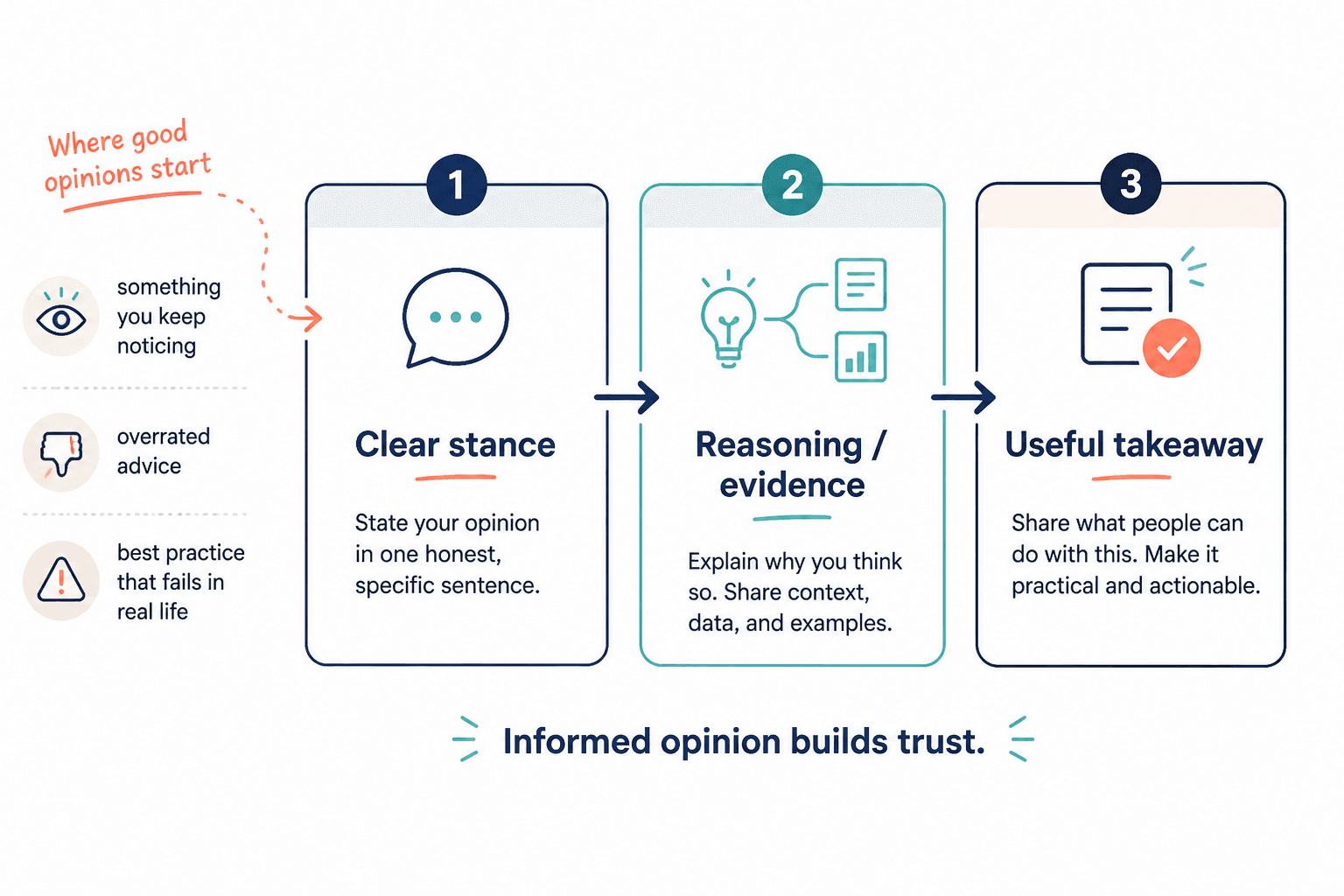
A good LinkedIn opinion post does three things:
- It takes a clear stance
- It explains the reasoning behind that stance
- It gives the reader something useful to think about, question, or apply
That’s it. No fake outrage needed. No dramatic “nobody talks about this” opener. No pretending your slightly different view on content calendars is a rebellious act.
The strongest opinion posts usually come from friction. Something you keep noticing. Advice you think is overrated. A best practice that breaks down in real life. A common habit that sounds smart but gets weak results.
And importantly, LinkedIn opinion posts work best when the opinion is connected to expertise. Random opinions are cheap. Informed opinions build trust.
Before you use any template, get the opinion sharp first
Templates help. They also make it very easy to publish polished nonsense if the underlying idea is fuzzy.
Before you write, force yourself to answer these three questions:
- What exactly do I believe?
- What do most people seem to believe instead?
- Why does this difference matter to my audience?
If you can answer those clearly, the post gets easier fast.
For example, “authenticity matters” is not an opinion. It’s a poster in a coworking space.
“On LinkedIn, authenticity is overrated if it comes without specificity, proof, or a useful point” is an opinion. Now you have tension. Now you have somewhere to go.
Simple LinkedIn opinion post templates for busy creators
These are meant to be fast, flexible, and not weirdly robotic. Use them as structures, not scripts. If every post sounds like it came out of the same little template oven, people notice.
1. The “popular advice is incomplete” template
This one works when the usual advice is not totally wrong, just oversimplified.
Template
People say [common advice].
That’s not wrong.
But it is incomplete.
What actually matters more is [missing factor].
Why?
[Brief explanation]
If you’re trying to [goal], focus less on [common obsession] and more on [better lever].
Example
People say consistency is the key to LinkedIn growth.
That’s not wrong.
But it is incomplete.
What matters more is publishable clarity.
A lot of creators are consistent. They are also vague, safe, and instantly forgettable.
If your posts do not make a clear point, posting more often just increases the number of missed opportunities.
Consistency helps.
Clarity converts.
This template works because it avoids cartoonish “everyone is wrong” energy while still giving you contrast.
2. The “stop doing this, do this instead” template
Simple. Direct. Useful. Great for busy creators who want a fast opinion post with practical value.
Template
Stop [common weak behavior].
Start [better behavior].
Why?
[Reason 1]
[Reason 2]
[Reason 3]
If you want [outcome], [clear concluding line].
Example
Stop writing LinkedIn posts that sound like cleaned-up panel answers.
Start writing posts that sound like a real point you would actually make to a client.
Why?
Panel-answer content sounds polished but forgettable.
Real opinions create differentiation.
Differentiation gets remembered.
If you want better content results, stop aiming for “professional” when you really mean “harmless.”
That last line matters. Land it cleanly. Do not keep talking after the point arrives.
3. The “I disagree with this trend” template
Useful when a platform trend, tactic, or style is getting copied too aggressively.
Template
I disagree with the idea that [trend or common belief].
Not because [misread motive].
Because [real reason].
[Short explanation]
For most [audience], a better approach is [alternative].
Example
I disagree with the idea that every LinkedIn post needs a big storytelling arc.
Not because stories are bad.
Because a lot of creators are using storytelling to hide the fact that the actual insight is weak.
Sometimes a sharp opinion, clearly stated and backed by experience, works better than a mini memoir about your coffee, your doubt spiral, and the lesson you learned at 6:14 AM.
For most creators, a better approach is simple:
make a real point, support it, and stop performing depth.
4. The “this sounds smart but backfires” template
Great for calling out advice that feels sophisticated but creates bad results in practice.
Template
[Advice or behavior] sounds smart.
But for many [audience], it backfires.
Here’s why:
[Problem 1]
[Problem 2]
[Problem 3]
Better move:
[replacement approach]
Example
Trying to sound “high level” on LinkedIn sounds smart.
But for many creators, it backfires.
Here’s why:
It makes your writing vague.
It strips out personality.
It hides what you actually know.
Better move:
Write like an expert who can explain things plainly, not like a consultant trying to fog a mirror and call it insight.
5. The “my unpopular working rule” template
This is a strong format when you want to share a practical belief that guides your work.
Template
My unpopular rule for [topic]:
[your rule]
Why I think this:
[explanation]
It helps me / my clients [benefit].
You do not have to agree.
But if you keep struggling with [problem], this might be the part worth rethinking.
Example
My unpopular rule for LinkedIn content:
Do not post a “value” post if the value could have been generated by a bored intern with Wi-Fi.
Why I think this:
Generic advice does not build trust anymore. It just proves you know what everyone already knows.
The posts that build authority usually contain one of three things:
a specific observation, a clear opinion, or a useful example.It helps me create content that sounds less replaceable.
You do not have to agree.
But if your posts keep getting polite silence, this might be the part worth rethinking.
6. The “you do not need more, you need better” template
This one is ideal for creators overwhelmed by advice to do more of everything.
Template
You do not need more [thing].
You need better [thing].
Most people are chasing [volume metric].
But the real issue is usually [quality issue].
If you improve [specific factor], [better outcome becomes more likely].
Example
You do not need more LinkedIn post ideas.
You need better angles.
Most people are chasing volume because it feels productive.
But the real issue is usually this: the idea is too broad, too safe, or too familiar.
If you improve the angle, one ordinary topic can turn into five strong posts instead of one sleepy one.
How to make these templates sound like you
This is where a lot of people go wrong. They grab a template, fill the blanks, and end up with something technically correct but lifeless. The structure works. The voice wandered off.
To keep your opinion posts human, change the wording to match how you naturally explain things. If you tend to be blunt, be blunt. If you’re more calm and analytical, use that. A decent template should support your voice, not flatten it into generic creator paste.
Three easy ways to make a template feel more like you:
- Swap stock phrases for your real language. Instead of “what actually matters is,” maybe you’d say “the real issue is” or “the bit people miss is.”
- Add one concrete detail. A pattern you keep seeing, a client mistake, a writing habit, a content example.
- Use a final line with some bite. Not fake drama. Just a clean sentence people can remember.
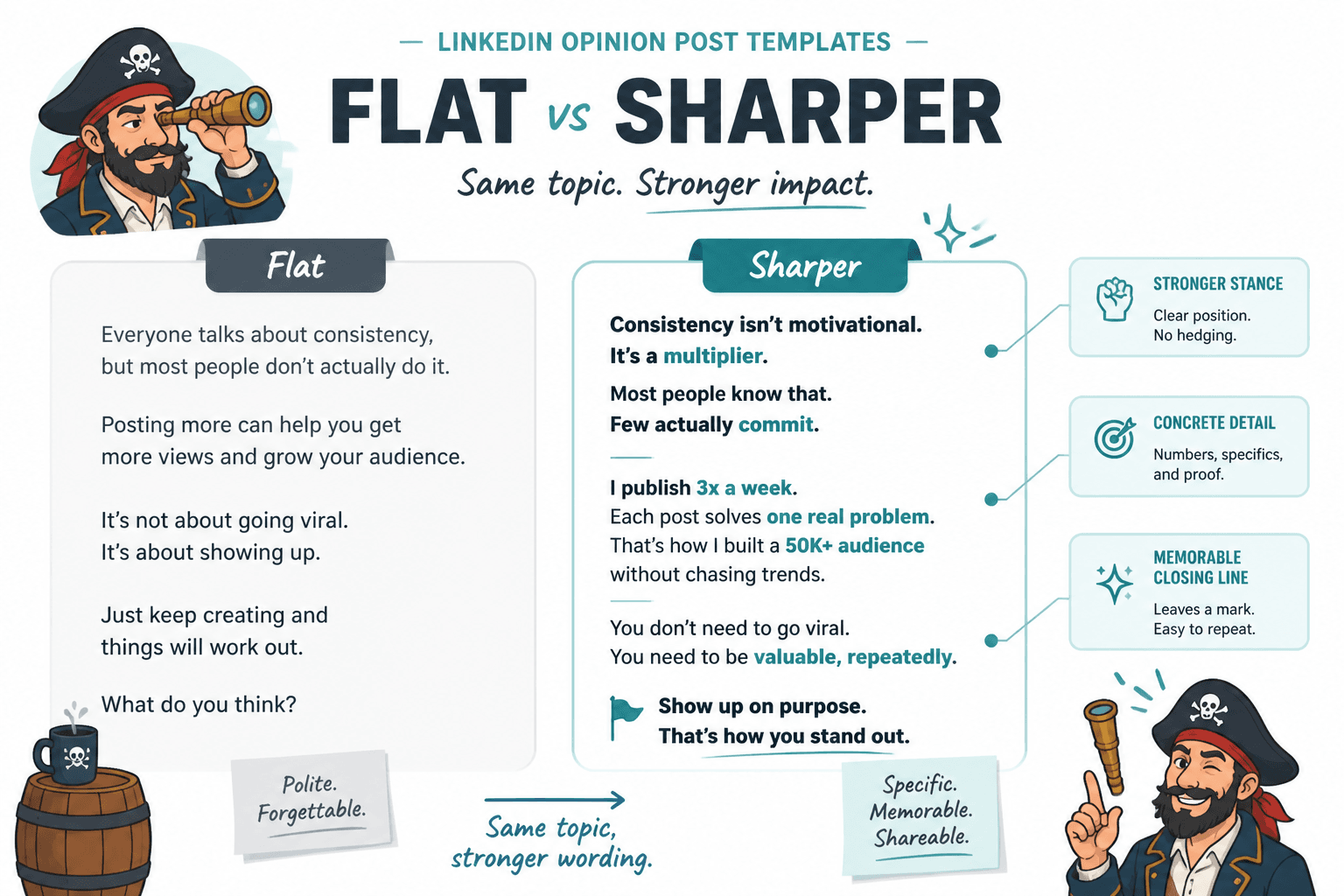
For example, compare these:
Flat: “I believe authenticity is important for personal branding.”
Sharper: “Authenticity is not the problem. Vague authenticity is. If people finish your post knowing you’re honest but not knowing what you actually believe, that did not help your brand.”
Same topic. Very different effect.
What busy creators should post opinions about
If you keep staring at LinkedIn trying to invent a “thought leadership opinion,” relax. You probably already have plenty of material. You just haven’t been treating it like content yet.
Strong opinion posts often come from:
- Advice in your industry you think is incomplete
- Tactics clients keep trying that do not work well
- Common mistakes beginners repeat
- Overrated platform habits
- Underrated skills that actually move results
- Popular content styles you think are hurting trust
- Simple rules you use in your own work
If you want a very quick idea filter, use this prompt:
“What do people in my space keep doing because it sounds smart, but I would not recommend it?”
That question alone can give you weeks of opinion posts.
If you need more topic inspiration, you can pair this article with best LinkedIn posts ideas and examples for creators and LinkedIn posts for creators with small audiences. Both help if you want practical ideas that do not depend on already being internet famous.
Common mistakes that make opinion posts weak
Being too vague
“People should focus more on quality” is not doing much. Quality of what? In what way? Why? Compared to what?
Specificity makes opinions useful.
Trying too hard to sound balanced
The bigger point is simple: clearer structure and clearer writing make the piece more useful. That is usually what makes the ending land better too.
LinkedIn posts usually improve when the point gets clearer and the fluff gets shorter. Stronger usefulness tends to outperform polished vagueness.