
Most boring newsletter subject lines are not boring because they are short, simple, or serious. They are boring because they make the reader do all the work.
“Weekly update.” “New blog post.” “A few thoughts.” “This week’s newsletter.” These are not subject lines. They are labels. Fine for your draft folder. Useless in a crowded inbox.
If you want to learn How to Rewrite Boring Newsletter Subject Lines, the fix is not adding fake urgency, random emojis, or a desperate “you won’t believe this.” The fix is usually much less dramatic: find the real point, sharpen the angle, and make the email feel worth opening by an actual human with limited patience.
That’s what this article will help you do. We’ll break down why subject lines go flat, how to rewrite them without sounding like a discount copywriting course, and how to turn vague inbox wallpaper into something clearer, sharper, and more clickable.
If you want the bigger picture, start with the parent guide.
Why most newsletter subject lines fall flat
A weak subject line usually fails before it even gets to “creativity.” The real problem is that it does not communicate a useful reason to open.
People often write subject lines as if the reader is already invested. They’re not. Your subscriber may like you, but they are still scanning fast, distracted, and half-deciding between your email and 27 others promising insight, updates, and “quick thoughts.”
So when your subject line is bland, vague, or self-centered, it gets ignored. Not because your audience is broken. Because the line did not earn attention.
- It says what the email is, not why it matters.
- It is too broad.
- It sounds like every other newsletter.
- It hides the interesting part.
- It tries too hard to sound clever and forgets clarity.
That last one deserves a quick note. Clever is nice. Useful is better. If your subject line is witty but the reader still has no idea what’s inside, congrats, you wrote a small riddle for tired people checking email between meetings.
The rewrite rule that matters most
Before you rewrite a boring newsletter subject line, ask one question:
What is the most interesting, useful, specific, or surprising thing in this email?
That is usually the subject line. Not the vague wrapper around it. Not the administrative description. Not the “just checking in” fluff people tack on because they haven’t decided what the real point is.
A lot of subject lines improve instantly when you stop summarizing the format and start surfacing the payoff.
Weak vs better thinking
- Weak: “This week’s newsletter”
- Better: “The content mistake that makes smart people sound generic”
- Weak: “A quick update”
- Better: “Why your best ideas keep dying in draft form”
- Weak: “New article”
- Better: “How to make people care about your opening line”
The better version gives the reader a reason. It carries a point of view. It suggests a payoff. It sounds like there’s something inside worth stealing, using, or thinking about.
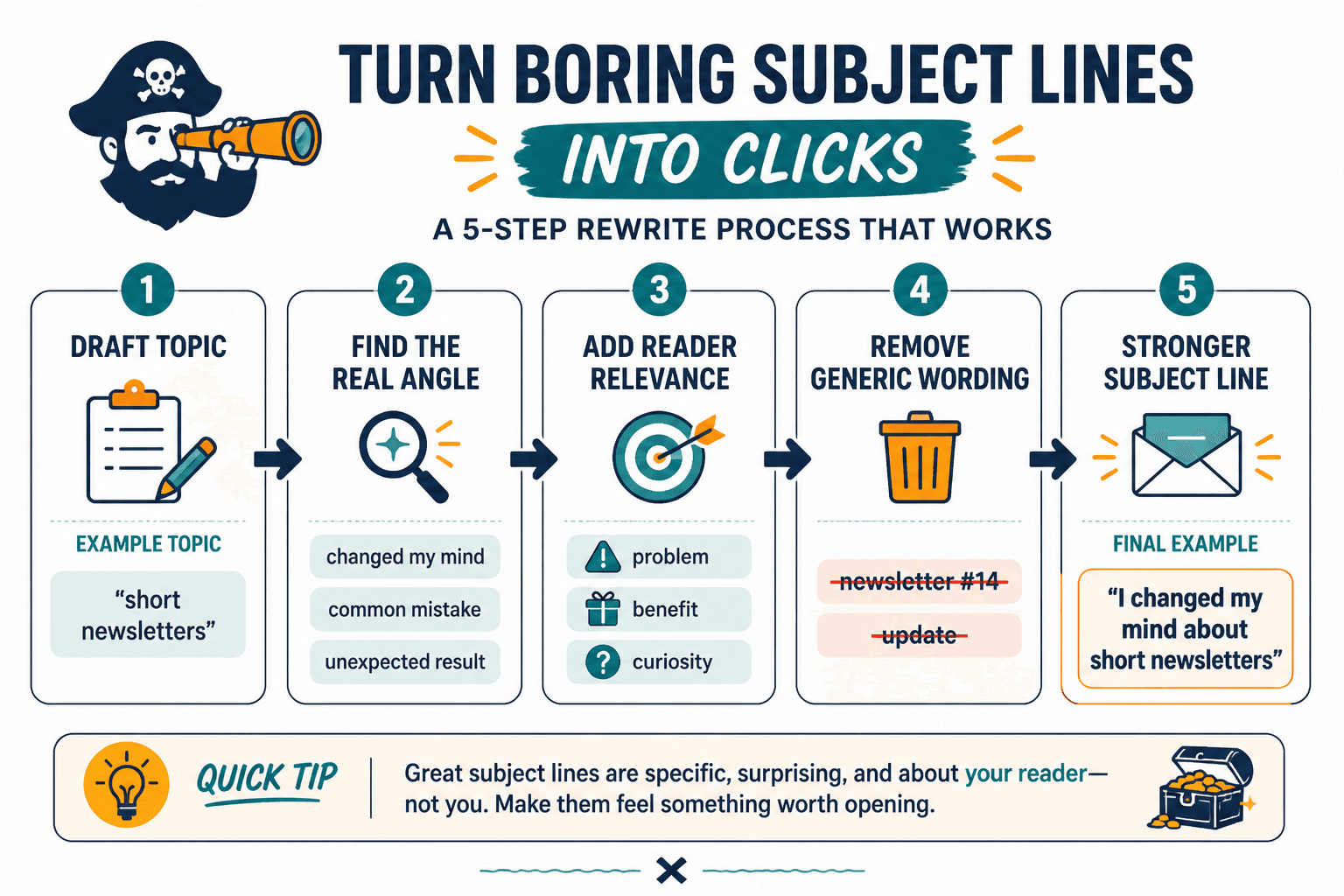
How to rewrite boring newsletter subject lines step by step
Here’s a simple rewrite process that works far better than staring at your draft and hoping inspiration lands like a polite bird.
1. Find the actual point of the email
Most weak subject lines come from writers who have not decided what the email is really about. They know the topic. They do not know the point.
Topics are broad. Points are sharp.
| Topic | Actual point |
|---|---|
| Newsletter growth | Most people lose subscribers because their emails feel skimmable and forgettable |
| Content strategy | Consistency is less useful than having a recognizable angle |
| Offers | Readers ignore pitches that arrive before trust does |
Your subject line should usually come from the point, not the topic.
2. Cut throat-clearing words
Newsletter subject lines are often weakened by soft, generic starters:
- This week’s…
- A few thoughts on…
- Some ideas about…
- Quick update…
- New post…
- Today I want to talk about…
These phrases rarely add value. They stall the line before it gets to the part anyone might care about.
Cut them and lead with the idea instead. If you want more help with stronger starts, this pairs well with How to Start Newsletter Subject Lines Without a Weak Opening.
3. Replace vague language with a sharper angle
Vague subject lines feel polite, safe, and instantly forgettable.
- Vague: “Thoughts on audience growth”
- Sharper: “Why useful content still gets ignored”
- Vague: “On writing better”
- Sharper: “The sentence habit that makes your writing feel flat”
- Vague: “Some marketing lessons”
- Sharper: “3 ways smart marketers accidentally sound generic”
Specificity creates tension. Tension earns opens.
4. Pull out the most “openable” detail
Sometimes the email itself is decent, but the subject line ignores the strongest part. Look for one of these:
- A contrarian point
- A mistake people keep making
- A practical payoff
- A useful number
- A sharp phrase
- A consequence worth avoiding
Example:
- Email draft topic: writing newsletters consistently
- Most openable detail: readers do not care that you send every week if every issue feels interchangeable
- Rewrite: “Consistency won’t save a forgettable newsletter”
That line has an angle. It hints at a problem. It sounds like there is an argument inside, not just a recap.
5. Make it sound like a person wrote it
A lot of newsletter subject lines are technically fine and still lifeless because they sound overprocessed.
If your line reads like a cleaned-up idea from a corporate content calendar, loosen it. Keep the clarity, lose the starch.
- Too polished: “Strategies for Enhancing Reader Engagement”
- Better: “Why readers stop caring faster than you think”
- Too formal: “Improving Newsletter Open Performance”
- Better: “Why your subject lines keep getting ignored”
Not every line needs edge. But it should sound alive.
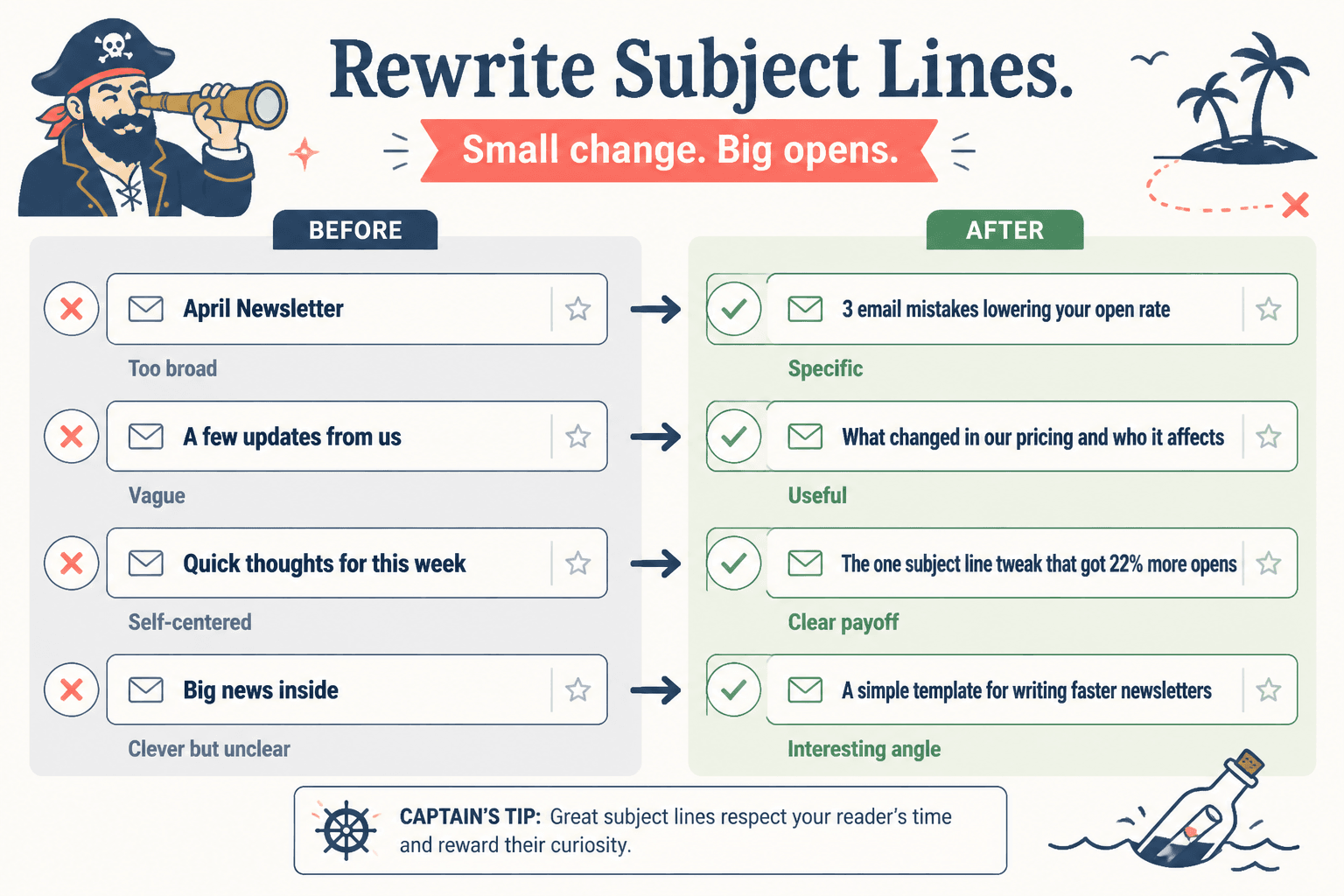
Before-and-after rewrites of boring subject lines
Let’s make this practical. Here are common weak subject lines and stronger rewrites, with the logic behind them.
1. “This week’s newsletter”
What’s wrong with it: It tells me nothing except that time has passed.
- Rewrite: “The quiet reason good newsletters get skipped”
- Why it works: It introduces tension and makes a useful promise.
2. “A few thoughts on content”
What’s wrong with it: “A few thoughts” is usually code for “I did not commit to an angle.”
- Rewrite: “Most content doesn’t fail from lack of effort”
- Why it works: It sounds like a real opinion, not a vague note to self.
3. “New blog post”
What’s wrong with it: The format is not the reason to open.
- Rewrite: “How to stop sounding smart and boring at the same time”
- Why it works: It leads with the payoff and problem.
4. “Marketing tips”
What’s wrong with it: So broad it could mean nearly anything. Which means it means nothing.
- Rewrite: “The marketing advice that makes your writing sound recycled”
- Why it works: It narrows the topic and adds opinion.
5. “Quick update”
What’s wrong with it: Quick for you is not automatically useful for me.
- Rewrite: “I changed my mind about short newsletters”
- Why it works: It creates curiosity without turning into clickbait fog.
6. “Newsletter #14”
What’s wrong with it: Unless your audience is collecting them like trading cards, numbering is not the hook.
- Rewrite: “The easiest way to make a newsletter feel worth opening”
- Why it works: It tells the reader where the value lives.
If you want more patterns and examples after this, see Best Newsletter Subject Lines Ideas and Examples for Creators.
5 reliable ways to make a subject line less boring
Lead with a problem people recognize
People open emails that seem relevant to a frustration they already have.
- Why your emails feel easy to ignore
- The reason smart newsletters still get skipped
- Why “helpful” writing often gets no response
Use a clear payoff
If the email helps the reader do something better, say that more directly.
- A cleaner way to structure your newsletter
- How to make your subject lines pull their weight
- A better way to end sales emails without sounding needy
Add contrast
Contrast makes a line feel sharper because it creates tension fast.
- Clear beats clever in crowded inboxes
- More advice, fewer opens
- Consistency without memorability is a bad trade
Make one claim, not three
Trying to cram every angle into the subject line usually weakens all of them. Pick the strongest idea and let the preview text do some support work if needed.
One clean point nearly always beats a crowded line full of topics, commas, and identity issues.
Use curiosity like an adult
Curiosity is useful when it opens a loop around something real. It gets annoying when it becomes manipulative mush.
- Weak curiosity: “You need to see this…”
- Better curiosity: “The tiny subject line fix that changed my open rates”
The second one still creates interest, but it also gives the reader an actual clue about the payoff.
What not to do when rewriting subject lines
- Do not slap on urgency you have not earned. “Last chance” for a regular weekly email is a great way to make people trust you less.
- Do not default to mystery when clarity would be stronger. Curiosity should create interest, not confusion.
- Do not rewrite every line in the same voice. Repetition makes the inbox feel mechanical.
The best rewrites keep the point while stripping away the lifeless phrasing. That is what makes the subject line feel more human instead of merely louder.