
Most weak newsletter subject lines do not fail because they are too short, too long, or missing some magic punctuation trick. They fail because the opening is soft, vague, and scared to say anything useful.
You have probably seen the usual suspects: “Quick update,” “A few thoughts,” “This week’s newsletter,” or the deeply thrilling “Checking in.” These are not subject lines. They are email equivalents of clearing your throat into a microphone.
If you want to know how to start newsletter subject lines without a weak opening, the fix is not to become louder or weirder. It is to start with a stronger angle. One that creates clarity, tension, relevance, or curiosity without sounding like a discount copywriter trapped in a funnel template.
This article will help you do exactly that. We will cover what makes openings feel weak, what to start with instead, how to rewrite limp subject lines into sharper ones, and a handful of practical formulas you can actually use. If your open rates are fine but your subject lines still feel a bit beige, this is for you too.
For the full path around this topic, head to the parent guide.
Why weak openings tank otherwise decent subject lines
The first few words of a subject line do most of the heavy lifting.
People are not studying your email with a cup of tea and a reflective expression. They are scanning their inbox while half-distracted, slightly suspicious, and probably deciding in under a second whether your email looks useful, ignorable, or mildly embarrassing.
A weak opening usually has one of these problems:
- It starts too generically
- It hides the point
- It sounds overly polite or cautious
- It relies on fake mystery
- It opens with filler instead of substance
- It sounds like every other newsletter in the inbox
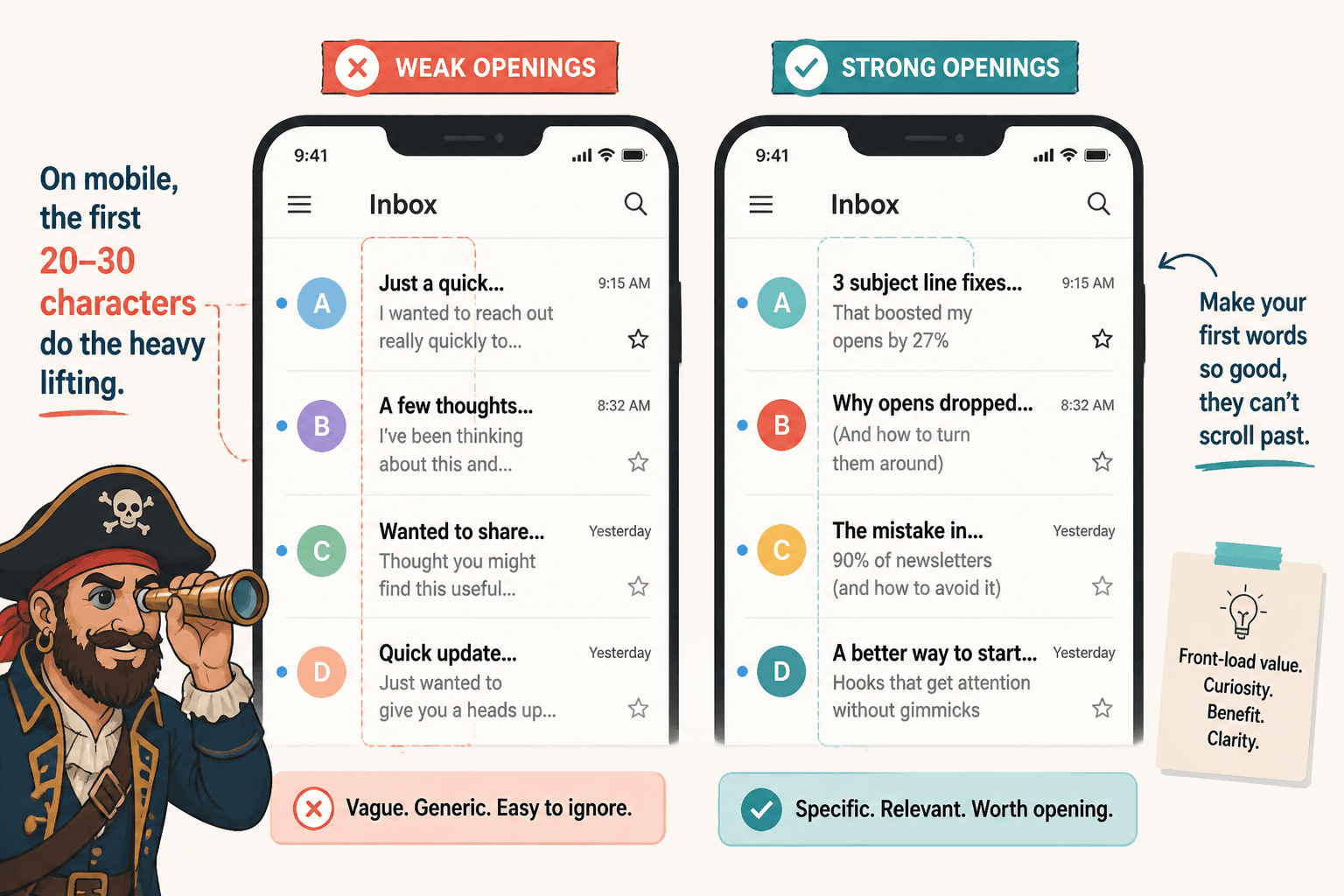
That matters because readers often see only the beginning of your subject line on mobile. So if the opening is weak, the whole thing is already limping before the rest can help.
Think of the start of your subject line as the handhold. If there is nothing solid to grab, the rest of the line does not really matter.
What a strong subject line opening actually does
A strong opening earns attention fast. Not with hype. With signal.
Usually, that signal comes from one of five things:
- Specificity: it names the topic clearly
- Tension: it hints at a problem, mistake, or contrast
- Relevance: it feels timely or useful to the reader
- Novelty: it frames a familiar topic in a fresher way
- Directness: it gets to the point without warm-up waffle
That does not mean every subject line needs to sound aggressive or dramatic. In fact, trying too hard is one of the easiest ways to make your emails feel cheap. You are not writing tabloid headlines. You are trying to make a smart person think, “That sounds worth opening.”
How to start newsletter subject lines without a weak opening
Here is the practical part. If your usual instinct is to ease into the subject line, stop doing that. Start closer to the actual point.
These opening styles work well because they begin with something concrete instead of fluffy throat-clearing.
1. Start with the problem
If the email solves something, lead with the thing that is bothering the reader.
- Weak: A few thoughts on writing emails
- Stronger: Why your emails keep getting ignored
- Weak: This week’s marketing note
- Stronger: The trust mistake hiding in your newsletter
Problem-led openings work because they instantly create relevance. They tell the reader, “This email is about something that may already be annoying you.” Much better than “quick note.”
2. Start with the outcome
If the email promises a clear benefit, open there.
- Weak: Some newsletter advice for you
- Stronger: Write cleaner subject lines in 10 minutes
- Weak: Email strategy idea
- Stronger: Get more opens without sounding desperate
This works especially well for educational newsletters, creator tips, and service-based businesses. Readers do not need to guess why they should care.
3. Start with a sharp claim
A good claim creates intrigue because it takes a stand. Not a fake hot take. Just a clear opinion.
- Weak: Thinking about open rates
- Stronger: Open rates are not your real email problem
- Weak: On newsletter consistency
- Stronger: Consistency matters less than this
Claims work when the email actually backs them up. If the subject line says something bold and the newsletter delivers mush, that is how trust starts leaking out of the walls.
4. Start with contrast
Contrast is one of the cleanest ways to make a subject line feel sharper.
- Weak: Better newsletter writing tips
- Stronger: More opens, less subject line drama
- Weak: Some thoughts on email strategy
- Stronger: Helpful emails beat clever ones
Contrast gives the brain something to resolve. It adds shape fast. And shape beats fog every time.
5. Start with the specific topic, not the intro words
A lot of weak openings happen because the writer starts with setup words instead of the subject itself.
- Weak: A quick note about pricing psychology
- Stronger: Pricing psychology is messing with your sales
- Weak: This week: newsletter mistakes
- Stronger: Newsletter mistakes that quietly kill opens
Notice the pattern. The stronger version removes the polite doorway and just walks into the room.
Openers that usually make subject lines weaker
Some subject line starts are not impossible to use well. They are just guilty until proven innocent.
Be careful with these:
- Quick update
- A few thoughts
- This week’s newsletter
- Checking in
- Just a reminder
- Some exciting news
- I wanted to share
- Let’s talk about
The problem is not that these phrases are grammatically offensive. It is that they waste prime subject-line real estate on words that carry almost no value.
Inbox readers do not reward politeness. They reward relevance.
A simple test for stronger subject line starts
If you are not sure whether your opening is weak, run it through this quick test:
- Cover the rest of the subject line.
- Read only the first 2 to 5 words.
- Ask: does this create any real interest, clarity, or tension?
- If not, rewrite the opening first before touching the rest.
For example:
| Opening | What happens |
|---|---|
| Quick update on | No one cares yet |
| A few thoughts on | Feels soft and optional |
| Why most newsletters | Now we have tension |
| The subject line habit | Specific enough to continue |
| Stop starting with | Clear instruction and conflict |
This is also why learning weak opener fixes for personal brands matters. A subject line can be technically fine and still feel lifeless if the first words do not pull their weight.
Before-and-after rewrites: weak openings fixed
Let’s make this less abstract. Here are some common weak starts and stronger rewrites.
Example 1
- Before: A quick note on email content
- After: Email content that people actually read
The rewrite drops the filler and leads with the implied benefit.
Example 2
- Before: This week’s newsletter: consistency
- After: Consistency is not your content problem
The stronger version has a point of view. It sounds like an email with an idea, not an archive label.
Example 3
- Before: Some thoughts on subject lines
- After: Subject lines fail before the first comma
This one uses a sharper claim. Specific enough to be interesting, odd enough to earn attention.
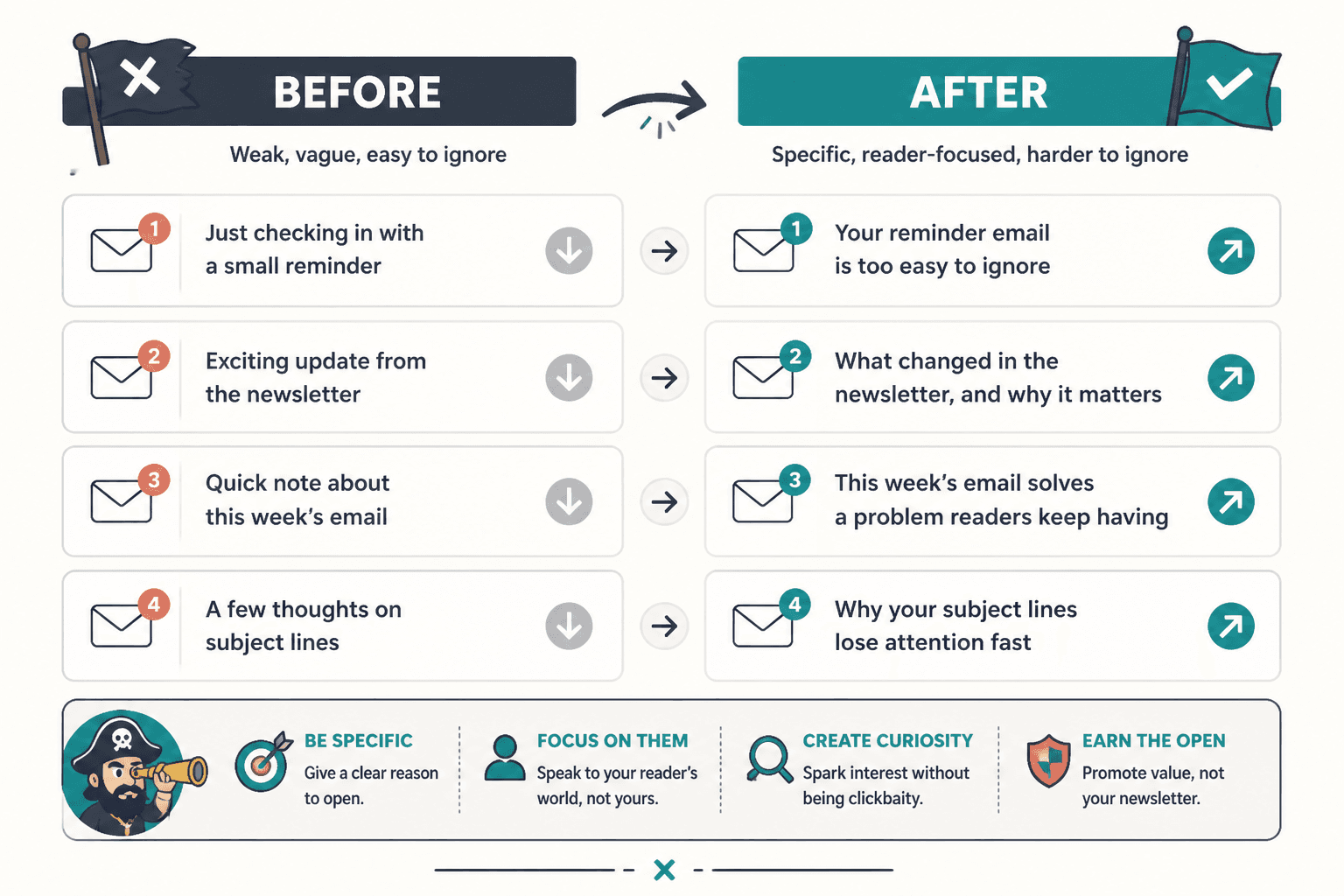
Example 4
- Before: Just checking in with a small reminder
- After: Your reminder email is too easy to ignore
The rewrite reframes the email around the reader’s problem rather than the sender’s intention.
Example 5
- Before: Exciting update from the newsletter
- After: What changed in the newsletter, and why it matters
“Exciting” is something the reader decides, not something you announce like a publicist. If there is an actual update, name it more directly.
Five reliable opening formulas that do not sound generic
You do not need a giant swipe file. You need a handful of opening patterns that are flexible enough to fit your voice and specific enough to avoid sounding factory-made.
1. Why [common thing] is not working
- Why your welcome email feels forgettable
- Why short subject lines still flop
- Why newsletter growth advice gets weird fast
This formula works because it taps into an existing frustration and promises an explanation.
2. The [specific mistake] hurting [desired outcome]
- The opener mistake hurting your open rates
- The clarity problem hurting your newsletter clicks
- The tone issue hurting your email trust
Very practical. Very usable. Also easy to adapt for coaches, consultants, creators, and service businesses.
3. Stop [bad habit]
- Stop starting subject lines like this
- Stop writing polite little email intros
- Stop using “quick update” in your newsletter
This one is punchier, so use it when the email has a clear corrective point. If your tone is usually softer, you can ease it slightly without losing strength.
4. [Better outcome] without [annoying tradeoff]
- More opens without clickbait
- Stronger subject lines without sounding salesy
- Cleaner email hooks without fake urgency
This formula works well because it pairs desire with relief. People like progress. They also like not feeling ridiculous while trying to get it.
5. [Specific topic], but from a sharper angle
- Subject lines, minus the lazy advice
- Email hooks that do not sound rehearsed
- Newsletter clarity over cleverness
This style is useful when your audience already knows the topic, but needs a fresher framing.
If you want more angle ideas, it also helps to study subject line formulas without sounding generic.
A stronger start usually comes from a sharper angle, not a louder phrase. If the subject line opens with a clear tension, readers do not need much more to understand why the email matters.