
Most weak blog titles are not weak because they are too short, too long, or missing a number.
They are weak because they sound like they were assembled by a nervous intern and a keyword tool. Too polished. Too generic. Too eager to “convert.” Which is exactly why people skim right past them.
If you want to learn how to write blog titles and headlines without sounding salesy or robotic, the fix is not to make them louder. It is to make them clearer, more specific, and more human. You need titles that sound like a smart person with a point, not a content machine trying to hit quarterly goals.
Here’s how to write headlines people actually want to click without stuffing them with fake urgency, awkward power words, or SEO sludge. We’ll cover what makes titles feel robotic, what makes them feel sharp instead, and how to build better ones fast.
To see how this fits into the wider strategy, open the parent guide.
Why so many blog titles sound fake in the first place
A lot of blog titles fail before the article even has a chance because they are trying to do too many things badly at once.
They want to rank in search. They want to sound impressive. They want to trigger curiosity. They want to promise a result. Fine. Reasonable goals. But then the title turns into this:
10 Proven Strategies to Skyrocket Your Brand Visibility and Unlock Explosive Growth
That is not a title. That is a cry for help in business-casual phrasing.
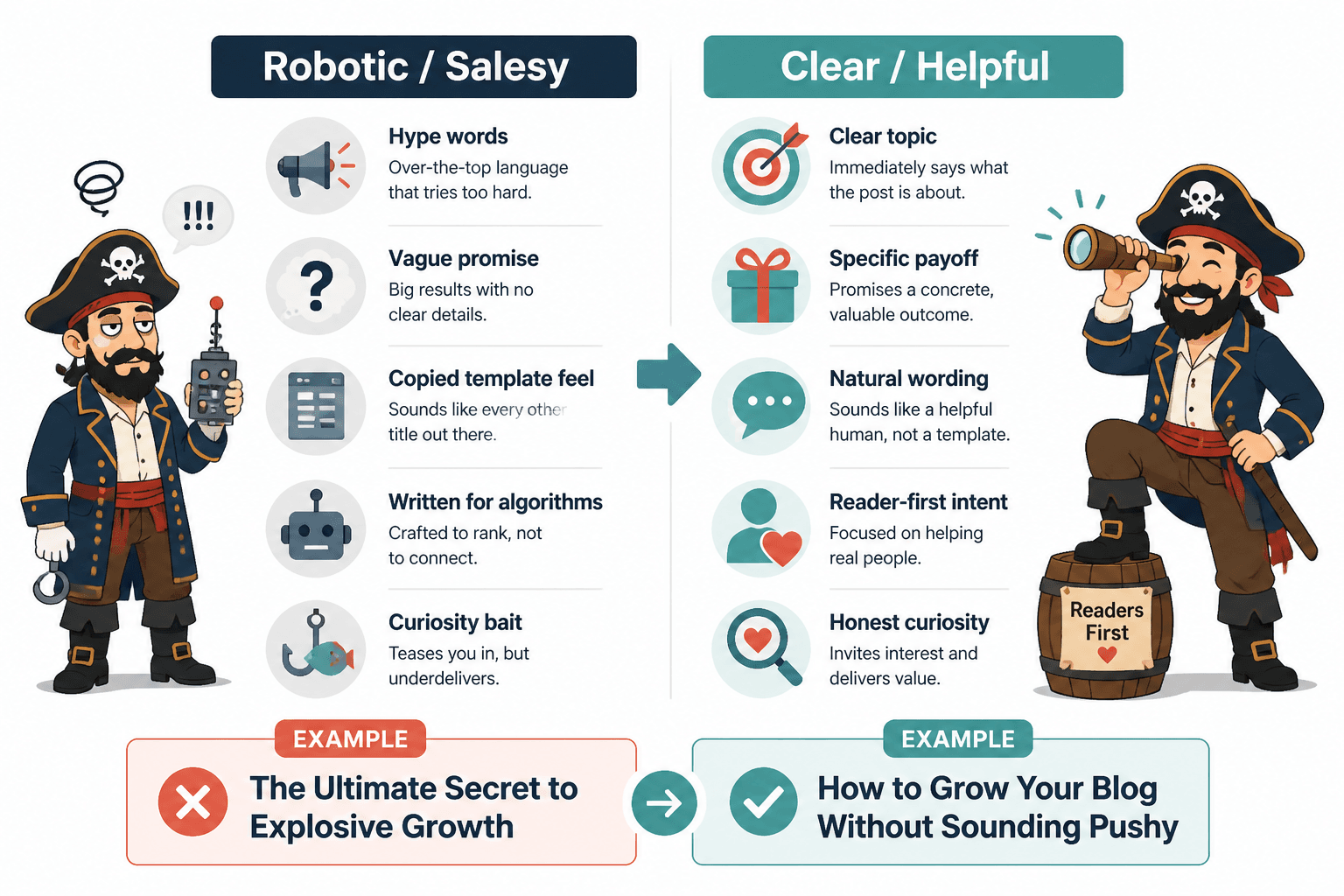
Salesy or robotic titles usually have one or more of these problems:
- They use vague benefit language instead of saying what the article actually helps with
- They pile on hype words like proven, ultimate, effortless, explosive, powerful, secret, and game-changing
- They sound copied from generic SEO templates
- They promise transformation without earning trust
- They are written for algorithms first and readers second
- They hide the real topic behind curiosity bait
The annoying part is that many people do this because they are trying to be strategic. They have been told titles need “emotion,” “curiosity,” “keyword intent,” and “click appeal.” True enough. But those things are not the same as sounding like a late-stage webinar funnel.
Good titles do not yell. They signal. They tell the right reader, “This is for you, and it will probably help.”
What a strong blog title actually needs to do
A strong title does not need to sound clever. It needs to do its job.
At minimum, your headline should do three things:
- Make the topic clear
- Show the angle or payoff
- Sound natural enough that a real person would say it
That is it. Not mystical. Not glamorous. Just useful.
For blog SEO, there is a fourth job too: it should include the main phrase naturally enough that search engines and humans can both understand it. “Naturally” is doing a lot of work there. If the title reads like a keyword got dressed up and went to a networking event, rewrite it.
The simplest headline formula that still sounds human
One of the easiest ways to write a strong title is this:
How to + specific task or outcome + real-world qualifier
Examples:
- How to Write Blog Titles People Actually Want to Click
- How to Write Better Headlines Without Sounding Like a Marketer
- How to Title Your Blog Posts So They Are Clear, Useful, and Not Embarrassing
- How to Write Blog Titles and Headlines Without Sounding Salesy or Robotic
The qualifier is often what saves the title from being bland. “Without sounding salesy or robotic” is not fluff. It names the exact fear or frustration many readers already have.
That matters because good titles do not just describe the topic. They frame the problem in a way the reader recognizes.
How to write blog titles and headlines without sounding salesy or robotic
Here’s the practical part. If your titles keep sounding stiff, generic, or weirdly overcaffeinated, use this process.
1. Start with the actual reader problem, not a marketing promise
Bad title:
Transform Your Content Performance With Better Headlines
Better title:
Why Your Blog Headlines Keep Falling Flat and How to Fix Them
The first one sounds like a brochure. The second one sounds like a person addressing a real issue.
Readers do not search for “content performance transformation.” They search for the thing that is annoying them. Low clicks. Bland titles. Posts no one reads. Headlines that sound too polished. Start there.
2. Replace vague benefits with concrete outcomes
Vague titles make people work too hard. Concrete titles lower friction.
Compare these:
- Vague: Improve Your Blog Strategy With Smarter Headlines
- Concrete: How to Write Blog Headlines That Get More Clicks Without Using Clickbait
“Smarter” means nothing. “Get more clicks without using clickbait” means something.
When in doubt, ask:
- What exactly will the reader be able to do after reading this?
- What specific mistake are they trying to avoid?
- What result do they want, in plain English?
3. Cut the words that instantly make titles sound like sludge
Some words are not banned because they are evil. They are just overused, lazy, and usually a sign that the title is compensating for weak thinking.
Words and phrases that often make titles worse:
- Ultimate guide
- Proven
- Powerful
- Game-changing
- Skyrocket
- Explosive
- Unlock
- Secret
- Revolutionary
- Boost your success
These words usually do one of two things: they inflate a weak title, or they make a decent title sound untrustworthy.
If the article is genuinely useful, you do not need to tape a rocket to the headline.
4. Write like your reader talks, not like a content template
People click headlines that feel familiar in a good way. Not boring. Just human.
That often means using natural phrasing people already use in conversations, searches, or client calls.
Instead of:
Optimizing Blog Title Frameworks for Engagement and Visibility
Try:
How to Write Blog Titles That Are Clear, Clickable, and Not Cringe
The second one is not trying to impress anyone. Good. That is usually a step forward.
5. Add tension, not hype
Good titles often contain a useful tension:
- Get clicks without clickbait
- Write for SEO without sounding robotic
- Be clear without becoming boring
- Sell without sounding pushy
This works because it shows the reader you understand the tradeoff they are trying to manage.
Most creators do not want more traffic at any cost. They want traffic without sounding awful. They want stronger titles without feeling fake. Titles that acknowledge that tension feel smarter immediately.
6. Make the angle specific enough to earn the click
Broad titles are easy to write and easy to ignore.
Weak:
Tips for Writing Better Headlines
Stronger:
7 Ways to Rewrite a Boring Headline Before You Publish the Post
The stronger version has shape. It implies process, timing, and usefulness.
Specificity can come from:
- A defined audience
- A clear mistake
- A sharp payoff
- A constraint or tradeoff
- A format, number, or use case
If you need help tightening weak openings, this is a good place to connect your title work to how to start blog titles and headlines without a weak opening. A title and opening line should feel like they belong to the same article, not like strangers trapped in the same post.
Before-and-after headline rewrites
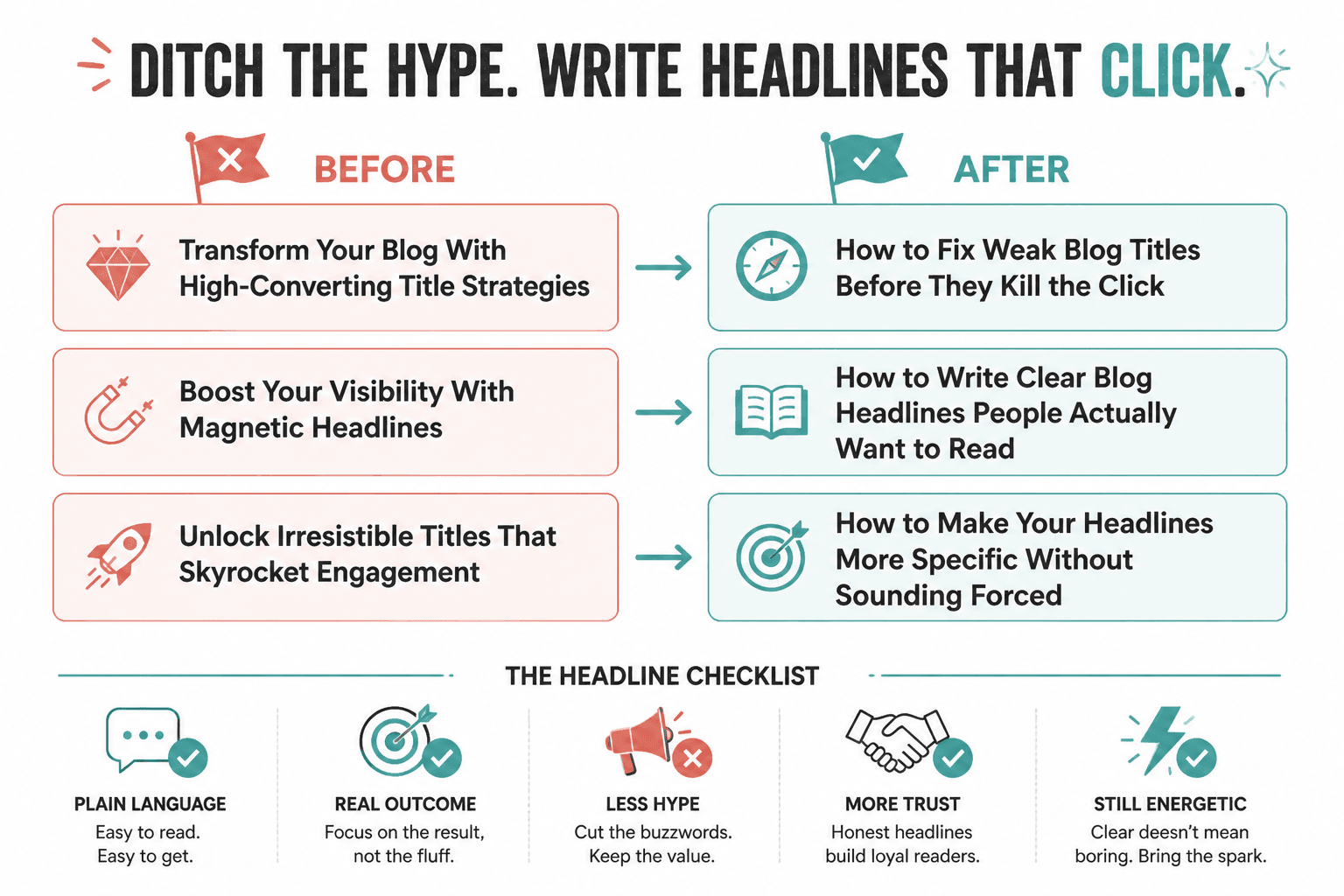
Sometimes the easiest way to see the problem is in rewrites. Here are some common salesy or robotic headlines, followed by better versions.
| Weak headline | Stronger rewrite |
|---|---|
| Unlock Better Content Results With These Powerful Headline Tips | How to Write Blog Headlines That Get Clicks Without Sounding Forced |
| The Ultimate Guide to Crafting Compelling Titles | How to Write Better Blog Titles That Don’t Sound Generic |
| 5 Proven Methods to Increase Engagement With Your Headlines | 5 Ways to Make Your Headlines More Clickable and Less Forgettable |
| Transform Your Blog With High-Converting Title Strategies | How to Fix Weak Blog Titles Before They Kill the Click |
| Boost Your Visibility With Magnetic Headlines | How to Write Clear Blog Headlines People Actually Want to Read |
Notice what changed:
- The rewrites use plain language
- They name a real outcome
- They remove empty hype
- They sound more trustworthy
- They still have energy, just not the desperate kind
If you want a deeper rewrite process, you’d naturally pair this with how to rewrite boring blog titles and headlines. That is where the editing muscle gets built.
Headline formulas that work without sounding like a template factory
Formulas are useful. They are also dangerous in the hands of people who stop thinking the second they find one.
Use these as structures, not scripts.
The “how to do X without Y” formula
- How to Write SEO-Friendly Headlines Without Sounding Like SEO Content
- How to Sell in Your Blog Posts Without Sounding Pushy
- How to Be More Specific in Your Headlines Without Making Them Clunky
This one works because it balances benefit with resistance. It speaks directly to readers who want the result but hate the usual version of getting it.
The “why this isn’t working” formula
- Why Your Blog Titles Feel Flat Even When the Content Is Good
- Why So Many SEO Headlines Sound Like They Were Written by a Bot
- Why Clearer Titles Usually Beat Clever Ones
This is useful when the reader already knows they have a problem but does not know the cause.
The “mistakes” formula
- 7 Blog Title Mistakes That Make Smart Content Look Generic
- 5 Headline Mistakes That Quietly Kill Clicks
- The Most Common Reasons Blog Titles Sound Salesy
Just make sure the article actually covers mistakes with specifics. Do not slap “mistakes” on a vague list of recycled tips and call it a day.
The “examples and templates” formula
- 15 Blog Headline Examples That Sound Natural and Still Get Clicks
- Blog Title Templates for Coaches, Consultants, and Personal Brands
- Headline Rewrite Examples: From Generic to Click-Worthy
These do well when the reader wants practical material they can steal responsibly.
If examples would help more than theory, send them to blog titles and headlines examples for coaches, consultants, and personal brands. People often learn headlines faster by seeing a dozen strong ones than by reading another lecture about “compelling copy.”
How to keep titles SEO-aware without making them ugly
This is where people often overcorrect. They hear “use the keyword in the title” and suddenly every headline sounds like a spreadsheet wearing a nametag.
Yes, your target phrase matters. But if you jam it into a title with zero regard for rhythm, clarity, or human dignity, the headline gets worse.
Here’s the cleaner way to do it:
- Use the core phrase naturally, ideally near the front if it fits
- Add a specific angle that gives the title life
- Trim duplicate wording
- Read it out loud to catch stiffness
- Ask if a smart reader would actually click it
For example, if the phrase is “blog titles and headlines,” these are clunky:
- Best Blog Titles and Headlines for Blog Titles and Headlines SEO
- Blog Titles and Headlines Tips for Better Blog Titles and Headlines
And these are sane:
- How to Write Blog Titles and Headlines Without Sounding Salesy or Robotic
- Better Blog Titles and Headlines: What to Fix Before You Publish
Search-friendly does not have to mean ugly. It just has to be intentional.
If you are building a broader system around this, it also makes sense to connect readers to the larger blog titles and headlines hub or the wider blog SEO writing section. Headline writing gets much easier once it lives inside a repeatable content process instead of a panic spiral right before publishing.
A quick test for every title before you publish
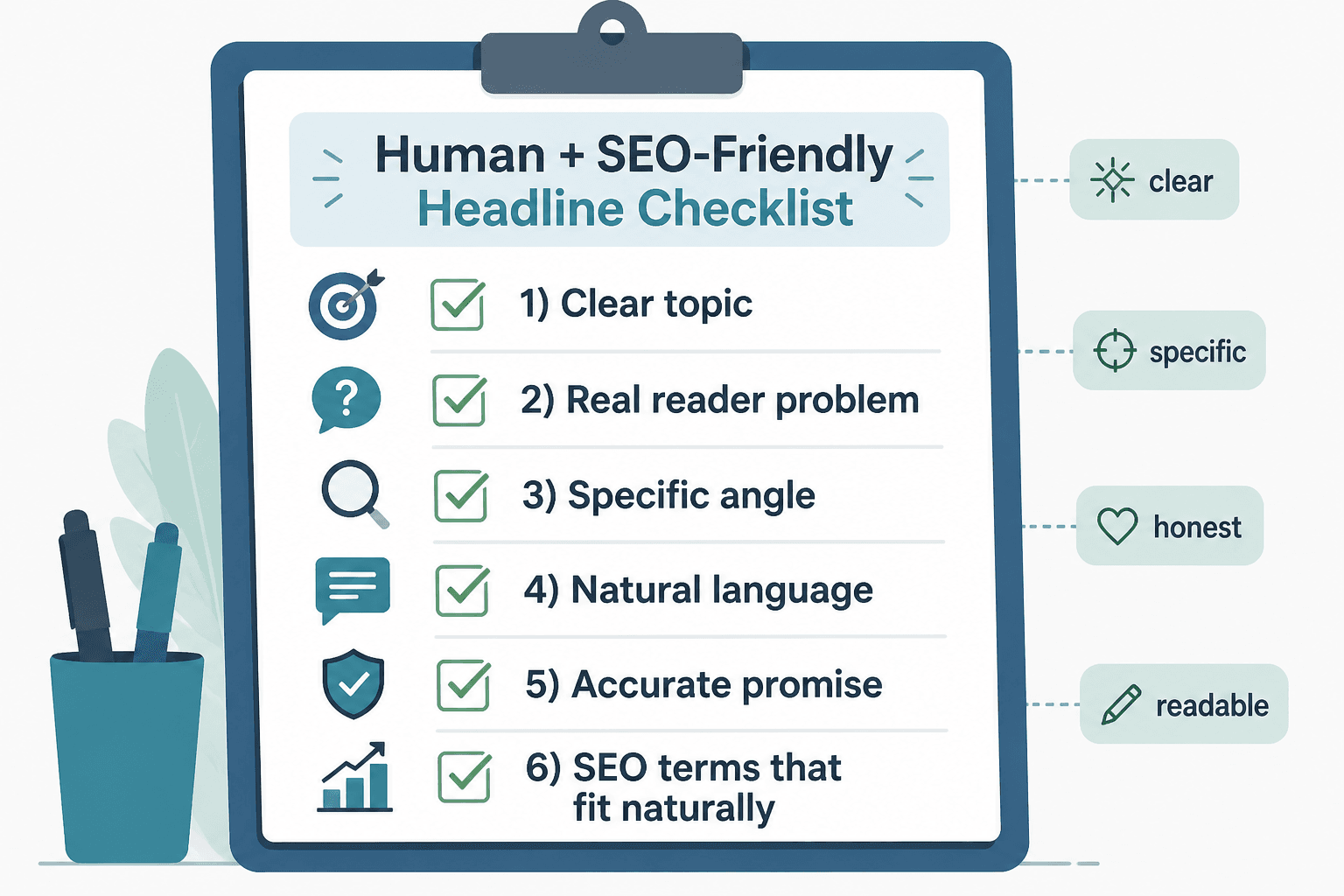
Run your draft headline through this quick filter:
- Is it clear? Can someone tell what the post is about immediately?
- Is it specific? Does it promise a real angle, outcome, or problem?
- Does it sound human? Would you say something like this out loud?
- Is there unnecessary hype? Cut it.
- Does it fit the article? No bait-and-switch nonsense.
- Would the right reader care? Not everyone. The right person.
If the answer is no to more than one of those, the title probably needs another pass.
And yes, another pass is normal. Good headlines are often rewritten, not magically birthed in one dazzling attempt. Annoying, but true.
How to balance clicks, trust, and conversion
A title is not just there to earn a click. It also sets the tone for trust.
If your headline sounds inflated, people bring that suspicion into the article. If it sounds robotic, they expect robotic writing. If it sounds clear and grounded, they are more likely to keep reading and take the next step.
This matters even more if your content supports leads or sales. The wrong title might get the click and still hurt the business. You do not want attention from people who feel mildly tricked the moment they arrive.
Better titles attract the right readers and pre-frame the article well. That makes them more useful not just for traffic, but for trust and conversion too.
That is also why title work connects naturally to how to turn blog titles and headlines into more leads or sales. The strongest headline is not always the loudest one. It is often the one that attracts the right person with the right expectation.
A practical workflow for writing better blog headlines faster
If you stare at one title too early, you usually make it worse. A better workflow looks like this:
- Write down the actual topic in plain language
- List the real problem the reader wants solved
- Choose the angle: mistake, how-to, rewrite, examples, comparison, or warning
- Draft 10 title options quickly
- Cut the hype words
- Keep the best 3
- Read them out loud
- Pick the one that is clearest, sharpest, and most accurate
That “draft 10” step matters more than people think. Your first title is often just the warm-up lap. Fine. Write it anyway. Then write nine better ones.
If you want more structure around title ideation and article systems, linking into blog article systems for titles and headlines makes sense here too. Strong titles are easier to produce consistently when your content angles are already organized.