
Most X posts do not fail because the writer is not smart enough. They fail because the post says too much, too softly, in a format that belongs on LinkedIn or in a newsletter draft nobody asked for.
X is less forgiving. You do not get much room. You do not get much patience. And if your post opens like a TED Talk warming up its microphone, people are gone.
That is why good X posts for coaches, consultants, and personal brands tend to be sharper, clearer, and a little more pointed than content on other platforms. They do not ramble. They do not over-explain. They do not try to sound wise by becoming vague soup.
Here’s how to write X posts that actually work, plus a pile of examples you can adapt without sounding like you swallowed a content template whole.
For the full path around this topic, head to the parent guide.
What makes X posts work for coaches, consultants, and personal brands
X rewards compression. Not just shortness. Compression. There is a difference.
A short bad post is still bad. A strong X post takes one useful idea, trims the padding, sharpens the angle, and says it in a way people can understand fast. That matters even more if you sell expertise. You are not trying to entertain random strangers for points. You are trying to be interesting enough, useful enough, and clear enough that the right people think, “Okay, this person gets it.”
Good X posts for service-based brands usually do one or more of these things:
- Make a clear point quickly
- Show expertise without sounding like a brochure
- Offer a useful reframe, observation, or mini-lesson
- State an opinion people can react to
- Create enough curiosity to earn replies, profile visits, or follows
- Lead naturally toward a deeper offer, newsletter, call, or resource
If your post does none of that and mostly sounds like a motivational desktop wallpaper, that is the problem.
The five X post types worth using most
You do not need 47 content pillars and a color-coded nonsense board. For most coaches, consultants, and personal brands, these five types cover plenty of ground.
1. Opinion posts
These work when you have a clear take and can support it fast. Not fake controversy. Not lazy dunking. Just a useful opinion with enough edge to be memorable.
Most people do not need more content ideas.
They need stronger standards for what is worth posting.
If your content strategy needs daily inspiration to function, it is not a strategy.
It is a mood swing with Canva.
“Be consistent” is incomplete advice.
Consistently posting forgettable content does not build trust.
It just builds a larger archive of things nobody saved.
2. Practical tip posts
These are short, useful, and easy to engage with. Great for building trust. Especially if you can make the advice specific instead of painfully generic.
Quick fix for weak content:
If the first line could fit on any post from any creator in any niche, rewrite it.
Specificity is doing more work than your “strategy” spreadsheet.
Easy way to improve your posts:
Cut the first sentence.
Half the time it is just your content clearing its throat.
Before posting, ask:
Is this a real point?
Is it clear in one read?
Would the right person care?
If not, more words will not save it.
3. Contrarian reframe posts
These are useful when your market keeps repeating advice that sounds smart but creates mediocre content. A good reframe makes people stop and reconsider what they are doing.
You do not need to “post more.”
You need to post more things worth remembering.
Not every expert needs a thread.
Sometimes one sharp post beats 14 mildly organized ones.
Audience growth is not always a reach problem.
Sometimes it is a positioning problem wearing a content hat.
4. Proof and credibility posts
These matter if you sell expertise. But they should not read like chest-thumping theater. The goal is to show evidence, not perform self-worship in public.
The posts that brought me the best client conversations this year were not the longest ones.
They were the clearest ones.
Useful lesson: clarity usually beats effort signals.
One of the fastest ways to improve a founder’s content:
Stop trying to sound impressive.
Start trying to sound understood.
Good content does not need to prove you are smart in every sentence.
It needs to prove you can help in a way people can recognize fast.
5. Conversation-starting posts
X is still a conversation platform. So give people something they can actually respond to. Not just “Thoughts?” tossed at the end like a lazy waiter dropping the bill.
What is one content habit you dropped that actually made your posts better?
What gets more overvalued in personal branding right now:
Consistency
Polish
Hot takes
Threads
My vote is polish.
What is a piece of common writing advice you ignored that turned out to be a good decision?
X posts examples by goal
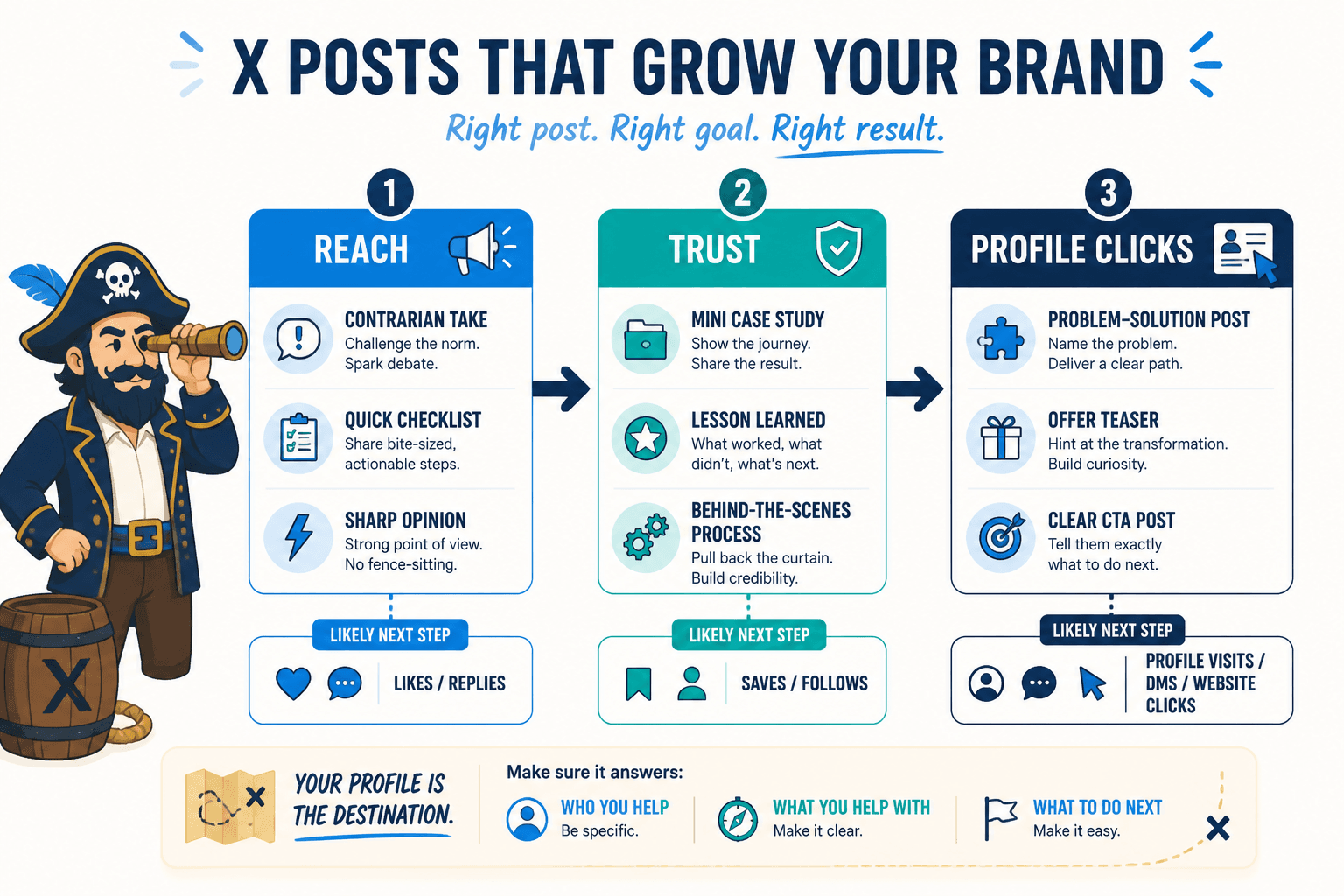
The right format depends on what you want the post to do. Reach is not the same as trust. Trust is not the same as leads. And trying to force one post to do all three often produces a strange little mess.
If your goal is reach
Reach posts usually need a stronger angle, cleaner hook, and faster readability.
Most “thought leadership” is just regular thoughts wearing a blazer.
Bad content advice in one line:
“Just be authentic.”
That is not a strategy. That is a vague blessing.
The easiest way to make your writing better:
Stop posting the version that still sounds like notes.
If your goal is trust
Trust-building posts should be useful, observant, and grounded in experience. Less performance. More clarity.
One thing I keep noticing in service businesses:
The more unclear the offer is, the more the content has to overwork.
Good posts help.
Clear positioning helps more.
A lot of content sounds polished but unhelpful.
That usually means the writer optimized for sounding smart instead of being clear.
When a post underperforms, I do not ask “How do we beat the algorithm?”
I ask:
Was the point strong?
Was the opening clear?
Was there anything worth repeating?
Usually the answer is there.
If your goal is leads or profile clicks
These posts need a natural path to the next step. Not a hard left turn into “DM me if you want to 10x your visibility.” Nobody likes that person.
If your posts are getting polite likes but no real business traction, your content may be too broad to attract the right people.
Specific content repels more people.
Good.
That is usually how relevance starts.
Writers and consultants do not always need better promotion.
Sometimes they need clearer profile copy, clearer offers, and a cleaner next step after the post.
If your content is doing its job, a profile visit should answer three things fast:
Who you help
What you help with
What to do next
If you want that next step to work better, pair your posts with smarter profile and funnel decisions, not just better wording. Related reads on engagement endings for personal brands and X post ideas and examples for creators can help fill that gap.
Before and after: turning a weak X post into a stronger one
Sometimes the fastest way to improve is to see what not to do.
Example 1: too vague
Weak: Consistency is key. Keep showing up and success will follow.
Stronger: “Just stay consistent” is lazy advice when the content itself is weak.
Consistency helps.
But consistency plus clarity is what people actually remember.
The second version has tension. It says something. It gives the reader a reason to react.
Example 2: too soft
Weak: I think storytelling can be very important in marketing and branding.
Stronger: Storytelling is not useful just because it is personal.
It is useful when it makes your expertise easier to trust, remember, or buy.
The stronger version removes hedging and makes the idea practical.
Example 3: too long for the point
Weak: There are many reasons why personal brands may struggle with content performance on social media, and one of those reasons is that they often are not speaking directly enough to their target audience.
Stronger: A lot of personal brands do not have a content problem.
They have an audience clarity problem.
If everybody can relate, nobody feels chosen.
Shorter. Sharper. More memorable. Much more like an actual X post.
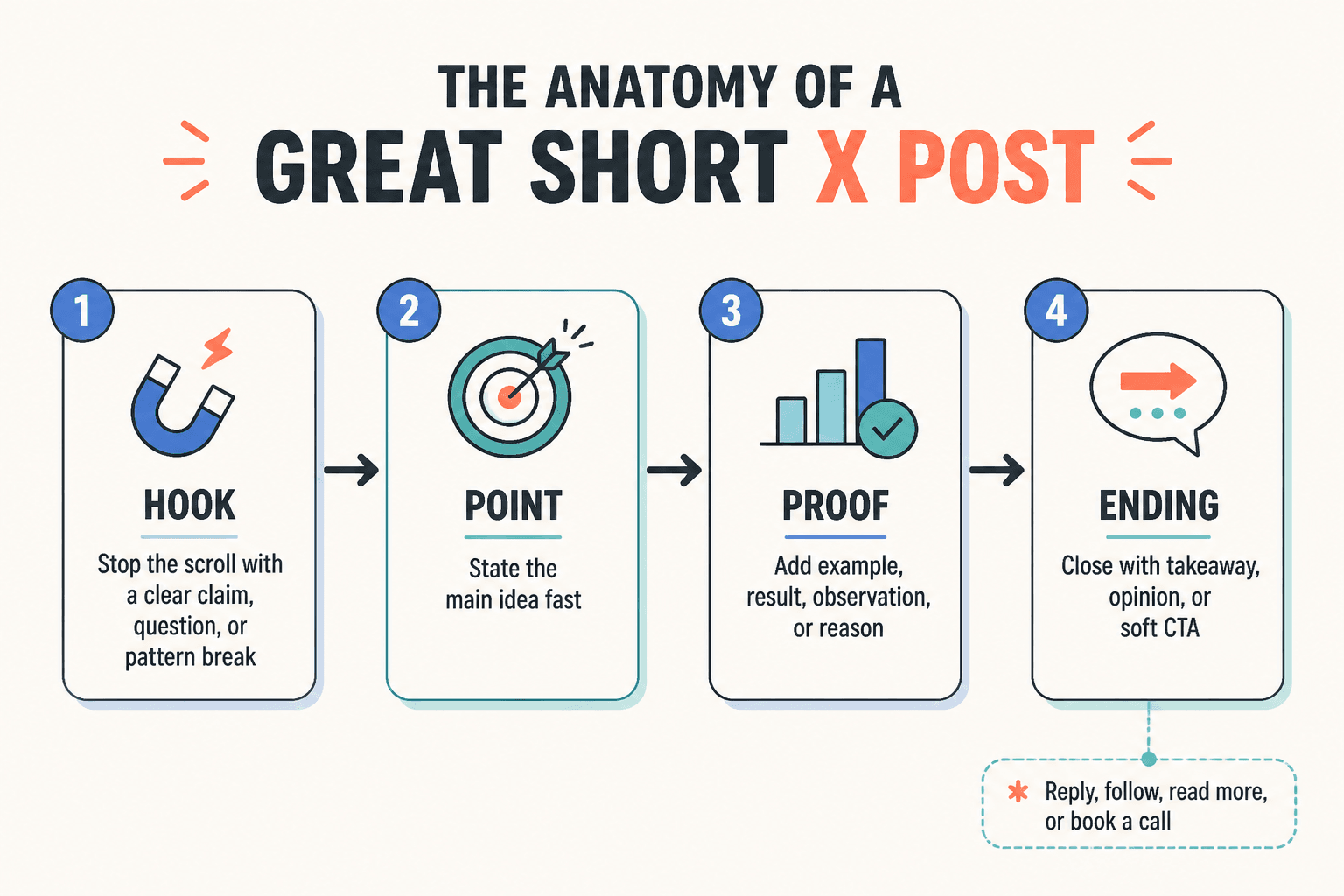
A simple formula for writing better X posts
If you freeze every time you open the app, use this basic structure:
- Hook: Start with a clear point, contrast, or opinion.
- Expansion: Add one useful explanation, example, or implication.
- Ending: Close with a punchy takeaway, question, or next-step idea.
That is enough for a lot of strong posts.
Example:
Being “good at content” is not the goal.
Being easy to understand is.
A lot of smart people post useful ideas in forgettable packaging, then blame reach.
Clear beats clever more often than content people want to admit.
You can also use this when repurposing ideas from articles, client calls, sales objections, or longer posts. If you already publish elsewhere, it helps to understand the broader context of social media writing and how X fits differently from slower formats.
And if you want a platform-specific view, the wider X posts hub is a useful next stop.
10 plug-and-play X post examples you can adapt
These are meant to be adapted, not copied word for word like a content raccoon stealing shiny objects. Swap in your niche, audience, and expertise.
The bigger point is simple: clearer structure and clearer writing make the piece more useful. That is usually what makes the ending land better too.