
Most people do not write long X posts because the idea deserves more room.
They write long X posts because they have not decided what the point is yet.
That is why short posts often win. Not because short is magically better. Not because the platform hates detail. Short X posts beat long ones when the idea is sharp, the opinion is clear, and the reader should understand it in one quick hit instead of wading through eight lines of setup and a mini identity crisis.
If you are trying to grow on X without sounding vague, overcooked, or weirdly theatrical, this matters. A short post can punch harder, travel faster, and get quoted more easily than a longer one. It can also flop instantly if it says nothing. So the real question is not “should I post short or long?” It is when does short actually work better?
That is what this article covers: when short X posts beat long ones, why they work, what kinds of ideas belong in shorter formats, and how to stop trimming posts into lifeless little scraps just because you heard brevity wins.
If you want broader context on platform-specific writing, you can browse more in social media writing or go straight to the main hub for X posts.
If you want the bigger picture, start with the parent guide.
When short X posts beat long ones
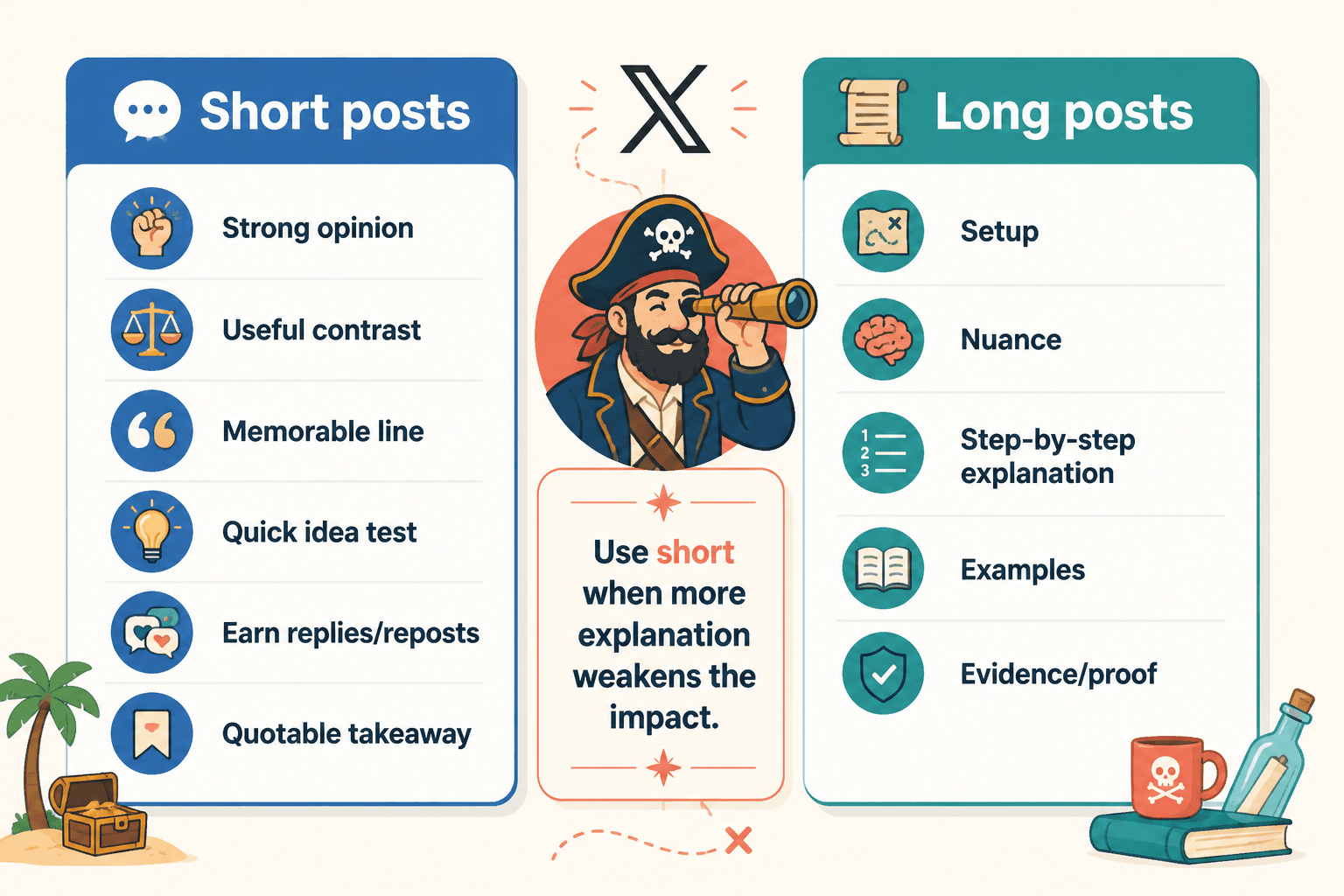
Short X posts beat long ones when speed, clarity, and punch matter more than detail.
X is still a fast-scrolling platform. People are not arriving in a patient, reflective mood, ready to study your five-part thought journey about brand positioning. They are scanning. Reacting. Deciding in a second whether something is worth their attention.
That makes short posts especially strong when your goal is to:
- make one sharp point
- state a strong opinion
- frame a useful contrast
- drop a memorable line
- test an idea quickly
- earn replies or reposts
- create a quotable takeaway
Longer posts do better when you need setup, nuance, steps, examples, or proof. Short posts do better when extra explanation would only weaken the impact.
Short works best when the next sentence would make the post worse, not better.
That is the real filter.
And yes, some creators massively overestimate how much context people need. If your point can be said in 14 words, saying it in 94 does not make it smarter. It usually just makes it easier to ignore.
The biggest advantage of short posts: compression
Good short X posts do not just say less. They compress more.
Compression is what happens when a post carries a full idea in very little space. It feels clean, confident, and easy to repeat. That makes it more likely to get liked, reposted, screenshotted, quoted in replies, or remembered later.
Here is the difference:
| Weak short post | Strong short post |
|---|---|
| Short because it is underwritten | Short because it is distilled |
| Vague point | Clear point |
| Generic advice | Specific insight |
| Reads like a note to self | Reads like a sharp takeaway |
| No tension | Includes contrast, surprise, or edge |
Bad short posts feel lazy.
Good short posts feel inevitable.
That is why you should not confuse short with effortless. The best short posts often come from cutting a larger thought down to the sentence that actually matters.
5 situations where short X posts usually win
1. When the idea is naturally one-line strong
Some ideas are built for one line. They do not need examples. They do not need a scene. They do not need three qualifying caveats to protect your reputation as a nuanced person on the internet.
Examples:
- “The problem is not that your content is too simple. It is that it says what everyone else says.”
- “Being consistent does not help if you are consistently forgettable.”
- “Most creators do not need more content ideas. They need stronger opinions.”
Each one lands quickly because the structure is tight and the contrast is clear.
2. When you want reposts more than dwell time
Longer posts can keep someone reading. Shorter posts can be easier to share.
If a post is immediately understandable and broadly useful to your niche, it has a better shot at getting reposted. People are more likely to share a line they can stand behind without needing to explain your entire argument for you.
This is especially true for creators posting about writing, marketing, freelancing, offers, positioning, audience building, or client work. Clear, compressed truths travel well.
3. When you are testing angles
X is excellent for testing ideas fast. A short post lets you throw out a hook, opinion, or framing angle without investing 20 minutes writing a mini essay that may quietly die in public.
Short posts are useful for testing:
- new positioning language
- contrarian opinions
- hook formats
- offer-adjacent pain points
- phrases your audience repeats back
- topics worth expanding into threads, articles, or emails
If a short post gets strong engagement, good replies, or clear resonance, that is often your signal to build it into something bigger later.
4. When the emotion is immediate
Short posts work well when the feeling is instant: frustration, relief, recognition, skepticism, annoyance, ambition, exhaustion.
The reader should be able to feel the point before they even fully analyze it. That is hard to do when you bury the punchline under six lines of throat-clearing.
Example:
“A lot of content sounds polished because it was edited. Very little sounds alive because it was actually thought through.”
That kind of line works because it carries an opinion and a sting. It does not need a long runway.
5. When you want replies, not a lecture hall
Long posts can close a conversation by saying too much upfront. Short posts leave more room for the audience to respond, disagree, ask for more, or add their own examples.
That makes them useful when your real goal is interaction. Not needy engagement bait. Actual conversation.
A short opinion with a little edge often invites stronger replies than a complete essay that leaves nothing open.
When long X posts are still the better choice
Short posts are not automatically better. They just fail faster when they are bad and travel faster when they are good.
Long posts still win when you need:
- context for a non-obvious point
- a step-by-step explanation
- a mini story that earns the lesson
- proof, examples, or case study details
- nuance around a risky or easily misunderstood claim
- a bridge into a stronger CTA
If the reader must understand how or why something works, not just what you think, longer may be the better call.
This is where a lot of creators make the wrong edit. They trim a post until it becomes clever but useless. It gets a few likes because it sounds nice, but it does not build trust because it did not actually help anyone do anything.
So do not chase shortness as a style badge. Use it when compression improves the post. Not when it strips out the substance.
What short X posts do better than long ones
When short X posts beat long ones, they usually outperform on one or more of these traits:
- Speed: the point lands instantly
- Clarity: the reader does not have to work to find the takeaway
- Memorability: easier to remember and repeat
- Quotability: easier to repost or screenshot
- Rhythm: works better in a fast feed
- Idea testing: faster to publish and learn from
- Consistency: easier to sustain without turning your account into a thread factory
That last point matters more than people admit. If every post feels like a major writing event, you will post less often, test fewer ideas, and over-attach your ego to each result. Short posts reduce production drag. Sometimes that alone is enough reason to use them more often.
For more angle and hook ideas, this piece on short X post hooks creators can adapt fast pairs well with this one.
How to tell if your idea should be short
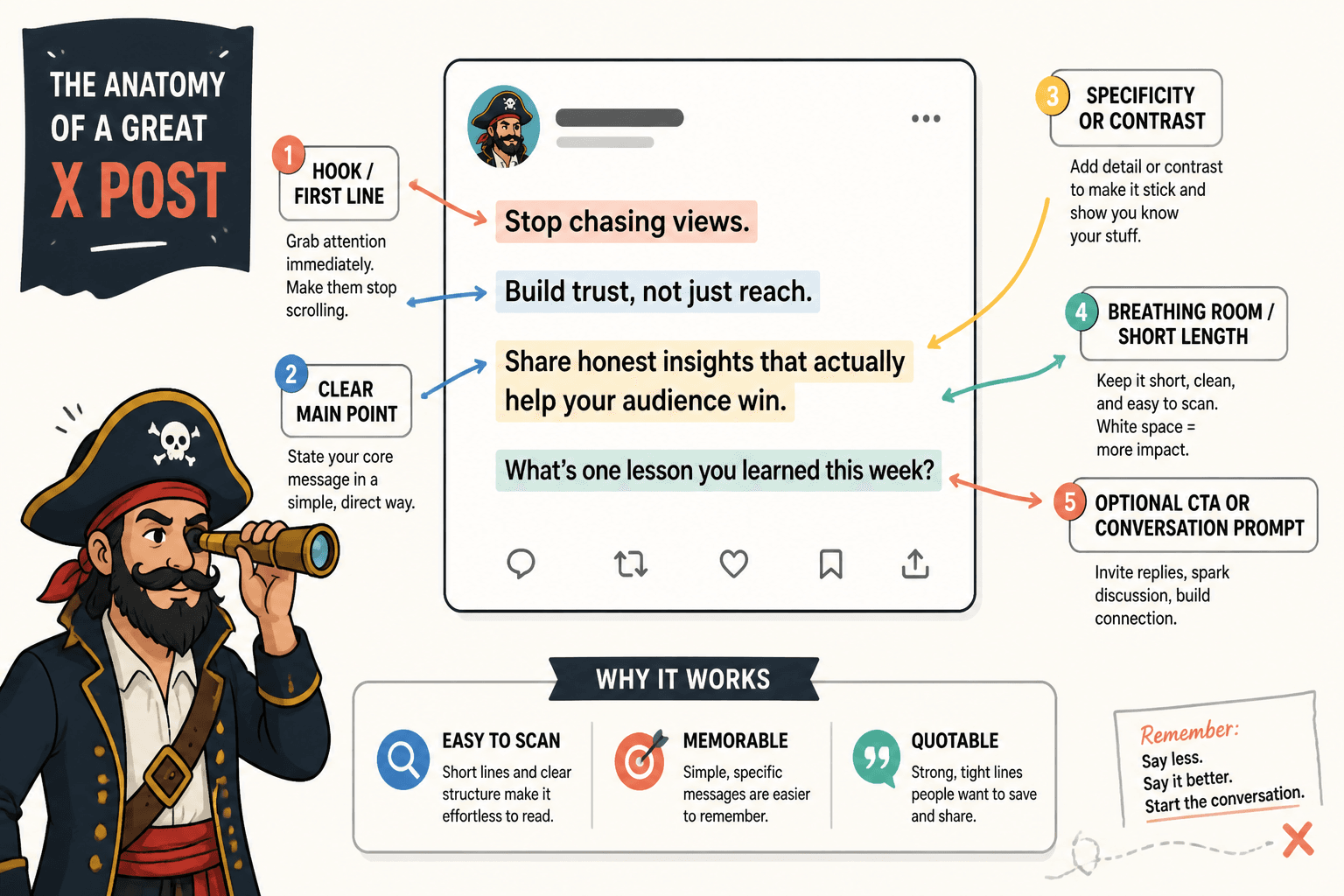
Before you post, ask these five questions:
- Can the main point be understood in one sentence?
If yes, short may be better. - Does extra context strengthen the post or dilute it?
If it dilutes it, cut. - Is the value in the line itself or in the explanation behind it?
If the line is the value, keep it tight. - Would this work well as a screenshot or quote post?
If yes, short has an advantage. - Am I adding words to clarify, or because I do not trust the point yet?
That last one stings a bit, but it is useful.
If you answer those honestly, you will make better decisions fast.
Before and after: turning long posts into better short ones
Here is where people usually improve the fastest.
Example 1
Too long:
“I think one of the biggest mistakes creators make is assuming they need to post more often to grow, when in reality it may be that they need to improve the clarity of what they are trying to say and make their content more resonant and specific to the people they are trying to reach.”
Better short version:
“Most creators do not need more posts. They need clearer points.”
The shorter version works because it cuts the hedging and keeps the contrast.
Example 2
Too long:
“Something I have noticed is that a lot of people on X are writing posts that sound smart on the surface but do not really say anything concrete or actionable underneath, and I think audiences are getting better at noticing that.”
Better short version:
“A lot of posts sound smart because they are vague.”
That line has more force because it stops explaining the observation and simply states it.
Example 3
Too long:
“If your audience is not engaging with your posts, it may not be because they do not care about the topic. It might be because the way the post is framed does not create enough tension or give them a reason to pay attention quickly.”
Better short version:
“Silence does not always mean the topic is weak. Sometimes the framing is.”
Again: compression, not just cutting.
A simple formula for writing stronger short X posts
If you want a practical structure, use this:
- Observation: what do you notice?
- Contrast: what do people get wrong?
- Compression: how do you say it in the fewest useful words?
That gives you a simple writing pattern:
Most people think [common assumption].
Actually, [clearer truth].
Examples:
The bigger point is simple: clearer structure and clearer writing make the piece more useful. That is usually what makes the ending land better too.