
Most people are sitting on a pile of usable content and still staring at X like they need a fresh revelation every morning.
They do not.
The problem usually is not a lack of ideas. It is a lack of adaptation. A decent LinkedIn post, newsletter section, podcast note, client answer, old thread, article paragraph, or even a spicy sentence from your draft folder can become a strong X post. But only if you stop pasting long-form thoughts into a short-form platform and expecting applause.
How to Turn Old Content Into Better X Posts is really about one thing: compression without losing the point. X rewards clarity, tension, punch, timing, and quotability. Old content tends to be bloated, softened, or built for a completely different reading behavior. So the job is not to repost it. The job is to remake it.
Here’s how to turn what you already have into sharper X posts that feel native to the platform, sound like a person, and give people a reason to stop scrolling instead of politely ignoring you.
For the full path around this topic, head to the parent guide.
Why most repurposed content flops on X
X is less forgiving than platforms where people expect longer setup. You get less runway. Less patience. Less room for warm-up sentences and thoughtful clearing of the throat.
That is why repurposed content often dies there. People take an old post, trim a few words, maybe add line breaks, and call it strategy. What they actually did was drag a medium-length thought into a fast platform and hope the platform would adjust. It will not.
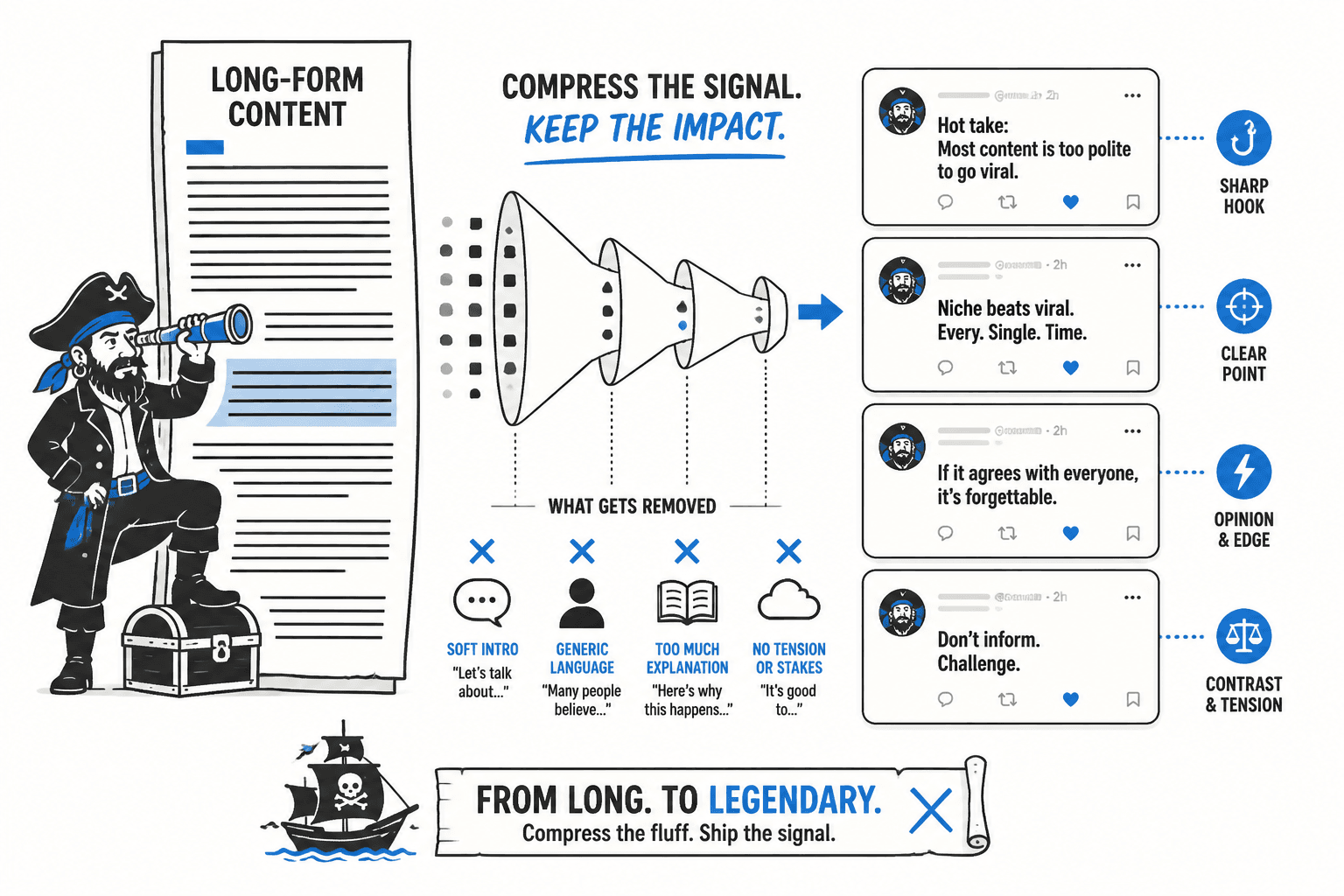
If old content underperforms on X, it is usually because it has one or more of these problems:
- The point shows up too late
- The opening is soft
- The language is generic
- The post explains instead of lands
- There is no tension, contrast, or opinion
- The wording sounds like it was ironed flat for LinkedIn
- The idea needs a thread, not a single post
X posts are usually stronger when they feel like a clean hit, not a miniature blog post. If the reader cannot quickly tell what you mean and why it matters, you have already lost.
If you want a broader foundation for platform fit, this piece works well alongside X posts guidance here and how to write better X posts.
What kind of old content is worth turning into X posts
Not every old asset deserves a second life. Some content was weak the first time. Repurposing does not perform miracles. It just helps you extract more value from thoughts that already had some signal.
The best source material usually has one or more of these traits:
- A clear opinion
- A useful distinction
- A mistake people keep making
- A specific lesson from experience
- A surprising line that can stand alone
- A tactical framework that can be condensed
- A strong example, before/after, or rewrite
- A line from a longer piece that sounds quotable
Good source material can come from:
- Old blog posts
- LinkedIn posts
- Newsletters
- Webinar notes
- Sales call notes
- Client FAQs
- Podcast transcripts
- Threads that had one strong post buried inside them
- Comments and replies that got a strong reaction
- Your drafts folder, which is often a graveyard of almost-good ideas
If a piece of old content contains one sharp, reusable point, that is enough. You do not need a masterpiece. You need a sentence or argument with some backbone.
Start by finding the actual point
This is where most people make a mess of things. They try to condense the whole piece instead of extracting the strongest point from it.
Do not ask, “How do I shorten this?” Ask, “What is this really saying?” Those are different jobs. One produces cramped leftovers. The other produces a post.
When you review an old piece of content, look for:
- The sentence that makes the strongest claim
- The moment where tension appears
- The part that would make someone nod, disagree, or reply
- The practical takeaway buried under explanation
- The line you would quote if you had to summarize the whole thing in one sentence
That is your raw material.
For example, imagine this came from an old newsletter:
Many creators struggle with consistency because they overcomplicate their content planning process and try to create every piece from scratch instead of building a repeatable system based on reusable ideas and proven themes.
The actual point is not “consistency matters.” That is tired. The actual point is this:
Most creators are not inconsistent because they lack discipline. They are inconsistent because they keep inventing from zero.
That version has shape. It gives you something to post.
A simple extraction test
If you cannot explain the old content’s main point in one sharp sentence, you are not ready to repurpose it yet.
Get it down to one of these:
- A claim
- A contrast
- A warning
- A lesson
- A rule of thumb
- An observation people recognize quickly
Match the old idea to the right X post format
Not every repurposed idea should become the same kind of post. Some ideas want a one-liner. Some need a short list. Some should be turned into a thread. Trying to force every old piece into one format is how you get awkward content that feels cut down with garden shears.
| Source material | Best X format | Why it works |
|---|---|---|
| Strong opinion from article or newsletter | Single punchy post | Works when the point is already clear and quotable |
| Step-by-step process | Short thread | Gives enough room without stuffing everything into one post |
| Client lesson or mistake pattern | Observation post | Good for trust and relatability |
| List of tips from longer content | 3-5 point post or thread | Keeps the useful parts, drops the filler |
| Great sentence hidden in a longer draft | One-liner or quote-style post | Fast, sharp, and native to X |
| Case study or before/after result | Short story post | Combines proof with a takeaway |
If the point cannot survive as a short post, do not force it. Make it a thread. And if it still needs too much setup, save it for an article, newsletter, or somewhere people have a bit more patience.
How to rewrite old content so it actually sounds like X
This is the part that matters. Good repurposing is not resizing. It is rewriting.
1. Cut the setup
Long-form content often earns its point slowly. X posts usually cannot.
Cut introductions like:
- I have been thinking a lot about this lately
- One thing I have noticed over the years
- There are many reasons why
- In my experience working with different people
Those lines are not helping. They are just loitering near the entrance.
2. Lead with the sharpest part
The strongest line should usually be first or very close to first. That could be:
- The contrarian point
- The uncomfortable truth
- The useful distinction
- The direct lesson
- The surprising result
Weak:
Over the past few months, I have had a lot of conversations with creators about why their content is not landing.
Better:
Most content does not flop because the advice is bad. It flops because the packaging is forgettable.
3. Replace broad language with sharper wording
X rewards crisp language. Broad phrases make posts feel lazy.
Replace this kind of wording:
- improve your content strategy
- build stronger engagement
- show up more consistently
- deliver value to your audience
With wording that actually means something:
- write posts people can repeat
- give readers a reason to reply
- stop creating from zero every week
- turn expertise into clearer posts
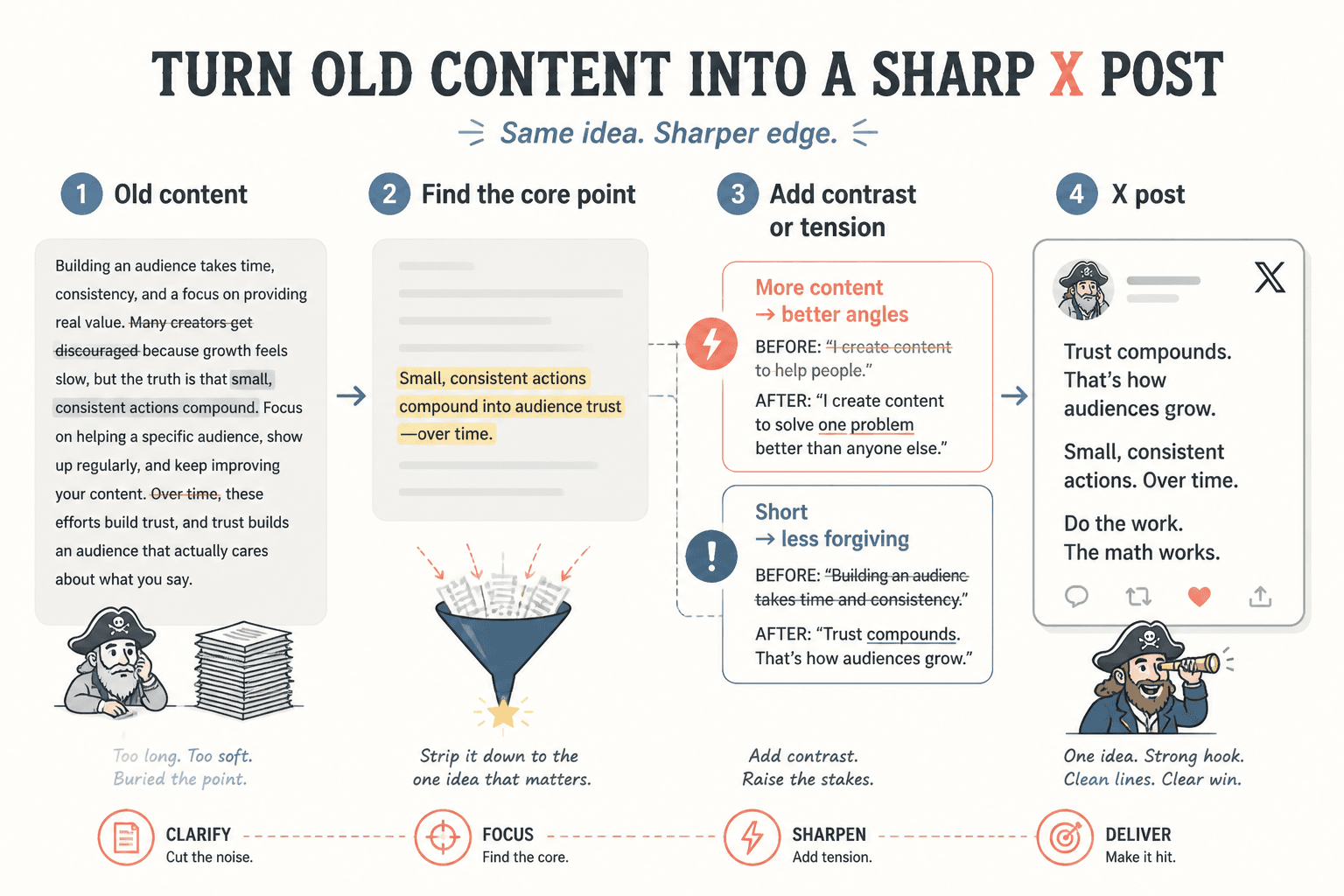
4. Add contrast, tension, or consequence
A lot of old content is technically fine and still too flat for X. It needs edge. Not fake drama. Just contrast.
Examples:
- Not more content. Better angles.
- Short posts are not easier. They are less forgiving.
- Useful advice is common. Useful phrasing is rarer.
- Most people do not need more ideas. They need better compression.
That contrast gives the post something to push against.
5. Stop before you explain the life out of it
This is a common mistake with repurposing. You find a solid point, then keep adding context until the post loses its snap.
X posts often work best when they land one idea cleanly. If you need three paragraphs to defend it, it might be a thread. Or it might need better wording. Or, bluntly, it might not be that interesting.
Before-and-after examples: turning old content into better X posts
Here is where this gets practical.
Example 1: from blog paragraph to single post
Old content:
When creators are trying to grow online, they often focus heavily on creating more content, but without a clear message or consistent positioning, the extra output does not always translate into meaningful traction.
Better X post:
More content does not fix fuzzy positioning.
You just become easier to ignore at scale.
Why it works: stronger contrast, tighter wording, more quotable.
Example 2: from LinkedIn advice post to sharper X post
Old content:
If you want your content to perform better, make sure that your posts are speaking directly to the needs, pain points, and goals of your target audience instead of trying to appeal to everyone.
Better X post:
When your post is “for everyone,” readers can feel it.
And most of them keep scrolling.
Why it works: shorter, more human, less workshop handout energy.
Example 3: from newsletter lesson to mini-thread
Old content:
A lot of consultants create long, thoughtful content but struggle to convert attention into leads because they do not connect the post to a relevant next step, and the audience is left with no clear action to take.
Better X thread opener:
A lot of good content dies one post too early.
Not because the idea was weak.
Because there was no next step.
3 simple ways to connect an X post to leads without making it sound like a desperate pitch:
The bigger point is simple: clearer structure and clearer writing make the piece more useful. That is usually what makes the ending land better too.