Most people do not need “the best AI course” in some grand, universal sense. They need a course that helps them stop poking random buttons, writing garbage prompts, and expecting a chatbot to somehow produce strategy, taste, and sales on command.
That is the real beginner problem. Not lack of tools. Not lack of access. Lack of structure.
If you are looking for the Best Beginner AI Courses for Writers, Marketers, and Content Creators, the useful question is not “Which course is most famous?” It is “Which course will actually help me use AI better in my work without turning my content into polished mush?”
This guide will help you choose well. We will cover what beginners should actually learn first, what makes an AI course worth your time, which course types fit different kinds of creators, and which red flags should make you close the tab immediately.
If you want the bigger picture, start with the parent guide.
What beginners actually need from an AI course
Beginner AI education gets weird fast because a lot of courses are built around hype, not work. They promise speed, scale, effortless content, passive income, and other things people say when they are trying to sell a shortcut in a trench coat.
But if you are a writer, marketer, coach, consultant, solo founder, or creator, your beginner needs are usually pretty practical:
- Understanding what AI tools are good at
- Understanding what they are bad at
- Learning how to prompt without rambling
- Using AI to brainstorm, outline, rewrite, and repurpose
- Keeping your voice instead of replacing it with corporate oatmeal
- Building lightweight workflows that save time
- Knowing where human judgment still matters a lot
That last one matters more than people think. AI can help you draft faster. It cannot hand you taste, positioning, original experience, or trust. If a course acts like it can, that is not education. That is just performance art for people who want easy answers.
What makes an AI course actually good for beginners
The best beginner courses do not try to impress you with complexity. They help you get competent fast.
1. It teaches principles, not just tool tours
A weak course shows you where the buttons are. A useful one teaches how to think.
You want frameworks like:
- How to break a task into steps AI can actually help with
- How to give context, constraints, and examples
- How to refine outputs instead of taking first drafts personally
- How to evaluate quality
- How to spot bland, fake, or incorrect output
2. It is built around real use cases
Beginners learn faster when the lesson maps to actual work.
Good examples include:
- Turning rough ideas into article outlines
- Rewriting a weak LinkedIn post into something readable
- Generating email variations without making them sound like a hostage note from a funnel bro
- Summarizing research notes
- Repurposing one article into posts, emails, and hooks
- Creating first-pass customer research questions
3. It teaches editing, not just generating
This is where a lot of beginner courses fall apart. They teach prompt-input-output like that is the whole game. It is not.
The real skill is knowing how to shape output. What to keep. What to cut. What sounds fake. What needs proof. What needs a sharper point. What should never have been generated in the first place.
4. It respects the limits of AI
A course worth taking should say this plainly: AI is not a replacement for strategy, expertise, or audience understanding. It is a support tool.
If that sounds less sexy than “build a six-figure content engine in one weekend,” yes. That is because it is less stupid.
The best types of beginner AI courses by creator goal
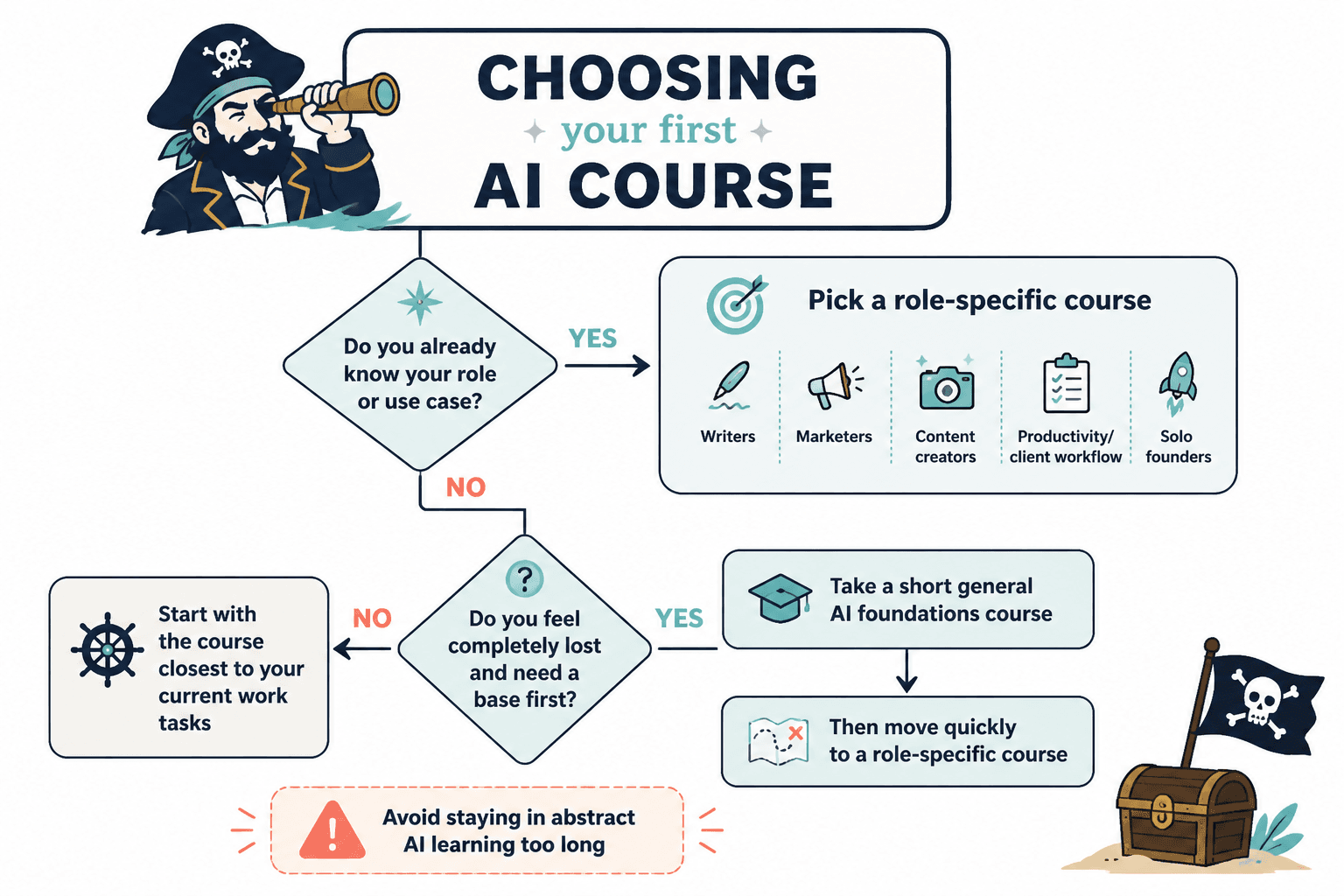
There is no single best course for everyone because “beginner” covers a lot of ground. A freelance writer does not need the same thing as a content marketer. A consultant trying to speed up client delivery has different needs than a creator trying to repurpose content across platforms.
So instead of pretending there is one perfect pick, use this filter.
| Creator type | Best course style | What it should teach |
|---|---|---|
| Writers | AI writing workflow course | Idea generation, outlining, rewriting, editing, voice control, research support |
| Marketers | AI for content and campaign execution | Messaging, email drafts, content systems, research, persona input, offer testing |
| Content creators | AI repurposing and content production course | Post variations, hooks, script support, batching, workflow design |
| Coaches and consultants | AI productivity and client workflow course | Notes, summaries, proposals, lead magnets, content support, admin simplification |
| Solo founders | General business AI operations course | Research, content, documentation, offer messaging, support systems |
If you are choosing between a broad “learn AI” course and a role-specific course, the role-specific option is often better for beginners. General AI education can be useful, but it gets abstract quickly. Most people learn faster once the lessons attach to work they already do.
That said, if you still feel completely lost, a short general course can help you build a base first. Just do not camp there forever. “Learning AI” in the abstract can become a very tidy form of procrastination.
Best beginner AI courses for writers
Writers should be picky here, because bad AI teaching can wreck your instincts fast. If a course overemphasizes speed and underemphasizes judgment, you will end up producing cleaner-looking drafts with less originality and less bite. Plenty of writers are already doing this and calling it efficiency.
A good beginner AI course for writers should cover:
- How to use AI for brainstorming without outsourcing the idea itself
- How to build rough outlines from messy notes
- How to rewrite for clarity, tone, and structure
- How to generate alternate angles or headlines
- How to use AI for research support without trusting it blindly
- How to preserve voice during edits
What to avoid
- Courses built around “write full blog posts in one click”
- Prompt packs pretending to be education
- Anything that treats volume as quality
- Lessons that never mention fact-checking, rewriting, or voice drift
If you are a writer, the right beginner course should make you better at directing and editing AI, not more dependent on it. That is a very different thing.
Best beginner AI courses for marketers
Marketers usually need AI less for “writing everything” and more for speeding up execution across many small tasks. The good stuff is often in research, synthesis, ideation, segmentation, repurposing, and variation.
A useful beginner AI course for marketers should teach how to use AI for:
- Campaign brainstorming
- Email draft variations
- Ad angle exploration
- Audience pain-point mapping
- Landing page message testing
- Content calendar support
- Summaries of interview notes or call transcripts
- Turning one strong idea into multiple channel formats
The key is that the course should still revolve around strategy. AI can help produce options. It cannot decide which message matches your market, your offer, your proof, and your positioning. You still need a functioning brain for that part.
What to avoid
- Courses that skip messaging fundamentals
- Courses obsessed with automating everything
- Courses that show outputs but not evaluation
- Anything that treats AI copy as ready-to-publish by default
Best beginner AI courses for content creators
Content creators often get sold the dream of infinite output. Post faster. Repurpose harder. Make 90 assets from one idea. Schedule your way to enlightenment.
Some of that is useful. A lot of it creates more content than clarity.
The best beginner AI courses for content creators should focus on three things:
- Turning rough thoughts into structured content ideas
- Repurposing one idea across formats without making every version identical
- Building a repeatable workflow that does not kill your voice
That might include:
- Hook generation
- Short-form post variations
- Video script support
- Newsletter expansion from a post idea
- Carousel or thread structuring
- Batching and scheduling prep
What it should not become is a machine for flooding the internet with interchangeable sludge. If the course teaches quantity without taste filters, you are not building a content system. You are building a landfill.
How to judge an AI course before you buy it
You do not need perfect information before buying. But you do need to stop buying courses because the sales page used the words “workflow” and “creator economy” in a confident font.
Use this checklist.
Good signs
- Clear lesson outcomes
- Real examples from writing, marketing, or content work
- A focus on prompting and editing
- Discussion of AI limitations
- Templates paired with explanations
- Beginner-friendly pacing
- Updates or notes about changing tools
Red flags
- Huge promises with vague curriculum
- “No experience needed” plus advanced automation jargon five minutes later
- Heavy focus on tool names, light focus on process
- Dozens of prompt templates but no guidance on when to use them
- No mention of quality control, voice, accuracy, or ethics
- Testimonials that say nothing except “This changed everything”
If you cannot tell what you will be able to do after the course, that is a problem. If the sales page sounds more polished than the actual teaching probably is, that is also a problem.
The beginner topics your course should cover first
If you are comparing options, here is a solid sequence. A beginner AI course does not need every advanced use case on earth. It should help you become competent in the basics quickly.
- Learn the core terms so you can tell tools, models, prompts, and workflows apart.
- Practice giving clear instructions and evaluating weak outputs.
- Use AI on a few real creator tasks like outlining, rewriting, or repurposing content.
- Build simple habits for fact-checking, editing, and protecting your voice.
If a beginner course can help you do those four things with confidence, it is probably useful. If it mostly dazzles you with jargon and screenshots, it is probably selling excitement more than skill.