
Most lists of the best prompt engineering courses online have one annoying habit: they act like prompt engineering is either a mystical superpower or a set of magic phrases you can copy into ChatGPT and retire by Thursday.
It is neither.
If you want to get better results from ChatGPT, Claude, Gemini, and other AI tools, you do not just need a pile of prompts. You need to understand how to frame tasks, add context, structure inputs, test outputs, and spot when the model is confidently making a mess. That is the actual skill.
This guide will help you find the best prompt engineering courses online for ChatGPT, Claude, Gemini, and other AI skills based on what you actually need: practical use, clear teaching, current relevance, and whether the course helps you do better work instead of just collect another certificate you will forget about by next Tuesday.
To see how this fits into the wider strategy, open the parent guide.
What a good prompt engineering course should actually teach
A good course should not just hand you templates and call it a day. Prompt engineering changes fast, and the exact wording tricks people obsess over tend to age badly. The stronger courses teach principles you can carry across tools.
That means the useful ones usually cover things like:
- how to define a task clearly
- how to give the model the right context
- how to control output format and tone
- how to break complex work into steps
- how to iterate when the first result is mediocre
- how to evaluate output quality instead of trusting it blindly
- how prompting differs across ChatGPT, Claude, Gemini, and similar tools
- how to use AI in actual workflows like writing, research, coding, analysis, customer support, or operations
The bad courses usually focus on hype, vague promises, or giant swipe files of prompts with no real explanation. That stuff can feel useful for about ten minutes. Then the prompt breaks, the model updates, and you are back where you started.
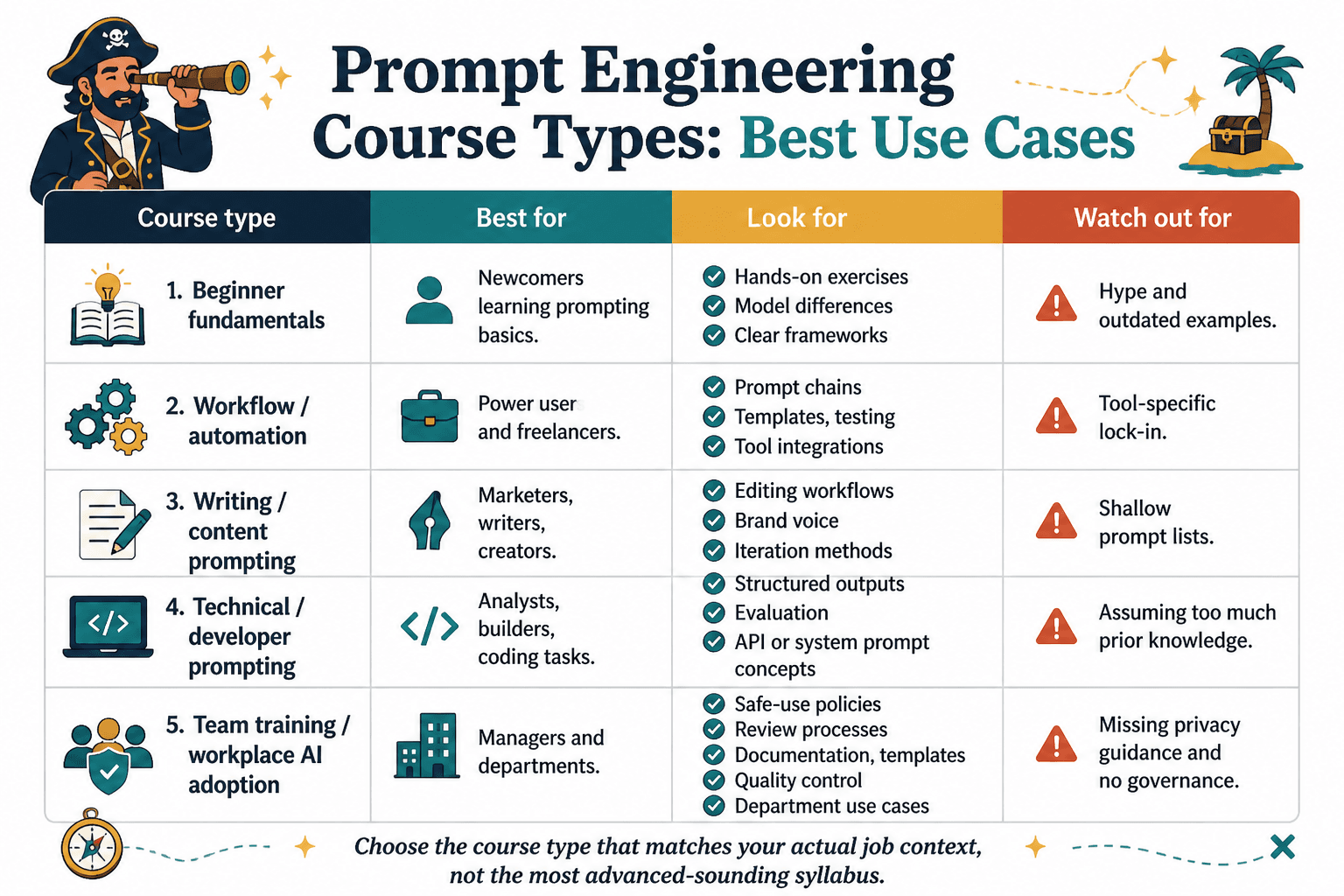
The best prompt engineering courses online, by type of learner
There is no single best course for everybody. A marketer using ChatGPT for content has different needs than a product person building AI workflows, and both need something different from a developer using APIs.
So instead of pretending there is one perfect course floating above the rest like some blessed PDF from heaven, here is a more useful breakdown.
1. Best for beginners who want a solid foundation
Look for a course that teaches prompting as a thinking skill, not a bag of tricks.
The right beginner course should explain:
- what prompt engineering is and is not
- why vague prompts produce vague output
- how role, context, constraints, and examples shape responses
- basic prompt patterns like summarization, extraction, rewriting, classification, brainstorming, and structured generation
- common failure modes like hallucination, overconfidence, and missing nuance
If a beginner course jumps straight into advanced frameworks without teaching how to think about inputs and outputs, it is probably more interested in looking smart than helping you get competent.
2. Best for creators, marketers, writers, and consultants
If you create content or client work, the best prompt engineering courses online for you will focus less on technical theory and more on practical workflows.
You want training that shows how to use AI for things like:
- content ideation
- headline and hook generation
- article outlining
- repurposing long-form content into posts or emails
- research support
- draft refinement
- voice guidance
- offer messaging and positioning help
But there is a catch. If the course sells AI as a way to replace your judgment, run. Prompting helps you work faster and think in more directions. It does not magically give you taste, positioning, or original insight. Plenty of people have learned that the hard way and published the proof all over LinkedIn.
3. Best for technical users and builders
If you are a developer, product manager, analyst, or automation-heavy operator, you probably need a course that goes beyond consumer chat interfaces.
Useful topics here include:
- system prompts and instruction hierarchy
- structured outputs
- function calling or tool use
- retrieval-augmented workflows
- evaluation methods
- prompt testing
- chaining tasks
- reducing failure rates in repeated workflows
For technical users, a flashy prompt library is not enough. You need repeatability. You need control. You need to know why the model failed and how to tighten the setup.
4. Best for team training and workplace AI adoption
Some courses are aimed less at individuals and more at teams trying to use AI without creating a low-grade chaos machine.
If that is your situation, prioritize courses that cover:
- safe use policies
- workflow design
- review processes
- documentation and templates
- quality control
- department-specific use cases
- how to avoid feeding confidential information into the wrong tools
A team does not need everybody becoming a prompt poet. It needs people using AI clearly, safely, and consistently.
What to look for before you buy a prompt engineering course
Before paying for anything, check a few simple things.
Current tool relevance
The course should mention current major tools like ChatGPT, Claude, and Gemini if it claims broad relevance. It does not need to worship each one equally, but it should acknowledge that prompting is not identical across them.
Claude often handles long context and nuanced writing well. ChatGPT has broad plugin, workflow, and multimodal familiarity. Gemini may fit people already working in Google-heavy environments. A decent course should prepare you to adapt, not lock your brain to one interface.
Real examples, not just theory
The best courses show prompts before and after improvement. They explain why one version works better. They walk through failures. They do not just toss out a framework like “Goal, Context, Format, Tone” and expect applause.
Use-case fit
A course can be excellent and still wrong for you.
If you need AI for client content, do not buy a heavily developer-focused course full of API architecture. If you are building internal tools, do not buy a course that only teaches social media prompt templates. This sounds obvious, yet people ignore it constantly because the sales page looked slick.
Teaches evaluation, not just generation
This one matters more than people think. Anyone can get AI to produce words. The useful skill is judging whether those words are accurate, complete, specific, on-brand, and fit for the task.
If a course does not teach you how to review, test, and refine outputs, it is incomplete.
Not built entirely on prompt formulas
Frameworks are helpful. Formula worship is not.
A lot of courses overpromise by acting like there is one elite prompt structure that unlocks everything. There is not. Good prompting is situational. Sometimes you need a tight instruction. Sometimes you need examples. Sometimes you need a multi-step back-and-forth. Sometimes the problem is not the prompt at all. Sometimes your task is just muddy.
Course formats: which one is worth your time?
The format matters almost as much as the content.
| Format | Best for | Watch out for |
|---|---|---|
| Self-paced video course | Busy learners who want structure | Outdated lessons, too much filler |
| Live cohort course | People who want feedback and accountability | Higher cost, variable teaching quality |
| Workshop or bootcamp | Fast practical upskilling | Can be shallow if too compressed |
| University or professional certificate | Credibility and broader foundations | Can be too theoretical or slow-moving |
| Membership or prompt library | Ongoing idea support | Often light on actual teaching |
For most people, a practical self-paced course with updated lessons and clear use cases is the safest bet. If you already know the basics and want stronger implementation, a live workshop or cohort can be more useful because you get feedback on your prompts and workflows.
Red flags that should make you close the tab
There is a lot of nonsense in this space. Some of it is polished nonsense, which is honestly more dangerous.
- It promises secret prompts that beat the system.
- It focuses more on income claims than skill development.
- It has no sample lessons or visible teaching style.
- It treats one AI tool as the only one worth learning.
- It sells giant prompt packs as if that equals expertise.
- It ignores fact-checking, editing, or output review.
- It uses endless hype words and says almost nothing concrete.
- It was clearly built around last year’s AI discourse and never updated.
The prompt engineering world attracts two kinds of nonsense merchants: the overhyped futurist and the lazy template seller. Neither is especially helpful when you are trying to build an actual skill.
How to choose the right prompt engineering course for your goals
If you are stuck between a few options, use this quick filter.
If your goal is better writing and content
- Choose a course focused on prompting for ideation, drafting, rewriting, and brand voice.
- Make sure it teaches editing and human refinement.
- Bonus if it covers workflows across articles, posts, emails, and research.
If your goal is productivity at work
- Choose a course with business use cases.
- Look for task automation, document summarization, meeting notes, data extraction, analysis, and communication workflows.
- Make sure it includes privacy and accuracy guidance.
If your goal is technical implementation
- Choose a course that covers APIs, structured prompts, tool use, evaluations, and system design basics.
- Look for examples beyond the chat box.
- Avoid beginner-only prompt template courses.
If your goal is staying adaptable across AI tools
- Choose a course based on principles, not one interface.
- Look for lessons on reasoning, structure, evaluation, and adaptation.
- Avoid anything that acts like one set of prompts will stay perfect forever.
The best prompt engineering course depends on the kind of work you want to do, not on whichever platform is loudest this month. If the course teaches you how to think clearly about prompts, you will still be able to use that skill when the tools change again.