
Most roundups of generative AI courses have the same problem as most bad AI content: a lot of hype, not much usefulness, and almost no respect for how creators actually work.
You do not need another course that spends three modules defining AI, shows a few magic-trick prompts, then leaves you staring at a blank doc like, great, now what? If you are a writer, coach, consultant, marketer, solo founder, or personal brand, the real question is not “Which AI course is popular?” It is “Which one will actually help me build a workflow that saves time without making my work sound like an intern fed on LinkedIn clichés?”
This guide on the Best Generative AI Courses for Real Creator Workflows, Not Just Theory is built around that question. We are looking at courses through a practical lens: can they help you research faster, draft better, repurpose smarter, keep your voice intact, and build repeatable systems you will still use a month later?
Because that is the gap. Plenty of people are “learning AI.” Far fewer are using it well inside real creator workflows.
Want the broader roadmap? Start with the parent guide.
What makes a generative AI course actually useful for creators?
A good course does not just explain what the tools can do. It shows you how to use them in context.
For creators, that usually means some version of this:
- Turning rough ideas into stronger angles
- Researching faster without becoming lazy or sloppy
- Drafting first versions you can actually improve
- Repurposing one idea into posts, emails, articles, threads, scripts, or lead magnets
- Building prompt systems and templates you can reuse
- Editing AI output so it sounds like you, not like warm corporate paste
- Using AI inside a content workflow instead of treating it like a slot machine
If a course is all theory, trend commentary, or tool tourism, it might be interesting for an afternoon. It will not change your workflow.
The best ones teach judgment along with mechanics. That matters because tools change fast. A course built around one flashy feature can age badly in months. A course that teaches how to think, structure prompts, evaluate outputs, and build workflows stays useful much longer.
How to judge the best generative AI courses for real creator workflows, not just theory
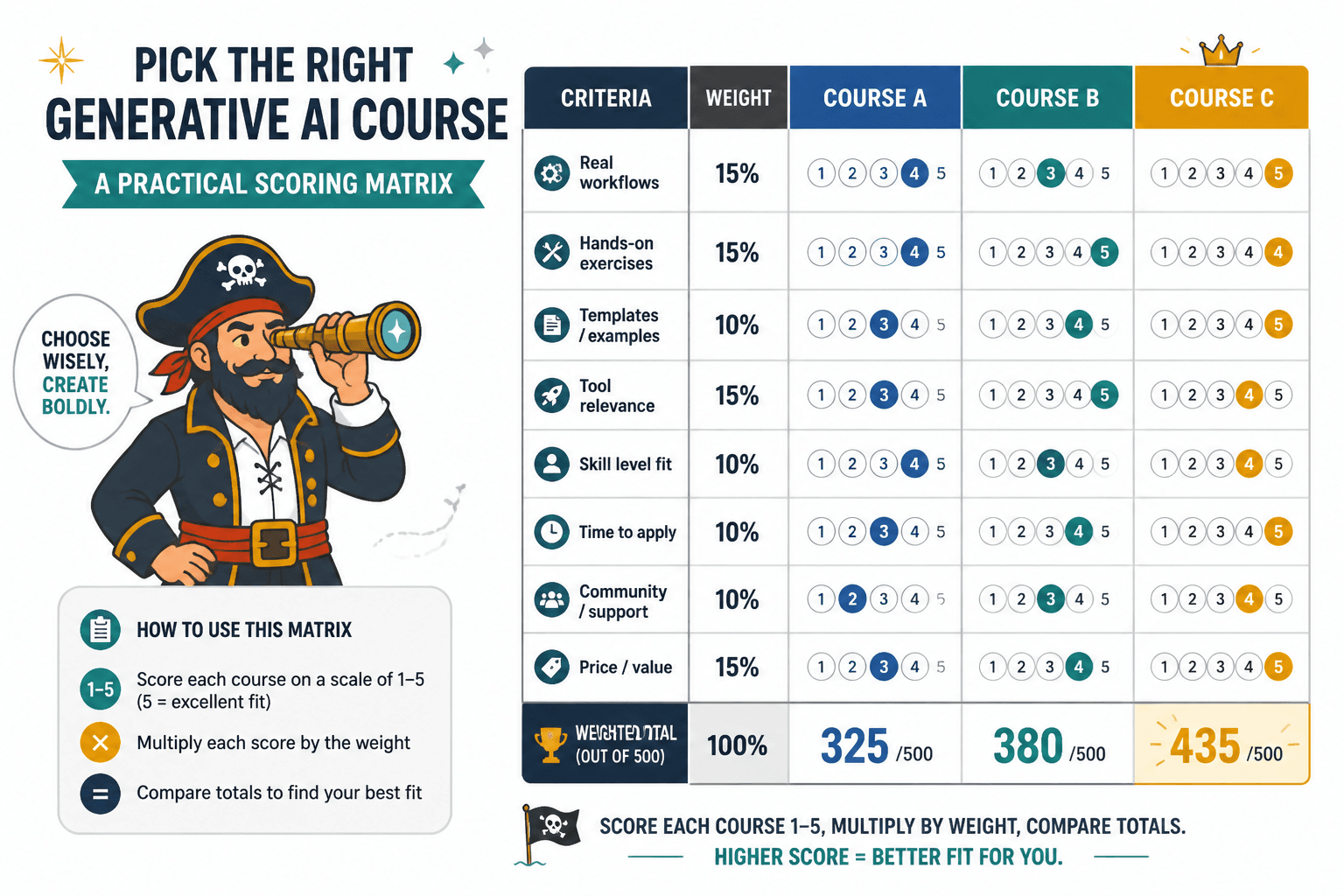
Before buying anything, check the course against a few practical filters.
1. Does it teach workflows, not just prompts?
A single clever prompt is not a workflow. It is a party trick.
Good courses show sequences like:
- idea capture
- research support
- outline generation
- drafting
- editing
- repurposing
- publishing
- review and improvement
That is what turns AI from novelty into leverage.
2. Is it built for your kind of work?
A course for software teams automating documentation is not the same as a course for creators building articles, posts, offers, emails, and audience trust.
Look for examples that resemble your actual output. If every demo is about writing code, generating product specs, or building enterprise dashboards, that course might be fine. It just may not solve your problem.
3. Does it address quality control?
If a course teaches AI as if output is automatically good, walk away.
The useful stuff lives in the editing layer:
- how to fact-check
- how to spot generic language
- how to inject your positioning and voice
- how to avoid hallucinated nonsense
- how to use AI without flattening your originality
4. Does it help you save time on repeat tasks?
Real workflow gains usually come from boring repeatable tasks, not dramatic one-off outputs.
For example:
- turning call transcripts into content drafts
- extracting quote candidates from long interviews
- rewriting content for platform-specific formats
- generating first-pass outlines from voice notes
- turning existing articles into email sequences
- creating reusable prompt templates for common content jobs
That stuff is not sexy. It is, however, how people actually reclaim hours.
5. Does it include examples, templates, or exercises?
You want something you can apply while learning, not just watch passively while nodding like a thoughtful houseplant.
The more hands-on the course, the better your chances of using it after the refund window closes.
The types of generative AI courses that tend to be worth it
Instead of pretending there is one perfect course for everyone, it is more useful to think in categories. Different creators need different things, and that is normal.
Foundational courses for understanding how to use AI well
These are useful if you still need the basics: how prompting works, where models help, where they fail, how to structure instructions, and how to review outputs critically.
The good version of a foundation course gives you durable skills. The bad version spends too much time on broad futurism and not enough on practical application.
Best for:
- creators just getting started with AI
- consultants who want enough competence to use tools safely
- writers who are skeptical and want a sane introduction instead of evangelism
Creator workflow courses
This is usually the sweet spot for most readers here. These courses focus on applying AI to content planning, idea generation, drafting, editing, repurposing, research, offer writing, and audience-building tasks.
Best for:
- writers publishing regularly
- coaches building content around expertise
- consultants trying to turn conversations into assets
- personal brands producing across multiple platforms
- small teams trying to get more output without hiring five more people
Prompt engineering courses with practical business use
These can be useful, but only if they move beyond “here is a prompt formula” and show how to build prompt systems for recurring work.
For creators, the value is not sounding technical. It is learning how to give better inputs so outputs need less rescue work later.
Best for:
- people already using AI weekly
- operators building reusable internal workflows
- creators managing more complex content pipelines
Tool-specific courses
These focus on one platform or tool. They can be great if that tool is central to your workflow. They can also age fast if they are too feature-dependent.
Take them when you have a reason, not because the landing page says the tool will write your content empire for you while you sleep.
Best for:
- teams already committed to a specific AI tool
- power users who want depth
- creators solving a narrow workflow problem
What the best courses usually teach that weak ones skip
The strongest courses tend to include a few things that shallow ones conveniently glide past.
Voice preservation
This is a huge one. Anyone can get AI to produce readable words. The harder part is keeping your work from sounding flattened, vague, and weirdly over-smoothed.
A useful course should show how to train prompts around your style, use source material well, and edit outputs so the final result still sounds like a person with a point of view.
Source material discipline
Good AI use usually starts with good inputs: transcripts, notes, interviews, customer language, original ideas, frameworks, examples, and past content.
Weak courses often imply you can generate great material from nothing. You usually cannot. Not consistently, anyway.
Strong creators use AI to shape and accelerate thinking, not replace having anything worth saying.
Repurposing systems
One of the best practical uses of AI is turning one strong idea into multiple assets without manually rebuilding everything from scratch.
A strong course might teach you how to turn:
- a podcast transcript into a long-form article
- an article into LinkedIn posts
- a webinar into email content
- a client call into a thought-leadership outline
- a case study into sales content and short posts
This is where workflow education beats theory every time.
Editing standards
A serious course should teach what to cut, what to rewrite, and what to never publish as-is.
If it does not warn you about generic intros, padded transitions, fake confidence, invented examples, and stale phrasing, the course probably is not preparing you for real-world use. It is just helping you produce more mediocrity faster, which the internet did not exactly need.
Red flags when choosing a generative AI course
- Too much future-of-AI talk, not enough doing. Interesting dinner conversation. Weak workflow training.
- No examples from real creator work. If every use case feels abstract, you will struggle to translate it.
- Heavy hype around passive income or effortless content. Usually nonsense wearing a dashboard screenshot.
- No mention of editing, verification, or brand voice. That is a problem, not a small omission.
- The course is really just a prompt pack with better branding. Prompts help. They are not a curriculum.
- No updates or versioning plan. AI tools change. Good educators know that.
- Claims that AI can replace strategy. It cannot. It can speed up execution. Different thing.
How to pick the right course for your actual workflow
Start with your bottleneck, not the course sales page.
Ask yourself where your content process is slow, messy, repetitive, or inconsistent.
For example:
- If you struggle to come up with article angles, look for training on ideation, research framing, and outlining.
- If drafting is slow, focus on courses that teach structured prompting and revision workflows.
- If your brand voice keeps disappearing, prioritize courses that include editing, examples, and voice control.
- If repurposing content is the bottleneck, look for systems that turn one source into multiple usable outputs.
The right course should make your real workflow feel lighter, not just make you temporarily excited about AI. That is usually the difference between a useful course and a glossy distraction.