
Most About pages have one job they quietly fail at: they explain who you are, then just sort of… stop.
You get a decent intro, a few credibility points, maybe a nice founder story, and then the page ends like it assumes the reader will figure out the next step through telepathy. They usually will not.
The best funnel ideas to pair with About page copy are the ones that fit the reader’s intent when they land there. Not every About page visitor is ready to buy. Some want proof. Some want a low-pressure next step. Some are checking whether you seem competent, normal, and relevant to their problem. Fair enough.
So the goal is not to turn your About page into a sweaty sales page in disguise. It is to give interested readers a clean path forward while trust is warm. Here’s how to do that without wrecking the tone of the page or stuffing it with awkward CTAs that sound like they escaped from a funnel template pack.
If you want the bigger picture, start with the parent guide.
Why your About page needs a funnel at all
An About page sits in a weirdly important spot.
People often land there after seeing your homepage, a social profile, a podcast mention, a blog post, or a referral. They are not cold in the same way a random ad click is cold. But they are not sold either. They are evaluating.
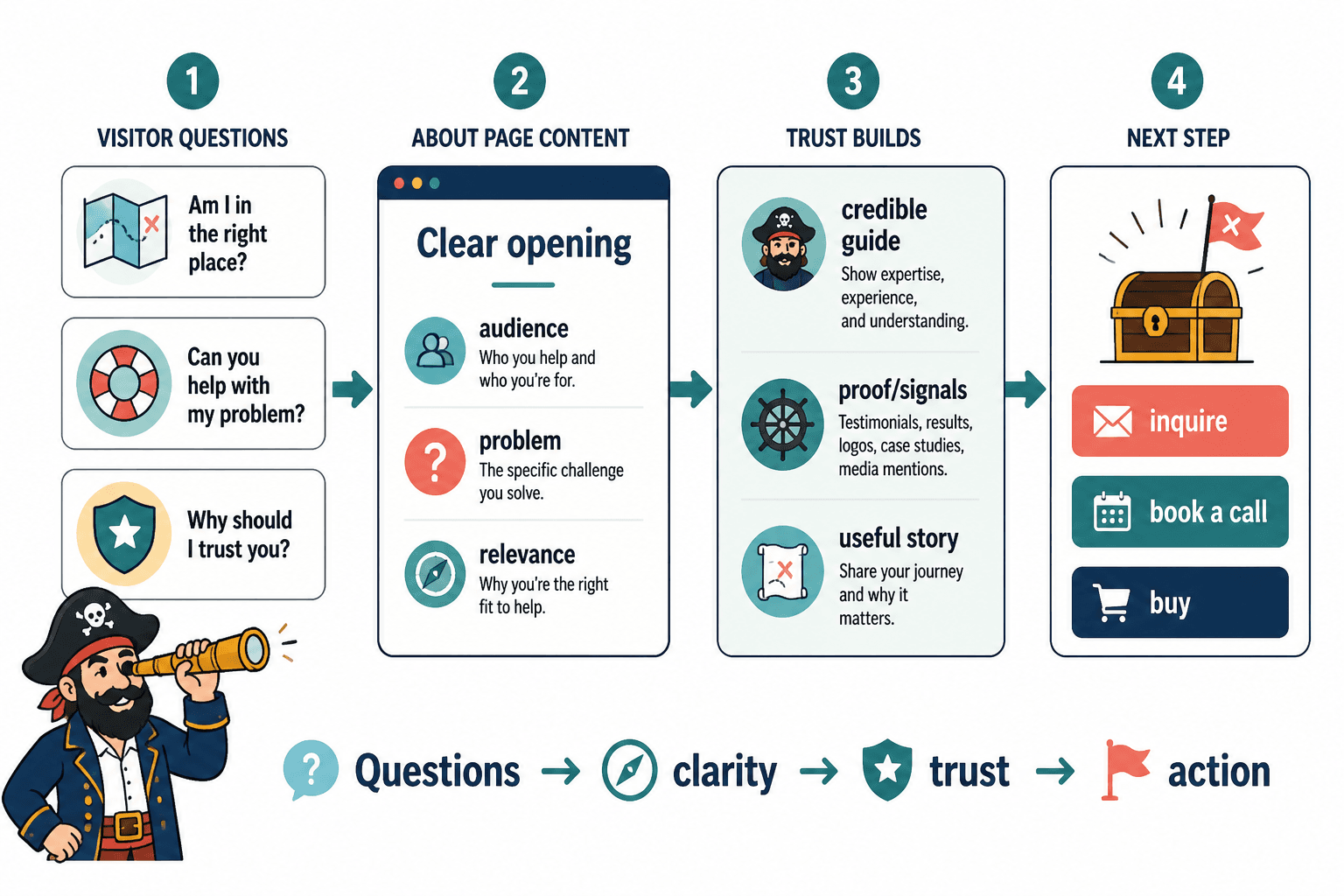
That makes the About page a bridge page. It helps people answer a few silent questions:
- Who is this for?
- Can this person actually help me?
- Do I like how they think?
- What should I do next if I am interested?
If your page answers the first three but fumbles the fourth, you’re leaving attention on the table. And attention does not age well.
If you want the copy foundation right first, this guide on About page copy is the obvious place to start. You can also browse the broader website conversion copy and core copy resources if your whole site needs a little less “nice words, no movement.”
What makes a good funnel fit an About page
The best funnel ideas to pair with About page copy have three things in common:
- Low friction: the next step feels easy enough to take right now.
- High relevance: it matches what the reader likely wants after reading about you.
- Trust continuity: it feels like a natural extension of the page, not a hard tonal swerve into “book your transformation call.”
That last point matters more than people think. If your About page sounds thoughtful and grounded, then the CTA should not suddenly start barking urgency and hype. That kind of mismatch makes people hesitate, and hesitation kills conversions more quietly than bad design does.
Before picking a funnel, get clear on the actual role of your About page in your business. Is it there to warm up service leads? Build authority? Send people to your newsletter? Filter out poor-fit inquiries? The page can do more than one thing, but it should still have a primary job.
Best funnel ideas to pair with About page copy
Here are the funnel types that usually work best, along with when to use them and what to avoid.
1. About page → lead magnet → nurture sequence
This is one of the safest and strongest options if your readers are interested but not ready to book or buy.
A good lead magnet from an About page should feel like the logical next layer of your expertise. Not random. Not broad. Not “download my free guide” with no real clue what that means.
Good fits include:
- A short strategy guide
- A checklist related to your service
- A mini email course
- A resource library
- A template pack
- A diagnostic quiz, if it is actually useful and not gimmicky
Best for: coaches, consultants, service providers, educators, and personal brands with longer buying cycles.
Why it works: the About page builds trust; the resource captures interest; the email sequence keeps the relationship moving without demanding too much too soon.
Strong About page funnel logic: “You’ve read who I help and how I think. Want the practical version? Here’s a useful next step.”
Do not do this badly: If your lead magnet is generic, old, or obviously just bait for a clumsy sales sequence, people will feel it. They may still sign up. They will not trust you more.
2. About page → newsletter signup
If your business grows through ideas, consistency, and long-term trust, a newsletter is often the cleanest next step.
This works especially well when your About page sells your perspective as much as your services. Readers who like how you think may not need a PDF. They may just want more of your thinking in a format they can keep up with.
Best for: writers, creators, consultants, solo founders, educators, and anyone building audience plus offers over time.
Make it stronger by:
- Saying what the newsletter is actually about
- Explaining who it is for
- Setting a rough frequency
- Giving readers a reason to care beyond “updates”
Weak: “Join my newsletter for updates and insights.”
Better: “I send one useful email a week on sharper content, clearer positioning, and better website copy for solo businesses that want leads without sounding like a beige funnel robot.”
Yes, that is more specific. That is why it works.
3. About page → services page → inquiry form
This is the obvious funnel, and it is obvious for a reason. It works when your About page does a good job of making readers want to understand how you help in more practical terms.
But there is a catch. If your About page links straight to a vague services page and then to a painful inquiry form full of unnecessary questions, you have not built a funnel. You have built a hallway with bad lighting.
Best for: service businesses with clear offers and readers who may already be solution-aware.
This funnel works best when:
- Your About page includes relevant credibility
- Your services page makes outcomes and fit clear
- Your inquiry form filters without acting like a tax audit
- Your CTA feels direct but calm
If you need to soften the transition from trust to action, these ideas on better About page soft CTAs for personal brands will help.
4. About page → case studies or proof page → consultation
Some readers like your story but still need receipts.
If your offers are high trust, high consideration, or expensive enough to trigger caution, send people from your About page to proof before asking for the call. This is especially useful when your About page is personality-led and your sales process still needs a stronger layer of evidence.
Best for: consultants, strategists, copywriters, designers, coaches, agency owners, and B2B service providers.
Useful proof assets include:
- Case studies
- Before-and-after examples
- Client testimonials with context
- Project snapshots
- Results pages
- “How I work” process pages
This funnel is underrated because it respects skepticism. Which is nice. Your reader is not annoying for wanting evidence.
5. About page → low-ticket product or workshop
If not everyone who reads your About page is a good fit for your main offer, a lower-commitment product can catch the right kind of interest without forcing a sales call.
This could be a workshop, template bundle, audit, short course, or paid resource that helps the reader make progress on their own.
Best for: creators and service providers with mixed audience readiness levels.
Why it works: it monetizes warm traffic, gives cautious buyers a simpler entry point, and can qualify people for higher-ticket work later.
Just make sure the offer matches the promise of the About page. If your page positions you as a sharp strategic expert, then the low-ticket offer should still feel thoughtful and useful. Not like a garage sale of old templates.
6. About page → booking page
This is the most direct route, and for some businesses it is exactly right.
If your About page gets mostly warm visitors from referrals, speaking, networking, podcasts, or social content, they may not need much more than confidence plus an easy scheduling path.
Best for: referral-heavy consultants, fractional leaders, specialists, and established personal brands.
Works best when:
- Your positioning is very clear
- Your About page quickly establishes authority and fit
- Your booking page explains what the call is for
- You remove friction around scheduling
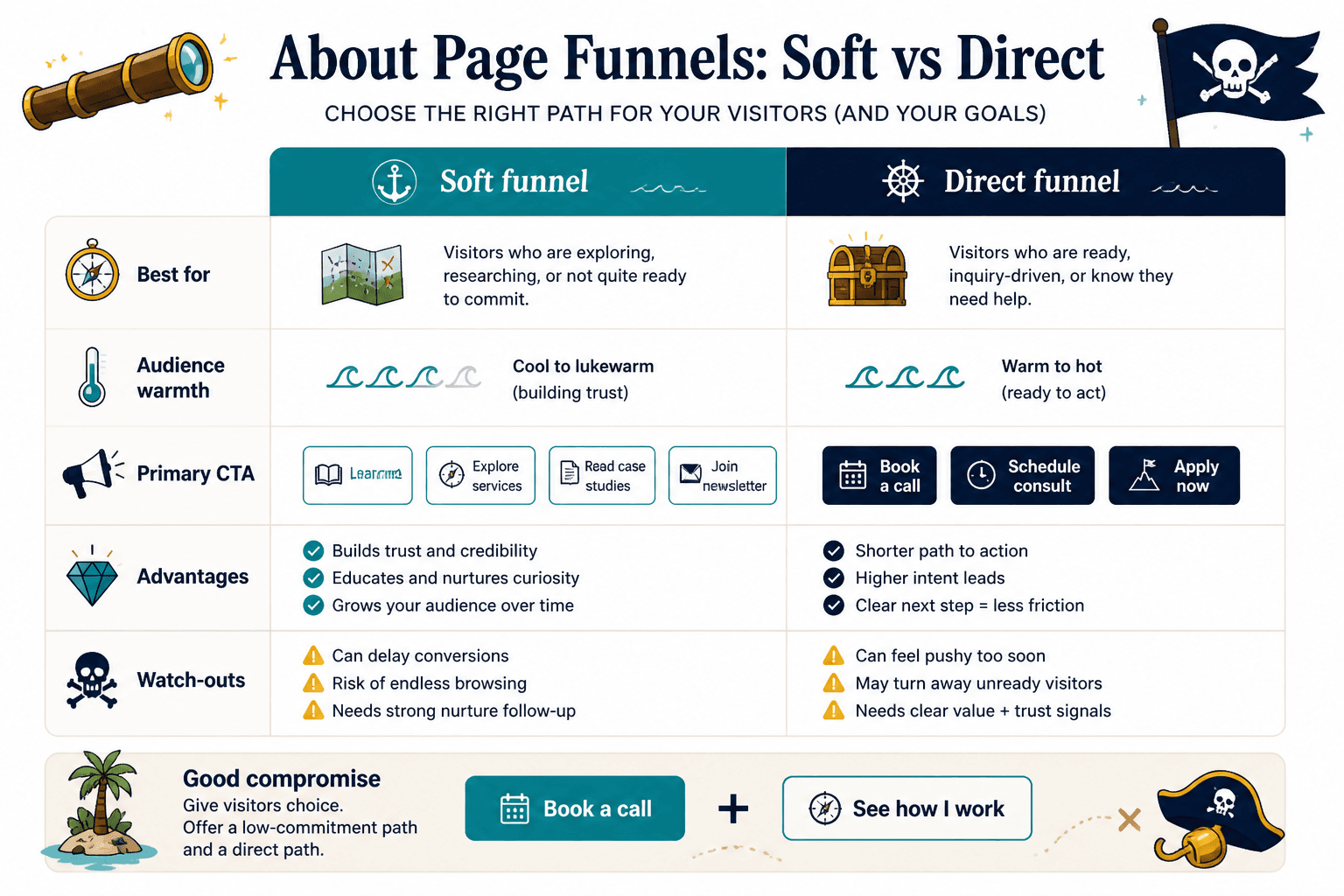
If the call CTA feels too abrupt, offer both options: book a call or explore how you work. Giving readers two sensible paths often converts better than forcing one.
7. About page → content hub → offer
This one is great if your audience needs more education before they buy, or if your expertise is nuanced enough that one About page cannot do all the heavy lifting.
Send readers to a content hub, article library, resource center, or pillar page that helps them go deeper. From there, route them toward your newsletter, services, or a lead magnet.
Best for: complex services, idea-led brands, SEO-driven businesses, and people whose work benefits from demonstration.
This is also where internal linking helps. For example, readers interested in refining the page itself could move from your About page into best About page copy ideas and examples for creators or learn how to use AI tools for About page copy without making the page sound like chrome-plated mush.
How to choose the right funnel for your About page
Do not choose based on what sounds most sophisticated. Choose based on reader intent and business model.
| If your reader is likely thinking… | Use this next step |
|---|---|
| “Interesting. I want to keep learning from this person.” | Newsletter signup |
| “I like this, but I am not ready to talk yet.” | Lead magnet + email nurture |
| “Can they actually do the thing?” | Case studies or proof page |
| “I may want help soon.” | Services page |
| “I am pretty much ready.” | Booking page or inquiry form |
| “I want a smaller first step.” | Low-ticket offer or workshop |
You can absolutely have more than one CTA on the page. You just should not make all of them scream at once.
A strong setup often looks like this:
- Primary CTA: the main next step you want most readers to take
- Secondary CTA: a softer option for people who are interested but not ready
- Contextual CTA: a relevant link placed after a proof point, story section, or credibility block
That gives readers choice without turning the page into a menu of competing exits.
Where to place funnel elements on the page
A lot of people stick one CTA at the bottom and call it strategy. It is not. It is hope with formatting.
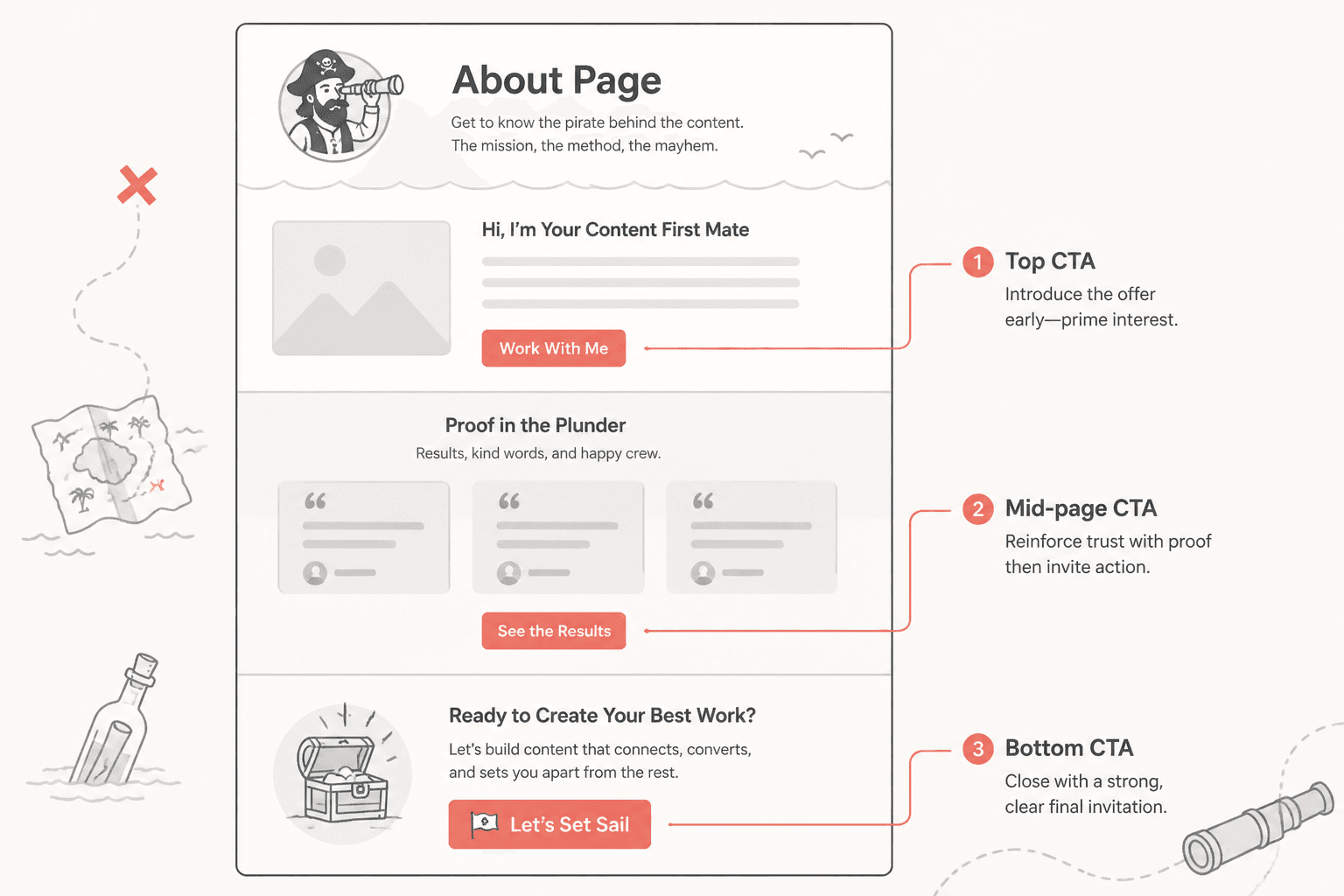
Better placement usually includes three moments:
At the top, after the positioning
If someone lands on your About page already fairly warm, give them a clear next step early. A simple text CTA or short signup block works well here.
Mid-page, after proof or credibility
This is where readers often become more ready. They now understand who you help and why you are credible. Perfect time for a soft CTA, a proof page link, or a service-related next step.
At the end, with a stronger invitation
Your final CTA can be more direct because the page has done its work. Just keep the wording clean and useful.
For a deeper look at how to turn the page into something that actually moves readers forward, see how to turn About page copy into more leads or sales.
CTA examples that fit an About page better
Your About page CTA does not need to sound like a webinar funnel from 2018. It should sound like the next sensible move.
Here are a few better options:
- Want the practical version? Get the checklist here.
- If you want sharper content without sounding overcooked, join the newsletter.
- Curious how this works in practice? See recent client results.
- If you think we might be a fit, you can book a call here.
- Not ready for that? Start with the free guide.
- Read more about how I help before you decide.
Notice the pattern. Clear. Calm. Specific. No strained urgency. No fake intimacy. No “apply now to unlock.”
Mistakes people make when pairing funnels with About page copy
- They ask for too much too soon. If the page is your first trust layer, pushing straight to a hard sale can feel abrupt.
- They use a generic CTA. “Get in touch” is not always wrong, but it is often lazy.
- They mismatch the offer and page tone. A thoughtful About page followed by a loud funnel feels off.
- They offer no softer path. Not everyone is ready to book, buy, or inquire.
- They bury the CTA once at the bottom. Readers do not all make it there.
- They confuse biography with conversion. Your story matters only if it helps the reader understand relevance, trust, or fit.
This is where strategy beats decoration. A prettier About page with no meaningful path forward is still a dead end. Just a more attractive one.
A simple framework for matching your About page to the right funnel
If you want a fast way to decide, use this:
About pages work better when they build trust with clarity instead of biography theater. A stronger through-line usually matters more than extra detail.