
Most About pages have one of two problems.
They either read like a hostage note written by a corporate bio generator, or they try so hard to sell that the whole thing starts giving “I learned persuasion from a funnel bro in 2019” energy.
That is why monetizing About page copy gets weird for a lot of people. They know the page should help generate leads or sales. They also know that if they turn it into a chest-thumping sales pitch, trust drops through the floor.
The good news: you do not need to choose between a warm, credible About page and one that helps your business make money. You can absolutely do both. You just need to understand what the page is supposed to do.
How to monetize About page copy without wrecking trust comes down to one simple shift: stop treating the About page like a place to impress people, and start treating it like a place to help the right reader move one step closer.
This article will show you how to do that with better structure, smarter offers, softer calls to action, and copy that sells without sounding needy, fake, or weirdly obsessed with your own origin story.
Want the broader roadmap? Start with the parent guide.
What your About page is actually for
Your About page is not just a biography page.
It is a trust page. A positioning page. A conversion page. Sometimes all three at once.
People usually land on it after they have already seen something else first: a post, a homepage, a podcast mention, a referral, a search result, an email, a lead magnet, a social profile. They are not showing up to admire your life timeline. They are trying to answer a few very practical questions:
- Who are you really for?
- Do you understand my problem?
- Can I trust you?
- What exactly do you help with?
- What should I do next?
If your About page answers those clearly, it can generate leads and sales without needing to swing a giant flashing BUY NOW sign at people.
If it does not answer those clearly, no amount of polished storytelling will save it.
If you want the broader foundation first, this About page copy guide is a useful place to start. And if your current version already sounds stiff, this piece on how to write About page copy without sounding salesy or robotic will help before you try to monetize anything.
Why most monetized About pages feel gross
Because they skip trust and lunge straight at conversion.
That usually looks like one of these:
- A long personal story with a hard pitch bolted on at the end
- Constant “work with me” prompts every few paragraphs
- Big claims with no proof
- Vague transformation language instead of concrete outcomes
- A bio that is secretly a landing page in disguise
- Overwritten empathy meant to sound caring but obviously engineered to sell
None of that is inherently evil. It is just badly timed.
Trust breaks when the copy asks for more commitment than the reader is ready to give. If somebody just clicked your About page to figure out if you seem credible, and your first move is to hit them with a premium offer before you have explained who you help, you are not being strategic. You are being impatient.
The fastest way to make an About page less trustworthy is to make every paragraph feel like it is trying to close.
How to monetize About page copy without wrecking trust
The trick is not hiding the fact that you sell something. The trick is making the path from trust to action feel natural.
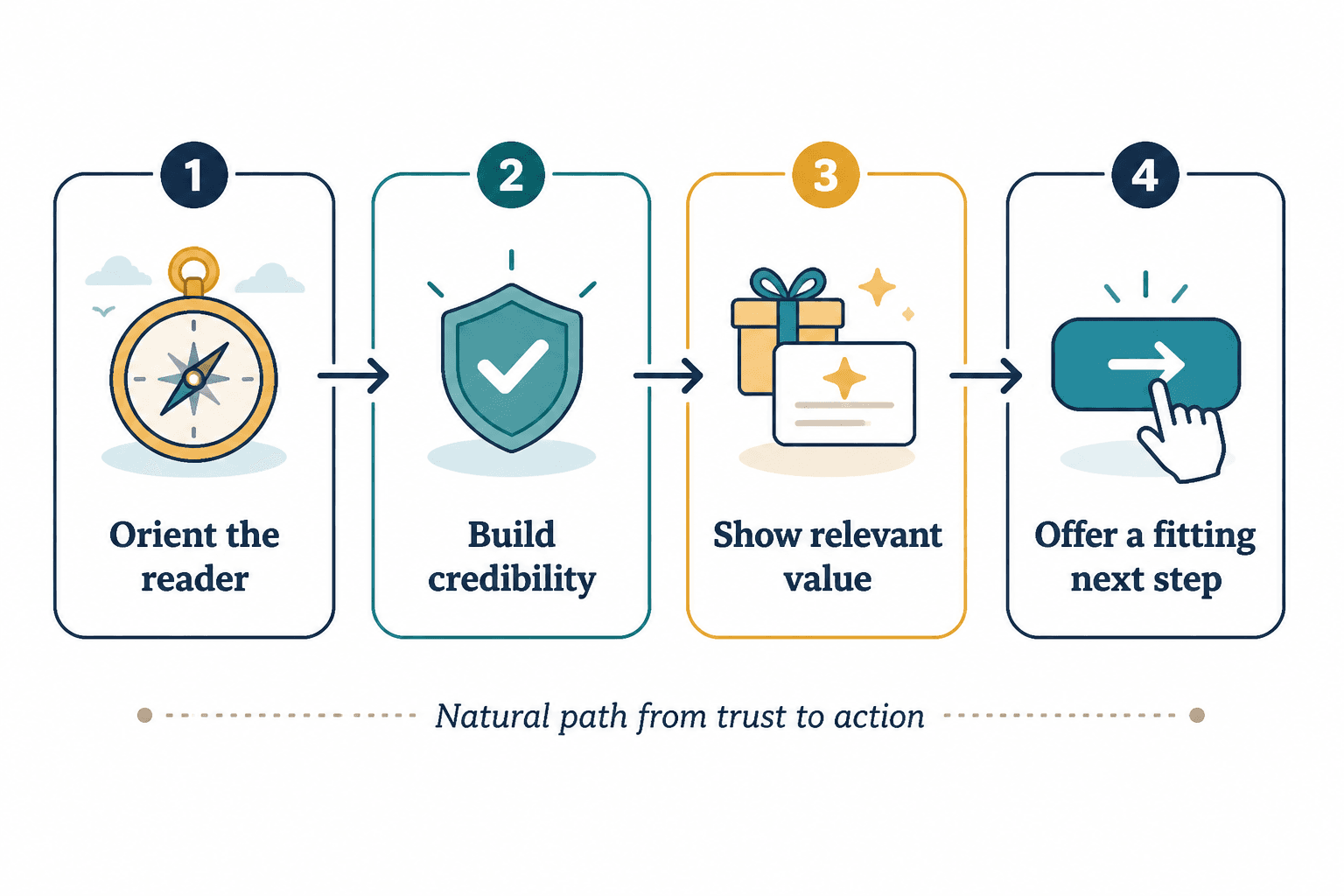
That means your page should do four jobs in order:
- Orient the reader
- Build credibility
- Show relevant value
- Offer a next step that fits their level of readiness
Get that sequence right, and monetization feels like a service. Get it wrong, and it feels like ambush copy.
1. Open with reader relevance, not your autobiography
A weak About page opening usually starts with some version of “Hi, I’m Sam, and I’ve always been passionate about helping people…”
That is not evil. It is just soft, familiar, and easy to ignore.
A better opening makes it immediately obvious who the page is for and what kind of problem you help solve. The reader should feel oriented within seconds.
For example:
- Weak: “Hi, I’m Dana, a business coach, writer, and entrepreneur passionate about helping others grow.”
- Better: “I help service-based founders turn vague positioning into clear offers, sharper messaging, and sales conversations that do not feel like performance art.”
That second version does more selling with less effort because it is useful immediately. It tells the reader what lane you are in. It also quietly filters out the wrong people, which is part of monetization too.
If your first paragraph is still dragging its feet, read how to start About page copy without a weak opening. A stronger start does a surprising amount of the sales work without looking salesy at all.
2. Make your story earn its place
Yes, your story can help sell.
No, people do not need every chapter.
The point of your story on an About page is not to provide a full emotional documentary. It is to increase trust and make your perspective make sense. Your background should explain why you work the way you do, what you understand deeply, or why your approach differs from the generic advice floating around your niche.
Good story sections usually do one or more of these:
- Show lived experience with the problem
- Explain your method or philosophy
- Reveal relevant expertise or hard-won lessons
- Make your positioning more believable
Bad story sections usually do this:
- Center your emotional journey without connecting it to the reader
- Wander through irrelevant career history
- Sound inspiring but say nothing specific
- Use trauma as a sales bridge
You do not need to bleed on the page to convert. In many cases, you just need to be clear about what shaped your approach and why that matters now.
3. Sell the method, not just the vibe
A lot of About pages try to monetize through personal brand glow alone. The copy leans on tone, relatability, charisma, and broad promises, but never clearly explains how the person helps.
That is a trust leak.
If you want readers to buy, book, subscribe, or inquire, they need a concrete sense of what happens when they work with you or enter your world. You do not need a giant process breakdown. You do need enough specificity that the offer stops feeling abstract.
For example:
- Vague: “I help experts amplify their authentic voice and grow with aligned content.”
- Stronger: “I help consultants and solo founders clarify their message, turn that into platform-specific content, and connect that content to offers that actually lead somewhere.”
One sounds polished. One sounds buyable.
Monetization gets easier when the reader can picture the value. Not just the personality. Not just the mission. The actual value.
4. Use proof where people are naturally looking for it
Your About page is one of the most natural places to include credibility signals because readers are already in evaluation mode.
That means proof does not feel forced here. It feels responsible.
Useful proof can include:
- Client results
- Relevant experience
- Selected credentials
- Notable projects
- Audience or readership size, if genuinely meaningful
- Media mentions, if relevant
- Testimonials
- Specific outcomes from your work
The key word is relevant. Nobody needs a random trophy shelf dumped into the middle of the page.
Instead of saying “trusted by many brands,” say what that trust looked like. Instead of saying “helped hundreds of clients,” explain what kind of clients and what changed. A small, specific proof point beats a giant vague one every time.
Example: “My content and messaging work has helped coaches, consultants, and personal brands tighten their positioning, improve inquiry quality, and turn profile traffic into actual conversations instead of polite lurking.”
That is still broad, but it gives shape. Shape matters.
5. Match the CTA to reader intent
This is where a lot of trust gets wrecked.
Not because people include a CTA, but because they include the wrong one.
Your About page often attracts warm readers, not always ready-to-buy readers. Some want to browse. Some want to validate. Some are one inch away from booking. Some need another step first.
If the only CTA on the page is “Book a call,” you are forcing every reader into the most committed option. That creates friction. And friction kills monetization much faster than subtlety does.
A smarter About page usually includes a primary next step and one or two softer alternatives.
Good CTA options include:
- Book a consultation
- Apply to work together
- Read about your services
- Join your newsletter
- Download a relevant free resource
- Reply to an email list prompt
- Browse case studies
For personal brands especially, softer CTAs often outperform pushier ones because they let trust keep building. If you want better options, read better About page copy soft CTAs for personal brands.
A simple About page structure that sells without pushing too hard
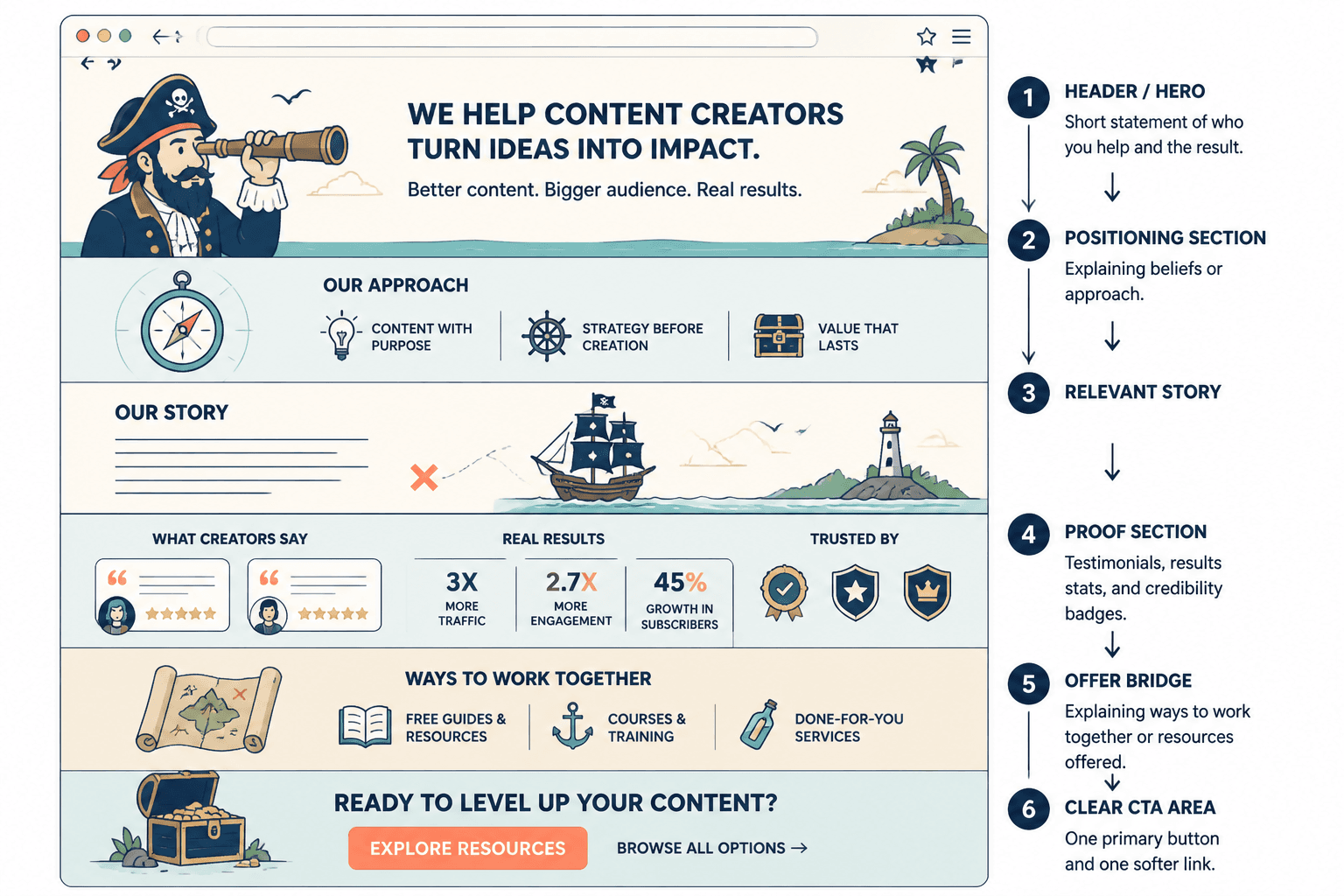
If your page currently feels fuzzy, overpersonal, or awkwardly promotional, use this structure.
- Opening: Who you help and what kind of result or problem area you work on
- Short positioning section: What you believe, how you work, or what makes your approach different
- Relevant story: Only the parts that build trust or explain your perspective
- Proof: Results, testimonials, experience, selected credibility markers
- Offer bridge: A plain-English explanation of how people can work with you or what resources you offer
- CTA: One clear primary action, optionally supported by a softer secondary one
That is enough for most service providers, creators, coaches, consultants, and solo operators. You do not need an About page that reads like a memoir crossed with a sales page crossed with a Pinterest quote board.
What to monetize on the About page
Not every About page needs to sell the same thing.
What you monetize should match your business model and the reader’s likely temperature.
For coaches and consultants
Your About page can naturally guide readers toward:
- Discovery calls
- Applications
- Service pages
- Case studies
- Lead magnets that qualify interest
Best move: explain your approach clearly, include proof, and offer a next step that feels proportional.
For creators and personal brands
Your About page can point readers toward:
- Email subscriptions
- Paid products
- Sponsorship inquiry pages
- Community memberships
- Featured content that deepens trust
Best move: focus on resonance and credibility first, then make your ecosystem easy to enter.
For freelancers and service providers
Your About page can support:
- Project inquiries
- Portfolio views
- Service packages
- Retainer applications
- Referral confidence
Best move: keep the page concrete. Clients usually do not need spiritual language. They need to know what you are good at and whether you seem safe to hire.
Before and after: selling without sounding like you are circling the reader
Example 1: The hard pitch problem
Before: “I know what it feels like to be stuck, overwhelmed, and desperate for change. That’s why I created my transformational coaching framework to help ambitious women step into their highest selves. If you’re ready to finally break through your limitations, book a call now.”
After: “I work with women building service businesses who are tired of vague offers, inconsistent messaging, and content that sounds better than it converts. My coaching focuses on sharper positioning, cleaner sales messaging, and practical growth systems. If that sounds like the kind of support you need, you can book a call or start with my free guide.”
The second one sells more cleanly because it uses specifics, reduces emotional theatre, and gives the reader a choice.
Example 2: The bio-only problem
Before: “I’m a writer, strategist, mom, coffee lover, and founder with a passion for helping brands tell better stories.”
After: “I help founder-led brands turn fuzzy messaging into clearer positioning, stronger website copy, and content people actually remember. My background in strategy and editorial work shapes a process that is part clarity, part conversion, and not especially interested in fluff.”
The first one is pleasant. The second one is useful.
Example 3: The too-soon CTA
Before: “Ready to work with me? Apply now for my premium experience.”
After: “If you want help tightening your message and turning your website into a better sales tool, you can explore my services here. If you are still getting a feel for how I think, start with these resources.”
One demands. One guides.
Common mistakes that quietly kill trust
Some About pages do not look aggressive at all. They still fail because the trust damage is subtle.
- Talking too much about yourself without translating why it matters. Readers are not cruel. They are busy.
- Using vague promise language. “Empower,” “elevate,” “unlock,” “transform” and friends are doing a lot of work and very little explaining.
- Stacking too many identities. If you are a coach, speaker, consultant, mentor, visionary, creator, facilitator, and thought leader, the page gets blurry fast.
- Forcing intimacy. Personal does not have to mean overexposed.
- Hiding the offer completely. Some people overcorrect and make the page so gentle that it never monetizes at all.
- Making the CTA feel detached from the rest of the page. If the offer appears out of nowhere, it feels bolted on.
Trust is usually lost through mismatch. Tone mismatch. proof mismatch. pacing mismatch. ask mismatch.
Fix the mismatch, and the page starts feeling more human and more profitable at the same time.
How to make the monetization feel natural
Here is the practical standard: by the time your reader reaches a CTA, it should feel like the obvious next step for the right person, not a plot twist.
You get there by creating continuity between these three things:
- What the reader wants
- What your page proves
- What your offer helps them do next
That continuity is why the best About pages monetize quietly. They do not rely on pressure. They rely on coherence.
If your page says you help founders simplify their messaging, your proof should show evidence that you have done that, and your CTA should lead to a service, offer, or resource related to messaging. Not a random workshop on confidence. Not a newsletter about mindset. Not a vague “join my world” button and a prayer.
Monetization works better when the page feels like one argument, not five tabs accidentally stitched together.
A quick self-audit for your current About page
If you already have an About page, run through this checklist:
- Can a new reader tell within seconds who the page is for?
- Is the opening useful, or just polite?
- Does the story section support trust, or just take up space?
- Do you explain what you actually help with in plain English?
- Is there proof that feels specific and relevant?
- Does the CTA match likely reader readiness?
- Is there a soft next step for people not ready to buy?
- Does the page sound like a human, or like a polished speaking proposal escaped onto your website?
If you answered “not really” to more than two of those, the page probably is not monetizing as well as it could.
About pages work better when they build trust with clarity instead of biography theater. A stronger through-line usually matters more than extra detail.