
Longer is not automatically smarter.
A lot of blog titles get stretched out because someone is trying to cram in every keyword, every nuance, and every possible click trigger at once. The result is usually a headline with the charm of a tax form. Technically descriptive, maybe. Compelling? Not so much.
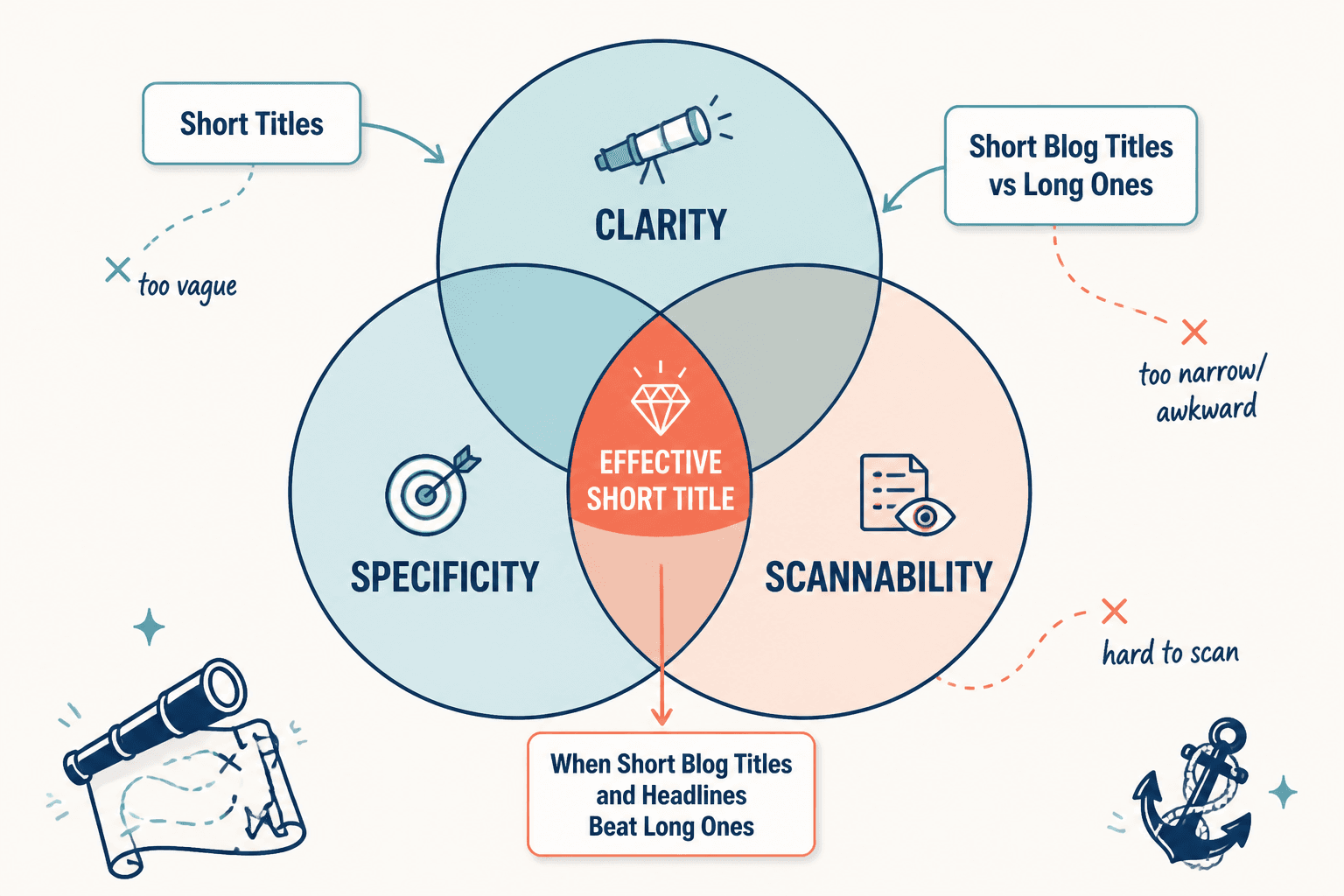
When Short Blog Titles and Headlines Beat Long Ones comes down to one simple thing: short titles work better when clarity, speed, and punch matter more than completeness. They are often easier to scan, easier to remember, and harder to mess up. That does not mean shorter always wins. It means there are specific situations where short is the better strategic choice, not the lazy one.
If you write blog posts, newsletters, landing pages, or social previews, this matters more than people admit. Your title does not live in a vacuum. It shows up in search results, browser tabs, mobile screens, Slack links, social shares, email subject lines, and recommendation blocks. In a lot of those places, long titles get clipped, diluted, or ignored.
So let’s get practical. Here’s when shorter blog titles and headlines genuinely outperform longer ones, when they do not, and how to tell the difference before you publish something bloated and weird.
For the main guide behind this topic, visit the parent guide.
Why short headlines can outperform long ones
Short headlines have one unfair advantage: they force you to know what your point actually is.
A long headline can hide weak thinking. You can pad it with context, soften it with qualifiers, and sneak in three related ideas that should have been one. A short headline does not give you that luxury. It either lands or it does not.
That is why short titles often feel stronger. Not because brevity is magical, but because compression usually produces cleaner positioning.
- They scan faster. Readers make snap decisions. Shorter titles reduce friction.
- They are easier to remember. This matters more than many SEO conversations would have you believe.
- They often hit harder emotionally. A tight phrase can carry more punch than a sprawling sentence.
- They look cleaner on mobile. This is not a small detail. A lot of blog discovery happens on smaller screens.
- They travel better across channels. Social posts, link previews, newsletter placements, and shared tabs all reward cleaner wording.
Short does not mean vague, though. If your title is short because it stripped away the useful part, congratulations, you made it sleek and useless.
When short blog titles and headlines beat long ones
There are clear cases where short titles have the edge. Not theoretically. Practically.
1. When the core idea is already strong
If the topic has natural tension, curiosity, or usefulness built in, you usually do not need much packaging.
- Good short title: Why Most Content Calendars Fail
- Longer, weaker version: Why Most Content Calendars Fail to Deliver Consistent Results for Modern Content Teams
The short version is sharper because the idea itself already carries weight. The longer one adds explanation, but not really more interest.
This is common with contrarian claims, strong warnings, myth-busting topics, and direct problem-solution posts. If the angle is good, stop decorating it.
2. When the audience already understands the context
You do not need to explain every term when you are writing for people who already live in the category.
If your audience is made up of marketers, writers, founders, or creators, they probably do not need a title that slowly walks them toward the point like a nervous tour guide. Familiar audiences can handle compression.
- Short: Better CTAs for Low-Traffic Pages
- Long: How to Write Better Calls to Action for Website Pages That Do Not Get Much Traffic
The second title is not terrible. It is just doing too much. If the audience knows what a CTA is, the shorter version respects their time and reads like it has a spine.
3. When discoverability depends on scannability
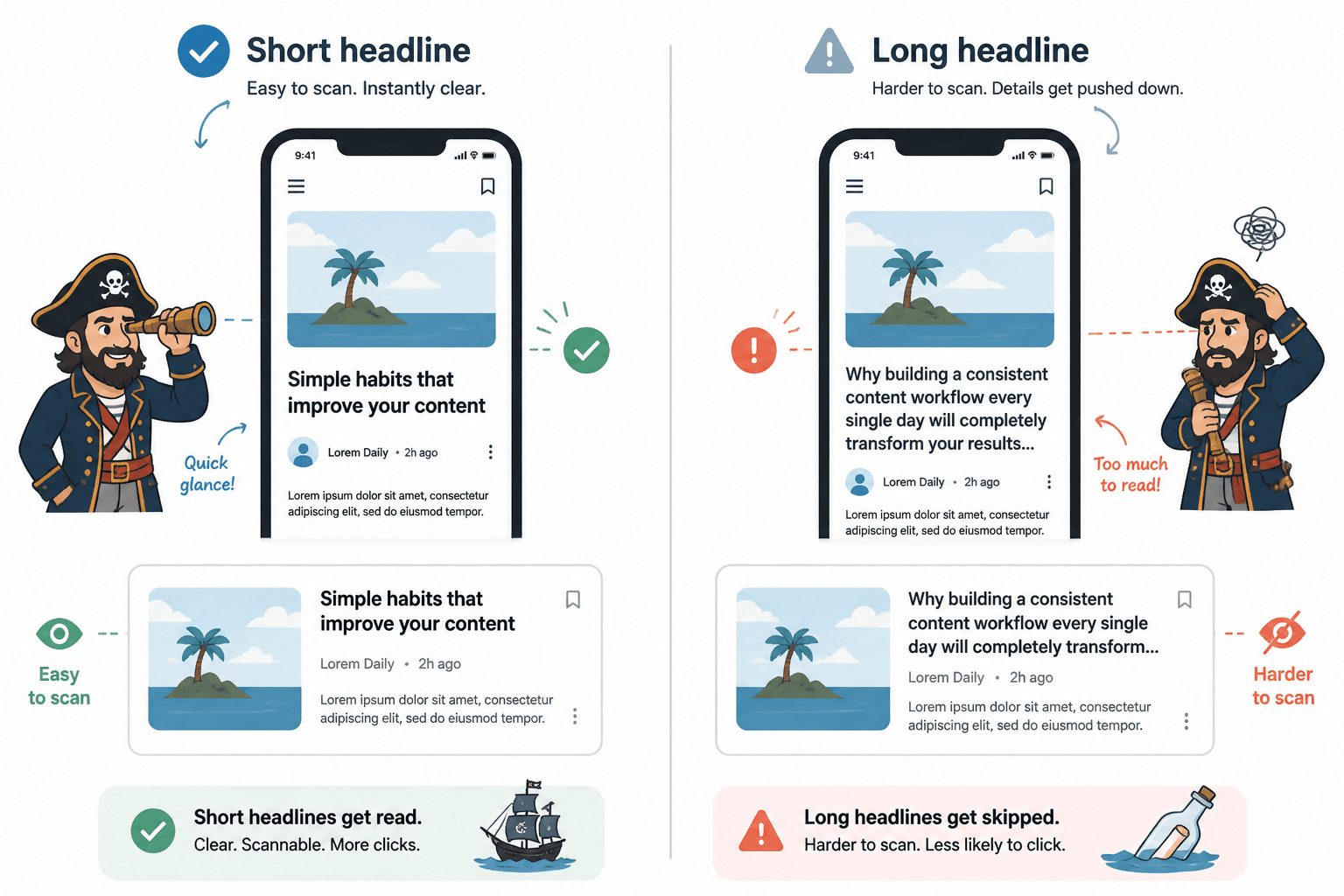
A headline is not only judged in search results. It is judged in crowded environments where people are skimming fast and deciding what deserves a click.
Think homepage grids, related article widgets, social link cards, mobile feeds, and email roundups. In these contexts, a short headline often performs better because the reader can process it instantly.
Longer headlines ask for more attention upfront. That can be worth it if the added detail improves relevance. But if the extra words mostly explain what the first few words already implied, they are dead weight.
4. When the title needs to sound confident
Short headlines often feel more authoritative because they get to the point without apologizing for it.
- Short: Stop Writing Titles Like This
- Long: Some Common Reasons You May Want to Reconsider Writing Blog Titles in This Particular Style
That second title sounds like it is waiting for permission. The first one sounds like someone has an actual opinion. Readers notice that difference.
Now, confident does not mean vague and dramatic. “This Changes Everything” is short, and also nonsense. But when you know the point, shorter titles can carry conviction better.
5. When the real value is in the article, not the title explanation
Some writers try to make the headline do all the work. They cram in the premise, scope, use case, audience, and emotional payoff because they are afraid the title alone is not enough. Fair concern. Bad solution.
A title’s job is to earn the next step, not perform the entire article in miniature. If the body can quickly clarify the details, the title can stay lean.
- Short: The Problem With “Value-First” Content
- Overstuffed: The Problem With “Value-First” Content and Why It Often Fails to Build Trust, Authority, and Qualified Leads
The second version explains more, sure. It also sounds like it was assembled by committee. The first one creates enough tension to do its job.
6. When memorability matters
Some headlines work because they stick. They are easy to repeat, easy to quote, and easy to remember later. That is much harder with a title that meanders through 14 words before arriving anywhere useful.
If you want a title that can become a recognizable phrase, short usually helps. This is especially useful for opinion pieces, brand-defining ideas, recurring article series, and pillar topics you may reference repeatedly.
- Content Without Stakes
- The Expertise Trap
- Posts That Sound Expensive
- Clarity Before Volume
These are not automatically good just because they are short. But they are easier to build recall around than something sprawling and overqualified.
When longer headlines are still the smarter move
This is where people get annoying about brevity. They hear “short titles can win” and suddenly every headline becomes two to five words and says almost nothing.
Short titles beat long ones in specific cases. They do not beat useful ones. If the extra words improve clarity, relevance, or search intent, keep them.
Longer headlines are often better when:
- The topic needs specificity. Broad, short titles can become generic fast.
- The keyword phrase matters for search intent. If people are searching a clear question or format, the title should reflect that.
- The angle is not obvious without more context. Compression should not create confusion.
- The post solves a narrow problem. Specific problem-solving titles often need more words.
- You are targeting lower-funnel intent. Buyers often respond better to clarity than cleverness.
For example:
| Too Short | Better Longer Version |
|---|---|
| Email Funnels | How to Build a Simple Email Funnel for a One-Person Business |
| LinkedIn Hooks | How to Write LinkedIn Hooks That Get Read Without Sounding Cringe |
| SEO Tools | Best SEO Headline Tools and Content Planning Tools for Blog Titles and Headlines |
Shortness is not a badge of sophistication. It is useful only when it improves the title instead of starving it.
Short vs long: what actually changes performance
Length by itself is not the thing. It is what length tends to affect.
Shorter titles often change these factors in your favor:
- Clarity: fewer chances to wander off the point
- Rhythm: easier to read quickly
- Visual cleanliness: less clutter on screen
- Emphasis: the important words carry more weight
- Memorability: easier to retain and repeat
Longer titles often improve these factors:
- Specificity: clearer promise and context
- Search alignment: better match to nuanced queries
- Qualification: attracts the right reader, not just any reader
- Intent signaling: easier for people to judge if the article fits their need
So the real question is not, “Should my title be short?” It is, “What would the extra words actually improve?” If the answer is “not much,” trim it.
How to tell when your title should be shorter
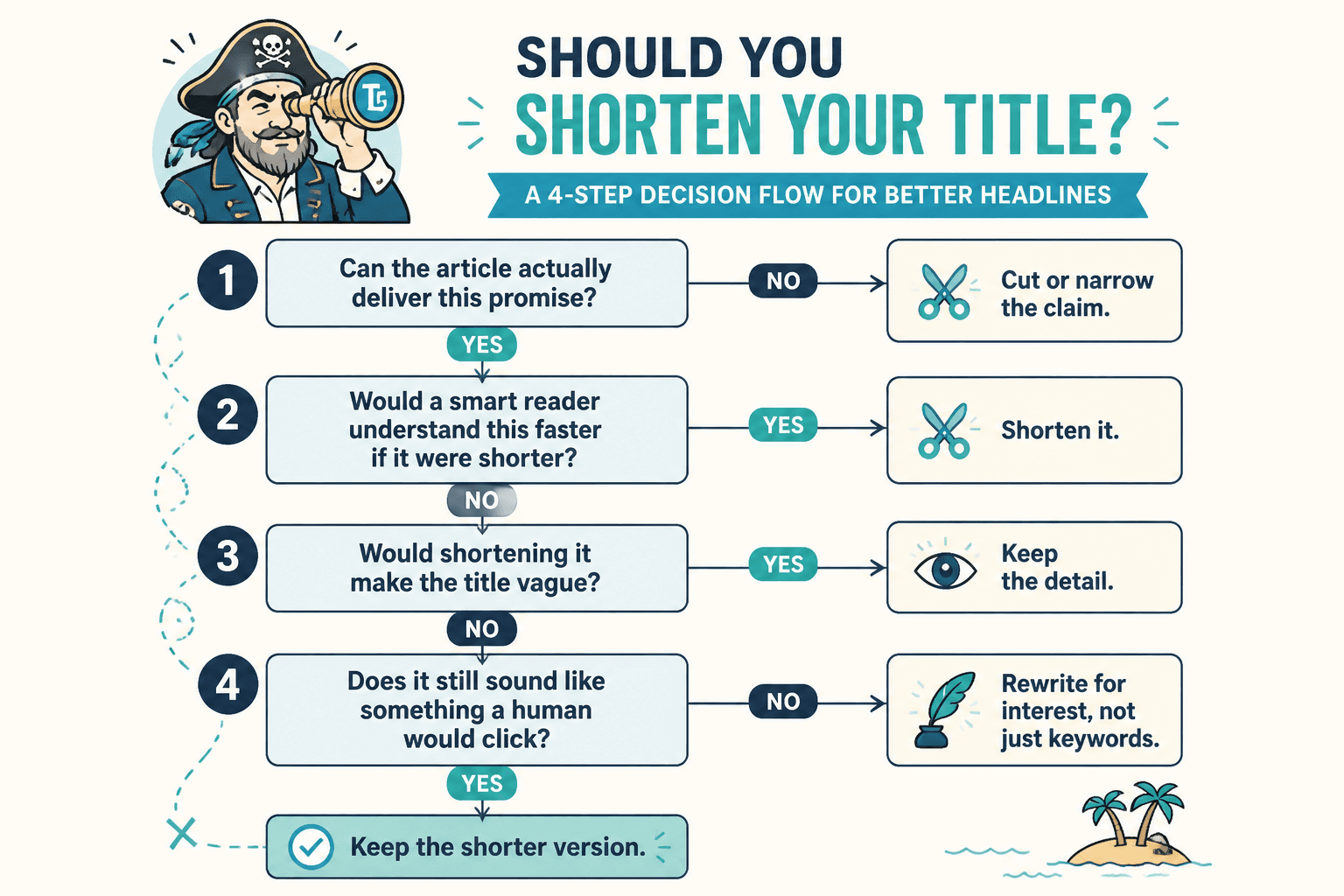
If you are unsure, run your draft title through a simple filter.
Ask these five questions
- What is the actual point?
If your title contains two or three points, you probably have not chosen the lead idea yet. - Which words are doing real work?
Cut qualifiers, filler, and explanation that the article can handle. - Would a smart reader understand this faster if it were shorter?
If yes, shorten it. - Would shortening it make it vague?
If yes, keep the detail. - Does it still sound like something a human would click?
Search-friendly is good. Search-drunk is not.
That last one matters. A title can be technically optimized and still deeply unappealing. Plenty of titles rank. Far fewer earn interest.
If you need help balancing title length with search logic, it is worth reading How Long Should Blog Titles and Headlines Be in 2026. Because no, there is not one magic number, despite the internet’s ongoing commitment to fake certainty.
Common signs a long headline should be cut down
You do not need a formula for this. You need a little editorial honesty.
- It sounds like two headlines fused together.
Pick the stronger angle. - It repeats ideas.
“Improve” and “get better results” do not both need to be there. - It explains what the category already implies.
You usually do not need “for blog posts” in a blog title about titles on a blog SEO site. - It front-loads throat-clearing.
Cut “A guide to,” “an overview of,” “everything you need to know about,” unless the intent truly demands it. - It got longer to fit keywords, not readers.
Readers can smell this. It smells bad.
One practical move is to write the full version first, then remove anything that does not increase click-worthiness, clarity, or relevance. You will usually lose 20 to 40 percent of the words and improve the headline in the process.
Before-and-after title rewrites
Here is what this looks like in practice.
Example 1: cutting redundancy
- Before: How to Write Better Blog Titles and Headlines That Improve Click-Through Rates and Get More People to Read Your Content
- After: How to Write Blog Titles People Actually Click
The rewrite keeps the benefit, removes the robotic explanation, and sounds less like a content machine trying to earn a pellet.
Example 2: choosing one angle
- Before: Why Some Short Blog Headlines Perform Better Than Longer Headlines for SEO, Social Sharing, and Reader Attention
- After: When Short Blog Titles and Headlines Beat Long Ones
The shorter title works because it creates a clear contrast and invites the obvious question: when do they beat them? The article can answer the rest.
Example 3: removing generic wrapper words
- Before: A Complete Guide to Understanding the Most Common Mistakes People Make With Blog Titles and Headlines
- After: Blog Titles and Headlines: Mistakes That Hurt Performance
Cleaner. Easier to scan. Better promise. If that topic is relevant for you, this related piece is worth reading: Blog Titles and Headlines: Title Templates and Mistakes That Hurt Performance.
Example 4: trimming without losing intent
- Before: The Best Ways to Rewrite Boring Blog Titles and Headlines So They Are More Interesting, Engaging, and Effective
- After: How to Rewrite Boring Blog Titles and Headlines
The original piles on outcomes. The rewrite trusts the reader to understand why boring titles are a problem. For that topic specifically, see How to Rewrite Boring Blog Titles and Headlines.
A simple framework for deciding title length
If you want a practical rule without turning your brain off, use this:
Make the title as short as possible, but only after it is specific enough to attract the right click.
That means your order of operations matters.
- Start with the search intent or reader need.
- Write the clearest useful version.
- Trim filler, repetition, and throat-clearing.
- Check whether the shorter version still signals the right promise.
- Pick the version that is both clear and tight.
Notice what is not in that framework: arbitrary word-count worship. Because a 6-word title can be bad. A 12-word title can be excellent. And a 19-word title can still be worth it if every word earns rent.
How short titles fit into SEO without becoming vague
This is where people either overcomplicate everything or flatten it into “just put the keyword in the title.” Neither approach is especially elegant.
Short titles can still be SEO-aware if they do three things well:
- Use the core phrase naturally
- Match the actual intent behind the search
- Avoid becoming too broad to compete or convert
For example, a title like “Better Headlines” is short, but too vague to do much. “Short Blog Titles vs Long Ones” is clearer, but still rough. “When Short Blog Titles and Headlines Beat Long Ones” works better because it includes the core topic, creates contrast, and frames a usable question.
Short SEO-friendly titles tend to work best when the keyword itself is already strong and the angle creates enough specificity around it.
If you are working on title ideation and want support tools without outsourcing your judgment to software, see Best SEO Headline Tools and Content Planning Tools for Blog Titles and Headlines. Tools can help you generate options. They cannot rescue weak editorial taste. Sadly, there is still no app for that.
Where short headlines work especially well
If you publish across multiple channels, here is where shorter titles often have an extra advantage:
- Mobile search results
- Homepage content cards
- Related reading sections
- Email newsletter link lists
- Social media shares
- Slack or team resource roundups
- Browser tabs and bookmarks
These are all environments where the title gets only a moment and limited space. The cleaner your phrasing, the better your odds.
That is also why title systems matter. If you are building a broader content engine, it helps to think beyond one headline at a time and look at how titles perform across a category or cluster. For more on that, browse the broader blog SEO writing section, the blog article systems hub, and the main blog titles and headlines pillar page.
Quick FAQ
Are shorter blog titles better for SEO?
Not by default. They are better when they still match search intent and keep the important phrase clear.
How short is too short for a blog title?
Short becomes a problem when the title loses the topic, hides the benefit, or becomes too vague to earn the click. Brevity helps only when clarity survives it.
A shorter title is not automatically better. A clearer one is.