
The popular story about creator ideation is that better ideas come from producing a longer list. Open a tool, request fifty topics, pick the least boring one, and start writing. That looks productive, but it usually creates a pile of interchangeable angles with no evidence behind them.
The harder skill is not generating options. It is filtering them. Strong creator research asks where the demand is coming from, what the audience is already struggling to explain, which questions keep repeating, and which angles match your positioning instead of copying the average of the internet.
AI is useful when it helps you organize signals, compare patterns, pressure-test assumptions, and turn messy research into clearer editorial choices. It becomes a liability when it replaces curiosity with confident guesses and makes generic topics sound finished too early.
This guide shows how to use AI for creator research and ideation before you write: gathering better inputs, reading audience evidence, developing sharper angles, and applying enough judgment that your content starts from a real reason to exist.
If you want a broader map of where this fits in the publishing process, start with the main creator AI research and ideation hub. This page is the hands-on workflow.
What AI Is Actually Good At in Creator Research and Ideation
AI is useful when you treat it like an analyst, not a slot machine.
It is especially good at:
- Finding patterns in messy inputs. Comments, reviews, emails, transcripts, old posts, survey answers, and community threads often contain repeated questions and tensions. AI can help group them faster.
- Turning scattered notes into themes. A creator’s raw material is usually fragmented. AI can identify recurring problems, objections, desires, and language patterns.
- Expanding one theme into multiple angles. A topic like “AI writing tools” can become a beginner guide, a mistake post, a comparison, a contrarian take, a workflow, a checklist, or a sales-enablement piece.
- Comparing options. AI can help you score ideas against audience fit, proof, novelty, search demand, offer fit, and publishing effort.
- Repurposing old content. Your existing posts, newsletters, videos, podcast transcripts, and sales pages are often better inputs than cold prompts.
- Building structured idea banks. AI can help tag ideas by audience, funnel stage, topic cluster, format, strength, and next action.
That is the useful version of AI ideation: it helps you think through options before you write.
What AI Is Not Good At, No Matter How Clean the Interface Looks
AI is not a substitute for knowing your audience. It can summarize signals you provide. It can infer likely questions. It can suggest angles based on patterns. But it does not magically know what your buyers, readers, viewers, or subscribers actually care about.
There are four limits to keep in mind:
- AI does not have your taste. It can imitate confident phrasing, but it cannot decide what feels true to your brand.
- AI does not know your audience firsthand. If you feed it vague inputs, it will return vague ideas.
- AI can invent or distort facts. Treat research outputs as leads to verify, not as finished evidence.
- AI defaults toward common patterns. If you ask for “best practices,” you will usually get overposted advice.
This is why direct audience research still matters. Nielsen Norman Group has made a similar point in the user research world: AI can support synthesis, but it does not replace real research with real people. The same principle applies to creator work. Use AI to organize and interrogate your inputs, not to pretend you have inputs you never collected.
The Simplest Creator AI Research and Ideation Workflow That Actually Works
A reliable workflow looks like this:
- Collect real source material.
- Ask AI to analyze the material before generating ideas.
- Extract questions, objections, beliefs, and tensions.
- Turn those themes into angles.
- Score the ideas before writing.
- Save the winners in an idea bank with useful tags.
- Rewrite anything that sounds generic before it enters your content calendar.
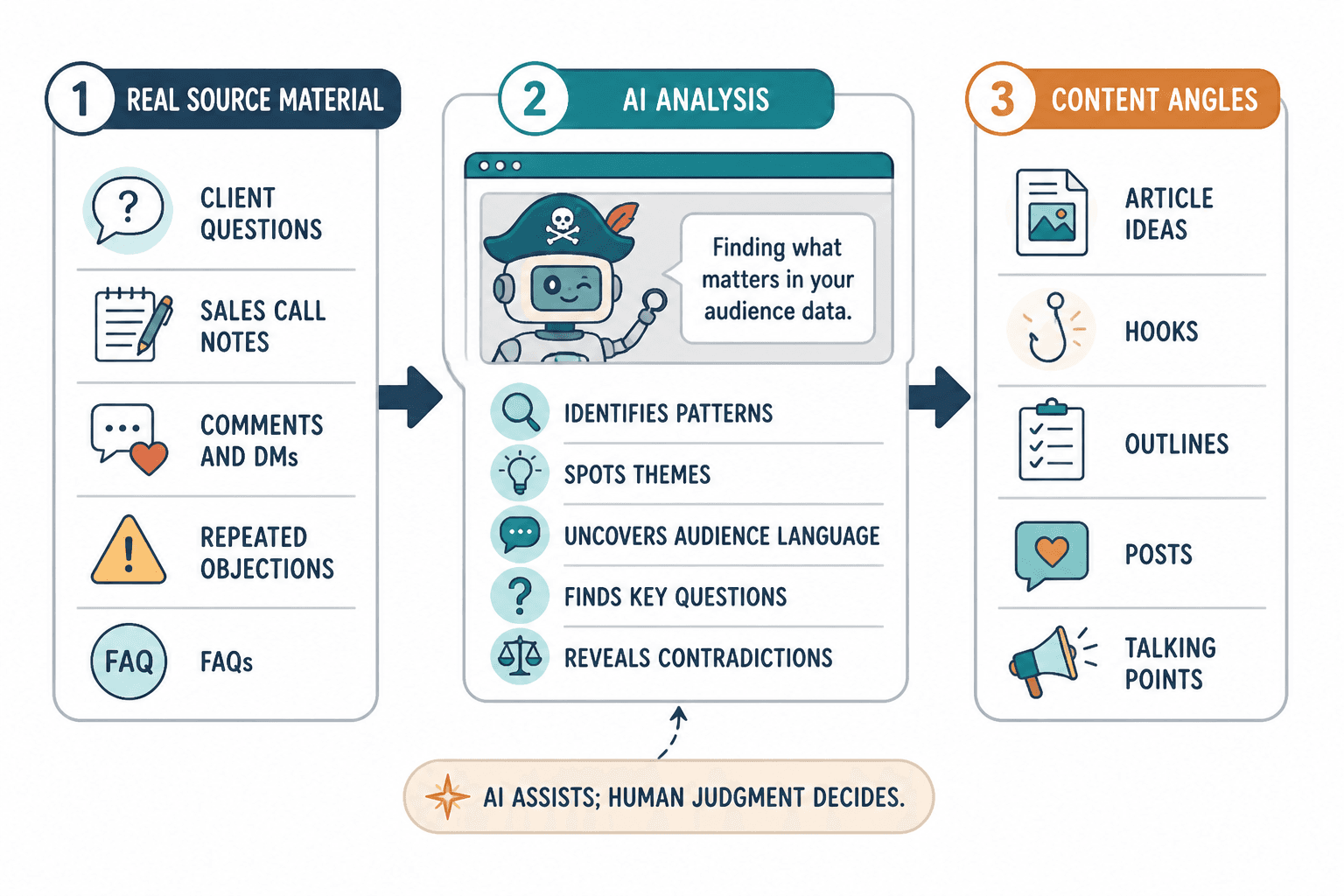
The workflow is simple, but the order matters. If you ask for ideas before you give AI anything meaningful to analyze, you force the tool to rely on generic patterns. If you start with real audience material, the ideas become more specific, more useful, and easier to judge.
1. Start With Real Source Material
Most creator AI research falls flat because the input is too thin. A prompt like “Give me content ideas for personal branding” gives AI almost nothing to work with. It has no audience, no friction, no proof, no point of view, and no business context.
Better source material includes:
- Audience comments and replies
- Questions from sales calls or consultation calls
- Newsletter replies
- YouTube comments
- Podcast reviews
- Reddit threads or forum discussions
- Customer support tickets
- Survey answers
- Old blog posts, newsletters, or scripts
- High-performing posts from your archive
- Low-performing posts that had a strong idea but weak packaging
- Competitor content, used for gap analysis rather than imitation
- Search results and “People also ask” style questions
If you have a small audience, do not wait until you have thousands of comments. Small creators can still collect useful signals from adjacent communities, client conversations, DMs, discovery calls, niche forums, and their own notes. The goal is not statistical perfection. The goal is to stop prompting from a blank page.
A useful starting batch might be:
- 10 audience questions
- 5 objections you hear often
- 3 pieces of old content
- 3 examples of content your audience already responds to
- 1 clear audience segment
- 1 business or creative goal
If you are stuck at the topic level, older TLG resources like essay topics and writing prompts for fiction and nonfiction can also help you think in terms of prompts, questions, and angles instead of flat subjects.
2. Open the AI Session With Diagnosis, Not Idea Generation
Most creator AI research and ideation goes wrong before the research part starts. The opening prompt is too broad, so the output is broad. The creator asks for ideas, and AI gives back a list of topics that could have appeared in anyone’s content calendar.
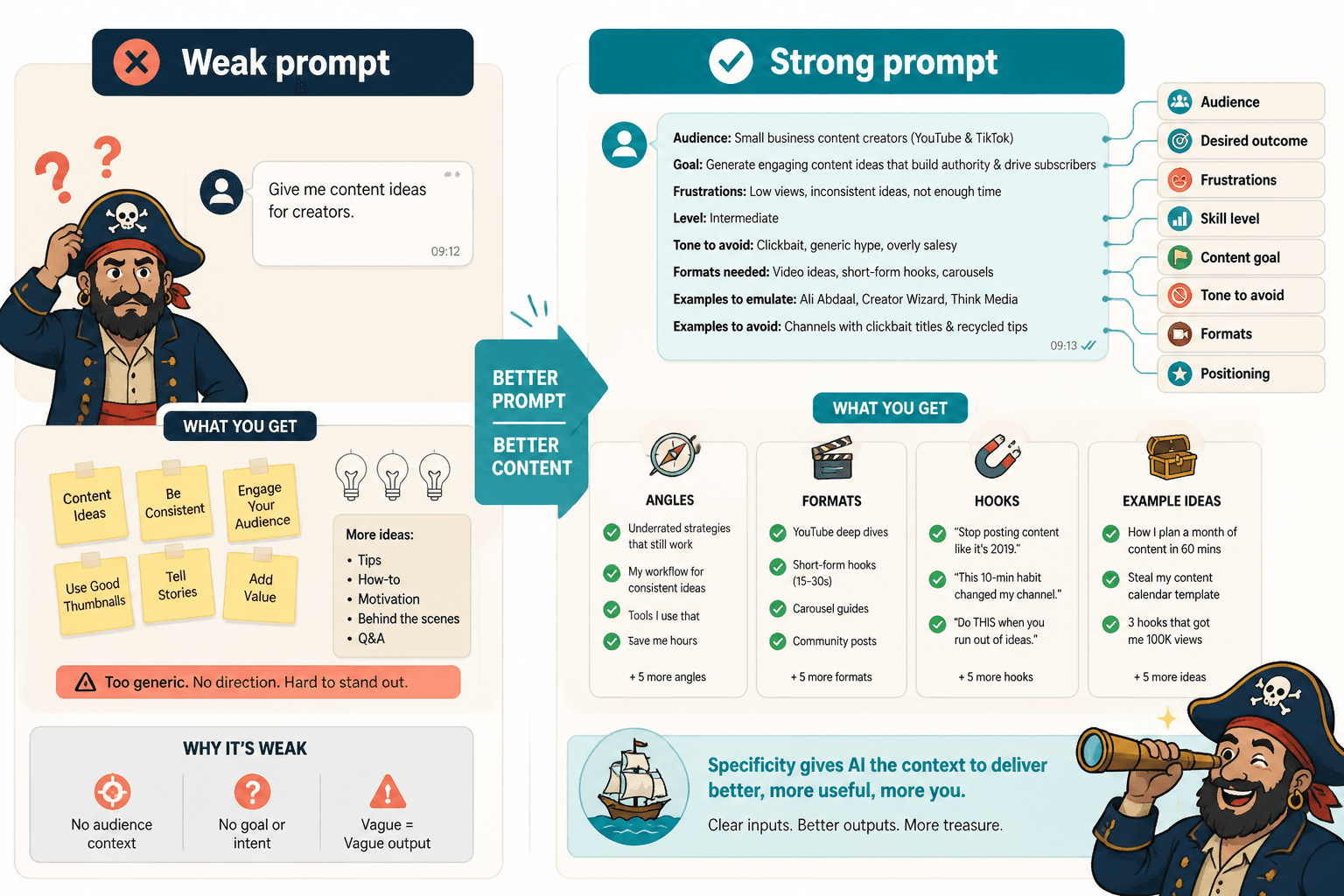
A weak opening sounds like this:
Give me 30 content ideas about using AI for content creation.
A stronger opening sounds like this:
I create practical content for solo creators who use AI writing tools but feel their output sounds generic. Analyze the audience notes below. Identify repeated frustrations, hidden objections, specific questions, and content angles that would help them improve their workflow without making them feel like they need to become prompt engineers.
The stronger version gives AI a job. It defines the audience, the problem, the emotional context, and the type of output needed.
A Simple Opening Formula That Works
Use this structure:
I create [format/type of content] for [specific audience] who are struggling with [specific problem]. Below is [source material]. First, analyze it for [questions, objections, frustrations, desires, misconceptions, language patterns]. Then suggest [number] content angles that help [audience] achieve [goal] while avoiding [constraint or bad pattern].
For example:
I create newsletter and LinkedIn content for freelance designers who want better leads but hate sounding salesy. Below are 12 client call notes and 8 audience questions. First, analyze them for repeated objections, language patterns, and moments where prospects misunderstand the value of design strategy. Then suggest 15 content angles that educate buyers without turning into generic “value of design” posts.
That prompt gives AI something to work with. It also tells the model what not to do.
3. Ask AI to Analyze Before It Generates
AI ideation improves when you separate analysis from generation. Do not ask for ideas in the same breath as dumping in source material. First, ask AI to inspect the material.
Useful analysis requests include:
- What problems repeat most often?
- What questions are explicit?
- What questions are implied but not directly asked?
- What objections would stop this audience from acting?
- What beliefs or assumptions shape the audience’s behavior?
- What language does the audience use that I should preserve?
- Which topics are too broad to be useful?
- Which tensions could become sharper content angles?
- What does this audience already know?
- What does this audience keep misunderstanding?
This matters because AI’s first idea list is often the most generic. But its analysis of your source material can reveal the raw ingredients for better ideas.
4. Gather Better Audience Questions
Most people using AI for content research ask weak questions, then act surprised when they get weak ideas back. Question gathering is the bridge between audience research and content strategy.
A question bank is not just a list of literal questions. It is a structured collection of the things your audience is trying to figure out, avoid, compare, justify, or believe.
The Five Question Types Personal Brands Should Collect
Direct questions
These are the questions people actually ask:
- “Which AI writing tool should I use?”
- “How long should my research process take?”
- “How do I make AI content sound more like me?”
Implied questions
These are hidden inside complaints or behavior:
- “I keep getting generic drafts.” → “How do I give AI better context?”
- “My posts get views but no leads.” → “How do I connect content ideas to buying intent?”
Objection questions
These reveal hesitation:
- “Will AI make my content sound fake?”
- “Is this worth learning if tools keep changing?”
- “Do I need a huge audience before this works?”
Comparison questions
These show decision pressure:
- “Should I use ChatGPT, Claude, Gemini, or Perplexity?”
- “Should I write from scratch or repurpose old content?”
- “Should this become a post, newsletter, video, or sales page?”
Identity and belief questions
These reveal how the audience sees itself:
- “Can I use AI and still be a real writer?”
- “Will using AI make me look lazy?”
- “How do I stay original when everyone has the same tools?”
Those identity and belief questions often produce stronger angles than surface-level keyword prompts because they get closer to why the audience cares.
5. Turn Themes Into Sharper Angles
Most creators do not have an AI problem. They have an angle problem.
A topic is the subject. An angle is the specific way you frame that subject for a specific audience, problem, and outcome.
| Topic | Stronger angle |
|---|---|
| AI writing tools | Why your AI writing tool is not the reason your content sounds generic |
| Content ideas | How to filter 50 AI-generated ideas down to the 5 worth publishing |
| Personal branding | The audience questions personal brands ignore because they are too focused on sounding authoritative |
| Lead generation | How to use AI research to find content ideas that attract buyers, not just viewers |
Weak AI ideation produces topic lists. Strong AI ideation produces angle options.
Ask AI to generate angles using different lenses:
- Beginner lens: What does the audience need to understand first?
- Mistake lens: What are they doing wrong without realizing it?
- Contrarian lens: What common advice is incomplete or misleading?
- Comparison lens: What options are they choosing between?
- Objection lens: What would stop them from acting?
- Proof lens: What examples, data, or experience can support the idea?
- Offer-fit lens: Which ideas naturally connect to your product, service, or expertise?
If the goal is revenue, do not stop at engagement fit. For a deeper version of that workflow, see creator AI research and ideation for leads and sales.
6. Improve Outline Prompts Without Sounding Generic
Generic creator AI outline prompts produce generic content because they contain no real editorial point of view. They usually ask for “a comprehensive outline” on a broad topic, which encourages AI to produce the same obvious structure everyone else gets.
A strong AI outline prompt needs five things:
- A specific audience. Who is this for?
- A clear problem. What are they trying to solve?
- A sharp angle. What is the piece really arguing or clarifying?
- Useful constraints. What should the outline avoid?
- The job of the outline. Is it meant to teach, persuade, compare, diagnose, sell, or simplify?
Weak outline prompt:
Create an outline for a blog post about AI content ideas.
Stronger outline prompt:
Create an outline for a practical guide for solo creators who use AI tools but keep ending up with generic content ideas. The angle is that they do not need more ideas; they need a better filtering and scoring workflow. Avoid vague “brainstorm more” advice. Include sections on source material, audience questions, angle generation, scoring, and idea-bank maintenance. Make the outline useful for someone publishing weekly content.
The second prompt is not longer for the sake of being longer. It gives AI editorial direction.
7. Score the Ideas Before You Write Anything
One of the biggest creator AI angle generation mistakes is confusing volume with quality. Fifty ideas are only useful if you have a way to choose.
Before drafting, score each idea against practical criteria:
- Audience fit: Does this address a real audience question, pain, desire, or decision?
- Specificity: Is the idea sharper than a broad topic?
- Proof available: Can you support it with examples, experience, research, screenshots, data, or a clear process?
- Novelty: Does it add something beyond generic best practices?
- Goal fit: Does it support awareness, trust, leads, sales, retention, or authority?
- Format fit: Does it belong as a short post, article, video, newsletter, carousel, podcast, or lead magnet?
- Effort level: Can you produce it well with the time available?
- Offer fit: If relevant, does it connect naturally to what you sell?
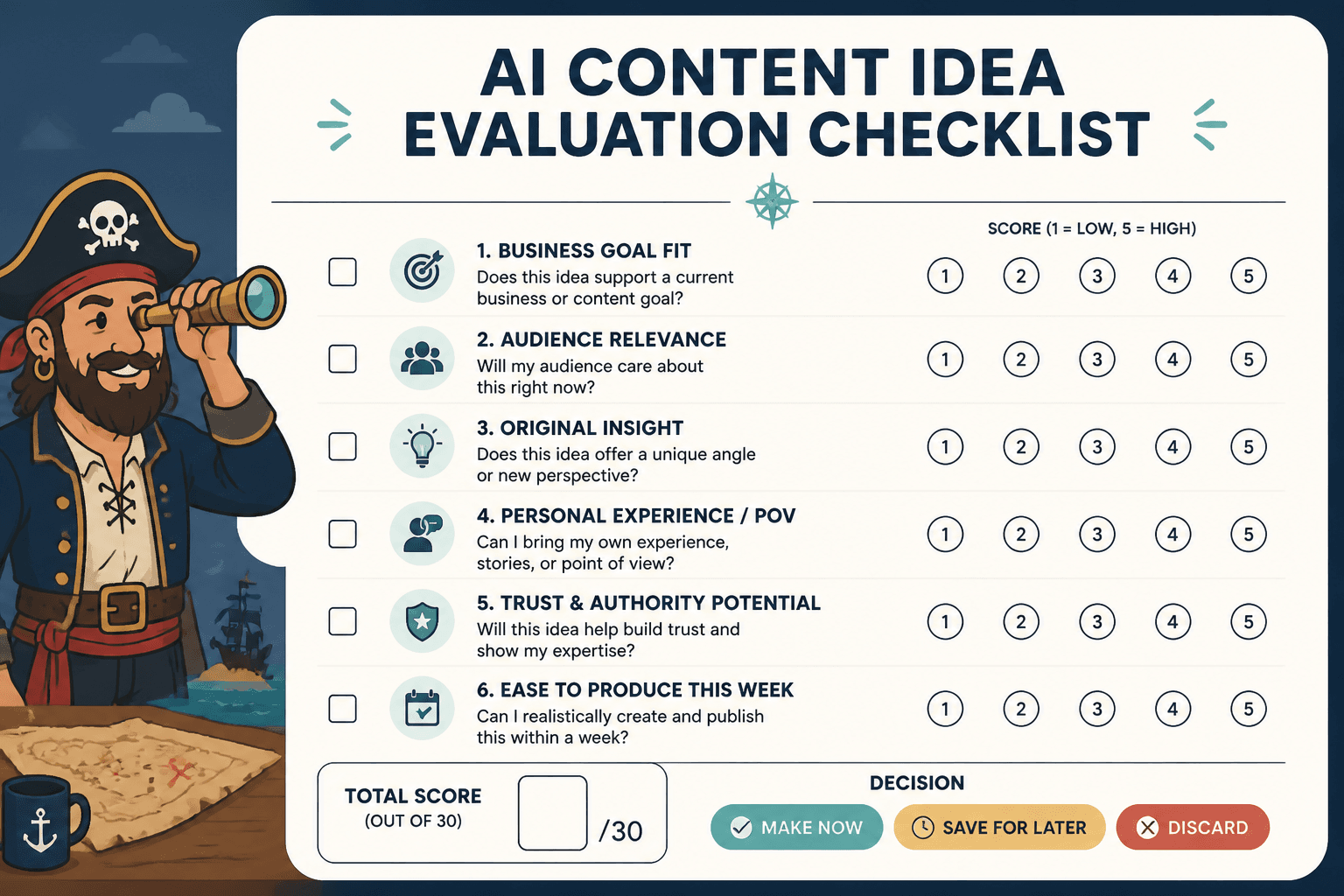
A simple scoring table can use a 1-5 scale:
| Idea | Audience fit | Specificity | Proof | Goal fit | Effort | Total |
|---|---|---|---|---|---|---|
| “AI content tips” | 2 | 1 | 2 | 2 | 5 | 12 |
| “How to filter 50 AI-generated ideas down to 5 worth publishing” | 5 | 5 | 4 | 4 | 4 | 22 |
The second idea wins because it is more specific, easier to prove, and more useful to the reader.
If you want to see how these workflows look in practice, use the companion page with creator AI research and ideation examples.
8. Decide How Long Creator AI Research and Ideation Should Take
Most creator AI research and ideation gets bloated because people confuse more input with better thinking. More research helps only when the extra material improves judgment.
For most creator content, aim for 10 to 30 minutes of focused AI-assisted research and ideation before drafting.
Use shorter sessions when:
- You already know the subject well.
- You are validating a quick idea.
- The piece needs your taste more than more data.
- The format is short, such as a social post or quick newsletter section.
- Your audience needs clarity, not exhaustive coverage.
Use longer sessions when:
- The piece supports a major offer or launch.
- You are entering a topic where accuracy matters more.
- You need examples, citations, comparisons, or expert nuance.
- The content will become a pillar guide, lead magnet, or sales asset.
- You are turning a messy archive into a structured content system.
| Content type | Suggested AI research and ideation time |
|---|---|
| Short social post | 5-15 minutes |
| Newsletter section | 10-20 minutes |
| Standard article | 20-45 minutes |
| Pillar guide | 45-120 minutes, often split across sessions |
| Sales or launch content | 30-90 minutes, depending on source material |
Short AI research often beats long research when you already have strong taste and a clear point. Long research helps when the stakes are higher or the evidence needs to be stronger.
9. Build an Idea Bank With Tags That Matter
An idea bank should not be a graveyard of random AI suggestions. It should help you decide what to publish next.
Useful tags include:
- Audience segment: beginner, advanced, buyer, subscriber, client, creator, founder
- Question type: direct, implied, objection, comparison, identity
- Funnel stage: awareness, trust, evaluation, conversion, retention
- Format: article, newsletter, short post, video, thread, carousel, lead magnet
- Angle type: how-to, mistake, contrarian, checklist, teardown, comparison, case study
- Proof needed: example, data, quote, screenshot, personal story, customer insight
- Status: raw, promising, needs proof, ready to outline, drafted, published, repurpose
- Goal: views, replies, leads, sales, authority, retention
This is where AI can help with organization. Give it a batch of ideas and ask it to tag them. But keep final judgment human. AI might tag an idea as “sales” because it mentions a product, even if the angle is too weak to attract real buyers.
If the goal is visibility, pair ideation with distribution thinking. TLG’s guide on how to increase article views can help you think beyond idea generation and into packaging, search intent, and promotion.
10. Rewrite Boring AI Output Before You Keep It
Most creator AI research does not fail because the tool is weak. It fails because the raw material is bland, the prompts are lazy, and the output gets accepted way too early.
Do not save an AI idea just because it is grammatically clean. Clean can still be boring.
Watch for dead phrasing like:
- “Unlock the power of…”
- “In today’s digital landscape…”
- “Leverage AI to streamline…”
- “Boost your productivity with these tips…”
- “The ultimate guide to…” when the piece is not actually ultimate
Rewrite bland ideas by adding tension, specificity, and audience context.
| Boring AI idea | Better rewritten angle |
|---|---|
| How to use AI for content creation | Why AI keeps giving you generic content ideas, and how to fix the input before blaming the tool |
| Tips for better prompts | The prompt details creators skip that make every AI outline sound interchangeable |
| AI tools for creators | How to choose an AI research tool based on your workflow, not someone else’s ranking list |
| Content ideas for small creators | How small creators can use audience signals before they have a large audience |
A useful rewrite prompt:
Rewrite these AI-generated content ideas so they are more specific, more audience-aware, and less generic. Add tension where appropriate. Avoid hype phrases, vague productivity language, and broad “tips” framing. Keep the ideas practical and publishable.
Quality Controls: Facts, Bias, Privacy, and Human Judgment
AI research output should not go straight into published content. You still need quality control.
Verify factual claims
If AI gives you statistics, dates, quotes, legal claims, medical claims, financial claims, or technical details, verify them against reliable sources. Google’s guidance on helpful, reliable, people-first content is a useful standard here: content should be created for people, demonstrate real value, and avoid pretending to have expertise or evidence it does not have.
Watch for bias and missing perspectives
AI can reproduce patterns from its training data and from the material you provide. If your source set is narrow, the output will be narrow too. For a broader media-literacy lens, TLG’s article on how biased news is is a useful reminder that source selection shapes conclusions.
Protect private audience material
Do not paste sensitive client information, private customer data, confidential business details, or personally identifiable information into tools without understanding the tool’s data policy. The NIST AI Risk Management Framework is a helpful reference for thinking about AI risk, governance, and responsible use at a higher level.
Keep the final editorial call human
AI can help you find options. It cannot decide what your audience should hear from you next. The final decision should come from your strategy, experience, ethics, and taste.
Example Creator AI Research and Ideation Prompts
Use these as starting points. Replace the bracketed sections with your own audience, source material, and goals.
Source analysis prompt
I create content for [specific audience]. Below are [comments/questions/call notes/reviews/transcripts]. Analyze the material before suggesting ideas. Identify repeated problems, direct questions, implied questions, objections, emotional language, misconceptions, and content opportunities. Do not generate content ideas yet. First, summarize the strongest audience signals.
Angle generation prompt
Using the analysis above, generate 20 content angles for [platform or format]. Each angle should be specific to [audience], address a real question or tension from the source material, and avoid generic best-practice framing. Group the angles by type: how-to, mistake, comparison, contrarian, checklist, case study, and sales-support.
Question bank prompt
Turn the source material into a question bank. Sort the questions into five categories: direct questions, implied questions, objection questions, comparison questions, and identity or belief questions. For each question, suggest one possible content angle and one format that would fit it.
Old content prompt
Below are excerpts from my old content. Analyze them for recurring themes, strong points of view, underdeveloped ideas, repeated audience problems, and content that could be repurposed. Then suggest new angles that build on what I have already published instead of starting from scratch.
Scoring prompt
Score the following content ideas from 1 to 5 on audience fit, specificity, proof available, novelty, goal fit, format fit, and effort level. Then rank them in publishing order. Explain why the top five are stronger than the rest and identify what proof or examples each one needs before drafting.
Outline prompt
Create an outline for the selected angle: [angle]. The audience is [specific audience]. The piece should help them [goal] by explaining [core idea]. Avoid generic tips, hype, and repeated advice. Include sections for diagnosis, practical steps, examples, mistakes to avoid, and a final action checklist. Make the outline specific enough that a draft would not sound interchangeable with other AI-generated content.
Common Creator AI Ideation Mistakes to Avoid
Asking for ideas before giving AI a point of view
If the prompt has no audience, goal, source material, or constraint, the output will usually be generic. Give the model a reason to choose one direction over another.
Confusing volume with quality
More ideas can create the illusion of progress. A smaller set of scored, specific, proof-backed angles is more useful than 100 vague topics.
Letting AI stay at the “best practices” level
Best-practice content is often too broad. Push for examples, tradeoffs, mistakes, edge cases, and audience-specific decisions.
Generating angles with no audience filter
An idea can be good in general and wrong for your audience. Always ask: “For whom, at what stage, with what problem?”
Ignoring offer fit
If content supports a business, some ideas should connect to your services, products, or expertise. Not every piece needs to sell, but your idea bank should include sales-support content.
Using AI to imitate what is already overposted
Competitor analysis is useful for identifying gaps, not copying formats that are already exhausted.
Accepting robotic language too early
AI-generated phrasing often sounds polished before it sounds alive. Rewrite ideas into language your audience would actually recognize.
Which Tools Should You Use?
The workflow matters more than the tool, but tool choice still affects speed and quality. Some tools are better for long-context analysis, some for search-assisted research, some for organizing notes, and some for drafting outlines.
If you want a practical comparison, use the companion guide to the best AI tools for creator AI research and ideation.
The Final Workflow
Here is the whole process in one compact checklist:
- Choose one audience slice. Do not ideate for everyone.
- Collect real source material. Use comments, questions, calls, old content, reviews, and community threads.
- Ask AI to analyze first. Extract patterns before asking for ideas.
- Build a question bank. Include direct, implied, objection, comparison, and identity questions.
- Turn themes into angles. Move from broad subjects to specific editorial frames.
- Score before drafting. Judge audience fit, proof, specificity, goal fit, and effort.
- Pick the right format. Not every idea should become a long article.
- Save ideas with useful tags. Make the idea bank searchable and actionable.
- Rewrite boring output. Add specificity, tension, proof, and human language.
- Verify and decide. Check facts, protect private data, and keep the final editorial call human.
AI can make creator research and ideation faster, but speed is not the real advantage. The real advantage is better filtering: seeing the patterns in your audience material, turning them into sharper angles, and choosing the ideas that deserve your effort before you start writing.