
Most About pages are weirdly bad for something so important.
Not because the person behind them has nothing useful to say. Usually it is the opposite. They have years of posts, emails, podcast riffs, client notes, sales calls, workshop slides, and half-finished drafts full of sharp thinking. Then they sit down to write an About page and suddenly produce beige mush about passion, mission, and “helping people thrive.”
That is the real opportunity in How to Turn Old Content Into Better About Page Copy: you do not need more ideas. You need to mine the right ones from content you already made, then shape them into positioning, proof, personality, and a clear next step.
If your About page feels vague, too formal, too self-focused, or suspiciously similar to everyone else in your niche, old content is often the fix. Here’s how to use it without pasting random old lines together like a scrapbook with conversion issues.
To see how this fits into the wider strategy, open the parent guide.
Why old content is usually better than writing from scratch
When people write an About page from scratch, they tend to perform. They try to sound established, polished, credible, and profound all at once. That cocktail produces stiff copy very quickly.
Old content is different. It often captures how you actually explain things when you are focused on helping, teaching, arguing a point, answering a client, or telling the truth before your inner brand consultant starts wearing a whistle.
That means your existing content can give you better raw material for:
- Your natural voice
- The problems you actually care about
- The phrases your audience already responds to
- Specific examples and proof
- Your point of view
- The promises you can honestly make
An About page is not a memoir. It is not a timeline of your professional life. It is a trust page. People are trying to figure out who you help, what you do, why your approach is worth listening to, and what they should do next.
Old content helps because it gives you evidence. Not invented “brand messaging.” Actual evidence.
What your About page actually needs
Before you start pulling lines from old content, get clear on what the page needs to do. Otherwise you’ll collect 47 spicy opinions and still have no page.
A strong About page usually needs five things:
- A clear reader fit — who this is for
- A useful promise — what you help them do
- A distinct angle — how you think or work differently
- Proof — why they should trust you
- A next step — what to click, read, book, or buy
That is why About pages fall apart when they are only autobiographical. Your story can support trust, sure. But if the page is just a polished life recap with no relevance to the reader, it is decoration.
If you want a broader foundation first, the core website conversion copy section and the website core copy hub are worth keeping nearby. And if your focus is specifically this page, the About page copy section connects the rest of the puzzle.
Where to find usable material in your old content
Not all old content deserves resurrection. Some of it should stay dead out of respect for everyone involved. You are looking for patterns, not random leftovers.
Best source material to review
- High-performing posts with strong comments or replies
- Email newsletters where your voice sounds especially natural
- Sales pages or offer descriptions that converted well
- Client onboarding answers
- Discovery call notes
- Workshop or webinar teaching points
- Podcast transcripts
- Case studies and testimonials
- Frequently sent DMs or email answers
- Your own rants, if they contain a real point and not just caffeine
What to pull from those sources
- Lines that clearly describe the problem you solve
- Phrases you repeat often without realizing it
- Opinions that show your approach
- Specific outcomes clients got
- Examples of what you do not do
- Short story fragments that explain why your work matters
- Clean explanations of your process
- Moments where your personality comes through naturally
The goal is not “content repurposing” in the lazy sense. You are not recycling old wording because you cannot be bothered. You are identifying the strongest raw material because it already reflects what is true, useful, and distinct about your work.
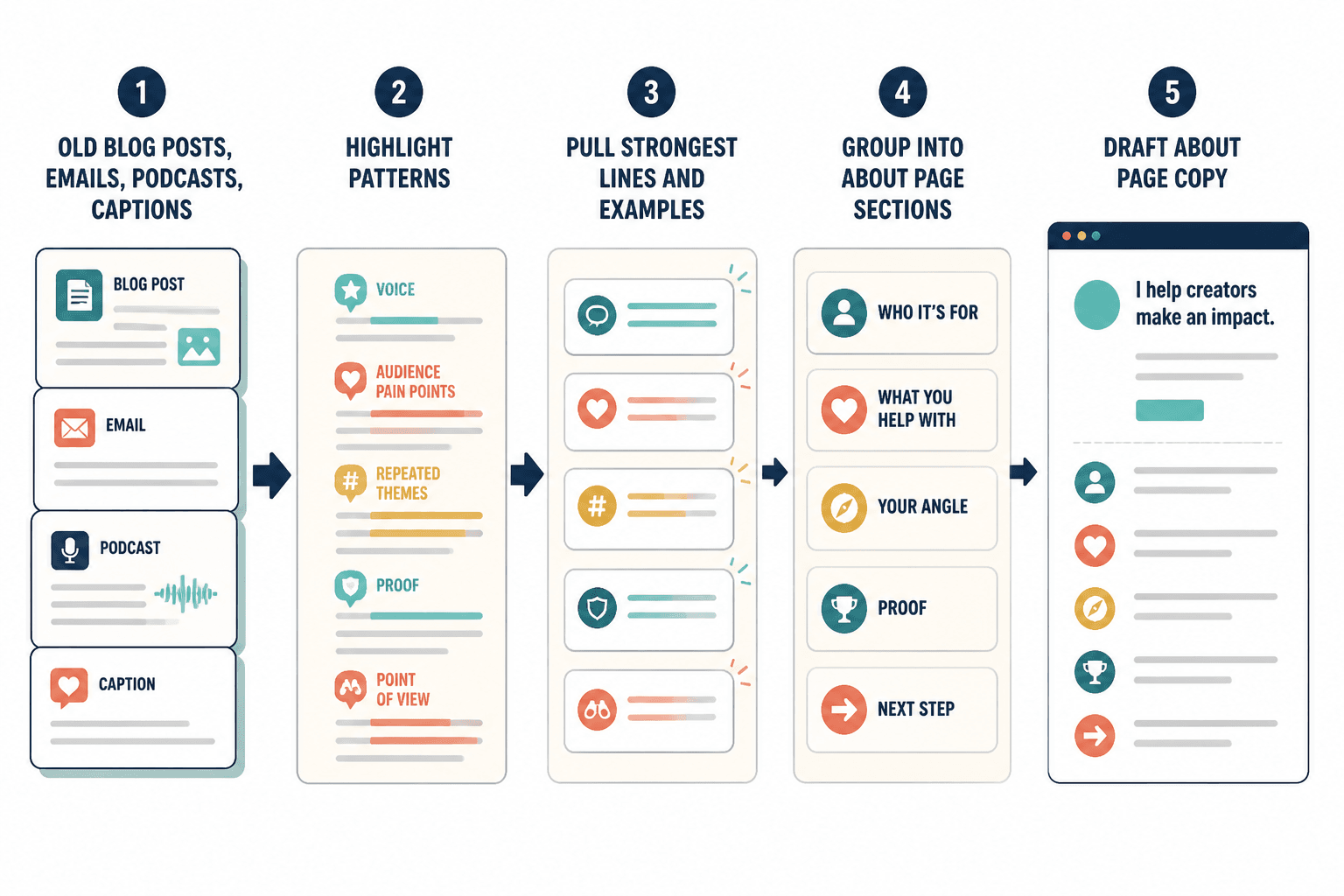
A simple system for turning old content into better About page copy
Here is the cleanest way to do it.
1. Gather everything into one document
Open a messy working doc. Paste in excerpts, screenshots, snippets, call notes, testimonial lines, post intros, and phrases worth keeping. Do not edit yet. This is the mining phase.
If a line makes you think, “That sounds like me on a good day,” keep it.
2. Tag each piece by function
Label the useful bits so they stop being random.
- Audience — who you help
- Problem — what they struggle with
- Promise — what changes after working with you
- Method — how you work
- Belief — what you think people get wrong
- Proof — examples, outcomes, credibility
- Personality — voice, style, tone
- CTA — what they should do next
3. Look for patterns, not one perfect sentence
Usually the best About page messaging is not hiding in a single magical line from a 2022 LinkedIn post. It appears in patterns.
Maybe you keep talking about helping smart people simplify messy ideas. Maybe half your client wins involve clearer positioning. Maybe your best content always pushes back on overcomplicated funnels. That is not an accident. That is your message trying to get your attention.
4. Build the page around sections, not chronology
Do not arrange the page as “first I did this, then I did that, then in 2021…” unless your story itself is the product.
Instead, build around reader-relevant sections like:
- Who I help
- What I help with
- What I believe works better
- Why people trust me
- How to take the next step
5. Rewrite for flow and relevance
This part matters. Old content gives you raw material, not final copy.
A line that worked beautifully as a post opener might be wrong for an About page. A client story might need context. A sharp opinion might need softening if it makes you sound allergic to nuance. You are not copying and pasting. You are shaping.
How to map old content to actual About page sections
Here is where people get stuck. They have the material, but they do not know where it goes.
| About page section | What to pull from old content | What it should do |
|---|---|---|
| Opening section | Your clearest explanation of who you help and what you help them do | Orient the reader fast |
| Positioning section | Strong opinions, repeated themes, contrarian but useful beliefs | Show your angle |
| Story section | Relevant story fragments, turning points, experience context | Build trust without rambling |
| Proof section | Results, testimonials, past roles, notable experience, case-study snippets | Make credibility visible |
| Process or approach section | Teaching frameworks, workshop material, client explanations | Show how you work |
| CTA section | Best-performing invitation language from emails, sales pages, or posts | Move the reader forward |
That one table can save you a lot of wandering.
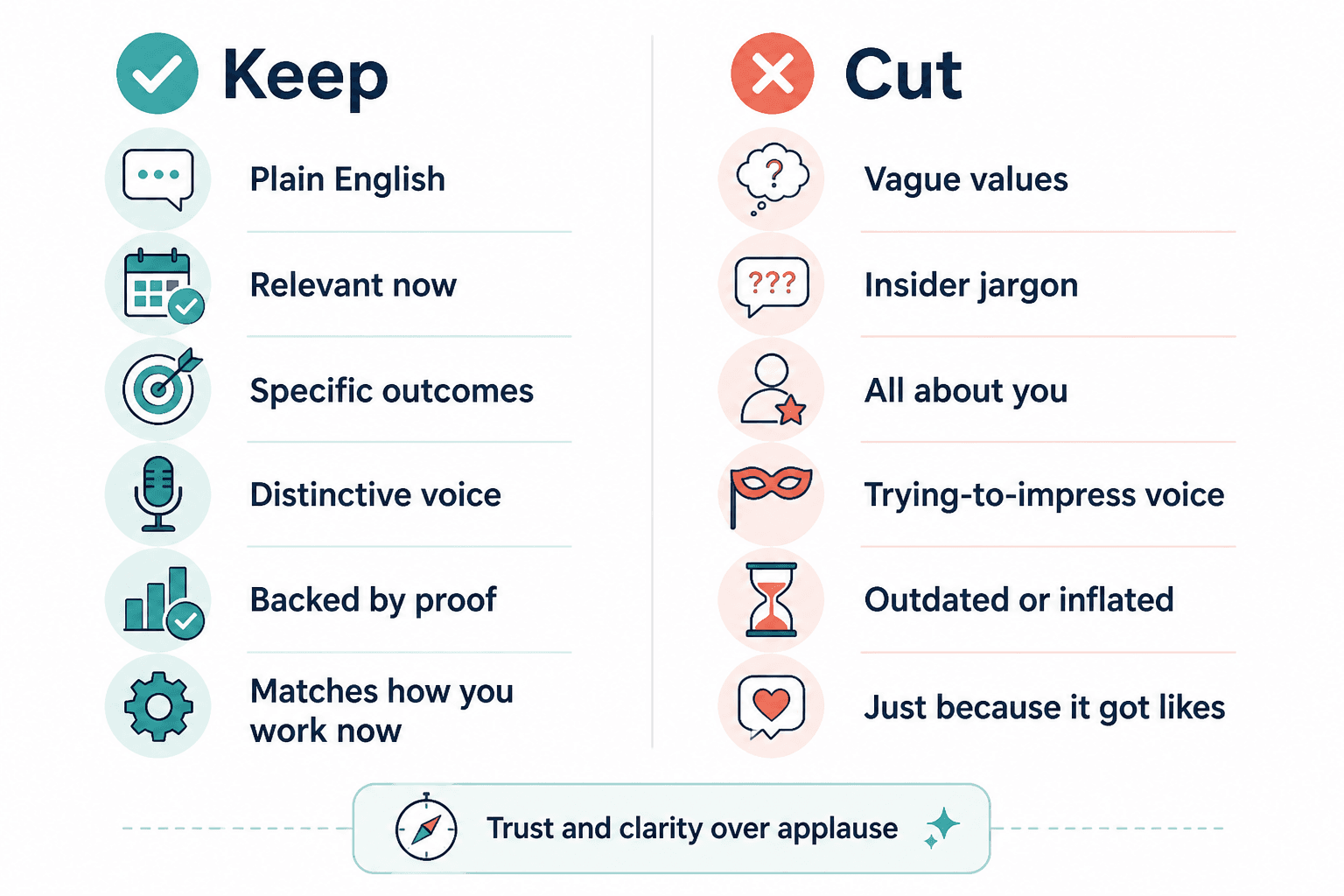
What to keep, what to cut
One reason About pages get bloated is that people feel oddly sentimental about their own backlog. Not every clever line belongs. Not every old achievement still matters. Not every post-aged opinion deserves permanent residence on your site.
Keep content that is:
- Clear in plain English
- Relevant to your current offers or audience
- Specific about outcomes or problems
- Distinctive without trying too hard
- Supported by proof
- Consistent with how you actually work now
Cut content that is:
- Full of vague values but no practical meaning
- Too insider-y for a new visitor
- Focused on you with no reader payoff
- Written in your old “trying to sound impressive” voice
- Outdated, inflated, or no longer true
- Just there because it once got likes
Likes are not proof that a sentence belongs on your site. Some lines thrive on social because they are dramatic, compressed, or spicy. Your About page needs trust and clarity, not applause.
Before-and-after examples
A few quick rewrites will make this easier to see.
Example 1: vague founder bio turned useful opening
Before: I’m a passionate strategist and entrepreneur dedicated to helping brands unlock growth through authentic storytelling and meaningful connection.
After: I help coaches, consultants, and personal brands turn fuzzy expertise into clearer messaging, better content, and website copy that actually pulls its weight.
The second version is less “conference panel intro,” more useful human sentence.
Example 2: random old post idea turned positioning
Say you find these lines in old content:
- “Most people do not need more content. They need sharper positioning.”
- “Being useful beats sounding impressive.”
- “Traffic is nice. Clarity converts.”
That can become:
I’m less interested in making your brand sound important than in making your message clear enough to earn trust and action. Pretty words are easy. Useful ones take a bit more work.
Example 3: old client notes turned proof section
From scattered notes:
- Helped a consultant rewrite site messaging
- Increased consult bookings
- Clients said copy sounded more like them
- Repeated issue: smart people struggling to explain what they do simply
Into actual page copy:
Much of my work is helping smart, experienced people say what they do without sounding generic, overcomplicated, or allergic to clarity. That has led to stronger About pages, clearer offers, and more qualified inquiries for clients who were already good at their work but not great at packaging it.
How to use your voice without making the page self-indulgent
This is where some About pages wobble. In an effort to avoid corporate mush, people swing hard into quirks, over-sharing, or cleverness that only makes sense to them.
Yes, your About page should sound like you. No, it should not read like your private notes app got a brand deal.
A good rule: keep the personality that supports trust, clarity, and relevance. Cut the personality that distracts from what the reader is trying to figure out.
That might mean keeping a dry one-liner, a sharp opinion, or a short story detail that humanizes you. It probably means cutting the seven-paragraph detour about your childhood lemonade stand unless your audience is hiring you specifically for lemonade funnel strategy.
A practical About page outline built from old content
If you want a working structure, use this.
- Opening: Who you help and what you help them do
- Why your approach: A short point of view pulled from your best old thinking
- Relevant story: Just enough background to explain your perspective
- Proof: Results, experience, credibility markers, client language
- How you work: Your method, process, or style
- Next step: Read, book, inquire, join, or buy
That outline is flexible enough for creators, service providers, consultants, and solo founders. And it helps stop the classic About page disease: saying a lot while somehow communicating nothing.
Mistakes people make when turning old content into About page copy
- They paste instead of rewrite. Old content needs adapting.
- They keep too much. Strong pages are selective.
- They overuse social-style punchlines. Your website needs more substance than a post.
- They make it all about their journey. The reader still needs a reason to care.
- They forget the CTA. A lovely page with no next step is just decorative competence.
- They use their old voice from three brands ago. If it feels fake now, it probably is.
If your draft still feels flat after this process, it may need stronger revision, not more source material. In that case, rewriting boring About page copy is usually the next fix, not another hour of rummaging through old posts like a copy archaeologist.
About pages work better when they build trust with clarity instead of biography theater. A stronger through-line usually matters more than extra detail.