Some About pages are trying to win a hostage negotiation with your attention.
They open with a lofty mission. Then a life story. Then a philosophy section. Then a values section. Then a soft little “work with me” whisper buried somewhere near the footer, exhausted and irrelevant.
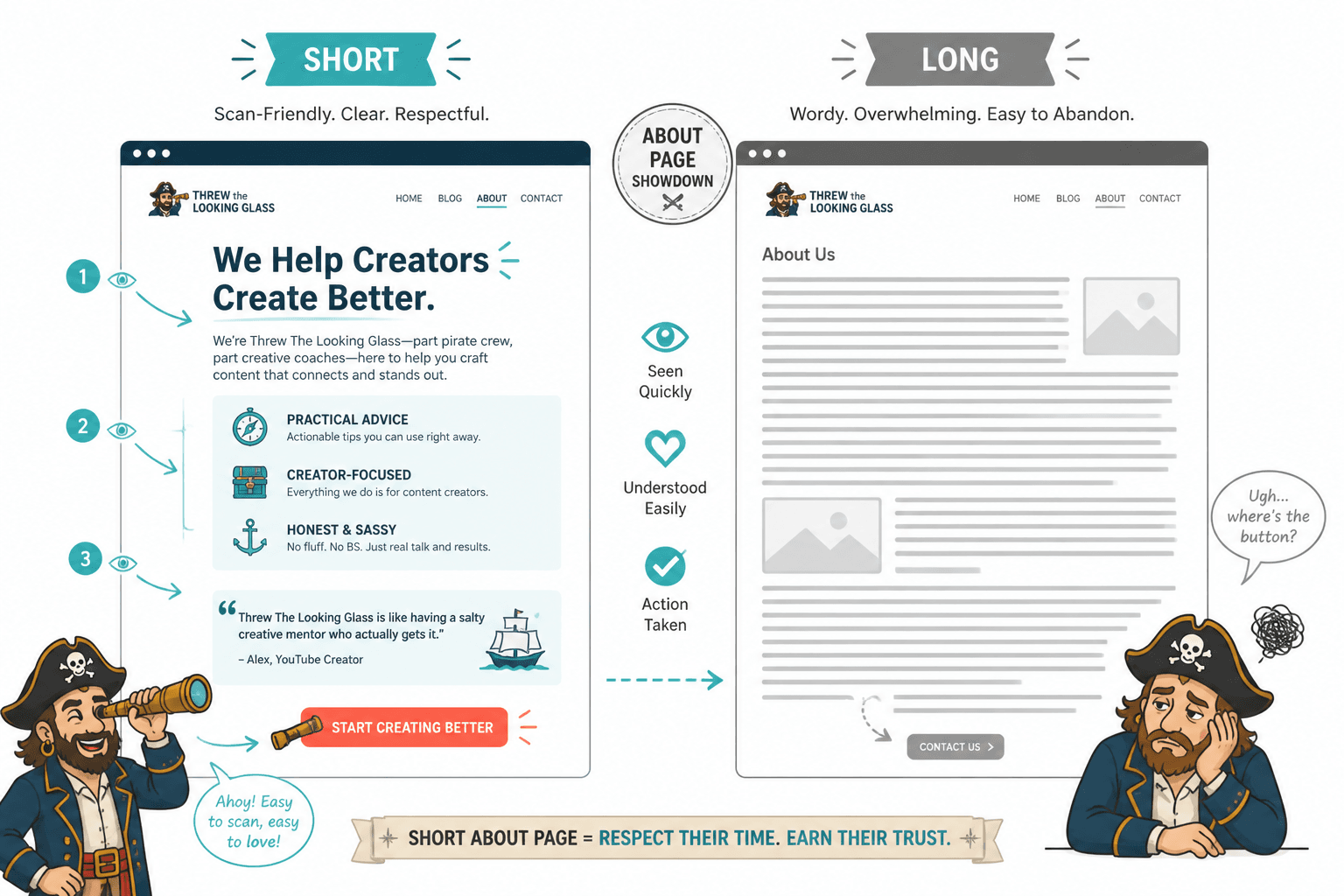
And meanwhile, a shorter About page quietly does the job in half the space: tells the visitor who this is for, what you do, why they should trust you, and what to do next.
That is the real question behind When Short About Page Copy Beats Long Ones. Not “is shorter always better?” It is “when does more copy stop helping and start clogging the page?”
If your About page is meant to build trust and move people forward, shorter often wins when the visitor does not need your autobiography. They need clarity. They need relevance. They need a reason to believe you can help. Fast.
Here’s how to tell when short About page copy is the smarter move, when longer copy actually earns its keep, and how to cut yours down without making it feel thin, cold, or suspiciously AI-scrubbed.
For the full path around this topic, head to the parent guide.
Why short About page copy often performs better
Most visitors do not arrive on your About page hoping for a beautifully structured memoir.
They usually want quick answers to a few practical questions:
- Who is this person or business?
- Are they relevant to me?
- Do they seem credible?
- Can they help with the thing I care about?
- What should I do next?
Short About page copy beats long ones when it answers those questions cleanly, without making people work for it.
That matters because About pages are not usually read like essays. They are scanned. People hop down the page looking for signals: positioning, proof, tone, fit, and a next step. If they have to dig through four sentimental paragraphs to find out what you actually do, that is not depth. That is friction wearing a scarf.
A shorter page can also feel more confident. It suggests you know what matters and what does not. You are not stuffing every corner with explanation because you are afraid clarity on its own will not be enough.
When short About page copy beats long ones
Short is not automatically better. But it tends to win in a few very common situations.
1. When your offer is simple and easy to understand
If you are a consultant, coach, freelancer, or service business with a clear offer, your About page usually does not need a sprawling explanation.
If you help B2B founders clarify their messaging, that is already understandable. If you design sales pages for online educators, same thing. The clearer the offer, the less copy you need to decode it.
In these cases, short copy works because visitors are not confused about the category. They just need confidence that you are the right person inside it.
2. When the visitor is already warm
If people arrive from your newsletter, social content, referrals, podcast appearances, or networking, they often know enough about you already. The About page is a trust checkpoint, not a first date that needs three courses and candlelight.
Warm visitors usually need confirmation, not a full origin story. A short page with a sharp intro, a little proof, and a clear CTA can do that beautifully.
3. When personality is not your main conversion lever
Some personal brands convert because people deeply buy into the person. Others convert because the service is useful, the positioning is clear, and the proof is strong.
If your business is not heavily built on personal storytelling, a shorter About page is often more effective. You do not need to narrate your emotional journey from confusion to clarity if the buyer mostly wants to know whether you can fix their website copy.
4. When long copy is mostly filler disguised as warmth
This one is painfully common.
People write long About pages because they think more words feel more human. But “human” is not the same thing as “rambling.” If half the page is vague belief statements, soft self-description, and broad claims about passion, it is not building trust. It is just taking up real estate.
If your longer copy is not adding specificity, proof, resonance, or clarity, shorter will almost certainly beat it.
5. When mobile readability matters a lot
A huge chunk of visitors will see your About page on a phone. Long copy that looks manageable on desktop can become a vertical swamp on mobile.
Shorter About page copy often performs better simply because it is easier to scan on smaller screens. Your best points show up faster. Your CTA appears sooner. People do not need Olympic thumb stamina just to reach the part where you explain how to work with you.
Signs your About page is too long
You do not need analytics to suspect the page has gone feral. Usually the copy tells on itself.
- Your opening takes more than a few lines to explain what you actually do.
- You have a mission statement that sounds noble but could belong to 900 other businesses.
- Your personal story takes longer than your explanation of how you help clients.
- You repeat the same point three different ways because shorter felt too abrupt.
- Your CTA appears only once, very late.
- The page feels “thoughtful” but not especially useful.
- You are explaining yourself more than positioning yourself.
If that sounds familiar, your About page probably needs trimming, not more decorative sincerity.
If your issue is specifically a soft, generic mission line, this is usually where performance starts slipping. See mission line mistakes that hurt performance for the kind of opening copy that sounds meaningful but says almost nothing.
What a short About page still needs to do
Short does not mean skeletal. A short About page still has a job.
At minimum, it should cover four things:
- Who you help
- What you help them do
- Why they should trust you
- What they should do next
That is the spine. You can add some personality around it, but if one of those pieces is missing, the page starts feeling incomplete.
A good short About page often looks more like this:
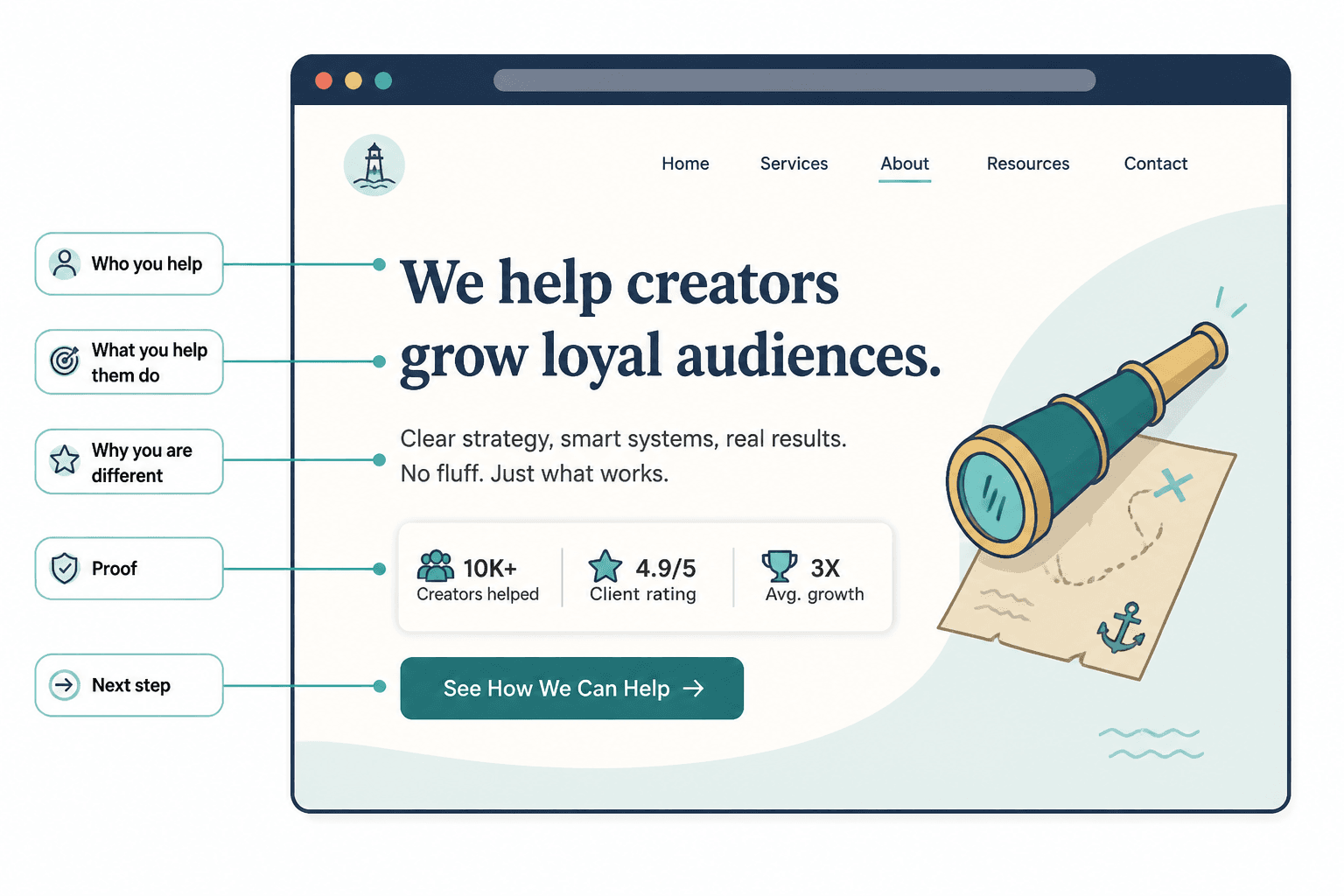
- A headline or intro that says who it is for and what you do
- A short paragraph with your approach or point of view
- A compact proof section with credentials, results, or notable work
- A simple CTA to work with you, read more, book, or inquire
That can absolutely be enough.
When longer About page copy actually makes sense
Now for the part people tend to skip: long is not bad. Unnecessary is bad.
Longer About page copy can work well when the extra detail genuinely helps a visitor believe, understand, or connect.
Longer copy usually earns its place when:
- Your work is complex or unfamiliar and needs context
- Your personal story is directly relevant to why people hire you
- Your audience is cautious and wants more trust-building detail
- Your brand is highly personality-led
- You have meaningful proof, philosophy, or differentiation worth explaining
For example, if you are a trauma-informed coach, a niche strategist with a very unusual process, or a founder with a strong body of original thinking, longer copy may help. But it still has to be structured. Length is not the problem. Wandering is.
If you are trying to figure out the right depth overall, how long About page copy should be in 2026 will help you think through length based on page purpose, not just preference.
How to shorten your About page without making it bland
This is where people overcorrect. They trim the page so aggressively it turns into a polished little brick of nothing.
The goal is not to remove all texture. The goal is to remove what is not pulling its weight.
1. Keep the strongest proof, cut the rest
You do not need every credential, every media logo, every workshop, every role you have held since 2014.
Pick the proof points that matter most to the buyer now. Usually that means:
- Relevant experience
- Clear outcomes
- Specific niche expertise
- Recognizable client or project signals
2. Cut any paragraph that could describe ten other people
Lines like these usually need to go:
- “I’ve always been passionate about helping people step into their purpose.”
- “I believe authenticity and connection are the foundation of every successful brand.”
- “My mission is to empower others to create meaningful impact.”
They are not offensive. They are just too generic to earn space.
Replace them with something more concrete:
I help consultants and small service brands turn vague website messaging into clear copy that gets more inquiries and fewer confused clicks.
3. Move interesting-but-optional detail lower on the page
Sometimes the answer is not deletion. It is sequence.
Your origin story, philosophy, and personality details may still help. They just should not block the reader from the main point. Lead with relevance. Save the deeper color for lower sections.
4. Tighten your opening first
If the first screen is doing its job, the whole page gets better.
A strong short opening usually includes:
- Who you help
- What you help them do
- A hint of how or why you are different
- A next step
That alone will outperform a lot of long About pages that spend 200 words warming up to say hello.
Before and after: long About page copy vs shorter copy
Here is a simple example.
Before
Welcome. I’m so glad you’re here. My journey into coaching began after years of navigating the corporate world, where I discovered a deep passion for helping others align with their authentic selves and create a life and business they truly love. Through many seasons of growth, challenge, and transformation, I realized my mission is to empower purpose-driven entrepreneurs to step into their fullest potential through mindset, strategy, and soulful support.
What is wrong with it? It is warm, but vague. We still do not know exactly who this is for, what kind of coaching this is, or why we should care.
After
I help service-based founders simplify their offer, sharpen their messaging, and sell with more confidence without turning their brand into motivational soup.
After years in corporate strategy and client positioning, I now work with business owners who are good at what they do but struggling to explain it clearly enough to convert.
If that’s you, start here or book a consultation.
Shorter. Clearer. More useful. Still human.
A practical framework for deciding short vs long
If you are stuck between “keep it brief” and “say more,” use this filter.
| Question | If yes | If no |
|---|---|---|
| Does the visitor already understand what you do? | Shorter usually works | Add context |
| Does your story directly affect buying trust? | Include more detail | Keep story brief |
| Is the extra copy specific and useful? | Keep it | Cut it |
| Does the page have clear proof early? | You can stay compact | Add trust signals |
| Can someone know the next step within one screen? | Good | Restructure fast |
This is the part many people miss: page length is a strategy question, not a personality test. Writing more does not make you deeper. Writing less does not make you lazy. The only useful question is whether the copy helps the visitor move closer to action.
What to include on a shorter About page
If you want the compact version, this structure works well for creators, consultants, coaches, and personal brands:
- Headline: Who you help and what you help them do
- Subhead or intro: A sharper explanation of your offer or approach
- Proof block: Credentials, results, clients, or meaningful experience
- Human detail: One brief line that adds personality without hijacking the page
- CTA: Book, inquire, read, subscribe, or view services
If you want examples of that done well, these About page copy examples for coaches, consultants, and personal brands will give you stronger models than the usual vague “I help humans thrive” parade.
Short About pages still need personality
This matters enough to say plainly: shorter copy should not sound sterile.
One reason people cling to long About pages is they are afraid short means robotic. Fair concern. But the fix is not adding six more paragraphs. It is writing with actual voice.
A single sharp sentence can do more personality work than a full section of generic self-description. A clear opinion, a distinct phrase, a slightly dry line, a specific way of describing your work — those things create texture fast.
About pages work better when they build trust with clarity instead of biography theater. A stronger through-line usually matters more than extra detail.