Most About pages are either unbearably vague or weirdly self-important.
You get the usual mess: a long personal backstory nobody asked for, a pile of identity labels, a few soft-focus values, and then absolutely no clear reason a potential client should trust you or take the next step.
That is why studying About Page Copy Examples for Coaches, Consultants, and Personal Brands actually matters. Not so you can copy someone else’s life story into your website, but so you can see what a strong About page is really doing under the hood: building trust, clarifying fit, and making the reader feel like they are in the right place.
If your About page currently sounds polished but forgettable, this will help you fix it. We are going to look at what good About page copy should include, what most people get wrong, and several practical examples you can adapt without sounding like you swallowed a branding workshop whole.
For the main guide behind this topic, visit the parent guide.
What a good About page is actually supposed to do
An About page is not just a biography page with better lighting.
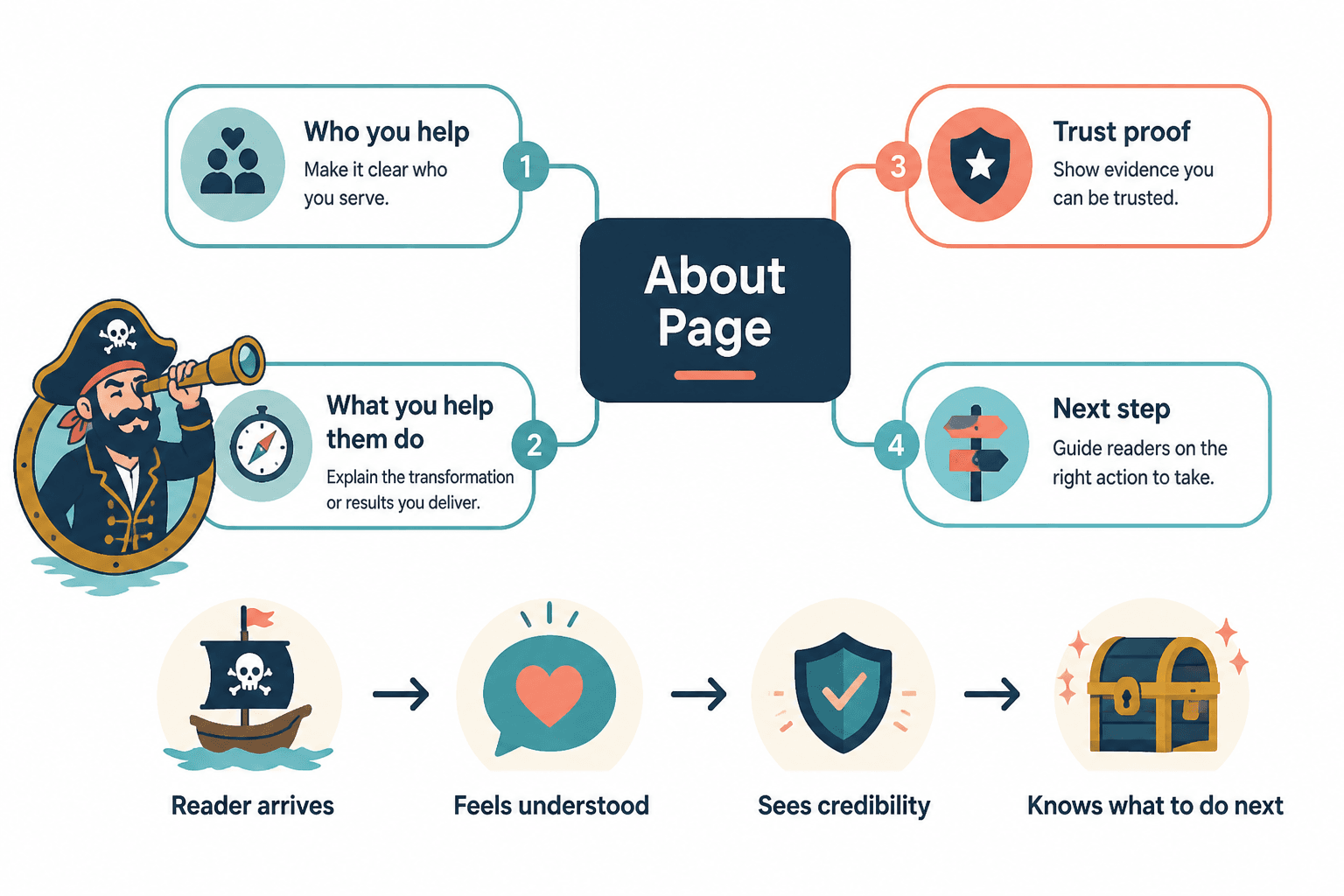
For coaches, consultants, and personal brands, it usually needs to do four jobs at once:
- Show who you help
- Explain what you help them do
- Give enough proof to feel credible
- Move the right reader toward a next step
That means your About page is part positioning, part trust page, part sales page, and part human page. Not in equal proportions, but all four matter.
And this is where people drift off course. They think “About” means “talk mostly about myself.” It does not. It means “help the reader understand who I am, why I matter to their problem, and why they should stick around.”
Yes, personality belongs here. Yes, story can help. But your story is supporting material, not the whole meal.
The anatomy of strong About page copy
Before the examples, here is the basic structure that works for most service-based experts and personal brands.
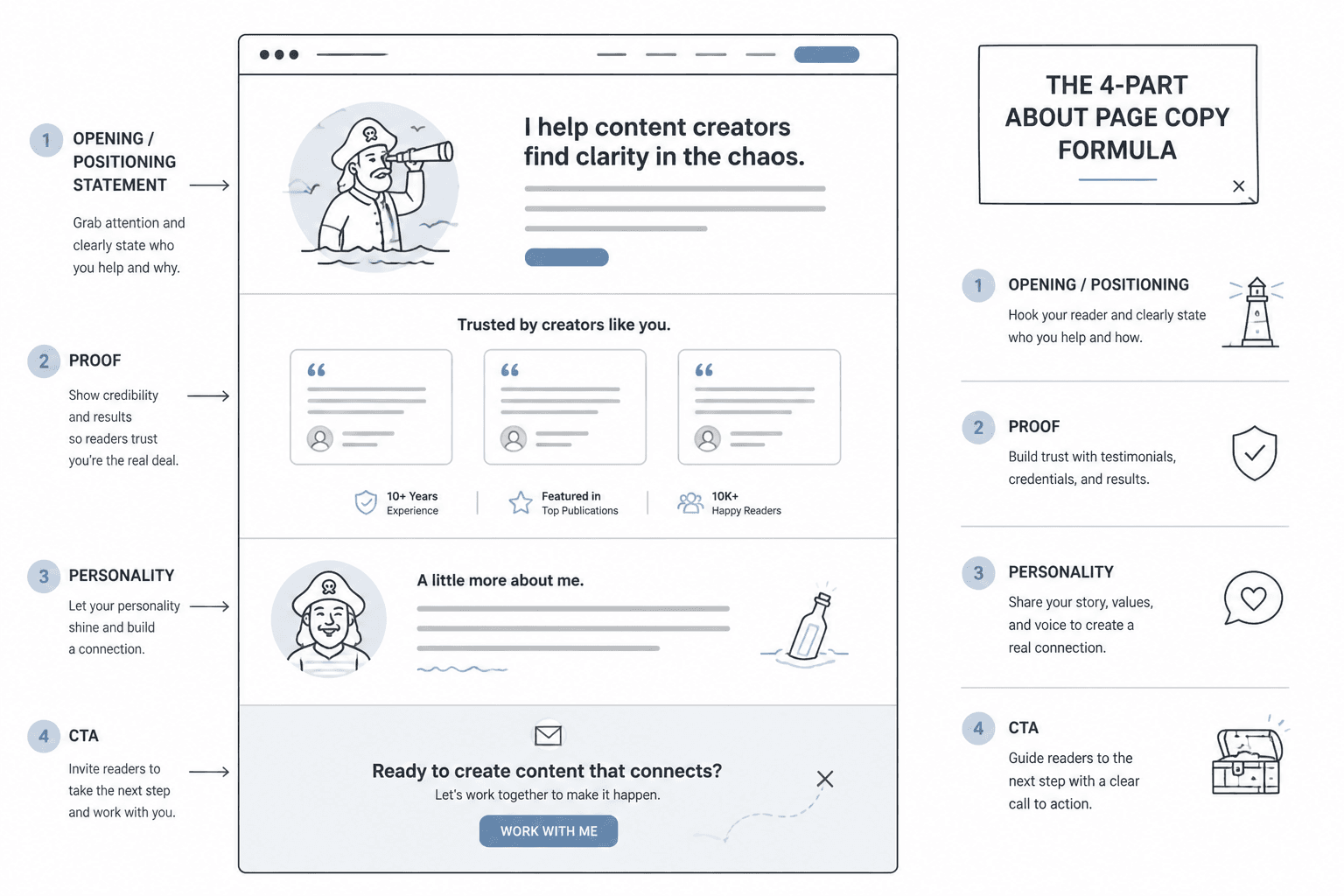
1. A clear opening
The top of the page should quickly answer:
- Who are you?
- Who are you for?
- What do you help with?
Not in a robotic formula. Just clearly enough that the right person does not have to squint.
2. A reader-centered bridge
This is where you show you understand the kind of person reading. What are they dealing with? What do they want? Why is your approach useful for that specific kind of problem?
3. Credibility without chest-thumping
You need proof. Not a TED Talk tone. Proof can include client results, years of experience, notable work, a distinctive method, featured platforms, audience size if relevant, or simply a smart explanation that shows you know what you are talking about.
4. Some actual personality
This is where you can sound like a person rather than a polished competence mannequin. A short values note, a perspective on your work, a few specific details, or even a line that shows your temperament can help.
5. A useful CTA
Your About page should not end with “Thanks for reading.” It should tell people what to do next.
If you need a stronger structure for this, the main About page copy guide is a good next stop, along with this deeper About page copy guide for creators who want better results.
What weak About pages keep doing wrong
- Leading with a vague mission statement instead of clarity
- Listing every role they have ever had
- Writing three paragraphs before saying who they help
- Using soft, fluffy language instead of concrete value
- Making the whole page about their personal journey with no reader payoff
- Adding no proof at all
- Forgetting to include a next step
A surprising number of About pages are basically résumé soup with a sunset filter.
The fix is usually not “be more creative.” It is “be clearer, more specific, and a bit more useful.”
About page copy examples by type
These are not meant to be pasted word-for-word. They are examples of structure, tone, and emphasis. Steal the logic, not the exact sentences.
Example 1: Coach About page copy
I help experienced freelancers and solo business owners simplify their offer, sharpen their messaging, and sell their work with less awkwardness.
Most of my clients do not need more ideas. They need a clearer way to explain what they do, a stronger buying path, and content that stops sounding like everyone else in their niche.
Over the last six years, I have worked with coaches, consultants, and service providers who were good at their work but far too fuzzy online. My approach is practical, honest, and built for people who want traction, not a new personality.
If you want clearer messaging, stronger positioning, and a business that feels more coherent from profile to offer, you are in the right place.
Why this works:
- It leads with who the person helps
- It describes the actual problems clearly
- It includes credibility without sounding theatrical
- It hints at personality and approach
- It positions the reader, not the writer, as the center of the page
Example 2: Consultant About page copy
I work with B2B founders and lean marketing teams that need better conversion copy, clearer offers, and fewer random acts of content.
My background spans brand messaging, website strategy, and demand-focused content systems. In plain English: I help companies say the right thing, in the right order, so more of the right people take action.
Clients usually come to me when their site sounds competent but forgettable, their content is busy but underperforming, or their offer has gotten harder to explain as the business has grown.
I bring strategy first, copy second, and fluff never.
Why this works:
- It sounds focused
- It shows business relevance quickly
- It translates expertise into reader benefit
- It uses one sharp line to add voice
Example 3: Personal brand About page copy
I write about content, positioning, and online authority for people building businesses around their expertise.
This site is for creators, coaches, consultants, and solo founders who want sharper content, clearer messaging, and a body of work that actually helps the right people trust them.
I am less interested in hacks and more interested in durable communication: clear ideas, stronger structure, better offers, and content that earns attention because it says something worth reading.
If that sounds like your kind of internet, have a look around.
Why this works:
- It is simple and audience-aware
- It gives the site a clear point of view
- It builds trust through clarity, not chest beating
- It fits a brand built around ideas and content
Before and after: boring About page copy vs stronger About page copy
Sometimes the best way to understand this is to see the bad version and the improved version side by side.
| Weak version | Stronger version |
|---|---|
| I am a passionate coach dedicated to helping people unlock their potential and live their best lives. | I help mid-career professionals make clearer career moves, communicate their value better, and stop drifting in jobs they have outgrown. |
| With a unique blend of experience and insight, I empower clients to thrive. | My work combines strategic coaching, practical decision-making tools, and honest feedback that cuts through the usual self-development fog. |
| I have always loved helping others and making an impact. | Clients usually come to me when they know something needs to change but cannot yet name the right move with confidence. |
| Feel free to reach out if you want to connect. | If you want help making a smarter next move, you can book a consultation here. |
The stronger version is not better because it is longer. It is better because it actually says something.
A simple About page template you can adapt
If you are writing from scratch, this structure is a solid starting point.
- Opening: Say who you help and what you help them do.
- Problem section: Name the issues your audience is dealing with.
- Approach section: Explain how you work or what makes your approach different.
- Credibility section: Add proof, experience, or evidence.
- Personality section: Add a few human details or a clear point of view.
- CTA: Tell the reader where to go next.
Here is a fill-in structure:
I help [specific audience] do [specific outcome].
Most of the people I work with are dealing with [problem 1], [problem 2], and [problem 3]. They are good at what they do, but [friction point].
My approach focuses on [your method or angle]. That means [practical benefit].
I have worked with [type of clients/audience], and my background includes [relevant proof].
If you are looking for [desired result], [soft CTA].
Not glamorous. Very useful. Which is a better trade than most people make online.
How to make your About page sound like you, not a copy template
This is where people get twitchy. They want structure, but they do not want to sound generic. Fair.
The trick is not avoiding structure. The trick is adding your actual voice inside a useful structure.
You can do that by changing the rhythm, using words you would really say, and adding a few lines that reflect your standards, beliefs, or working style. If you are naturally warm, sound warm. If you are more direct, be direct. If your brand has a sharper edge, fine. Just do not confuse personality with vagueness.
For example, compare these two lines:
- “I believe in empowering transformation through authentic strategy.”
- “I help people simplify messy messaging and stop hiding behind polished nonsense.”
Only one of those sounds like a person with a pulse.
If you want more inspiration, this piece on best About page copy ideas and examples for creators can help you find angles that feel less canned.
What different audiences need from your About page
Not every About page should lean the same way. A coach, consultant, and personal brand may all need slightly different emphasis.
For coaches
- Lead with the kind of client you help
- Name the transformation clearly
- Balance empathy with confidence
- Use proof carefully so it does not sound inflated
For consultants
- Show business relevance fast
- Clarify your expertise and scope
- Use credibility markers early
- Keep the page tighter and sharper
For personal brands
- Clarify the themes you cover
- Show what the audience gets from following you
- Let your perspective come through
- Connect content to offers, services, or next steps
And if your audience is still small, do not panic and start writing like a mini celebrity. You do not need an About page that pretends the whole internet is already obsessed with you. You need one that makes the right people trust you faster. This is especially true if you are building with a smaller audience, which is covered well in About page copy for creators with small audiences.
How to write a better CTA on your About page
The CTA on an About page should feel like a natural next step, not a hard swerve into funnel mode.
Good options include:
- Book a consultation
- Read the services page
- Join the newsletter
- Browse the best articles
- Get a free resource
- Reply or get in touch
Examples:
- “If you want help clarifying your messaging, you can book a strategy session here.”
- “If you are not ready for that yet, start with these articles.”
- “If you want sharper content and better positioning, join the newsletter.”
If your CTA tends to feel abrupt or too salesy, read better About page copy soft CTAs for personal brands. A softer CTA often works better here because the About page sits in that useful middle ground between interest and action.
A quick checklist before you publish
- Can a stranger tell who you help within a few seconds?
- Does the page explain what you actually do in plain English?
- Have you included some proof?
- Does the copy sound like a person, not a workshop worksheet?
- Is there at least one clear next step?
- Did you cut the parts that are only interesting to you?
That last one matters more than people think.
FAQ
How long should an About page be?
Long enough to build trust and clarity. For most coaches, consultants, and personal brands, that usually means several strong sections, not two paragraphs and not a memoir.
Should an About page be written in first person?
Usually, yes. First person tends to feel more natural and credible for personal brands and service businesses.
Should I include my personal story?
Only if it helps the reader understand your work, credibility, or perspective. Keep the parts that matter. Cut the rest.
What if I do more than one thing?
Lead with the main thing you want to be hired for. Your About page is not the place to showcase every possible identity you contain.
About pages work better when they build trust with clarity instead of biography theater. A stronger through-line usually matters more than extra detail.