
Most product and service descriptions are not weak because the offer is bad. They are weak because the copy was written from scratch in a vacuum by someone trying very hard to sound professional.
That is usually how you end up with pages full of phrases like “tailored solutions,” “high-quality support,” and “results-driven approach.” Which is a lovely way to say absolutely nothing.
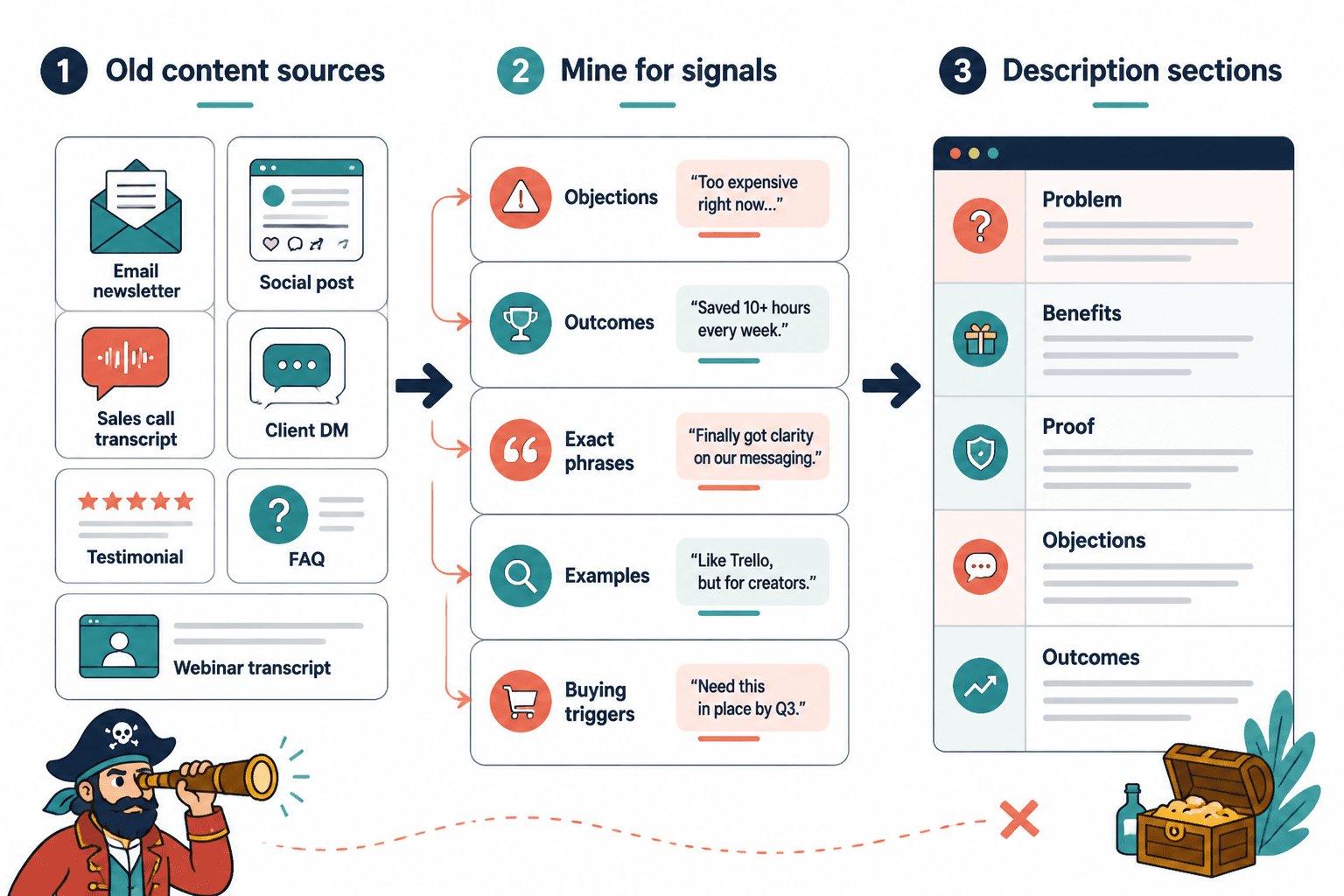
If you already have old content, you probably already have better raw material. Past posts, emails, sales calls, FAQs, client messages, workshop notes, newsletter rants, comment threads, even half-decent captions often contain the language your audience actually uses and the angles they actually care about. That is the good stuff. That is what your descriptions should be built from.
How to Turn Old Content Into Better Product and Service Descriptions is really a process of mining what already worked, spotting what people responded to, and reshaping it into clearer buying copy. Not prettier copy. Better copy. Copy that helps the right person think, “Yes, this is for me.”
Here’s how to do that without creating another beige page full of polished nothing.
To see how this fits into the wider strategy, open the parent guide.
Why old content is usually better source material than a blank page
When people sit down to write a service description from zero, they often switch into “website voice.” That voice is stiff, vague, and weirdly formal, like your business just put on a blazer and forgot how humans talk.
Old content tends to be better because it was created closer to the real problem. A post may have been written to explain a mistake. A sales email may have been written to answer objections. A client DM may contain the exact sentence someone needed to hear before buying. Even an old thread that performed well can reveal what framing made people care.
Your goal is not to recycle content lazily. Your goal is to extract the useful language and decision-making triggers hiding inside it.
- What problem did people react to most?
- Which phrases got replies, clicks, saves, or questions?
- What objections kept showing up?
- What outcomes did clients repeat back to you?
- What examples made the offer feel real instead of abstract?
That material is far more valuable than inventing “compelling copy” from a blank document and hoping for the best.
Start with the right kinds of old content
Not all old content deserves a second life. Some of it should stay in the past where it belongs. You want material that reveals audience language, buying motivation, proof, and specificity.
Best sources to pull from
- High-performing social posts
- Email newsletters with strong reply rates
- Sales call notes or transcripts
- Discovery call questions
- Client onboarding forms
- Testimonials and client feedback
- Comment sections and DMs
- Workshop recordings or webinar transcripts
- FAQ docs
- Previous sales pages that converted better than your current one
Use these carefully
- Old blog intros full of throat-clearing
- Generic mission statements
- Posts that got attention for being dramatic, not useful
- Anything written in your most corporate voice
If the old content made people nod, ask questions, or buy, keep digging. If it just sounded polished and sat there collecting dust, move on.
What to extract from old content before you rewrite anything
Do not start by copying and pasting random paragraphs into your website. First, pull out the parts that actually help someone make a decision.
A strong product or service description usually needs a few specific ingredients: the problem, the promise, the process, the proof, the fit, and the next step. Old content can feed all of those if you know what you’re looking for.
| What to extract | What it does in the description | Where it often lives |
|---|---|---|
| Problem language | Helps the reader feel seen | Posts, DMs, sales calls, comments |
| Desired outcomes | Makes the offer feel relevant | Testimonials, calls, onboarding forms |
| Objections and hesitations | Reduces friction | Sales emails, consult calls, FAQs |
| Specific process details | Makes the offer tangible | Workshop notes, SOPs, onboarding docs |
| Proof and examples | Builds trust | Client results, case-study posts, reviews |
| Exact phrases people use | Improves clarity and resonance | Replies, forms, comments, transcripts |
Read through your old content and highlight anything that sounds like a real buyer thought, fear, need, frustration, or hope. Those lines are often more persuasive than your most carefully edited “brand messaging.”
Build your description around buying decisions, not content categories
A lot of people repurpose old content badly because they organize it by format instead of function. They pull a paragraph from a post, a line from an email, a testimonial from a Slack message, and stack it all together like copy lasagna. The result is messy and strangely exhausting.
Instead, organize what you find around the questions a buyer needs answered.
- What is this?
- Who is it for?
- What problem does it solve?
- What does the result look like?
- How does it work?
- Why should I trust you?
- What should I do next?
That structure immediately makes your old material more useful. You are not “reusing content.” You are converting scattered proof and insight into decision-making copy.
A simple process for turning old content into better descriptions
1. Gather your strongest source material
Pull 5 to 10 pieces of old content connected to the offer. That might include a few posts, an email sequence, client questions, and a testimonial folder. You do not need 87 tabs open. You need enough to spot patterns.
2. Highlight repeat language and useful specifics
Look for repeated words, emotional phrases, objections, examples, and before-and-after moments. If multiple clients say some version of the same thing, pay attention. That is probably core messaging, even if you did not plan it that way.
If your audience keeps describing the problem one way and your website describes it another way, your website is probably the one that is wrong.
3. Sort what you found into description sections
- Headline or opening: strongest problem or desired result
- Who it is for: audience clues from onboarding forms or calls
- What’s included: process language from workshop notes, SOPs, or service delivery docs
- Benefits: outcomes named in testimonials and client wins
- Objection handling: concerns that came up before buying
- Proof: examples, wins, transformations, specific feedback
- CTA: the most natural next step based on your sales flow
4. Rewrite for clarity, not originality
This is where people overcomplicate things. You do not need every line to sound fresh and brilliant. You need the page to be easy to understand and easy to trust.
Clean up the language. Tighten the claims. Replace vague words with concrete ones. Keep useful phrasing from old content, but shape it into a clean reading experience. If a sentence worked in a social post but looks messy on a sales page, rewrite it. The point is to preserve the insight, not worship the original sentence.
5. Cut anything that sounds smart but says nothing
This step removes a shocking amount of fluff.
- Results-driven
- Customized solutions
- Elevate your brand
- Transform your business
- Done-with-you support
- Strategic approach
These phrases are not illegal. They are just weak on their own. If you keep one, it should be followed immediately by a concrete explanation.
Before-and-after rewrites: turning old content into better product and service descriptions
Here is where this gets practical.
Example 1: turning a social post into a service description opener
Old post line: “Most consultants do not need more content ideas. They need a clearer way to explain what they do so the right clients stop scrolling past.”
Weak service description: “I help consultants grow their online presence through strategic content marketing solutions.”
Stronger service description: “This service helps consultants clarify their message, sharpen their content, and explain their value in a way that makes the right clients pay attention instead of scrolling past.”
The stronger version keeps the useful tension from the original post. It sounds like a real problem, not brochure filler.
Example 2: turning a client question into objection-handling copy
Client question from a discovery call: “I already have offers and content, but none of it connects. Can this help me fix the messaging without rebuilding my whole brand?”
Weak description copy: “Ideal for businesses seeking brand alignment and message consistency.”
Stronger description copy: “If your offers, website, and content feel disconnected, this helps you fix the message without tearing down your whole brand and starting from scratch.”
That is cleaner, more reassuring, and much easier to understand.
Example 3: turning testimonial language into benefits
Testimonial line: “I finally had language for what made my offer valuable, and writing content got way easier after that.”
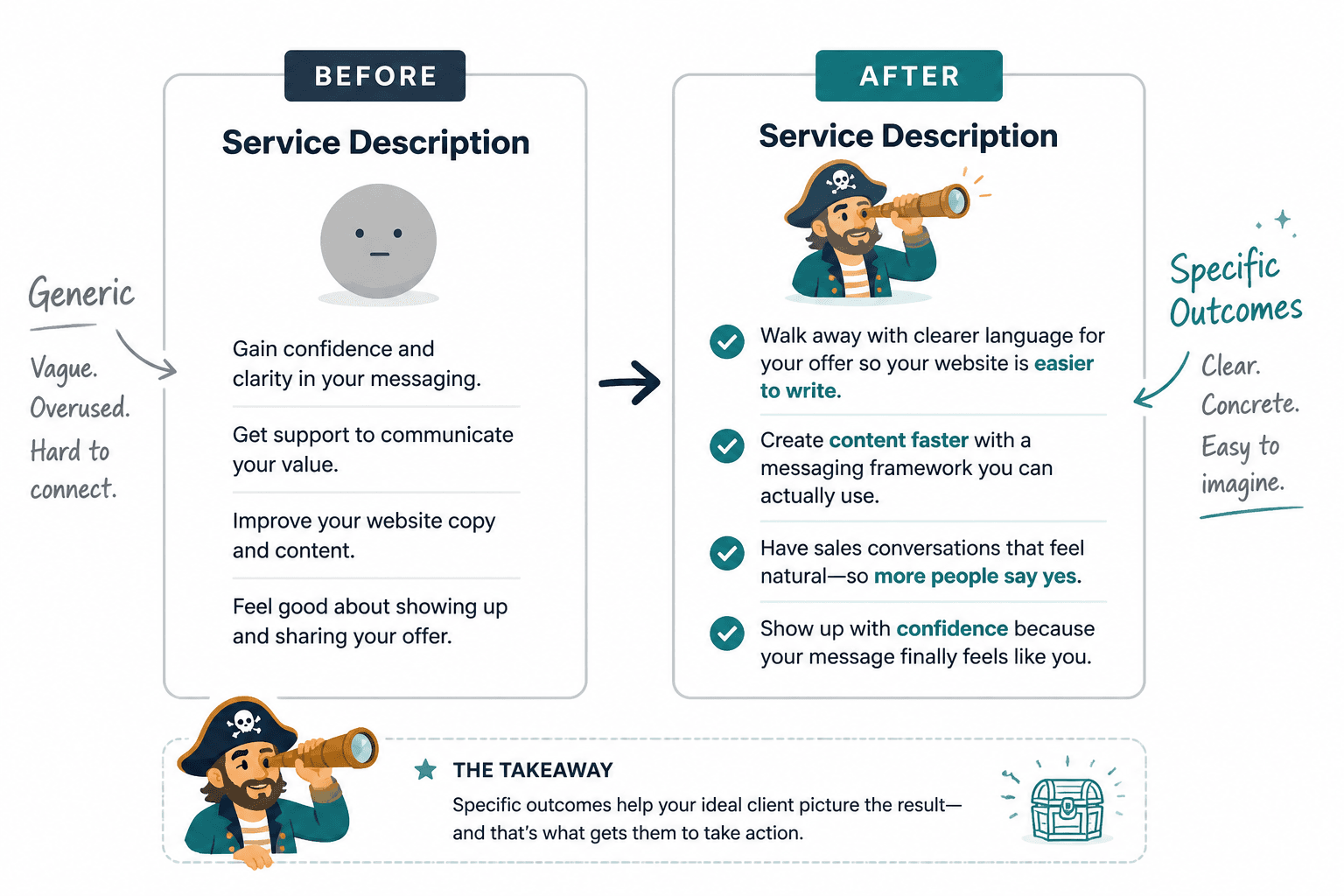
Weak benefit section: “Gain confidence and clarity in your messaging.”
Stronger benefit section: “You will walk away with clearer language for your offer, which makes your website easier to write, your content easier to create, and your sales conversations less clunky.”
Same idea. Much more useful.
What a strong product or service description should include
Once you have mined your old content, shape it into a page section or full description that actually helps someone decide. A solid description usually includes most of the following.
- A clear opener: what it is and why it matters
- Specific audience fit: who it is for and sometimes who it is not for
- Problem language: the frustrating thing they want solved
- Concrete outcomes: what changes after using or buying it
- What is included: enough detail to make it tangible
- Proof: examples, results, testimonials, patterns
- Objection handling: reassurance around common concerns
- A clean CTA: book, inquire, buy, apply, download, message
If you want a broader foundation for structuring these sections, you can also read how to write better product and service descriptions and the main product and service descriptions guide.
How to spot the strongest lines in your old content
Not every sentence deserves promotion to your website. Here is a quick filter for finding lines worth reworking.
- It names a real problem clearly.
- It sounds like something a client would actually say.
- It makes the offer more tangible.
- It adds proof, contrast, or specificity.
- It reduces confusion or friction.
Bad source lines tend to be broad, flattering, or self-important. Good source lines are specific, grounded, and useful.
This matters because your description is not there to impress people with how polished your business sounds. It is there to help the right person understand the value fast. Those are not the same thing, and a lot of websites quietly suffer because the owner keeps choosing “sounds nice” over “helps someone decide.”
Common mistakes when repurposing old content into descriptions
- Copying the content word for word. Social content and website copy do different jobs.
- Using only your own language. Client phrasing often converts better than brand phrasing.
- Keeping the clever line but losing the meaning. Style is not the point.
- Pulling from content that got attention for the wrong reason. High engagement is not always buying intent.
- Turning the page into a scrapbook. You still need structure and flow.
- Using results without context. Proof works better when attached to a clear problem or outcome.
- Forgetting the CTA. A strong description should point somewhere.
If your current descriptions feel vague, overpolished, or disconnected from what people actually ask you about, old content is often the fix. Not because old content is magical. Because it usually contains real language from real moments of interest, friction, and trust.
A practical template you can use
Here is a simple structure for turning old content into a better service or product description.
The bigger point is simple: clearer structure and clearer writing make the piece more useful. That is usually what makes the ending land better too.