
Most About pages are weirdly self-centered while pretending not to be.
They ramble through a founder story nobody asked for, stack up vague values like “authenticity” and “impact,” then end without telling the visitor what to do next. Which is impressive, in a bad way.
An About page is not just your internet biography. It is a trust page. A positioning page. A quiet sales page for people who are not ready for the hard pitch yet. If your homepage gets attention, your About page often decides what happens next.
This About Page Copy Guide for Creators Who Want Better Results will help you write a page that actually pulls its weight: clearer positioning, more trust, better fit, and a stronger path to inquiry, subscription, or sale. Not more fluff. Not a TED Talk about your childhood. Just sharper copy that makes people think, “Yep, this is probably for me.”
For the broader learning path, visit our parent guide.
What your About page is actually supposed to do
A good About page should answer a few questions fast:
- Who is this for?
- What do you help with?
- Why should I trust you?
- What kind of person or brand are you?
- What should I do next?
That is the job.
Not “tell my full life story in chronological order.” Not “sound impressive with seven abstract adjectives.” Not “prove I am passionate.” Passion is nice. Clarity converts.
For creators, coaches, consultants, solo founders, and personal brands, the About page often matters more than people think. Visitors check it when they are curious but unconvinced. They are doing a quiet background check. They want signs that you understand their problem, know what you are doing, and are not about to waste their time.
If you want a broader foundation for this topic, the main About page copy guide hub is a useful place to keep bookmarked.
Why most About pages underperform
Usually, the problem is not bad writing mechanics. It is bad priorities.
People sit down to write an About page and think, “I need to explain who I am.” Fair enough. But visitors are thinking, “Can you help me, and are you credible?” Those are not the same thing.
Here are the common mistakes:
- Starting with a generic personal intro instead of audience relevance
- Leading with your story before giving the reader a reason to care
- Using broad claims with no proof
- Listing every role you have ever had
- Writing in stiff “personal brand” language that sounds faintly AI-marinated
- Forgetting the CTA completely
- Making the page about you in a way that does not help the visitor make a decision
The fix is not to erase personality. The fix is to give your personality a job.
Personality should make the page feel human and memorable. Structure should make the page useful. You need both.
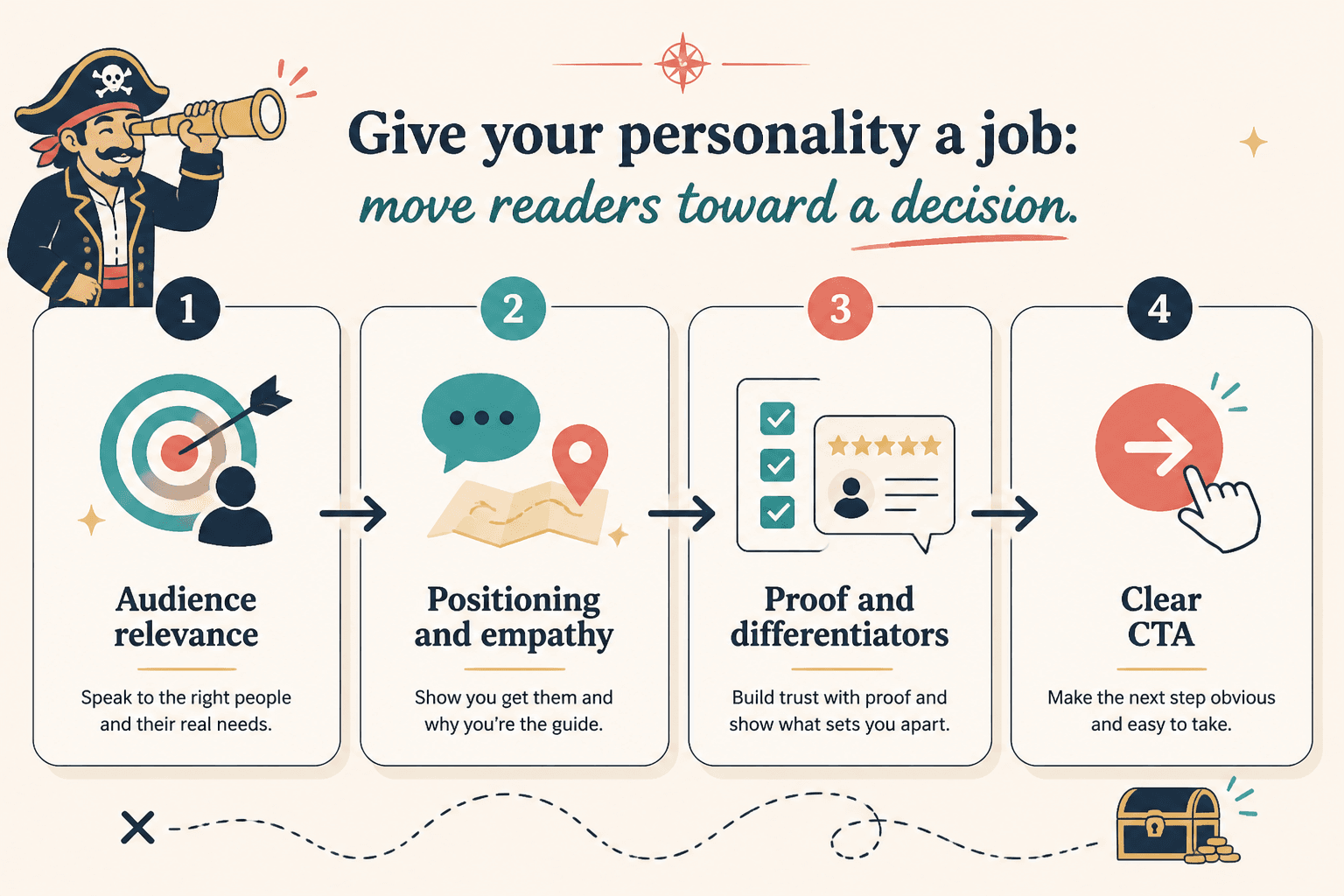
The simplest structure that works
If your About page is a mess right now, do not overcomplicate it. Start with this structure:
- A clear opening that says who you help and what you help them do
- A short section that shows you understand the audience’s problem or goal
- Your story or background, but only the parts that build relevance and trust
- Proof, process, philosophy, or differentiators
- A clear next step
That is enough for a strong About page in most creator businesses.
You do not need a dramatic hero narrative. You do not need ten headshots and an inspirational quote floating over a beige background. You need a page that reduces doubt.
A practical section-by-section framework
| Section | What it needs to do | What to avoid |
|---|---|---|
| Opening | State who you help, what you help with, and why it matters | “Hi, I’m Sarah, and I’m so glad you’re here” |
| Audience problem | Show you understand what they are dealing with | Generic pain points anyone could say |
| Your story | Build trust and relevance | Long autobiography with no point |
| Proof or method | Explain why your approach works | Big claims with no support |
| CTA | Direct the visitor to one next action | No action, or five competing actions |
How to write an opening that does not waste everyone’s time
The top of your About page matters a lot because many visitors skim before deciding whether to keep going. If the first few lines are foggy, warm, or painfully generic, they will bounce.
Your opening should answer this fast: what are you about, and why should this person continue reading?
Weak opening
Hi, I’m Jenna. I’m a creative entrepreneur, storyteller, and coffee lover passionate about helping people live more aligned lives.
This tells me almost nothing. It sounds friendly, sure. It also sounds like 4,000 other About pages.
Stronger opening
I help coaches and service-based creators turn vague expertise into clearer messaging, stronger website copy, and content that attracts better-fit clients.
Now we have something. Audience. Problem space. Outcome. Immediate relevance.
If you want, you can add one line of personality or philosophy underneath that. Just do not lead with it.
I like sharp positioning, useful words, and marketing that does not sound like it was assembled by a committee in a fleece vest.
That kind of line can help the page feel human. It works because the useful part came first.
A simple opening formula
- I help [specific audience]
- do/get/fix [specific outcome]
- through [service, approach, expertise, or lens]
Example:
I help independent consultants simplify their message, tighten their website copy, and turn more visitors into qualified inquiries.
If you need more help with structure and wording, this guide on how to write better About page copy is the natural next read.
Make the page about the reader before you make it about yourself
This is where a lot of creators miss the mark.
Visitors do want to know about you. They just want to know the parts of you that help them understand whether you are relevant, credible, and a good fit. So before you launch into your backstory, spend a little time showing that you understand what they are trying to solve.
That might sound like:
- The frustration they have with bland content or weak messaging
- The gap between their expertise and how clearly it shows up online
- The kind of results they want but have not been able to create consistently
- The type of support they are probably looking for
Example:
If your work is strong but your website still sounds vague, safe, or strangely interchangeable, that is usually not an expertise problem. It is a messaging problem. Good work gets ignored all the time when the copy around it does not carry the same weight.
That kind of section buys attention because the reader feels seen. It also creates a cleaner runway into your story and offer.
Your story matters, but only the useful parts
Yes, your About page should include your story. No, it should not include every chapter.
The best creator About pages use story selectively. They pull out the moments that explain how you think, why you care, what shaped your approach, and why your perspective is worth listening to.
Think relevance, not completeness.
Include story details that do one of these jobs
- Explain why you understand the audience’s problem
- Show what experience led to your method or point of view
- Add credibility without sounding chest-thumpy
- Make you more memorable and human
Skip story details that do none of those jobs
- Every career step you have ever taken
- Long childhood narratives with no clear tie-in
- Random personal facts because someone told you to be “relatable”
- Overwrought origin stories trying a bit too hard to be cinematic
A good test: if a detail makes the visitor more likely to trust you, remember you, or feel aligned with your approach, it stays. If it is there just because it happened, maybe not.
There is also a style point here. You do not have to write your story like a movie trailer. A plain, honest explanation is usually stronger.
After years of watching smart people with solid offers publish painfully vague websites, I started focusing less on “brand voice” as decoration and more on messaging that actually helps the right people say yes.
That works. It is grounded. It has a point. Nobody had to “discover their calling under a lavender sunset.”
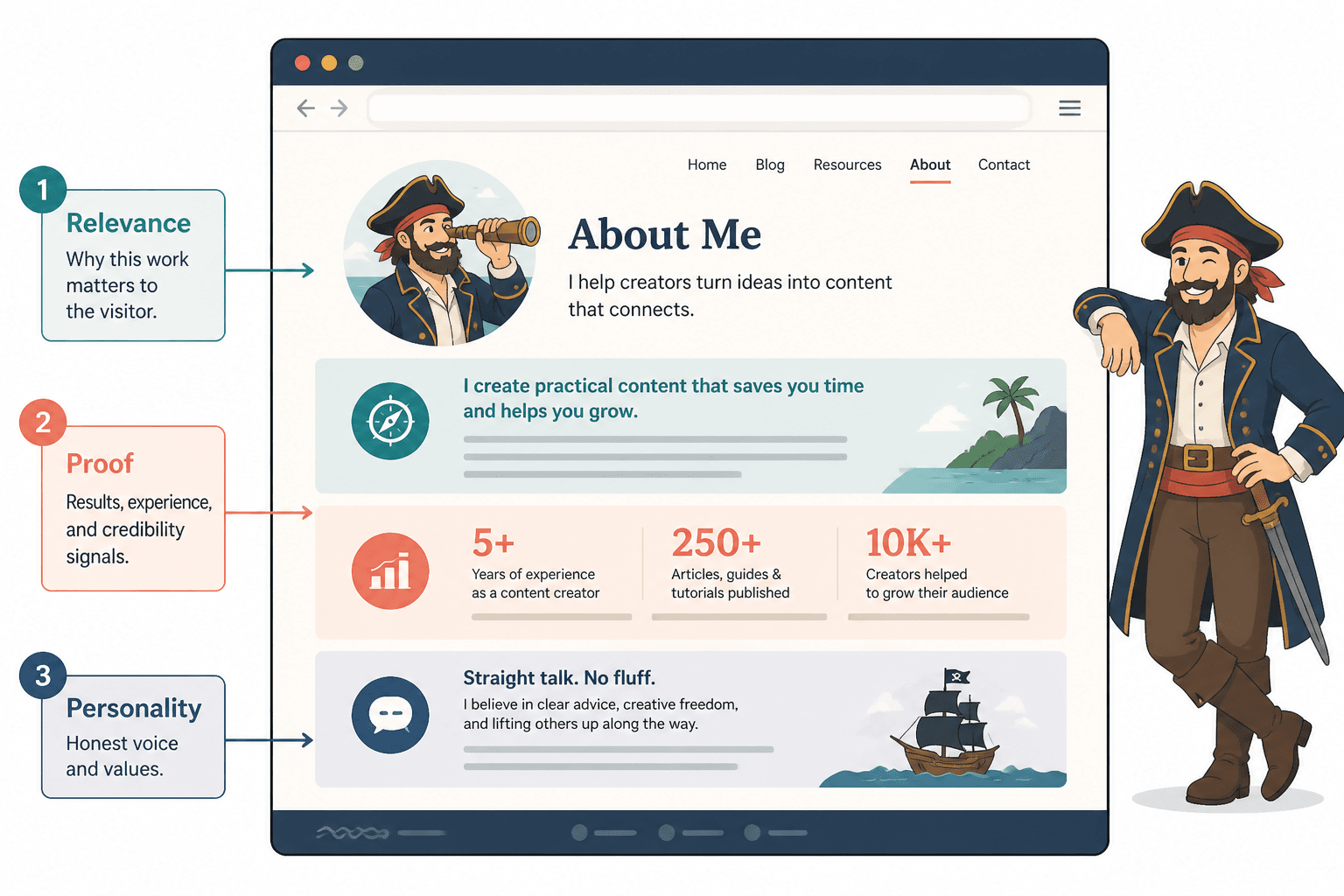
Proof is what keeps your About page from sounding like a polite fiction
Claims are cheap. Every creator site says some version of “I help people grow” or “I create results-driven strategies.” That copy slides right off the brain because it is too broad and too familiar.
Your About page needs proof.
That proof can take different forms:
- Client results
- Years or depth of experience
- Specific industries or audiences served
- Published work, audience growth, or media mentions
- A strong body of practical content
- A clear method or process
- Relevant credentials, if they matter in your field
Notice “if they matter.” Some credentials help. Some just sit there looking formal.
Weak proof line
I have helped many clients achieve transformational results.
Stronger proof line
My work has helped coaches, consultants, and service brands sharpen their messaging, improve inquiry quality, and stop sounding like slightly different versions of everyone else in their niche.
Even better if you can make it more concrete:
Over the past three years, I have rewritten websites, bios, and service messaging for coaches, consultants, and personal brands who needed clearer positioning and more qualified leads from their content.
Specificity creates trust. Not because every sentence must be packed with data, but because specific language sounds like somebody who has actually done the work.
What to include if you do not have a huge audience or giant credentials
This matters because a lot of creators freeze here.
If you do not have a massive following, famous clients, or a cabinet full of framed certificates, you can still write a strong About page. You just need to stop measuring credibility only in the loudest possible ways.
Smaller creators can build trust through:
- Clear niche focus
- Strong understanding of the audience
- A useful perspective or method
- Relevant work samples
- Case studies, even small ones
- A thoughtful, specific body of content
- Honest framing about who you help and how
Sometimes a tightly positioned creator with a small but relevant body of work feels more trustworthy than a broad creator with a giant audience and mushy messaging. Bigger is not automatically better. Bigger and vaguer is often worse.
If that is your situation, read About page copy for creators with small audiences. It will help you build trust without pretending you are already internet royalty.
Add personality without turning the page into improv night
People do not buy from robots. They also do not buy from chaos.
Your About page should sound like you, just slightly more organized and useful than you might be in a voice note to a friend. Personality helps people feel the fit. It can make your page more memorable, more likable, and less interchangeable.
Good ways to add personality:
- Your actual tone and rhythm
- A sharp opinion about your work
- A clear philosophy
- A few grounded personal details that reinforce your brand
- Small moments of humor, if that is natural for you
Bad ways to add personality:
- Random quirky facts with no purpose
- Trying too hard to sound “fun”
- Stuffed metaphors
- Performative vulnerability
- Writing the whole page like captions from a personal diary
You are not trying to entertain people into trusting you. You are trying to make trust easier.
A simple About page formula for creators
If you want a template you can actually use, here is a clean one.
1. Headline
Say who you help and what you help them do.
I help service-based creators and experts write clearer copy that earns more trust and better leads.
2. Support line
Add a little context, personality, or philosophy.
No foggy messaging. No stiff brand voice. No copy that sounds expensive but says nothing.
3. Reader relevance section
Name the problem your audience is likely facing.
If your site, bio, or content feels technically fine but still does not create much trust or momentum, the issue is usually not effort. It is clarity.
4. Your background
Share the relevant version of your story.
I started focusing on conversion copy after seeing how many smart creators were losing opportunities because their message was too broad, too polished, or too forgettable.
5. Proof or approach
Show what backs up your work.
My work focuses on positioning, messaging clarity, and practical conversion copy for creators, coaches, consultants, and personal brands who want better-fit leads, not just more traffic.
6. CTA
Tell them what to do next.
If you want help tightening your website copy, start here.
That CTA can lead to your services page, contact page, newsletter, free resource, or best starting-point page. Just pick one primary action. An About page should guide, not shrug.
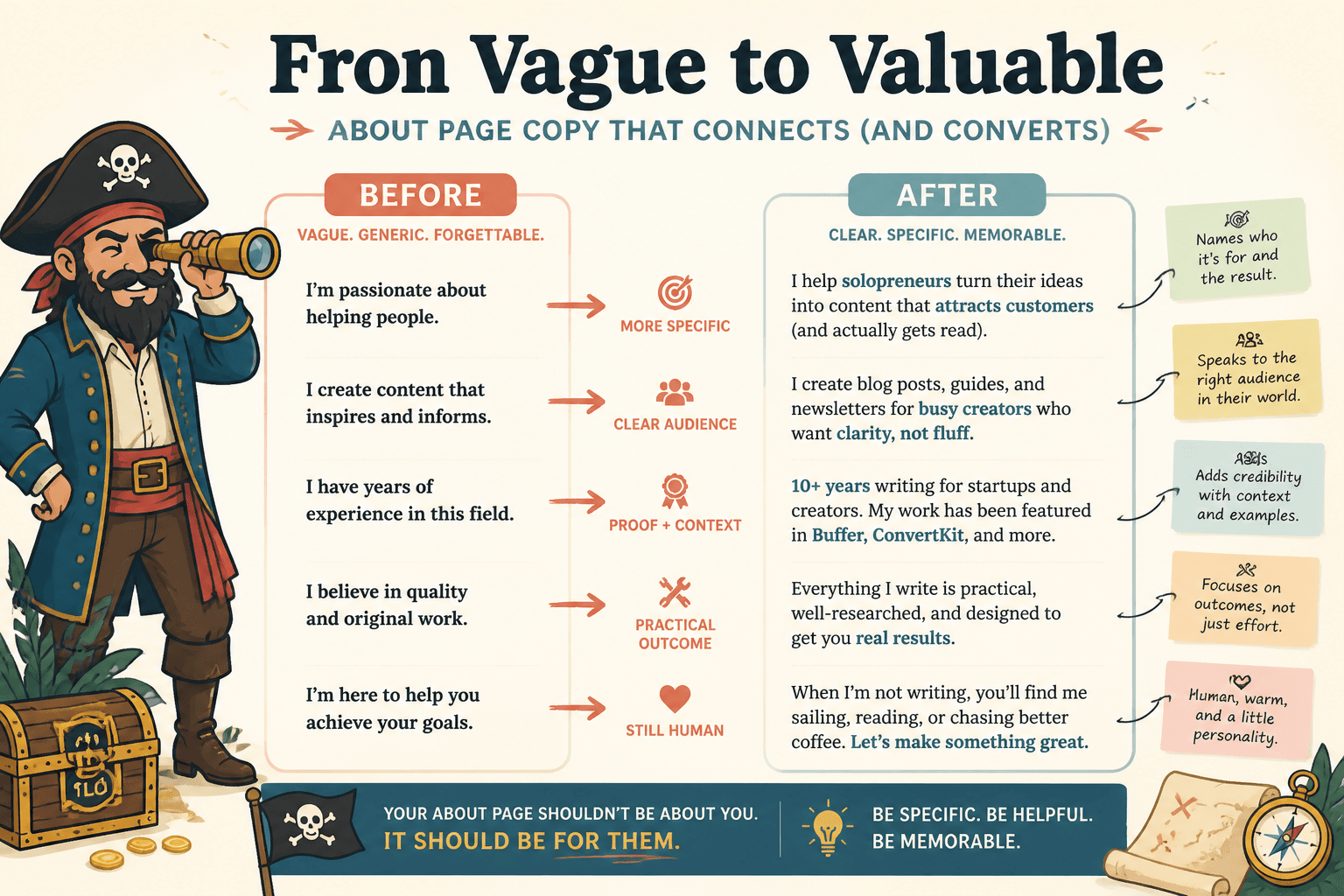
Before and after: a quick About page rewrite
Before
Hi, I’m Melissa, a multi-passionate entrepreneur dedicated to helping ambitious humans step into alignment and build businesses they love. Through mindset, strategy, and authenticity, I support my clients on their journey to greater success and fulfillment.
This is not evil. It is just foggy. We do not know who she helps, what she actually does, or why this approach is different from every other “mindset and strategy” sentence on the internet.
After
I help early-stage coaches turn scattered expertise into clearer offers, sharper messaging, and a business that is easier for the right clients to say yes to.
If your ideas are strong but your website, content, or positioning still feels fuzzy, you are probably not missing talent. You are missing clarity.
My work blends messaging strategy, offer refinement, and practical guidance for coaches who want traction without building a brand that feels fake, overcooked, or exhausting to maintain.
Better. More concrete. More useful. Still human.
If you want more examples like that, these About page copy ideas and examples for creators are worth a look, along with these About page examples for coaches, consultants, and personal brands.
What your CTA should do
A weird number of About pages end with no CTA at all, as if the writer suddenly got shy.
If someone has made it to the bottom of your About page, they are at least mildly interested. Do not make them guess what happens next.
Your CTA should fit the visitor’s likely intent. On an About page, that usually means a softer next step than “buy now.”
- View services
- Book a consultation
- Read case studies
- Join your newsletter
- Start with your best resource
- Get in touch
Examples:
- Want help tightening your messaging? See how I work.
- If you are exploring whether we are a fit, start with my services.
- Not ready to reach out yet? Read the guide that will help you fix the biggest messaging mistakes first.
Clean. Specific. Not weirdly aggressive.
Things that usually make About page copy worse
- Too many roles: writer, strategist, mentor, speaker, visionary, founder, podcaster, guide. Pick the identity that actually matters here.
- Vague audience: “helping people” is not a positioning strategy.
- Abstract promises: growth, success, alignment, impact. Fine words. Weak copy.
- Long paragraphs with no structure: most people are scanning before they commit.
- Fake relatability: random mentions of coffee, dogs, and “wearing many hats” do not create trust by themselves.
- No proof: if your page could belong to anyone in your niche, it is not doing enough.
- No next step: attention with no direction is just a nice little dead end.
If your page has three or four of those at once, that would explain a lot.
A practical checklist before you publish
- Can a new visitor tell who this is for within a few seconds?
- Does the page explain what you help with in concrete terms?
- Have you shown audience understanding before diving into your story?
- Does your story feel relevant instead of exhaustive?
- Have you added proof, specifics, or a clear method?
- Does the page sound like a human, not a networking event brochure?
- Is there one clear CTA?
- Could at least one section be tightened by 20 percent?
That last one matters more than people think. Most About pages improve immediately when you cut the throat-clearing and keep the useful stuff.
FAQ
How long should an About page be?
Long enough to build trust, short enough to keep momentum. For most creators, a few clear sections is enough. You do not need a novella.
Should my About page be written in first person?
Usually yes. It feels more human. Third person can work if your brand is more editorial or company-led, but first person is often better for personal brands and solo businesses.
About pages work better when they build trust with clarity instead of biography theater. A stronger through-line usually matters more than extra detail.