Most creators with small audiences make the same mistake on their About page: they write like they need to impress strangers instead of help the right people feel understood.
So the page ends up full of broad identity fluff, a life story nobody asked for, and lines like “I’m passionate about helping people step into their next level.” Which is lovely, I guess. It is also useless.
About Page Copy for Creators With Small Audiences needs to do a slightly different job than About copy for bigger brands. You do not have massive social proof doing the heavy lifting. You do not have a flood of traffic. You cannot afford vague.
Your About page has to build trust fast, make your work feel relevant, and give people a clear reason to stick around. If your audience is still growing, that matters even more. A smaller audience is not a weakness here. It just means your copy needs to be sharper, more specific, and less interested in sounding impressive.
Here’s how to write an About page that makes a small audience feel like an advantage, not a disclaimer.
For the full path around this topic, head to the parent guide.
What small-audience creators actually need their About page to do
If you are a creator, coach, consultant, writer, or solo founder with a modest audience, your About page is not there to prove you are internet famous. Good. That would be a terrible strategy anyway.
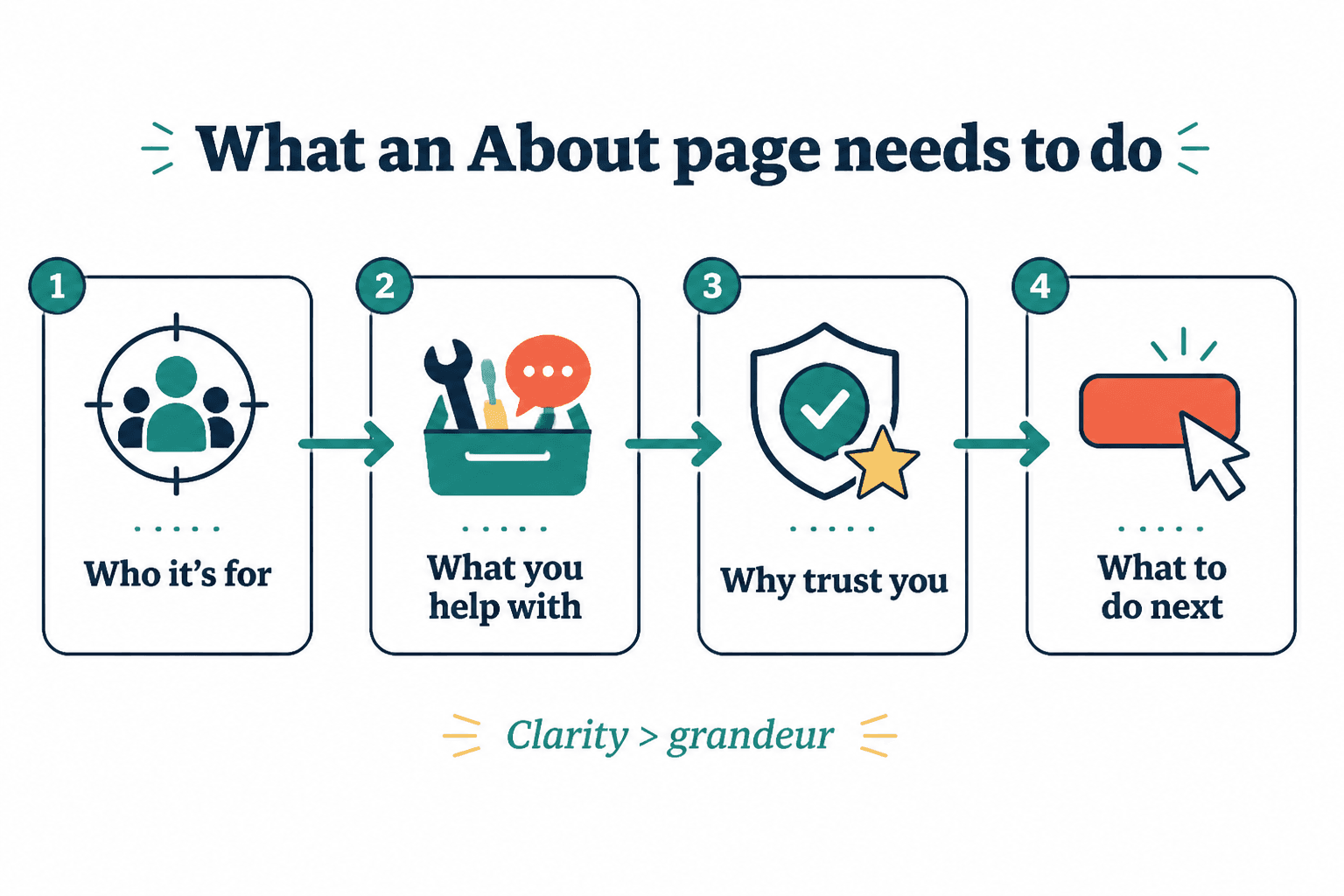
Its real job is to answer four questions quickly:
- Who is this for?
- What do you help with?
- Why should I trust you?
- What should I do next?
That is the core. Not your childhood. Not your favorite coffee order. Not a wandering origin story that takes 600 words to reveal what you actually do.
For small creators, clarity beats grandeur. Relevance beats polish. Specificity beats “personal brand vibes.” If someone lands on your About page and still has to guess whether you can help them, the copy is not doing its job.
Why most About pages underperform
The usual problem is not that the page is too short or too long. It is that the copy is built around the wrong center of gravity.
A weak About page is often too focused on the creator’s identity and not focused enough on the reader’s decision. The visitor is trying to figure out one thing: Is this person relevant to me? Your page keeps answering a different question: How can I sound accomplished online?
That gap is where trust leaks out.
Here are the usual offenders:
- Opening with vague mission statements
- Listing too many roles and offers
- Using soft, generic language with no clear audience
- Hiding credibility because you think you are “not big enough yet”
- Making the whole page a biography instead of a buying-confidence page
- Forgetting to tell readers what to do next
If your audience is small, the fix is not pretending to be bigger. It is making your value easier to trust.
The best structure for About Page Copy for Creators With Small Audiences
You do not need a clever structure. You need one that works. A simple About page for a small-audience creator usually needs six parts.
1. A clear opening that says who you help and what you help with
This is not the place for mystery. Your first few lines should make the page instantly legible.
Weak: “I’m a multi-passionate creator building a life and business around authenticity, impact, and aligned growth.”
Better: “I help coaches, consultants, and solo creators turn fuzzy expertise into clear website and content copy that earns more trust and better leads.”
The second one tells the reader where they are. The first one tells them you have visited Instagram.
2. A short section that shows you understand the reader’s problem
This is where you build resonance. Not fake empathy. Actual recognition.
You want the reader thinking, “Yes, that is exactly the mess I’m in.”
For example:
If your site sounds vague, overly polished, or like three different businesses wandered into one homepage, people do not feel confident. They feel confused. My work is about fixing that without turning your brand into bland corporate oatmeal.
3. A credibility block that does not rely on having a huge audience
This part matters a lot for smaller creators, because many of them either skip credibility entirely or think credibility only means massive numbers.
It does not.
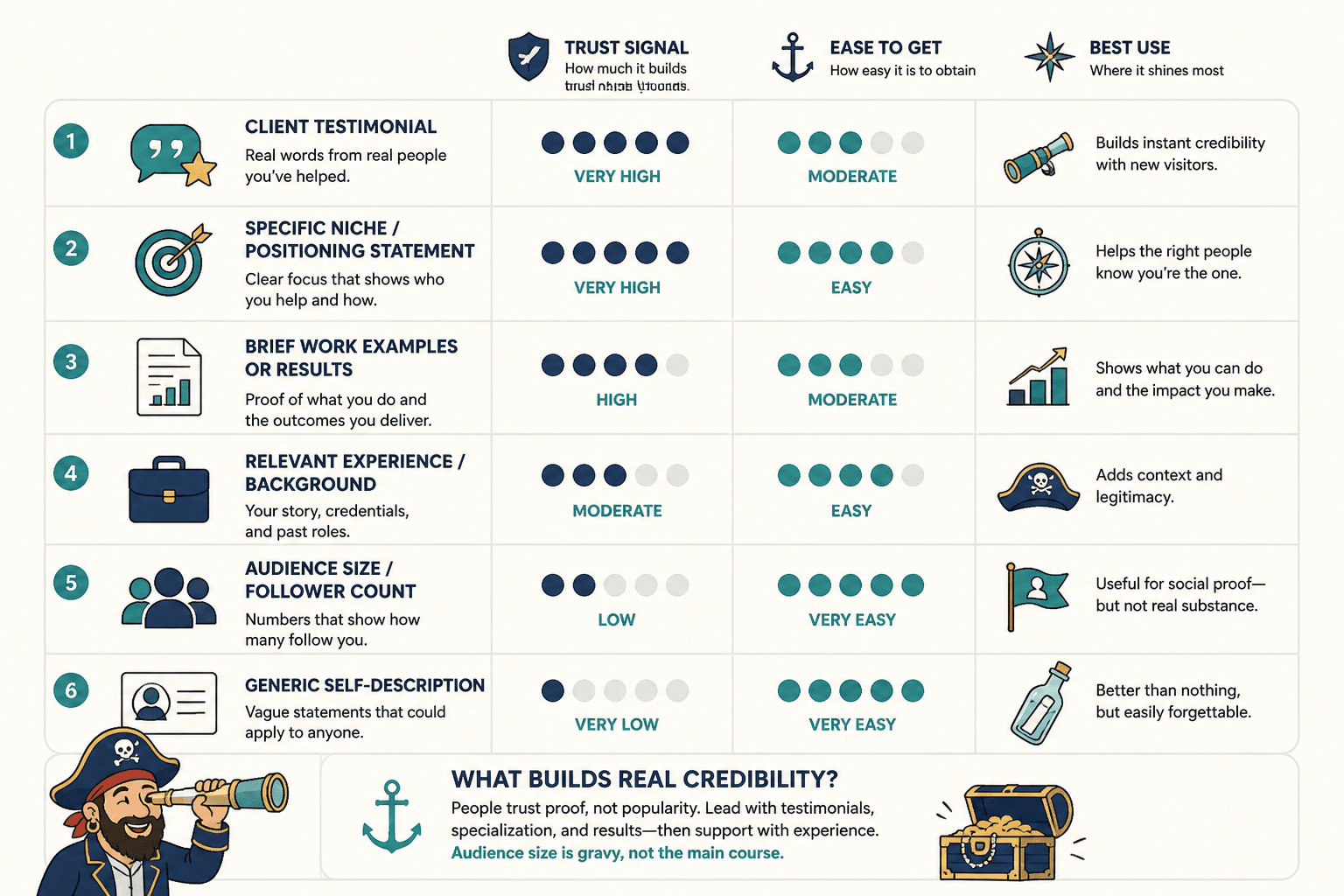
Credibility can come from:
- Client results
- Years of work in the space
- Specific projects completed
- Relevant background or industry experience
- Well-known types of clients served
- Sharp, concrete philosophy that shows expertise
- Testimonials
- Published work, speaking, features, or collaborations
If you want help building this section, simple credibility block templates can make it much easier to stop overthinking it.
And yes, you can use small proof. “Helped 12 coaching clients clarify their website messaging” is far more believable and useful than “Empowering visionary leaders to amplify impact.” One of those sounds like work. The other sounds like a tote bag.
4. A more personal section with a point
You are allowed to sound human here. In fact, you should. But the personal part still needs a job.
The point is not “share facts about yourself.” The point is “show the kind of person and perspective your right-fit audience will want to work with.”
That might include:
- How you think about your work
- Why you care about this specific problem
- What you refuse to do in your process
- What clients tend to appreciate about working with you
This section is where personality belongs. Not sprayed randomly across every line.
5. A simple explanation of what happens next
After reading your About page, visitors should not need to go on a scavenger hunt.
Tell them what to do next:
- Read your services page
- Book a call
- Browse your portfolio
- Join your newsletter
- Read a useful guide
Pick one primary next step. Two at most. Tiny audiences do not benefit from extra friction.
6. Optional proof or FAQ near the bottom
If you need to handle common objections, this is a good place. Keep it clean and practical. A quick testimonial strip, a few proof points, or a short FAQ can do a lot of work here.
For broader strategy and page structure, this About page copy guide for creators who want better results pairs well with what you are building here.
What to say when you do not have giant social proof yet
This is where a lot of creators freeze. They assume they need huge metrics, major press, or hundreds of clients before they are “allowed” to sound credible.
You do not.
You just need to stop treating credibility like a celebrity ranking.
If your audience is small, try using proof in these forms:
- “I’ve helped service-based creators simplify confusing messaging and turn it into clearer pages, offers, and content.”
- “My background in editing and brand messaging shapes how I approach conversion copy: clear first, clever second.”
- “Clients usually come to me when their site sounds polished but not persuasive.”
- “My work focuses on trust-building copy for small service brands that do not want to sound generic or overhyped.”
Notice what is happening there. You are not pretending to be bigger than you are. You are showing pattern recognition, useful specialization, and real-world context. That is often enough to make the right person think, “Okay, this person gets it.”
Also, if you have testimonials, use them. Even one or two strong ones. Small-audience creators often hide perfectly decent proof because they think it is “not enough yet.” Meanwhile, visitors are trying to evaluate risk. Give them something to work with.
How to make your About page feel specific without sounding stiff
Some creators hear “be clear” and immediately write like a tax form. That is not the goal.
The sweet spot is clarity with texture. You want readers to understand what you do, who it is for, and what makes your approach distinct, without sounding like a robot who recently learned the word “strategy.”
Three ways to do that:
Use concrete language
Swap abstractions for things people can picture.
Vague: “I help people communicate their brilliance.”
Specific: “I help consultants and creators rewrite muddled website copy so visitors understand the offer, trust the expertise, and know where to click next.”
Name the mess, not just the dream
Dream outcomes matter, but readers trust you faster when you can describe the actual problem in front of them.
Examples:
- Your homepage sounds polished but generic
- Your About page talks about you without helping the reader decide
- Your site feels like three offers fighting in a trench coat
- Your copy is technically fine but not persuasive
Let your standards show
Strong About pages often include a line or two that reveals how you think.
For example:
I do not write copy that tries to sound “premium” by becoming unreadable. Clear sells better.
That kind of sentence gives readers a feel for your approach. It is memorable because it has a spine.
A practical About page framework you can steal
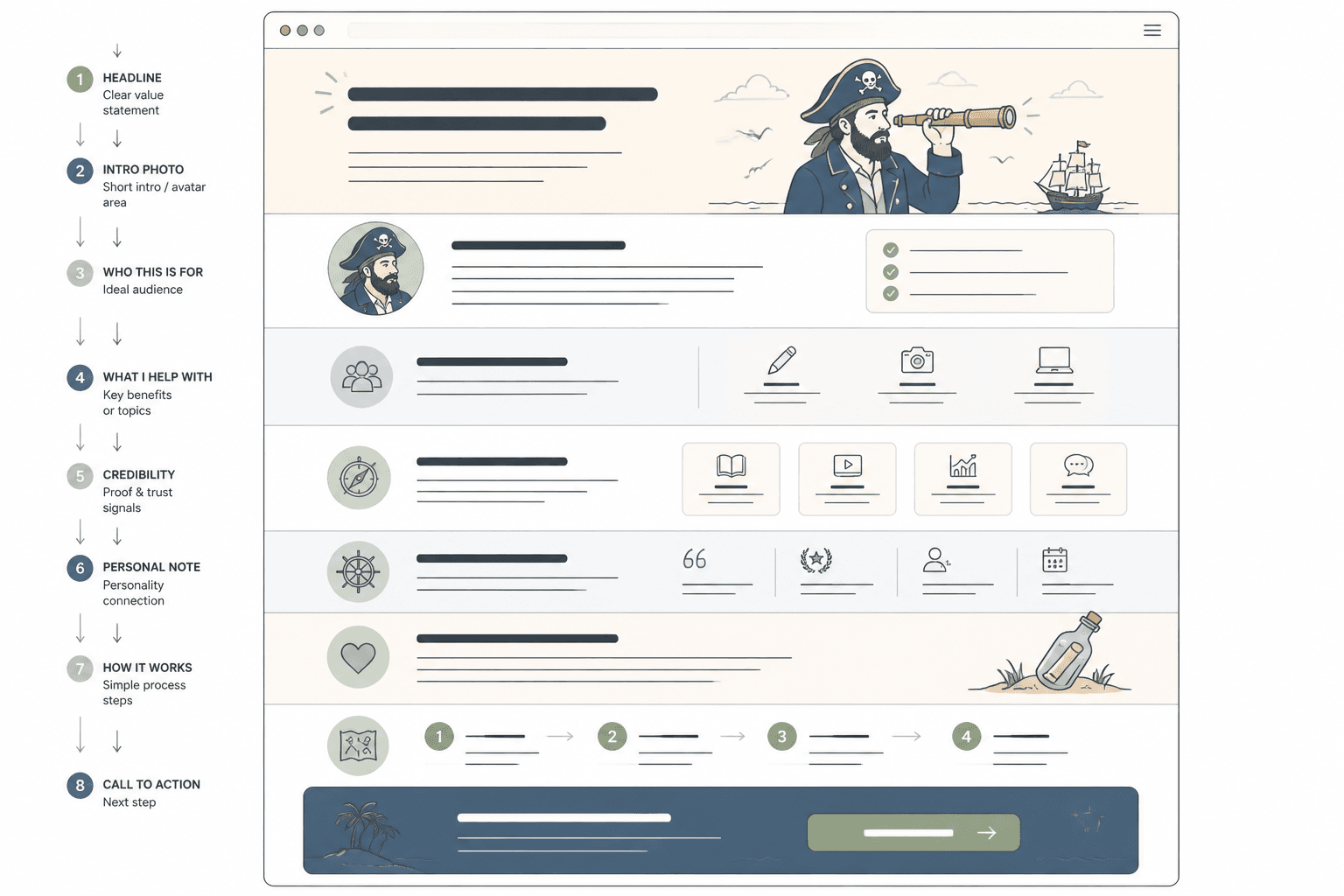
If you want a simple working draft, use this structure:
- Headline: who you help and what you help with
- Intro paragraph: the problem you solve and why it matters
- Credibility section: proof, experience, approach, or client context
- Personal section: your perspective, style, or reason for caring
- Offer bridge: what kinds of help, services, or resources you provide
- CTA: the next best step
Here is a stripped-down example:
I help small service-based creators write clearer website copy, stronger About pages, and sharper messaging that builds trust faster.
If your site sounds decent but not convincing, that is usually a messaging problem, not a design problem. People need to understand what you do, who it is for, and why your approach is worth paying attention to.
I work with coaches, consultants, writers, and solo brands who want copy that sounds smart without sounding stuffed with buzzwords. My background in messaging and conversion-focused content shapes how I help clients simplify the story, sharpen the offer, and make the next step obvious.
I care about clear copy because vague brands lose good-fit clients every day. Not because they are bad at what they do, but because their site never quite makes the case.
If you want help tightening your messaging, start with the About page examples or get in touch to talk about your site.
It is not flashy. It does not need to be. It is clear, grounded, and useful.
Common About page mistakes small creators should stop making
- Writing for everyone. If your page could apply to a designer, a mindset coach, a branding agency, and a copywriter all at once, it is too vague.
- Leading with your life story. Personal context can help, but only after the reader knows why they should care.
- Hiding proof. Small proof is still proof.
- Overusing adjectives. “Intentional, impactful, authentic, aligned” is not copy. It is decorative fog.
- No CTA. If the page ends with “thanks for being here,” that is polite, not persuasive.
- Sounding weirdly formal. You do not need courtroom energy on an About page.
If you want to study stronger models, these About page ideas and examples for creators and About page examples for coaches, consultants, and personal brands can help you see what good specificity looks like in practice.
What your About page can do that your social audience size cannot
A lot of creators underestimate this page because they assume audience size is the main trust signal. It is not. Not on your website.
Your About page can do things your follower count cannot:
- Show how clearly you think
- Frame your work in a way that attracts better-fit people
- Turn scattered proof into a stronger case
- Make your personality feel grounded instead of random
- Guide a visitor toward action
That matters because many small-audience creators are quietly more qualified than louder people online. They just have weaker packaging. And yes, that is fixable.
For a broader look at this content category, you can also explore the About page copy hub and the wider website conversion copy section.
Quick FAQ
How long should an About page be for a small creator?
Long enough to create trust and move the reader forward. Usually that means more than a tiny bio, but less than a memoir. For most creators, 400 to 900 words is a solid working range.
Should I mention that I have a small audience?
Usually no. Do not lead with your perceived disadvantage. Lead with relevance, proof, and clarity.
What if I do not have testimonials yet?
Use other forms of proof: experience, project types, background, sharp specialization, process clarity, or concrete examples of what you help fix.
Should my About page be personal?
Yes, but with a purpose. Personality helps. Random autobiography does not.
Write the page that makes your small audience feel focused, not lacking
About pages work better when they build trust with clarity instead of biography theater. A stronger through-line usually matters more than extra detail.
About pages work better when they build trust with clarity instead of biography theater. A stronger through-line usually matters more than extra detail.