
Most Facebook comment CTAs do not fail because asking for comments is bad. They fail because the ask is lazy, badly timed, weirdly needy, or clearly there to juice engagement instead of start a real conversation.
And Facebook readers can smell that from a mile away.
If you write Facebook long-form posts or rants, the ending matters more than people think. A strong post can lose momentum in the final two lines if the CTA feels bolted on, desperate, or copied from some engagement template graveyard. A weak one can make the whole post feel less honest than it was five seconds earlier.
Here’s how to spot the Facebook comment CTA mistakes that hurt performance, and what to do instead if you want better comments, stronger discussions, and posts that do not die the moment the scroll resumes.
If you want the broader context for writing stronger posts in this format, start with Facebook long-form and rants. You might also want the wider social media writing and Facebook writing hub if you are building a bigger content system instead of fixing one post at a time.
To see how this fits into the wider strategy, open the parent guide.
Why comment CTAs matter more on Facebook than people admit
On Facebook, especially with long-form posts and opinion-led rants, comments are not just a vanity metric. They are part of the experience. A good comment section extends the post. It adds examples, disagreement, nuance, jokes, stories, and proof that the topic actually hit a nerve.
That means your CTA is not just there to “increase engagement.” It is there to shape the kind of response your post earns.
A good comment CTA can:
- pull the right people into the conversation
- invite stories instead of one-word replies
- help readers apply your point to their own situation
- surface objections or friction you can use in future content
- make the post feel alive instead of finished and dead on arrival
A bad one does the opposite. It cheapens the post, lowers the quality of replies, and makes your whole thing feel a bit too “please clap.”
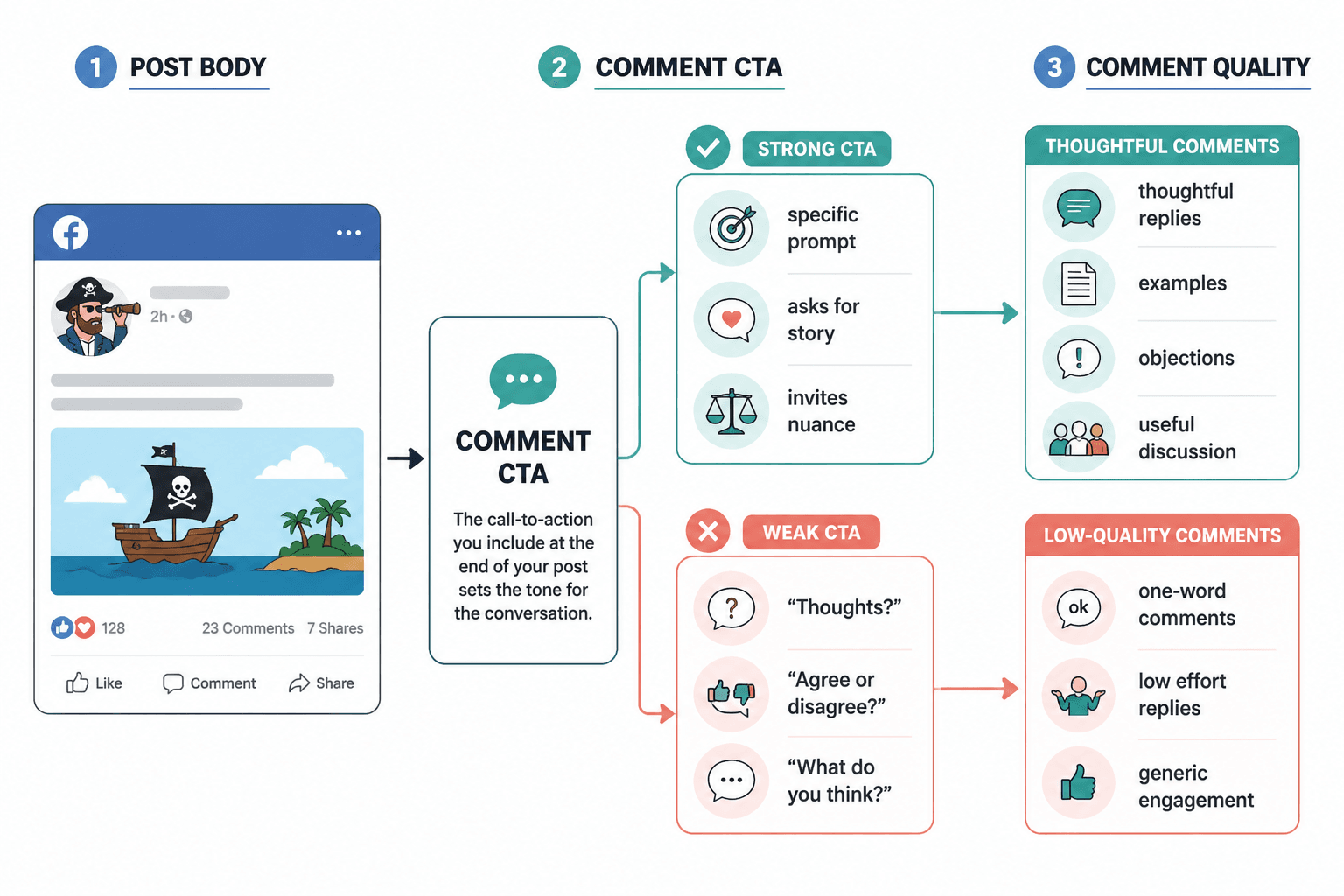
Facebook comment CTA mistakes that hurt performance
1. Asking for comments with no real reason to comment
This is the classic:
Thoughts?
Or:
Agree or disagree?
Or the truly magnificent non-question:
What do you think?
The problem is not that these are short. The problem is that they ask people to do the work of finding the angle. Most readers will not do that. They will either keep scrolling or leave a low-effort reply that adds nothing.
If you want comments, give readers something specific to react to.
Weak: What do you think?
Better: Which part of this is hardest in your business right now: staying consistent, finding a real angle, or ending posts without sounding like a pitch?
The second version gives people handles. That matters.
2. Using generic engagement bait that feels fake
Some CTAs are basically social media slot machines.
- Comment YES if this resonates
- Drop a 🔥 if you agree
- Type “guide” and I’ll send it
- Comment 1, 2, or 3
Now, to be fair, some of these can work in certain contexts. If you are delivering a resource and the exchange is clear, simple, and genuinely useful, a keyword CTA is not automatically evil. But on Facebook long-form and rants, especially personal-brand content, these often feel mechanical. They turn a real opinion into a cheap funnel move.
Readers came for a thought, a story, or an argument. If the ending suddenly sounds like an exhausted webinar script, trust drops a little.
If you do use a keyword CTA, make sure the post actually earns it and the offer is worth the interruption. Otherwise, ask for a real response instead of a ritualized keyword sacrifice.
3. Asking a broad question after a specific post
This mistake is sneaky. The post itself may be sharp, opinionated, and focused. Then the CTA goes vague.
For example, imagine you wrote a post arguing that most brand voice advice makes people sound polished and forgettable. Good. Strong point. Then you end with:
How do you approach content creation?
That is far too wide. The post was narrow. The question should be too.
Try:
What is one phrase you keep seeing in content that instantly makes it feel generic?
Now people know what lane to stay in. You are still inviting discussion, but you are not dumping them into an empty parking lot and calling it conversation.
4. Ending with a CTA that breaks the emotional tone
This one hurts good posts all the time.
If your rant is thoughtful, frustrated, honest, or reflective, the CTA should match that energy. If you end a serious post with something chirpy and formulaic, it feels off.
Example:
Post tone: nuanced, slightly sharp, based on experience
Bad CTA: Let me know your thoughts in the comments below 👇
That line sounds like it wandered in from a completely different writer.
A better version might be:
Curious if you have noticed the same thing, or if your experience has been different.
Same basic function. Much more human. Much less template-coated.
5. Turning every post ending into a disguised sales move
People are not stupid. They can tell when your “conversation starter” is really just a trap door into your offer.
If every post ends with some version of:
- Comment if you want help
- DM me if this sounds like you
- Reach out if you need support
- I help people with exactly this
then your audience starts reading your posts with their guard up. Even useful content begins to feel like pre-sales fog.
That does not mean you can never connect content to business. You should. But not every rant needs to end with you standing in the doorway holding a calendar link.
Sometimes the best CTA is just a good conversation. That conversation builds trust. Trust is usually what makes the sales part easier later.
6. Asking for opinions when the post really needs stories
Opinion questions often get thin replies. Story prompts usually get better ones.
If your post is based on lived friction, pattern recognition, or real client-side messiness, ask readers for examples from their own world.
Thin CTA: Do you agree?
Stronger CTA: Have you had a moment where a post was useful but still got ignored because the framing was too bland?
That second question gives people something to retrieve from memory. Memory creates better comments than abstract agreement does.
7. Making the comment CTA too demanding
Not every reader has the time or energy to write a mini essay under your post. If the ask is too heavy, fewer people will respond.
You need enough specificity to guide the response, but not so much complexity that commenting feels like homework.
Too much: Share your complete framework for handling objections in your long-form Facebook content, with examples.
Better: What objection do you hear most often when you talk about your work?
Keep the door open. Do not install a gate with a clipboard.
8. Repeating the same CTA on every post
If all your posts end the same way, readers start skimming the last lines. They know the move already.
This is especially common with creators who have one comfortable CTA and use it forever. The result is stale endings and stale comments.
Rotate your CTA style based on the post:
- question CTA
- story prompt
- contrast prompt
- experience check
- practical challenge
- quiet reflective close with no CTA at all
Yes, no CTA at all is sometimes the right call. Not every post needs to beg for a response. Some posts naturally invite comments because the point is strong enough. Funny how that works.
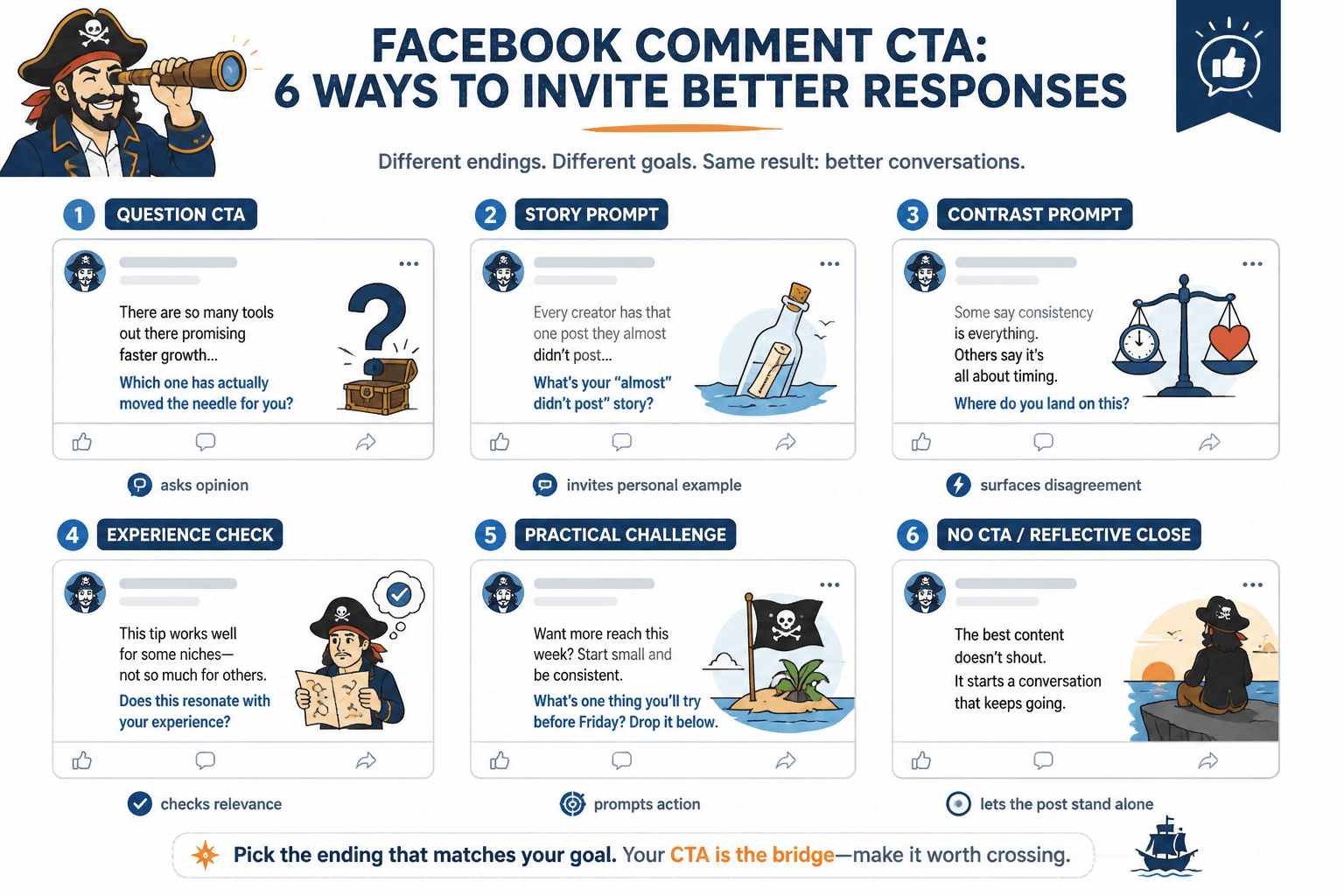
How to write a better Facebook comment CTA
A useful Facebook comment CTA usually does three things:
- matches the tone of the post
- gives the reader a specific angle to respond to
- invites a response that is easy to give but meaningful enough to matter
That means the best CTA is often built from the post itself, not pasted on after the fact.
A simple framework
- Find the sharpest point in the post. What is the real tension, complaint, lesson, or pattern?
- Choose the kind of response you want. Opinion, story, confession, example, disagreement, pattern, question?
- Ask one focused question. Not three. Not a buffet.
- Make it sound like you. If your whole post is grounded and direct, your CTA should be too.
That is it. Simple beats fancy here.
Examples of stronger Facebook comment CTAs
Here are some better options for long-form posts and rants:
- Pattern prompt: What version of this are you seeing in your own niche right now?
- Experience prompt: Have you run into this with clients or audiences too, or is this more specific to my corner of the internet?
- Story prompt: What is one moment where this clicked for you the hard way?
- Contrast prompt: Which matters more in your experience: stronger ideas or stronger packaging?
- Friction prompt: What part of this is hardest to do consistently?
- Disagreement prompt: If you think I am wrong on this, I am genuinely curious where your experience differs.
Notice what these have in common. They sound like real conversation. Not a growth hack in a blazer.
Match the CTA to the kind of post you wrote
| Post type | Best CTA style | What to avoid |
|---|---|---|
| Opinion rant | Disagreement or pattern prompt | “Thoughts?” |
| Personal lesson | Story prompt | Generic agreement bait |
| Practical how-to | Friction or implementation question | Broad philosophical questions |
| Industry critique | Experience check or specific example request | Emoji comments |
| Reflective post | Quiet, open-ended but focused question | Hard sales CTA |
This is where a lot of people go wrong. They treat comment CTAs as interchangeable. They are not. The right CTA for a spicy rant is usually not the right CTA for a practical teaching post.
The bigger point is simple: clearer structure and clearer writing make the piece more useful. That is usually what makes the ending land better too.