
Most people ruin Facebook long-form posts and rants at the exact moment they try to monetize them.
The post works. It gets comments. People clearly care. Then comes the ending: a clunky pitch, a needy “DM me if you want to work together,” or a random link drop with all the grace of a folding chair hitting concrete.
That is not a funnel. That is a vibe collapse.
The best funnel ideas to pair with Facebook long-form & rants do not interrupt the post’s momentum. They continue it. They take the energy, trust, or tension from the post and give the reader a next step that feels obvious instead of forced.
If you write long Facebook posts that get attention but do not reliably turn into email subscribers, calls, leads, buyers, or warm conversations, the problem usually is not the post itself. It is the bridge after the post. You have content, but no clean path.
Here is how to build better paths. We will cover the funnel formats that actually fit Facebook long-form content, when to use each one, what kind of post pairs best with what kind of offer, and how to avoid turning a strong rant into a cheap sales trap.
If you want the bigger picture, start with the parent guide.
Why Facebook long-form and rants need a different kind of funnel
Facebook is not LinkedIn in a different shirt.
People read long-form Facebook posts and rants because they want perspective, honesty, tension, story, or something worth reacting to. The format works when it feels human. Slightly rough around the edges is fine. In fact, overpolished usually performs worse because it smells like “content strategy” from across the room.
That matters for funnels.
If your post feels personal, opinionated, or conversational, the next step cannot suddenly sound like webinar-funnel taxidermy. The funnel has to match the tone and the trust level. It has to feel like a continuation of the conversation, not a costume change into marketing mode.
A good Facebook funnel usually does one of four things:
- Captures interest while emotion or curiosity is still high
- Moves people from public engagement into a more focused next step
- Turns agreement into deeper trust
- Creates a simple path to action without making the post feel like bait
That is why the best funnel ideas to pair with Facebook long-form & rants are usually softer, simpler, and more context-aware than the average “click here to optimize your revenue machine” nonsense.
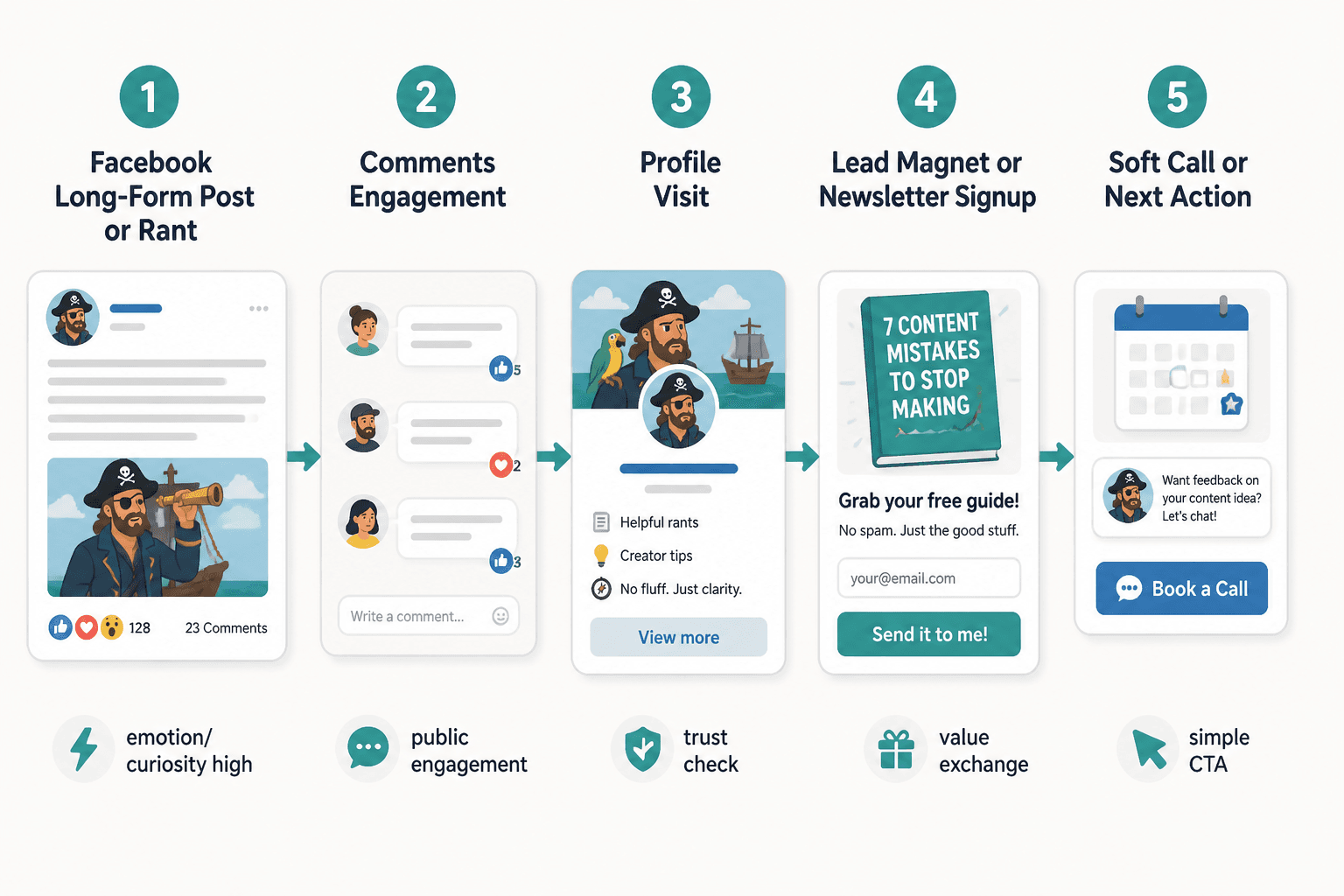
Start with the right post-to-funnel match
Not every rant should lead to a sales call. Not every story post should push a freebie. Not every useful opinion needs a newsletter signup.
The cleaner move is to match the post type to the next step based on what the reader is feeling by the end.
| Post type | Reader state | Best next step |
|---|---|---|
| Opinionated rant about a common industry mistake | Agitated, curious, agreeing | Comment prompt, lead magnet, newsletter |
| Personal story with a business lesson | Connected, trusting, interested | Profile visit, soft DM, newsletter |
| Educational long-form breakdown | Learning, evaluating expertise | Resource, article, consultation page |
| Contrarian post challenging bad advice | Intrigued, emotionally activated | Comments, free guide, waitlist |
| Case-study style rant with proof | Convinced, solution-aware | Booking page, audit offer, consultation |
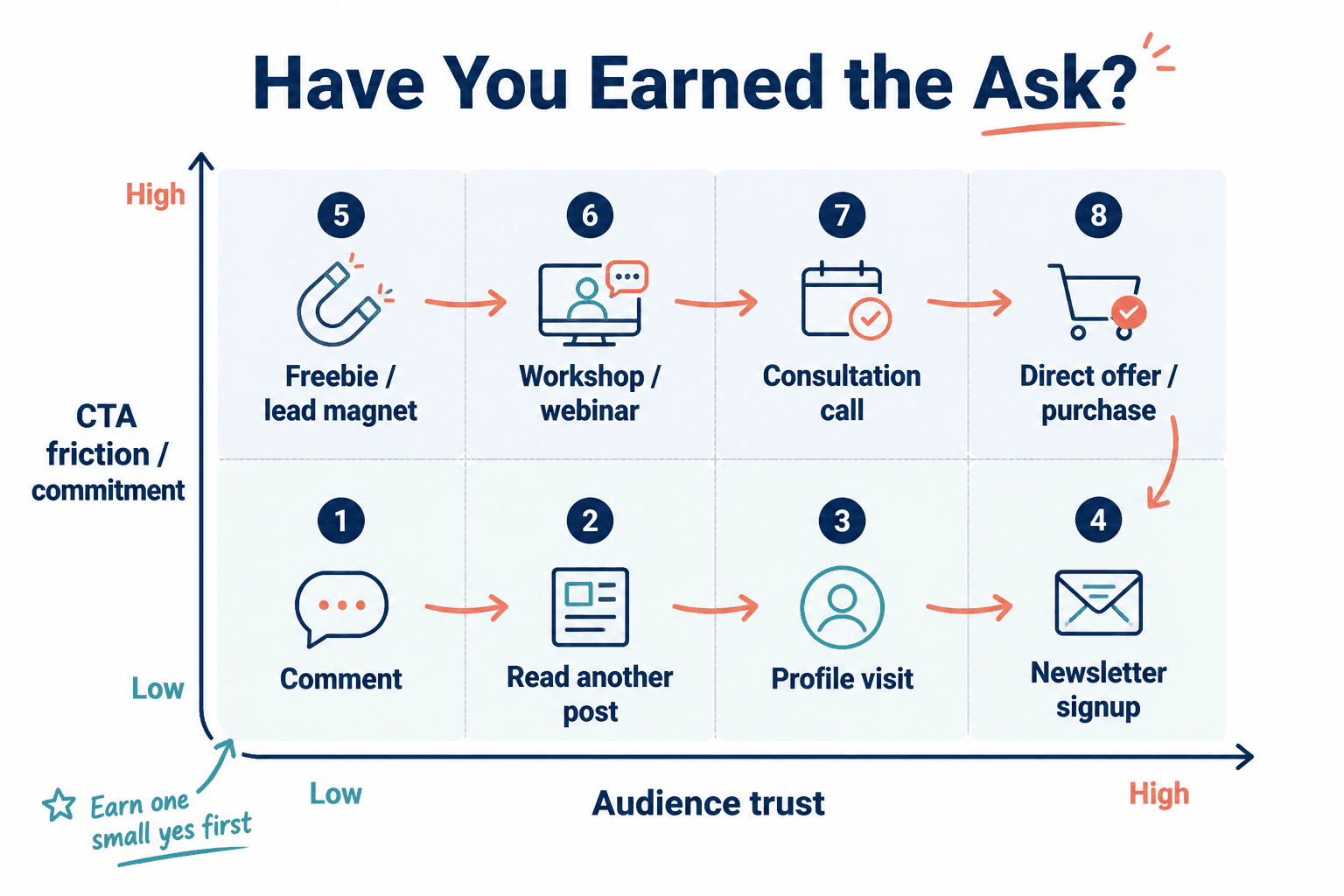
That little match matters more than people think. Funnels fail all the time because the CTA asks for a bigger commitment than the post earned.
If your rant made someone nod aggressively and type “YES,” that does not mean they are ready to buy. It means they are engaged. Your job is to turn engagement into the next useful action, not immediately into a checkout page like a maniac.
The best funnel ideas to pair with Facebook long-form & rants
1. Post to comment to soft DM
This is one of the best options when your long-form post sparks strong reactions and clear relevance.
The structure is simple:
- You write a post with a strong opinion, lesson, or breakdown.
- You end with a specific comment invitation.
- You continue the conversation publicly first.
- If someone is clearly a fit, you move to DM naturally.
This works because Facebook is conversational by nature. The comments are not just engagement decoration. They are part of the funnel.
Good CTA examples:
- “If this is something you are dealing with in your business, say ‘guide’ and I’ll send you the framework.”
- “If you have seen this problem in your niche too, tell me what version of it you keep running into.”
- “If you want the checklist we use before posting this kind of content, comment ‘checklist.’”
What not to do:
- Jump straight into a pitch in the comments
- DM everyone who comments with the same canned message
- Pretend the post is “just for value” when it is obviously bait
If you use this funnel, keep it human. Reply to people like a person. Qualify naturally. A good soft DM starts after an actual exchange, not after someone leaves a flame emoji.
2. Post to lead magnet
This is a strong fit when the rant identifies a frustrating problem and the lead magnet helps solve the next obvious piece of it.
Example:
- Post topic: why most experts write Facebook posts that sound polished but say nothing
- Lead magnet: 25 better Facebook post openings or a simple post-structure template
The key is relevance. The freebie should feel like the natural extension of the post, not a random asset you are shoving under every piece of content because your funnel software needs to justify its monthly fee.
Best for:
- Writers
- Coaches
- Consultants
- Service providers
- Creators building an email list
Keep the lead magnet tight. Facebook readers respond better to useful, immediate resources than bloated “ultimate guides” nobody asked for. Checklists, scripts, examples, mini-guides, audits, or templates usually beat 47-page PDFs full of recycled blog compost.
3. Post to newsletter signup
If your Facebook long-form content is thoughtful, recurring, and idea-driven, a newsletter is often the cleanest next step.
This works especially well when your post leaves readers thinking, “I want more of how this person thinks.” Not just what they sell. How they think.
That distinction matters. Newsletter funnels work when the appeal is ongoing perspective, not a one-off freebie.
Good CTA angle:
If you like sharp breakdowns on content, positioning, and the stuff people keep doing wrong online, my newsletter is where I send the deeper versions.
This is better than forcing a generic “subscribe for updates” line. Nobody wants updates. People want useful stuff, better ideas, and less noise.
If you need help shaping the posts themselves, it makes sense to connect this kind of article with resources on Facebook long-form and rants and examples and ideas for creators.
4. Post to profile to pinned offer
Sometimes the smartest funnel is not in the post at all.
On Facebook, plenty of readers will click through to your profile if the post lands. That means your profile can do some of the conversion work for you. Your bio, featured links, pinned post, and intro copy should not be a neglected junk drawer.
This funnel looks like this:
- Strong long-form post earns attention
- Interested readers visit profile
- Profile points them to one clear next step
- That next step leads to your email list, booking page, or offer
This works well when you do not want every post to carry a direct CTA. It keeps the writing cleaner and lets intent do some of the filtering.
Just make sure your profile is ready. If readers arrive and find vague bio fluff, no pinned resource, and a bunch of disconnected links, you have basically built a funnel into a hedge.
5. Post to low-friction consultation
This is best when the post demonstrates expertise and makes a problem feel urgent, expensive, or annoying enough that people may want help now.
It works especially well for:
- Consultants
- Coaches
- Strategists
- Freelancers with high-value services
- Agency owners with a clear specialty
But the consultation CTA needs to be low-friction. “Book a free discovery call” sounds tired because it is tired. Better options:
- “If you want help fixing this in your business, here is where you can apply for a strategy call.”
- “If this is the bottleneck in your content right now, you can book a short working session here.”
- “If you want another set of eyes on this, I offer paid audits and limited consulting spots.”
Paid audits often work better than vague free calls. They filter out tire-kickers and feel more credible. Free calls can still work, but only if the post has built serious trust and the service is clearly defined.
6. Post to waitlist
If your long-form post highlights a problem your upcoming offer solves, a waitlist is a smart middle ground.
This is useful when:
- Your offer is not open yet
- You want to test demand before building more
- You are warming people up before a launch
- You do not want to hard-sell in the post
Good waitlist CTAs sound specific and calm. Not fake scarce and twitchy.
Example:
I’m putting together a small offer for people who want help turning strong opinions into posts that actually convert. If you want first look when it is ready, join the waitlist.
That works because it matches the post. It does not sound like a countdown timer disguised as a sentence.
7. Post to paid product or workshop
This can work, but only when the post has enough proof, specificity, and buyer relevance.
Direct sales from Facebook long-form usually perform best when the offer is:
- Easy to understand
- Fairly low friction
- Closely related to the post topic
- Credibly supported by the post itself
Think workshops, mini-products, audits, templates, short intensives, or focused services. Not giant abstract offers with six layers of positioning language and a checkout page written like a business cult.
If your rant clearly names the problem, demonstrates the cost of the problem, and hints at the fix, then a direct offer can work beautifully. If not, use a softer step first.
How to choose the right funnel for your post
Use these three questions.
What is the reader most likely ready for?
Not what do you want them to do. What are they actually ready for?
If they just discovered you through a rant, they may be ready for a newsletter or resource. If they have seen you repeatedly and this post confirms your expertise, they may be ready for a call or audit.
Does the next step match the emotion of the post?
A high-energy rant often pairs well with comments, a relevant freebie, or a sharper workshop offer. A reflective story post often pairs better with a newsletter, profile visit, or thoughtful consultation CTA.
Match the energy. If the post feels raw and human, a stiff corporate CTA at the end will feel absurd.
Have you earned the ask?
This is the filter a lot of people skip.
Did the post provide enough clarity, proof, perspective, or authority to justify the action you are asking for? If not, lower the friction. Earn one small yes before asking for a bigger one.
Simple funnel structures that work well on Facebook
You do not need a 14-step automation map for this. A few simple structures are enough.
Structure 1: Rant → comments → resource → email nurture
Best for audience growth and lead capture.
- Write a rant about a common problem
- Invite comments from people who want the related resource
- Send the resource
- Add them to a short nurture sequence with related insights and an offer
Structure 2: Story post → profile visit → pinned post → booking page
Best for service providers selling expertise.
- Write a story-based long-form post
- Let interested readers click through naturally
- Use your pinned post to explain your offer clearly
- Link to a booking page or application
Structure 3: Educational breakdown → lead magnet → newsletter → offer
Best for authority building.
- Publish a useful, practical post
- Offer a highly relevant checklist, template, or guide
- Follow up via email with deeper education
- Present a service or product later
Structure 4: Contrarian rant → waitlist
Best for validating demand before launching something.
- Call out an annoying problem or bad norm
- Explain your angle clearly
- Introduce the upcoming solution lightly
- Invite readers to join the waitlist
How to write the CTA without ruining the post
This is where people get weird.
The CTA should feel like the final sentence belongs in the same post as the rest. Not like it was stapled on by someone from another department.
Three rules help.
Make it specific
Bad: “Reach out if this resonates.”
Better: “If you want the checklist we use to tighten long-form Facebook posts before publishing, comment ‘checklist’ and I’ll send it.”
Make it proportional
A small post promise should lead to a small ask. A big ask needs a stronger setup.
If the post is mostly opinion, ask for a comment or signup. If the post includes serious proof, examples, and a clear business case, then a consultation CTA may fit.
Make it sound like you
If your post sounds human and your CTA suddenly sounds like “claim your complimentary strategic transformation session,” you have lost the plot.
Keep the same voice all the way through. Clean, direct, maybe a little sharp if that is your style. No weird funnel accent.
Common funnel mistakes with Facebook long-form posts
- Making every post a pitch. People stop trusting the content and start scanning for the trap.
- Using the same CTA on every post. It makes your content feel mechanical and lowers relevance.
- Offering the wrong next step. A booking link after a casual opinion post is often too much, too soon.
- Overexplaining the offer. Your post is not the place for an 11-part sales page.
- Ignoring your profile. If readers click and find nothing useful, the funnel leaks instantly.
- Trying to automate the human bits too fast. Comment and DM funnels still need real judgment.
A good rant has shape, tension, and payoff. A good funnel should too. If you need help strengthening the post side of that equation, these related resources can help: templates and tools for Facebook long-form and rants, advice for creators with small audiences, and AI tools for Facebook long-form and rants.
What works best for small audiences
If your audience is small, that is not a reason to avoid funnels. It just means your funnels should be more precise and less theatrical.
Small-audience creators often get better results from:
- Comment-based funnels
- Simple lead magnets tied to one clear problem
- Newsletter signups
- Profile-to-booking flows
- Soft DMs after real conversation
The bigger point is simple: clearer structure and clearer writing make the piece more useful. That is usually what makes the ending land better too.