
Most welcome emails are weirdly bad for something so simple.
They are either painfully generic (“thanks for joining!”), instantly salesy (“book a call now”), or stuffed with so much backstory that the reader forgets why they signed up in the first place. And that is a shame, because your welcome email is not admin. It is positioning.
If you are a coach, consultant, or personal brand, your first email sets the tone for everything that follows. It tells people what kind of brain they just subscribed to, what they can expect, and whether paying attention to you will actually be worth it.
Here’s how to write welcome emails that feel warm, clear, and useful without sounding like a funnel template wearing a fake smile. You will get practical structure, strong examples, and a few simple frameworks you can steal immediately.
For the full path around this topic, head to the parent guide.
What a welcome email is actually supposed to do
A welcome email is not just there to confirm that the internet worked.
Its real job is to reduce friction and increase trust. The reader just gave you access to their inbox, which is a mildly intimate place. Your first email should reward that decision fast.
In practical terms, a strong welcome email usually does at least three things:
- Confirms they are in the right place
- Sets expectations for what they will get
- Gives them one clear next step
That next step might be reading a resource, replying to the email, following you somewhere else, checking out a service, or simply watching for the next message. The point is not to force action. The point is to guide it.
And yes, this matters more than people think. Your welcome email often gets some of your best open rates. Waste that attention and you are voluntarily fumbling one of the easiest wins in your email system.
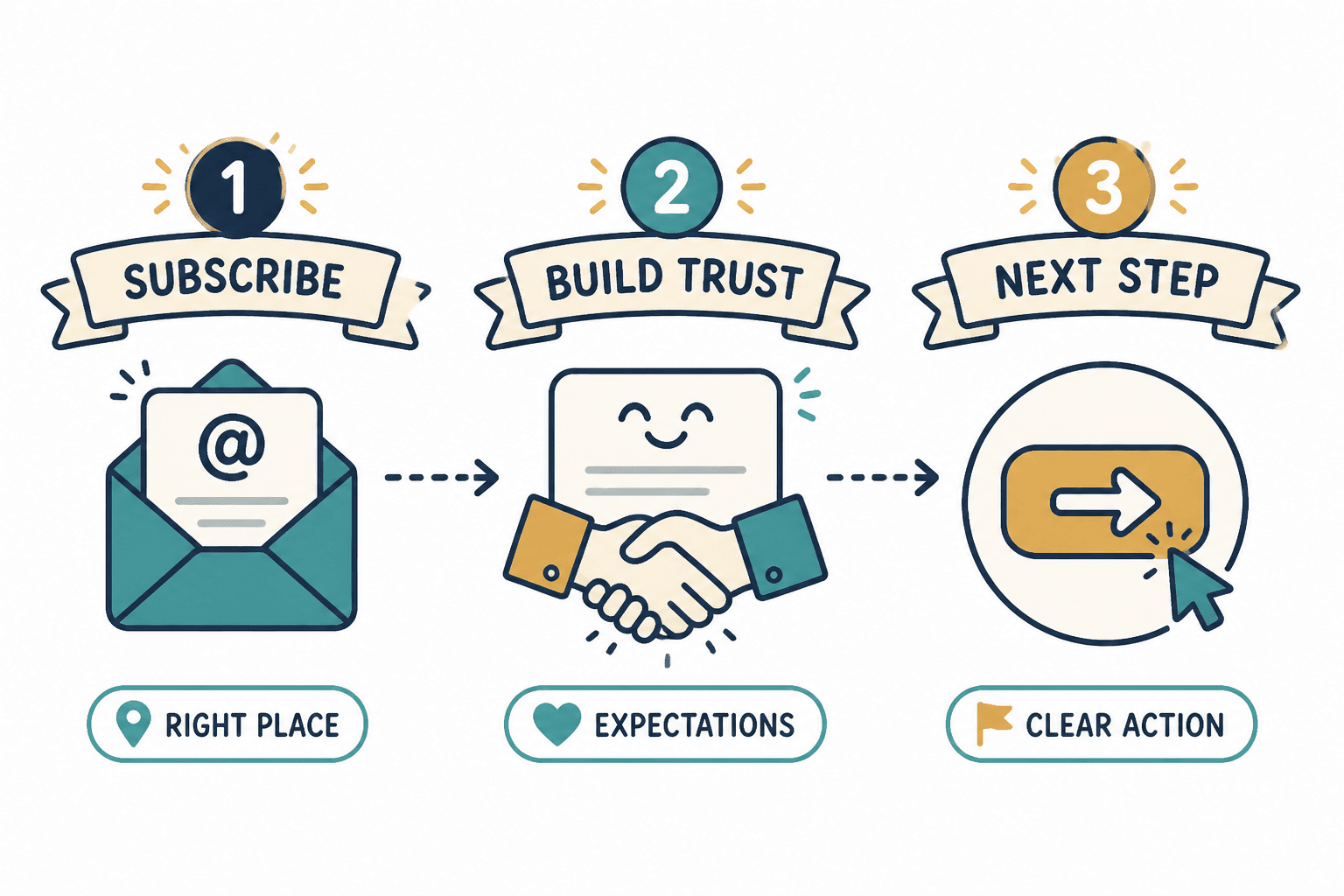
The best welcome emails feel like a good handshake, not a hostage note
There is a tone problem in a lot of email marketing advice.
Some welcome emails sound so polished they feel generated by a corporate fern. Others try so hard to be “authentic” that they become messy, overlong, and emotionally demanding. Nobody signed up to process your full founder journey 14 seconds after joining your list.
For coaches, consultants, and personal brands, the sweet spot is usually this:
- Human, but not rambling
- Confident, but not self-important
- Warm, but not clingy
- Useful, not just nice
If your first email feels easy to read and gives the subscriber a quick win, you are already ahead of a surprising amount of the internet.
A simple structure that works for most welcome emails
You do not need a 9-part automation masterpiece. Most strong welcome emails can follow a simple structure:
- Quick welcome — confirm they signed up successfully
- Clear positioning — remind them what you help with
- Expectation setting — what kind of emails they will get and how often
- One useful next step — a resource, reply prompt, or offer
- Short sign-off — human, not theatrical
That is enough for a lot of brands. Not every welcome email needs a dramatic reveal, a mini memoir, and three links competing for attention like toddlers on sugar.
Basic welcome email template
Subject: You’re in
Hey [First Name],
Glad you joined.
You signed up for [what they signed up for], and over the next few emails I’ll send you practical ideas on [topic/outcome]. Expect [type of content] without the usual fluff.
To get started, here’s the best place to begin: [link or resource]
And if you want, hit reply and tell me what you’re currently working on. I read these.
— [Name]
Simple. Clear. Not trying to win an award for emotional vulnerability.
Welcome email examples for coaches, consultants, and personal brands
Below are several welcome email examples for coaches, consultants, and personal brands, each built around a different goal. Do not copy them word-for-word unless you enjoy sounding borrowed. But absolutely steal the structure.
1. The simple trust-builder
Best for: personal brands, writers, educators, and anyone building a relationship-first list.
Subject: Good choice
Hey [First Name],
You’re in.
I send emails about [topic] for people who want [outcome], without the recycled internet advice and fake urgency.
Expect practical ideas, sharper positioning, and the occasional opinion that may mildly annoy people who love buzzwords.
If you want a good place to start, read this first: [link]
And if there’s something you’re stuck on, reply and tell me. It helps me send better stuff.
— [Name]
Why it works:
- It confirms the subscription quickly
- It positions the brand clearly
- It sets a tone without trying too hard
- It invites a reply in a low-pressure way
2. The coach welcome email that feels personal without oversharing
Best for: coaches in career, mindset, health, business, or relationships.
Subject: Welcome — here’s what you’ll get
Hi [First Name],
Thanks for joining.
You’re here because you want help with [specific outcome], and that is exactly what these emails are for.
I’ll send simple, useful guidance on [topic], plus tools, prompts, and the occasional behind-the-scenes lesson from what I’m seeing with clients.
No daily inbox ambushes. No “just checking in” nonsense. Just ideas that help you make progress.
For now, start with this: [link to a free resource, assessment, worksheet, or best article]
If you want, hit reply and tell me what feels hardest right now. I may not reply instantly, but I do read them.
Warmly,
[Name]
Why it works:
- It speaks to the subscriber’s desired outcome
- It manages expectations cleanly
- It avoids the fake intimacy trap
- It gives one next step instead of seven
3. The consultant version with a stronger authority angle
Best for: consultants, strategists, freelancers, and service providers selling expertise.
Subject: Welcome — useful stuff starts here
Hi [First Name],
You’ve joined my list for ideas on [topic], and that is what you’ll get.
I write about what actually improves [business result]: sharper messaging, better content, stronger positioning, cleaner offers, and fewer expensive mistakes dressed up as strategy.
Most emails will be short, practical, and built to help you think better and act faster.
If you want the best starting point, read this: [link]
And if you are already working on [problem], just reply with one sentence about what’s stuck. That gives me a better sense of what to send next.
— [Name]
Why it works:
- It sounds competent without becoming stiff
- It names business outcomes clearly
- It creates authority through specificity, not chest-beating
- It opens the door to future conversation
4. The offer-bridging welcome email
Best for: people with a clear paid service, program, or consultation offer.
Subject: Welcome — and a quick way to keep going
Hey [First Name],
Glad you’re here.
You joined for [lead magnet/newsletter/topic], and I’ll send useful emails on [topic] that help you [result].
Before anything else, here’s a resource that will help right away: [link]
Also, if you already know you want hands-on help with [specific problem], you can see how I work here: [link to service or booking page]
No pressure if now is not the time. The emails will still be useful either way.
— [Name]
This is the version a lot of people get wrong. The mistake is not mentioning your offer. The mistake is making the whole email about your offer.
A quick, relevant service mention can work beautifully when it feels like an optional next step, not an immediate pounce.
5. The community-style personal brand welcome email
Best for: creators and personality-led brands with a stronger voice.
Subject: Welcome to the list
Hey [First Name],
You made it in.
This email list is where I share the better stuff on [topic]: ideas I’m testing, things I’m noticing, what’s working, what’s overrated, and how to make smarter moves without turning your brand into a motivational poster.
You’ll get [rough frequency] emails. Mostly practical. Occasionally pointed. Always meant to be worth opening.
Best place to start: [link]
If you reply, tell me what you’re building. That part is always interesting.
— [Name]
This works because it sells the experience of being on the list, not just the topic. For personal brands especially, that matters.
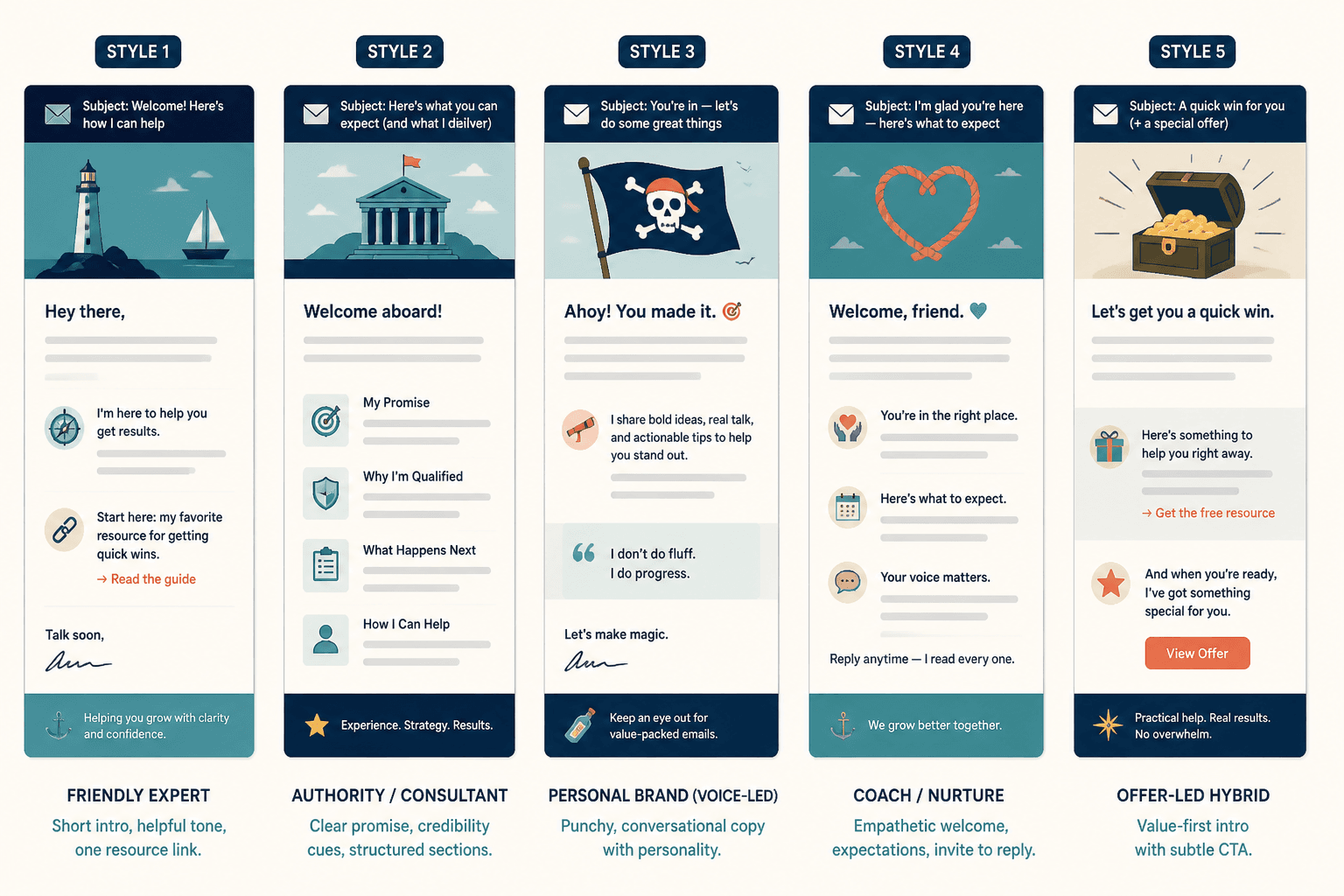
What to include in your welcome email if you want better replies, trust, or sales
You do not need every element below in every email. But these are the pieces worth considering.
| Element | Why it helps |
|---|---|
| Clear reason for the email | Reminds readers what they signed up for |
| Audience/outcome language | Makes the email feel relevant fast |
| Expectation setting | Reduces unsubscribes and confusion |
| One strong resource | Delivers immediate value |
| Reply invitation | Builds relationship and engagement |
| Light offer mention | Can create qualified leads without feeling pushy |
| Distinct voice | Makes you memorable instead of interchangeable |
If your email feels bland, the missing ingredient is often not “more copy.” It is clearer positioning. The best welcome emails tell people not just what you do, but what kind of approach they can expect from you.
Common welcome email mistakes people keep making
If you want stronger results, avoid these:
- Writing like a generic email platform template. If your email could belong to any business in any niche, it is too vague.
- Talking too much about yourself. A little context is fine. A full life story is not the move.
- Adding too many links. Attention splits fast. One main next step usually wins.
- Using fake warmth. “I’m so incredibly honored and thrilled…” relax.
- Pitching too hard, too soon. Especially for personal brands and service businesses, trust tends to convert better than pressure.
- Forgetting tone. A welcome email should sound like the same person readers will hear from later.
If this section feels uncomfortably familiar, you might also want to read common welcome email mistakes for personal brands. Some of them are small. Some quietly murder trust.
Before and after: a weak welcome email rewrite
Before
Subject: Welcome!
Hi there,
Thank you so much for signing up for my newsletter. I am so excited to have you here. I will be sharing lots of tips, tricks, and insights related to coaching, mindset, success, and personal growth. Stay tuned for future emails and exciting updates.
Best,
[Name]
This is not offensive. It is just empty. It says nothing with confidence, gives no reason to care, and sounds like 40,000 other welcome emails.
After
The bigger point is simple: clearer structure and clearer writing make the piece more useful. That is usually what makes the ending land better too.
Welcome emails work best when they set expectations clearly and move the relationship forward without overperforming. Clarity and trust do more than extra cleverness.