
Some welcome emails try to do everything at once.
They introduce the brand, tell the founder story, explain the newsletter, link five resources, set expectations, pitch an offer, ask a question, and politely wave from the porch. By the time the reader gets to the end, they have forgotten why they signed up in the first place.
That is exactly when short welcome emails beat long ones.
Not because short is automatically better. It isn’t. But a short welcome email often wins when the real job is simple: confirm the signup, deliver the promised thing, make a clean first impression, and get the reader to take one obvious next step.
If your welcome email is underperforming, the problem may not be your subject line or your copy style. It may be that you gave a first-touch email the workload of a six-email sequence.
Here’s how to tell when short is smarter, when long still makes sense, and how to write a short welcome email that does not feel thin, lazy, or weirdly abrupt.
You can also explore more resources in our email newsletter writing section and the broader welcome emails hub if you’re building out the whole system, not just one message.
For the full path around this topic, head to the parent guide.
Why short welcome emails often perform better
A welcome email is not a memoir. It is a moment.
The subscriber just did something. They signed up, downloaded something, joined a list, booked a freebie, or asked to hear from you. Their attention is highest right now. Their patience is not.
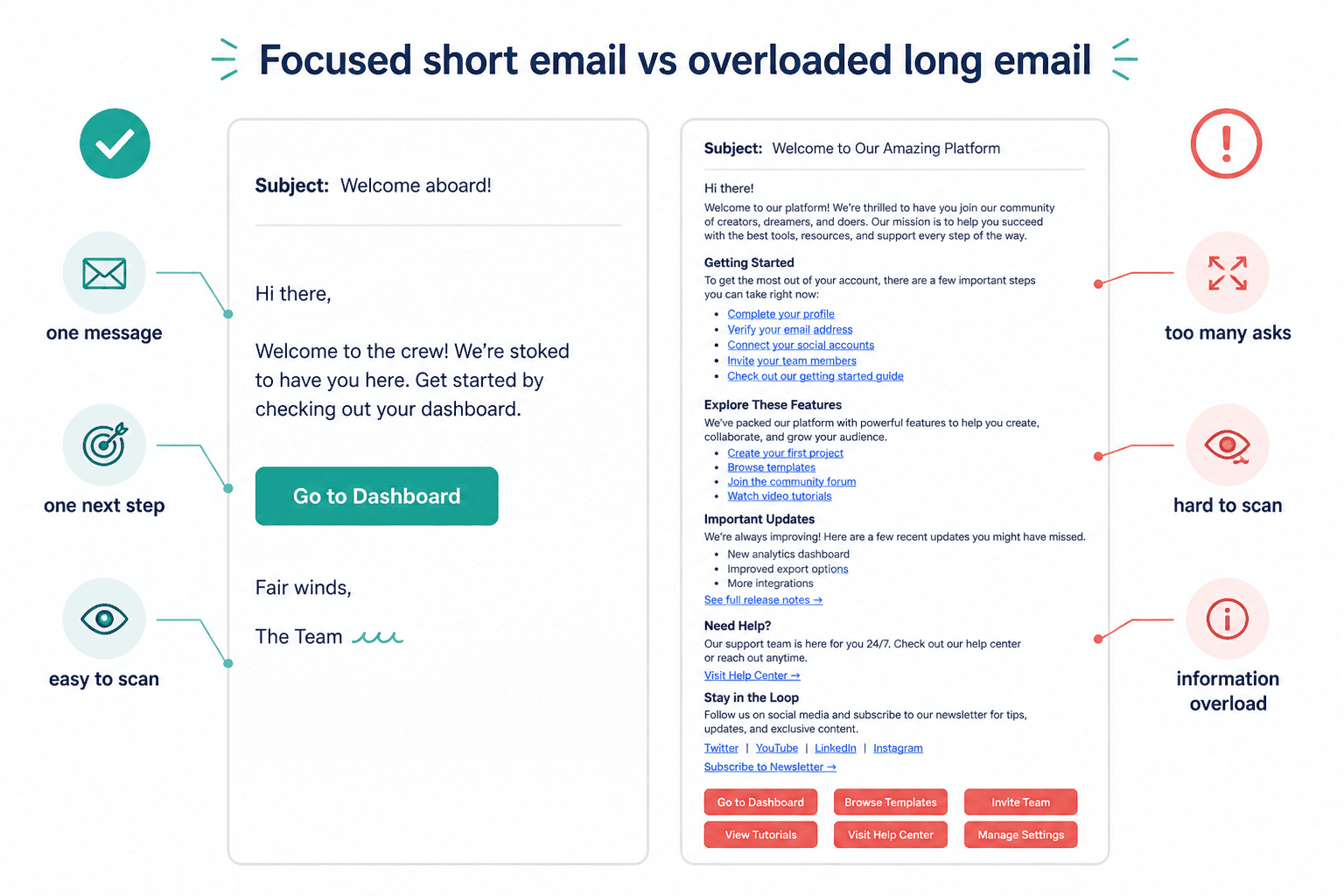
Short welcome emails work because they respect that moment. They reduce friction. They make the next move obvious. They are easier to scan, easier to trust, and much harder to abandon halfway through.
That matters more than people think. The best welcome emails are usually not trying to impress. They’re trying to orient.
- They get to the point fast. Readers instantly know they are in the right place.
- They reduce cognitive overload. One email, one core message, one next step.
- They feel more human. A concise note often sounds more personal than a polished mini-sales page.
- They increase the chance of action. Fewer links and fewer asks usually mean clearer decisions.
- They leave room for the sequence. You do not need to cram the entire relationship into email number one.
In other words, short welcome emails beat long ones when the job is clarity, not persuasion theater.
And yes, some creators still write a first email like they are trying to justify their existence to a skeptical panel of judges. Relax. The reader already signed up. You do not need to perform a TED Talk before saying hello.
When short welcome emails beat long ones
Let’s get practical. Short is not a religion. It is a format choice. It works best in a few very specific situations.
1. When the subscriber signed up for one clear thing
If someone joined your list to get a checklist, template, workshop replay, or free guide, your welcome email should mostly do one thing: deliver that thing cleanly.
They do not need your complete brand philosophy yet. They need the resource they were promised and a basic sense of what happens next.
A short email works well here because the user intent is narrow. Match that intent.
2. When the next step matters more than the backstory
If the goal of the welcome email is to get the subscriber to whitelist your address, reply with one answer, read one article, or use one resource, shorter is usually stronger.
Long copy tends to bury the action. Short copy puts it where it belongs: right in front of the reader.
3. When you already have a welcome sequence
This is where people make a mess. They write a long first email and a full welcome sequence, which means the first message does all the jobs badly and the later emails feel repetitive.
If you have multiple welcome emails, your first one can stay lean. Let later emails handle story, positioning, proof, common mistakes, and offers. The first email just needs to open the door properly.
4. When your audience is busy and already gets too many emails
Creators, consultants, founders, and clients are not sitting around hoping for a 900-word greeting note. A concise welcome email often feels more respectful, especially if your audience values speed and clarity.
This does not mean your audience hates detail. It means detail should arrive when they actually want it.
5. When trust is built better through consistency than intensity
One long welcome email often tries to force trust too early. That usually backfires. Real trust tends to come from repeated usefulness, a clear voice, solid follow-through, and offers that do not smell like panic.
Short emails leave room for that. They do not overreach on day one.
When long welcome emails still make sense
Now for the part the internet loves to skip: sometimes longer really is better.
If the signup moment carries higher intent, more context, or a stronger buying signal, a longer welcome email can absolutely work. It just needs to earn its length.
- Complex offers: If someone joined after a webinar, workshop, or application process, they may need more orientation.
- Strong founder-led brands: If your story is part of why people buy, more context may help.
- Premium services: If the reader needs to understand your method, values, or process to trust you, depth can help.
- Newsletter-first businesses: If the newsletter itself is the main product experience, a richer welcome can set the tone well.
- Warm audiences: If people already know you from social, podcasts, or referrals, they may be happy to read more.
The key difference is this: long works when it adds clarity or momentum. It fails when it adds drag.
If you are unsure how much is too much, this companion guide on how long welcome emails should be in 2026 will help you pick a length based on goal, not superstition.
What a strong short welcome email actually needs
A short email is not just a chopped-down long one. It still needs structure. It still needs purpose. It just cannot afford filler.
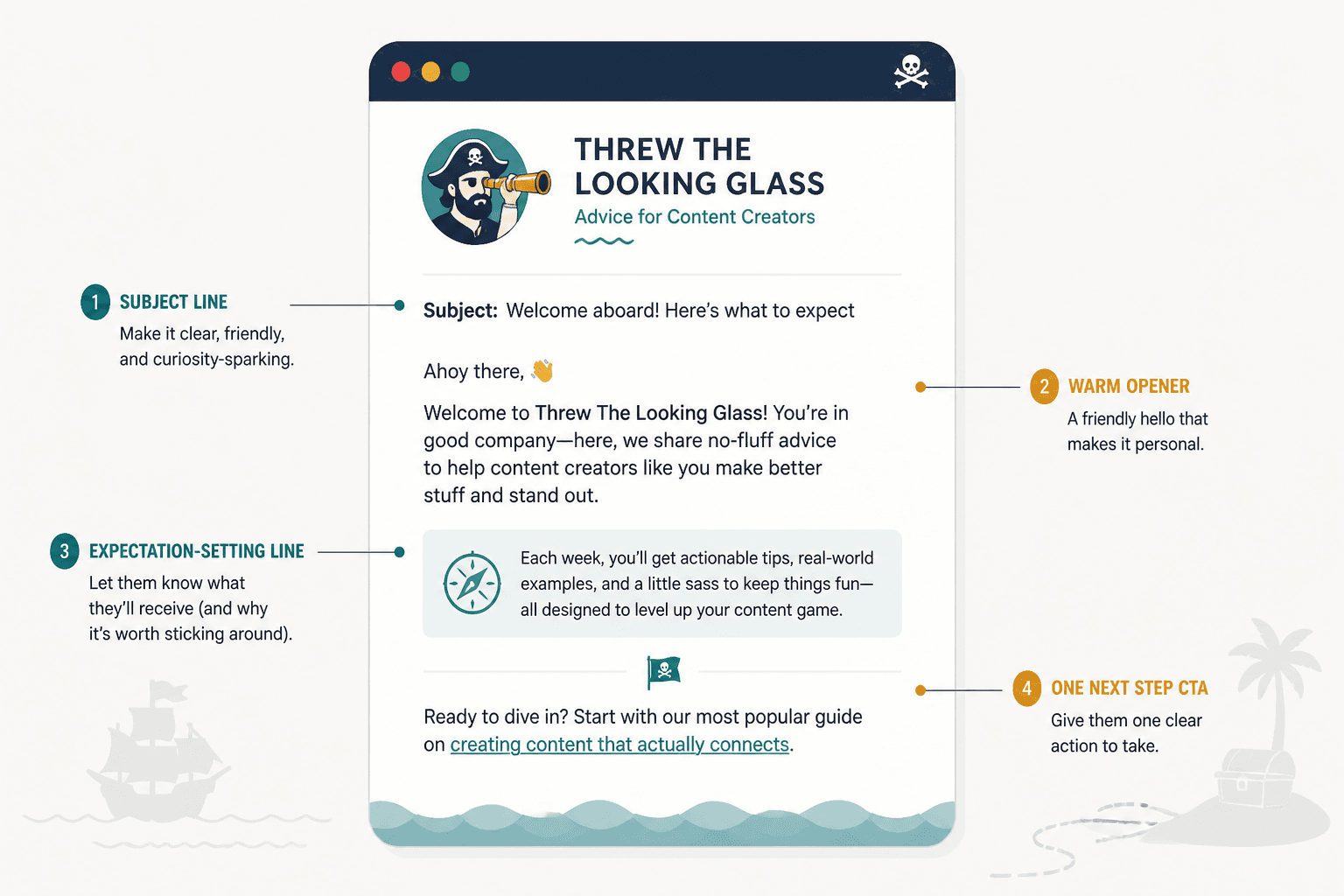
Most strong short welcome emails include four simple parts.
1. A clear opening
Confirm what just happened.
Examples:
- Thanks for signing up. Your guide is below.
- You’re in. Here’s what to expect from me each week.
- Glad you joined. Let me get you the template first.
No throat-clearing. No “I just wanted to reach out and personally say…” You have already reached out. You are in the email.
2. The promised value
Deliver the resource, the link, the access point, or the immediate benefit.
Do not bury it under a wall of text. If they signed up for something specific, that thing should be easy to find in under three seconds.
3. A brief expectation-setting line
Tell them what kind of emails they will get next. Keep it concrete.
- I send one practical email each Tuesday about better welcome emails, nurture sequences, and newsletter conversion.
- You’ll get a few short emails from me this week to help you use the template well.
- Most of my emails are about sharper content, cleaner funnels, and not sounding like a business podcast in human clothes.
This lowers uncertainty and reduces unsubscribes from people who feel blindsided later.
4. One next step
Give the reader one thing to do.
- Download the file
- Read one article
- Reply with one answer
- Add you to contacts
- Check out one related resource
One is enough. Two can work. Five is how you get polite nothing.
Short does not mean empty
This is where some people get it wrong. They hear “keep it short” and send something so bare it feels automated in the worst possible way.
A good short welcome email still has a voice. It still sounds like a person. It just does not wander off and start hosting a conference in the inbox.
You can keep an email short while still making it feel warm, clear, and intentional. That usually comes from small touches: a sharp subject line, a clean first sentence, a grounded expectation line, and a CTA that does not sound like it was dragged out of a dead funnel template.
For example, compare these two versions.
Too long and unfocused:
Hi there, and welcome to my community. I’m so excited to have you here. Over the years I’ve helped hundreds of creators improve their messaging, refine their brand voice, and create systems that scale. In this email, I wanted to introduce myself, share how I got started, explain what this newsletter is about, link to some of my favorite resources, and tell you a bit about what you can expect moving forward…
Short and useful:
You’re in.
Here’s your welcome email checklist: [link]
I send one short email a week about newsletter writing, welcome sequences, and soft-sell email strategy.
If you want a good next read, start here: best welcome email ideas and examples for creators.
The second version is not fancy. That is kind of the point. It is easy to understand, easy to act on, and easy to trust.
Common reasons long welcome emails lose
Long welcome emails usually do not fail because readers hate reading. They fail because the writing lacks discipline.
- Too many goals: The email tries to introduce, nurture, sell, educate, and entertain all at once.
- Buried value: The promised freebie or next step is hidden below a huge intro.
- Founder overexposure: Too much personal backstory before the reader has a reason to care.
- Weak hierarchy: Nothing stands out, so nothing gets action.
- Too many links: Readers click nothing because you offered everything.
- Forced enthusiasm: The tone sounds polished but not believable.
This is especially true when creators use AI to draft a welcome email and forget to remove the “friendly yet professional” fog. You know the style. Warm greetings. Broad promises. Zero pulse.
If your first email feels interchangeable with 8,000 others, making it shorter might not fix everything, but it will remove more places for generic sludge to hide.
A simple rule for deciding short vs long
Use this rule:
If the reader needs to understand one thing and do one thing, go short.
If the reader needs to understand a system, shift belief, or make a bigger decision, go longer.
That one distinction will save you a lot of pointless overwriting.
It also helps to ask a blunt question: what would break if I cut this email in half?
If the answer is “not much,” you already know what to do.
A short welcome email template that actually works
Here is a clean structure you can adapt.
- Confirm the signup
- Deliver the promised thing
- Set one expectation
- Offer one next step
The bigger point is simple: clearer structure and clearer writing make the piece more useful. That is usually what makes the ending land better too.