
Most welcome emails are not bad because the writer lacks ideas. They are bad because the writer starts from scratch, panics a little, and ends up sending a polite beige note that says almost nothing memorable.
Meanwhile, they are sitting on old posts, newsletters, threads, articles, client replies, and half-decent rants that already explain what they believe, how they help, and why someone should stick around.
That is the real move here. How to Turn Old Content Into Better Welcome Emails is not about recycling for the sake of efficiency. It is about taking ideas you have already proven, shaping them for a new reader, and building a welcome sequence that actually earns attention instead of politely requesting it.
If you are a creator, coach, consultant, freelancer, or founder, your old content is probably a better source for welcome emails than a blank page ever will be. The trick is knowing what to pull, what to cut, and what needs rewriting so it feels like a welcome, not a lazy repost in a trench coat.
If you want the bigger picture, start with the parent guide.
Why old content makes better welcome emails than fresh writing
Fresh writing feels noble. It also tends to produce fluff when you are under pressure.
Old content has one big advantage: it already contains your real opinions, useful teaching, natural phrasing, and recurring themes. In other words, it usually sounds more like you. That matters because welcome emails should do three things fast:
- Show people what you are about
- Prove you are worth paying attention to
- Point them toward a useful next step
If your old content has already performed well, sparked replies, generated leads, or made people say “this is exactly what I needed,” you do not need a totally new idea. You need better packaging.
And even if the old content did not “perform” publicly, it may still contain sharp raw material. A forgotten LinkedIn post with six likes can still become an excellent welcome email if the idea was strong and the delivery was just off. Vanity metrics are noisy. Useful ideas are not.
What a welcome email actually needs to do
Before you start repurposing anything, get clear on the job.
A welcome email is not just a thank-you note. It is an orientation tool. The best ones help the reader quickly understand who you help, what kind of content or value they can expect, what makes your perspective different, and where to go next.
That means your welcome email usually needs some mix of:
- A quick, human introduction
- A strong idea or useful takeaway
- A positioning clue that says, “Here is how I think”
- Proof, specificity, or credibility without chest-beating
- A simple CTA
If your old content can support those pieces, it can become welcome email material.
For a broader foundation on structure and strategy, it also helps to review the main welcome emails hub and the larger email newsletter writing and creator email systems collection. Yes, the naming is a mouthful. No, your email should not be.
What kind of old content is worth repurposing
Not all old content deserves a second life. Some of it should be thanked for its service and quietly buried.
The best candidates usually have at least one of these qualities:
- A clear opinion or point of view
- A practical lesson people can use quickly
- A story that explains your approach
- A framework that makes something simpler
- A myth-busting angle that cuts through common bad advice
- A piece that got strong replies, saves, shares, or client mentions
- A topic that naturally leads into your offer, service, or next email
Strong sources to mine
- LinkedIn posts that taught one sharp lesson
- Email newsletters that got unusually high replies
- Threads that broke a process into steps
- Articles with one strong section you can extract
- Sales call notes where you explained a problem clearly
- Client onboarding docs or FAQs
- Voice notes or captions that sound especially natural
Sometimes your best welcome email material is hiding in places that were never meant to be “content.” If you explained something brilliantly in a DM, Loom follow-up, or client answer, that may be more useful than a polished public post. Real clarity often shows up when you are just trying to help one person.
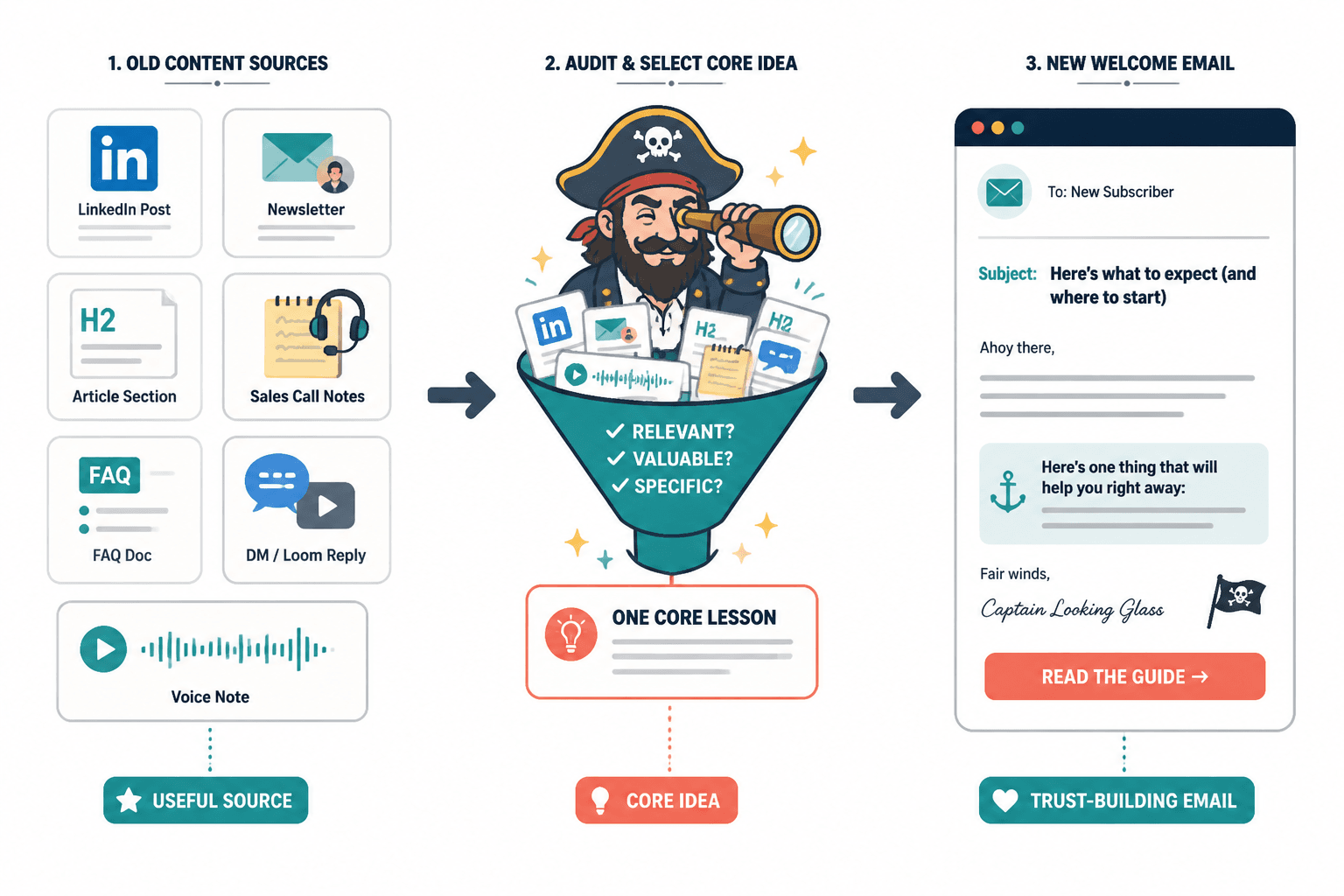
How to Turn Old Content Into Better Welcome Emails without making them feel recycled
This is where people get sloppy. They paste an old post into an email, add “welcome,” and call it strategy. It is not strategy. It is light admin work with confidence issues.
Here is a cleaner process.
1. Find the core idea, not the original format
Do not ask, “Can I reuse this post?” Ask, “What is the one idea inside this post that belongs in a welcome email?”
A social post may have been built for reach. A welcome email is built for trust and orientation. Same raw idea, different job.
For example, a post called “3 mistakes coaches make on LinkedIn” might contain a stronger welcome-email core idea like:
- Most people are not struggling because they lack expertise. They are struggling because their positioning is vague.
- Good content loses when the packaging is weak.
- You do not need more content volume. You need stronger message clarity.
That core idea is what you repurpose.
2. Rewrite the opening for a new subscriber, not a cold audience
Your old content probably opens by trying to earn attention fast. Fair enough. A welcome email does not need the same kind of hook.
Someone just subscribed. They have already raised a hand. So instead of a big theatrical opener, lead with relevance.
Old post opening: “Most creators are posting constantly and still hearing crickets.”
Better welcome email opening: “Glad you are here. A lot of smart creators do not have a content problem so much as a packaging problem, which is why I want to start with one idea that tends to fix a lot of nonsense fast.”
Same concept. Better context.
3. Cut anything that only made sense on the original platform
Delete platform-specific clutter like:
- “This post might annoy some people”
- “Unpopular opinion”
- “A thread”
- “Comment GUIDE and I’ll send it”
- Engagement bait questions
- Context that only worked because of the feed format
Email has different strengths. It can be quieter, more direct, and more intimate. Use that.
4. Add orientation, not just information
This part matters more than most people realize. Welcome emails should not just teach. They should help the reader understand your world.
That means adding little lines that frame your approach:
- “Most of my work sits at the overlap of content, positioning, and conversion.”
- “I tend to care less about hacks and more about repeatable messaging principles.”
- “Around here, we are usually trying to make content clearer, sharper, and more commercially useful without making it sound like a funnel goblin wrote it.”
Those lines do real work. They tell people what kind of advice to expect and whether they are in the right place.
5. End with one useful next step
If your repurposed email teaches something useful and then just wanders off, you wasted attention.
Pick one next step:
- Read another welcome email
- Check out your best article
- Reply with a challenge
- Book a consultation
- Browse a resource page
- Learn about your offer
One is enough. A welcome email is not a shopping mall directory.
A simple repurposing framework: pull, reshape, sequence
If you want a practical workflow, use this:
- Pull 10 to 20 old pieces of content that still reflect your best ideas.
- Tag each one by theme: beliefs, mistakes, process, case-study style proof, story, offer bridge.
- Reshape each piece into one welcome-email lesson with a clearer intro and simpler CTA.
- Sequence them so each email introduces one part of your thinking and nudges the reader deeper.
This works especially well if you are building a short welcome sequence instead of one lonely email doing all the heavy lifting.
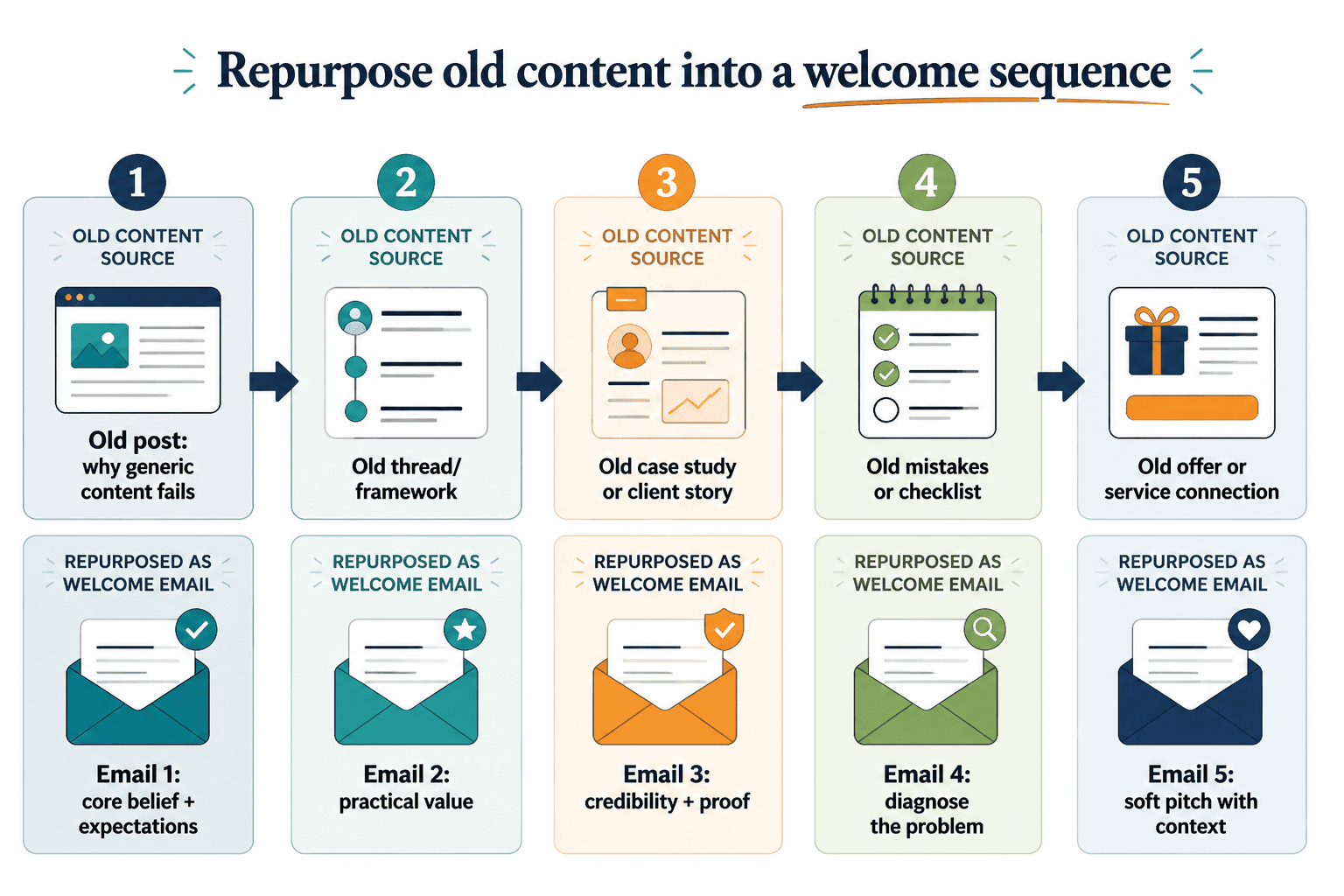
Example sequence from old content
| Old content source | Repurposed welcome email role |
|---|---|
| A post about why generic content fails | Email 1: introduce your core belief and set expectations |
| A thread with a simple framework | Email 2: give immediate practical value |
| A client story or case-study lesson | Email 3: build credibility with proof |
| An article section about common mistakes | Email 4: sharpen the reader’s diagnosis of their problem |
| A post that naturally connects to your service | Email 5: soft pitch with context and relevance |
That is a welcome sequence with shape. Much better than five random essays and a panic discount.
Before-and-after examples
Example 1: turning a LinkedIn post into a welcome email
Old post:
“Most people do not need more content ideas. They need better angles. Content only gets attention when the message feels specific, timely, and pointed.”
Weak repurpose:
“Welcome to my newsletter. Most people do not need more content ideas. They need better angles. Content only gets attention when the message feels specific, timely, and pointed. Thanks for subscribing.”
Technically an email. Emotionally a shrug.
Better repurpose:
“Glad you signed up. One idea you will hear me come back to a lot is this: most content does not fail because the creator ran out of things to say. It fails because the angle is too broad, too safe, or too forgettable.
That is actually good news. Better content often does not require more effort. It requires better framing.
If your posts are useful but not landing, start by asking:
- Is this specific enough for the right person to feel called out?
- Am I saying something with a point of view, or just restating common knowledge?
- Did I package the lesson in a way someone would care to read?
That is the kind of thing we will get into here.
If you want a stronger foundation, read how to write better welcome emails next.”
Example 2: turning an article section into a welcome email
Old article section:
“A weak CTA often comes from asking too much too early. Readers need a logical next step that matches their level of trust.”
Better welcome email version:
“Quick thing I wish more people understood: weak calls to action are usually not a wording problem. They are a trust problem.
If someone just met you, asking them to ‘book a strategy call’ can be a bit much. A better next step might be reading your best guide, replying to the email, or checking out a relevant resource.
Good welcome emails respect where the reader is. They do not act like one signup means instant devotion.
If you want to see how that turns into more business without getting weird about it, read how to turn welcome emails into more leads or sales.”
What to change when old content is good but not email-ready
The bigger point is simple: clearer structure and clearer writing make the piece more useful. That is usually what makes the ending land better too.
Welcome emails work best when they set expectations clearly and move the relationship forward without overperforming. Clarity and trust do more than extra cleverness.