
Most old tool reviews do not lose rankings because they got older. They lose rankings because they quietly stopped being useful.
The tool changed. The pricing changed. The interface changed. Half the screenshots look like they were taken during a minor software civilization. Meanwhile, the article still opens like it is reviewing the hottest thing on the internet in 2022.
If you want to know how to update old tool reviews without losing rankings, the goal is not to “refresh content” in some vague SEO ritual. The goal is to preserve what already works, improve what is outdated, and give search engines and human readers a much clearer reason to keep trusting the page.
That means updating with a steady hand. Not rewriting the whole thing into a different article. Not changing the angle so much that you accidentally kill the intent that earned rankings in the first place. And definitely not slapping on a new date, swapping one screenshot, and calling it content maintenance.
Here is how to update old tool reviews so they stay relevant, stay monetizable, and stand a much better chance of keeping the rankings they already fought for.
For the main guide behind this topic, visit the parent guide.
Start by protecting the parts already doing the heavy lifting
Before you change a sentence, figure out what the current page is already winning with.
A lot of people update reviews like they are renovating a kitchen with a sledgehammer. They rewrite headers, change the structure, remove sections, soften the opinion, and accidentally strip out the exact phrases, comparisons, and use cases that made the page rank.
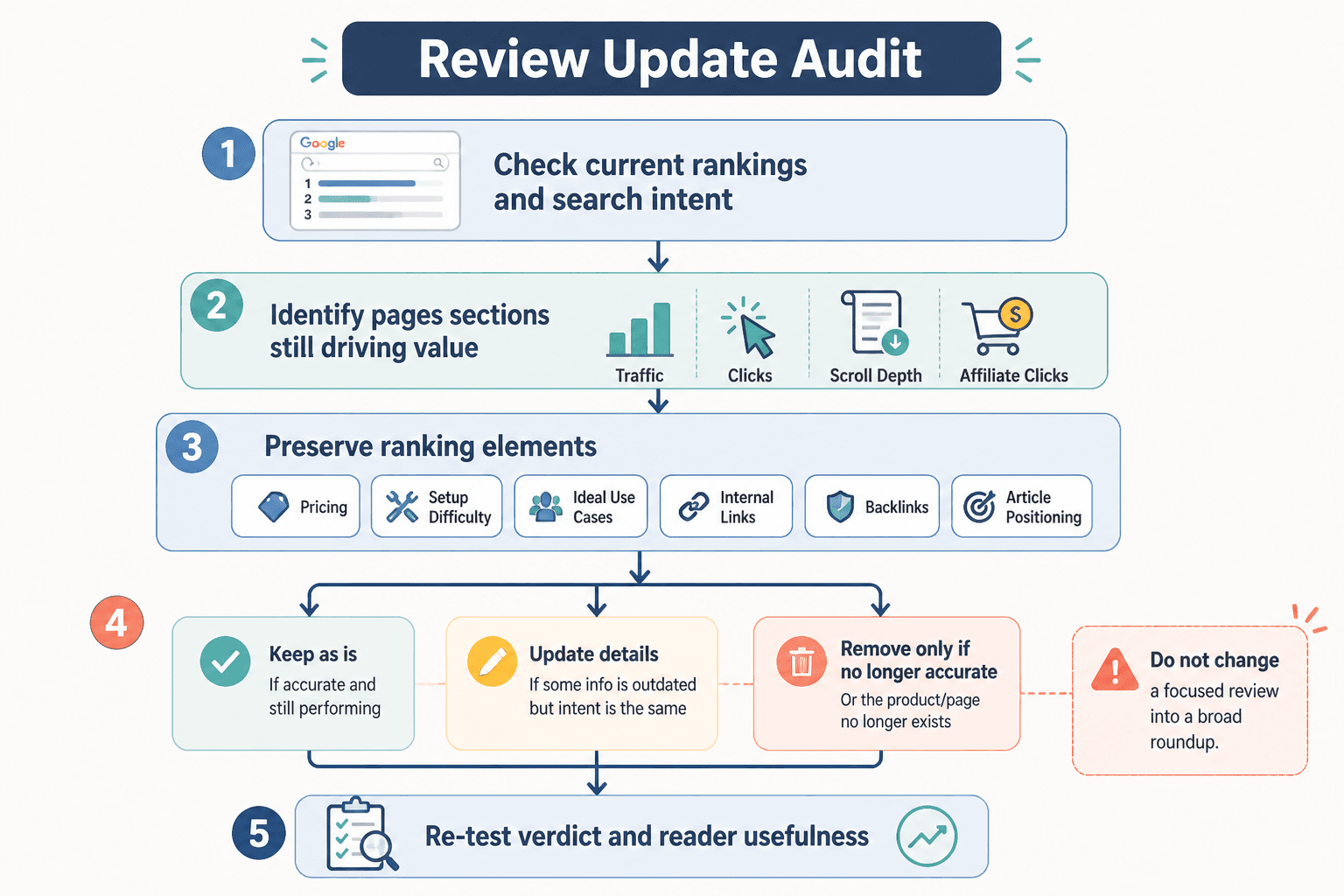
So first, identify the assets you do not want to casually break:
- The main keyword and close variants the page already ranks for
- The core search intent of the review
- Headings that are already pulling traffic
- Sections earning clicks, scroll depth, or affiliate clicks
- Internal links pointing to the review
- Backlinks, if the page has any
- The basic opinion or positioning of the article, unless the tool genuinely changed enough to warrant a different verdict
If the article ranks because people want “Tool X review for creators,” do not turn it into a broad “best software tools” post halfway through the update. If it ranks because you covered pricing, setup difficulty, and ideal use cases well, do not remove those sections because you felt like making it “cleaner.” Cleaner is not always better. Useful is better.
Think of this stage as content triage. You are not just asking, “What is old?” You are asking, “What is still carrying this page?”
Audit the review like a reader who is about to spend money
This is where many review updates go weirdly shallow. They check the pricing page, swap a screenshot, and move on. But a real reader is trying to answer practical questions before they click buy.
So review the article through that lens. Ask:
- Is the tool still for the same audience?
- Did the pricing model change?
- Have major features been added, removed, or renamed?
- Does the setup process look different now?
- Are there new limitations, annoyances, or strengths that matter?
- Have competitors changed the comparison landscape?
- Is your verdict still honest?
This matters because old review pages often become inaccurate in subtle ways. Not dramatic lies. Just enough drift to make the article feel stale. Maybe you still describe a feature as premium when it is now included in a cheaper plan. Maybe you say the interface is clunky when the company rolled out a redesign six months ago. Maybe your “best for” section is no longer true because the product shifted upmarket.
Those little mismatches matter. Readers notice them. Search engines are getting better at noticing when pages no longer satisfy what the query needs. And if your monetization depends on trust, stale details are expensive.
Use a simple review update checklist
- Re-test the tool if possible
- Check pricing, plans, and billing structure
- Verify screenshots and interface steps
- Reassess who the tool is best for
- Refresh pros and cons
- Update comparison sections
- Check affiliate links and CTA placement
- Remove claims you can no longer support
- Add any missing details readers clearly need now
Do not rewrite the URL, angle, and structure unless you have a very good reason
If you are nervous about losing rankings, this is one of the big ones.
When people panic-update old content, they often change too much at once. They alter the URL slug, replace the title with a completely different keyword target, rewrite every heading, and turn a focused review into a messy hybrid of tutorial, comparison, and listicle.
That is not refreshing. That is identity theft.
Keep these stable when possible:
- The URL
- The core keyword target
- The basic article purpose
- The primary heading structure, especially if it aligns with search intent
You can absolutely improve a title, tighten weak sections, or add better subheadings. But if the page currently ranks, treat that structure as something to refine, not bulldoze.
A safer update usually looks like this:
- Keep the main topic the same
- Improve weak or outdated sections
- Add missing context readers now expect
- Strengthen examples and proof
- Clarify your verdict and CTA
Not this:
- Change the keyword
- Change the title angle
- Delete half the original sections
- Stuff in unrelated affiliate products
- Hope Google enjoys chaos
Update the facts first, then improve the usefulness
There are two layers to a good review update.
Layer one is factual accuracy. Layer two is reader value. You need both.
Factual accuracy includes things like:
- Current pricing
- Current feature names
- Current setup steps
- Current interface screenshots
- Current integrations or limitations
Reader value includes things like:
- A clearer explanation of who the tool is actually for
- A better breakdown of tradeoffs
- More specific pros and cons
- Use-case based recommendations
- Honest alternatives
- A stronger summary verdict
Here is the mistake: some people update accuracy but not usefulness. So yes, the prices are current, but the review is still thin and generic. Others do the opposite. They add more personality and fluff up the article, but the details are outdated. Neither version is great.
The best updated tool reviews feel more current and more helpful. They answer the obvious questions faster. They reduce buyer friction. They sound like someone actually checked what changed.
A quick before-and-after example
| Weak update | Stronger update |
|---|---|
| “This tool is great for businesses of all sizes and offers a range of useful features.” | “This tool makes the most sense for solo creators and small teams who want simple scheduling without paying for a pile of enterprise extras they will never touch.” |
| “The dashboard is easy to use.” | “The dashboard is cleaner than it used to be, but the reporting tab is still clunky if you manage more than one client account.” |
| “Pricing may change, so check the website.” | “Pricing now starts at the lower tier, but key automation features are locked behind the mid-level plan, which matters if you need this for client work.” |
Add a visible freshness signal without faking “newness”
Readers want to know the review is current. Search engines also like seeing signs that a page is maintained. That does not mean you need to perform freshness like a content intern on too much coffee.
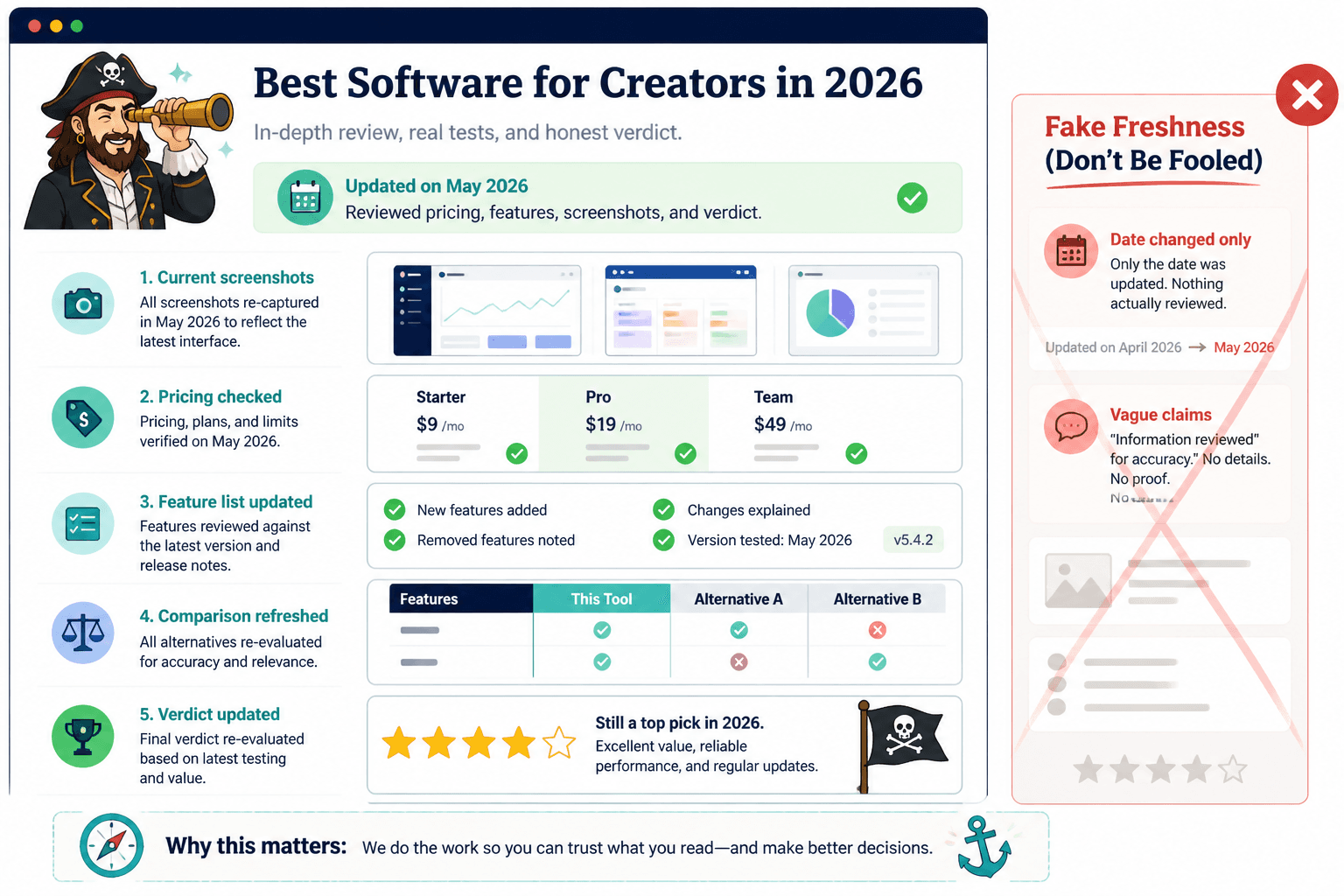
A good update usually includes clear signals such as:
- A brief note near the top that the review was updated
- Current screenshots
- Recent pricing and feature checks
- Updated comparisons or verdict sections
- Language that reflects the tool’s current version or positioning
What you do not want is fake freshness. Things like vague lines about “the latest revolutionary updates” with no specifics, or changing the publish date while leaving the body mostly stale. Readers can smell that. So can quality reviewers. It is lazy, and it usually shows.
If the review changed substantially, say so briefly and plainly. Something like a short note that pricing, features, screenshots, and recommendations were updated is enough. Clean. Credible. No drumroll needed.
Keep the original ranking intent, but expand where readers need more help
This is the balancing act. You want to preserve the page’s ranking identity while making the review more complete.
Usually, the safest improvements are expansions that support the existing intent, not detours away from it.
Good additions often include:
- A “best for” section
- A “not ideal for” section
- A short comparison with one or two alternatives
- A practical setup or user experience note
- A value-for-money section
- An honest limitations section
These additions work because they help the same reader make the same decision better. They do not drag the article into a different keyword battle it was never built to win.
If you need a stronger structure for writing useful reviews in the first place, this guide on writing tool reviews without sounding like affiliate fluff pairs nicely with the update process. It is easier to preserve rankings when the review actually had substance to begin with.
Refresh affiliate sections without turning the review into a cardboard sales page
Old tool reviews often monetize badly for one of two reasons.
Either the affiliate links are buried and awkward, or the article gets updated in a way that makes the money intent painfully obvious. Suddenly every other paragraph sounds like it was approved by a commission calculator.
When updating, check:
- Are affiliate links still working?
- Do the CTAs still fit the article naturally?
- Is the recommendation still honest?
- Have you added too many monetization prompts?
- Does the review still feel like a review first?
The safest conversion improvements are usually subtle:
- Clarify who should use the tool
- Add a stronger verdict near the end
- Place a natural CTA after the key decision section
- Link to related comparison or buyer-guidance content
If your review makes money, good. It should. But monetized reviews hold rankings better when they still feel helpful, specific, and grounded in reality. If you want more on that balance, this piece on monetizing tool reviews without thin reviews is worth reading.
Update internal links so the review fits the rest of your content better
Refreshing a review is also a good excuse to make it more connected.
Internal links help readers keep going, help search engines understand context, and help your review do more than sit there hoping for affiliate clicks. If the article lives in a larger review or monetization cluster, use that.
Natural internal links here could include:
- Your broader tool reviews hub
- A guide on choosing tool reviews without wasting money
- A guide on turning old content into better affiliate articles
This matters more than people think. A review that sits inside a clear content ecosystem often performs better than a lonely page with no contextual support. It also gives you more ways to capture readers who are not ready to buy from one article alone.
Prune weak sections instead of politely preserving dead weight
Not every part of the old article deserves to survive.
If the review has bloated intro paragraphs, vague feature summaries, outdated competitor mentions, or generic filler like “this tool has many benefits,” cut it. You do not get points for preserving bad writing in amber.
Here is a useful pruning rule: if a section does not help a real reader evaluate the tool, update it or remove it.
Good things to cut:
- Throat-clearing intros
- Generic praise with no specifics
- Features lists copied from the homepage
- Outdated comparisons
- Bloated FAQ answers that say little
- Weak CTAs repeated too often
Good things to keep and sharpen:
- Use-case guidance
- Pricing analysis
- Tradeoffs
- Hands-on observations
- Who it is and is not for
- Alternative recommendations
Make the update large enough to matter, but not so wild it resets the page
This is the part people want a magical percentage for, and sadly the internet loves pretending there is one.
There is no perfect number of words or exact percentage of content you should change. What matters is whether the update meaningfully improves the article while preserving its core relevance.
As a practical guideline, a worthwhile review update often includes a mix of:
- Several factual corrections or refreshes
- At least one stronger or expanded section
- Improved screenshots or visual references
- Tighter language in stale areas
- Refined CTA or monetization flow
If literally all you did was change a date, that probably is not enough. If you rewrote the piece so aggressively that it now targets a different reader with a different buying intent, that might be too much.
Useful updates are usually surgical, not theatrical.
Track what happens after the update instead of assuming you nailed it
Once the update is live, watch the page.
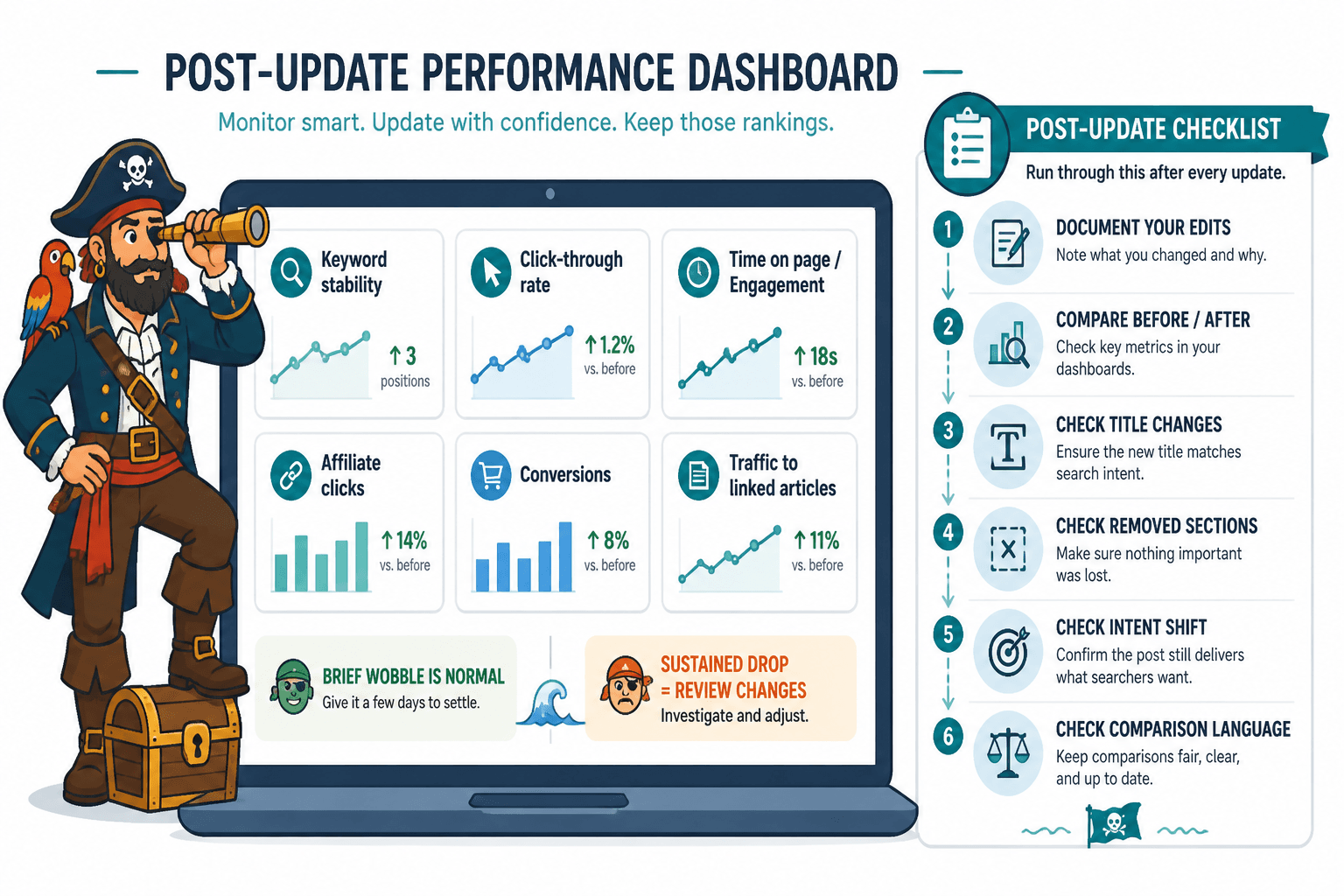
You do not need to obsess over every micro-fluctuation. Rankings can wobble after changes. But you should monitor whether the update improved the things that matter:
- Keyword stability
- Click-through rate
- Time on page or engagement signals
- Affiliate clicks
- Conversions
- Traffic to linked articles
If rankings dip briefly and then recover, that is not unusual. If rankings collapse and stay there, review what changed. Did you alter the title too drastically? Remove useful sections? Shift the intent? Strip out comparison language people were searching for? This is why documenting your edits matters. It helps you diagnose instead of guessing.
A simple process for how to update old tool reviews without losing rankings
The bigger point is simple: clearer structure and clearer writing make the piece more useful. That is usually what makes the ending land better too.
The bigger point is simple: clearer structure and clearer writing make the piece more useful. That is usually what makes the ending land better too.