
Most tool review monetization advice is built on a bad premise: write faster, publish more, sprinkle affiliate links around like confetti, and hope Google or your audience does the rest.
That is how you end up with thin reviews nobody trusts, nobody remembers, and almost nobody buys from unless they were already planning to click something anyway.
If you want to figure out How to Monetize Tool Reviews Without Thin Reviews, the answer is not “be less salesy” in some vague moral sense. It is to make the review genuinely useful enough that the monetization feels earned. Good tool review content does not hide the money part. It just gives the reader enough specificity, context, proof, and decision help that the money part stops feeling cheap.
That means your review needs to do more than describe features and slap on a verdict. It needs to help the right person decide: Is this tool good for me, for this job, at this stage, with these tradeoffs?
Here is how to monetize tool reviews without turning them into affiliate fluff, generic comparison sludge, or 2,000 words of repackaged pricing-page furniture.
Want the broader roadmap? Start with the parent guide.
Why most monetized tool reviews feel thin
Thin reviews are usually not thin because they are short.
They are thin because they do not contain original judgment.
A lot of creators think a review becomes “complete” when it includes features, pricing, pros, cons, and a CTA. That is not a review. That is a product summary wearing a review costume.
If the reader could get almost the same information from the tool’s homepage, your content is not doing enough work.
Thin reviews usually have a few familiar problems:
- They describe the tool but do not evaluate it
- They list features without explaining who those features matter for
- They avoid clear downsides because the writer is scared of hurting conversions
- They aim at everyone, so they help no one much
- They read like affiliate content first and decision-help second
- They have no use-case framing, examples, screenshots, workflow notes, or comparisons that actually clarify anything
And yes, readers can smell this. So can search engines, frankly. Thin review content tends to have that polished, bloodless tone of someone who has technically used the tool for seven minutes and now feels spiritually qualified to rank “best alternatives.”
If you want to monetize review content well, start by making it harder to fake.
The real job of a monetized tool review
A monetized tool review has one job: help the reader make a better buying decision, then make the next step easy.
That sounds simple, but it forces better content choices. You stop asking, “How do I fit the affiliate link in?” and start asking, “What does this reader need in order to trust my recommendation enough to act on it?”
A strong review usually does four things:
- Frames the tool around a real use case
- Explains where it works well and where it falls short
- Matches the tool to a specific kind of buyer
- Provides a natural path to click, compare, sign up, or keep researching
Notice what is missing: fake neutrality. You do not need to pretend every tool is “great for all kinds of users.” That kind of review sounds safe, but it destroys trust. Useful reviews have edges.
Sometimes the highest-converting line in a review is not praise. It is a clear limitation that makes the praise more believable.
Good review monetization comes from better recommendation quality, not louder recommendation volume.
Start with buyer intent, not the tool itself
One of the fastest ways to write thin reviews is to organize everything around the product menu.
That gives you sections like features, dashboard, integrations, pricing, support, final verdict. Fine. Functional. Also boring and often not that helpful.
A better approach is to organize the review around what the buyer is actually trying to solve.
For example, a creator looking at an email tool is probably not asking, “What are the six key automation features?” They are asking things like:
- Can this handle a simple newsletter without me needing a PhD in funnels?
- Is it overkill for my audience size?
- Will this save me time or create admin work in a prettier dashboard?
- Does it play well with my existing workflow?
- What will annoy me after two months?
That is the material a useful review is made of.
Before you write, get clear on the reader’s likely intent. Usually it falls into one of these buckets:
- Validation: They already want the tool and need a final nudge
- Comparison: They are choosing between a few options
- Suitability: They want to know if the tool fits their business model, audience, or stage
- Risk reduction: They are looking for honest drawbacks before buying
- Workflow proof: They want to see how the tool works in practice, not just in theory
If your review does not clearly serve one or more of those intents, monetization gets shaky because trust gets shaky.
A better review angle
Instead of “Tool X review,” try writing from one of these angles inside the article itself:
- Best for solo creators who want simplicity over endless features
- Worth it if you have a team, overkill if you do not
- Strong on automation, weak on writing workflow
- Great for consultants, clunky for ecommerce
- Excellent starter option with obvious limitations once you scale
That kind of framing gives the reader a faster path to self-identification. And self-identification is what moves clicks that actually convert.
Use a review structure that creates trust before revenue
If you put affiliate links everywhere before you have established judgment, the whole review starts to feel sticky in a bad way.
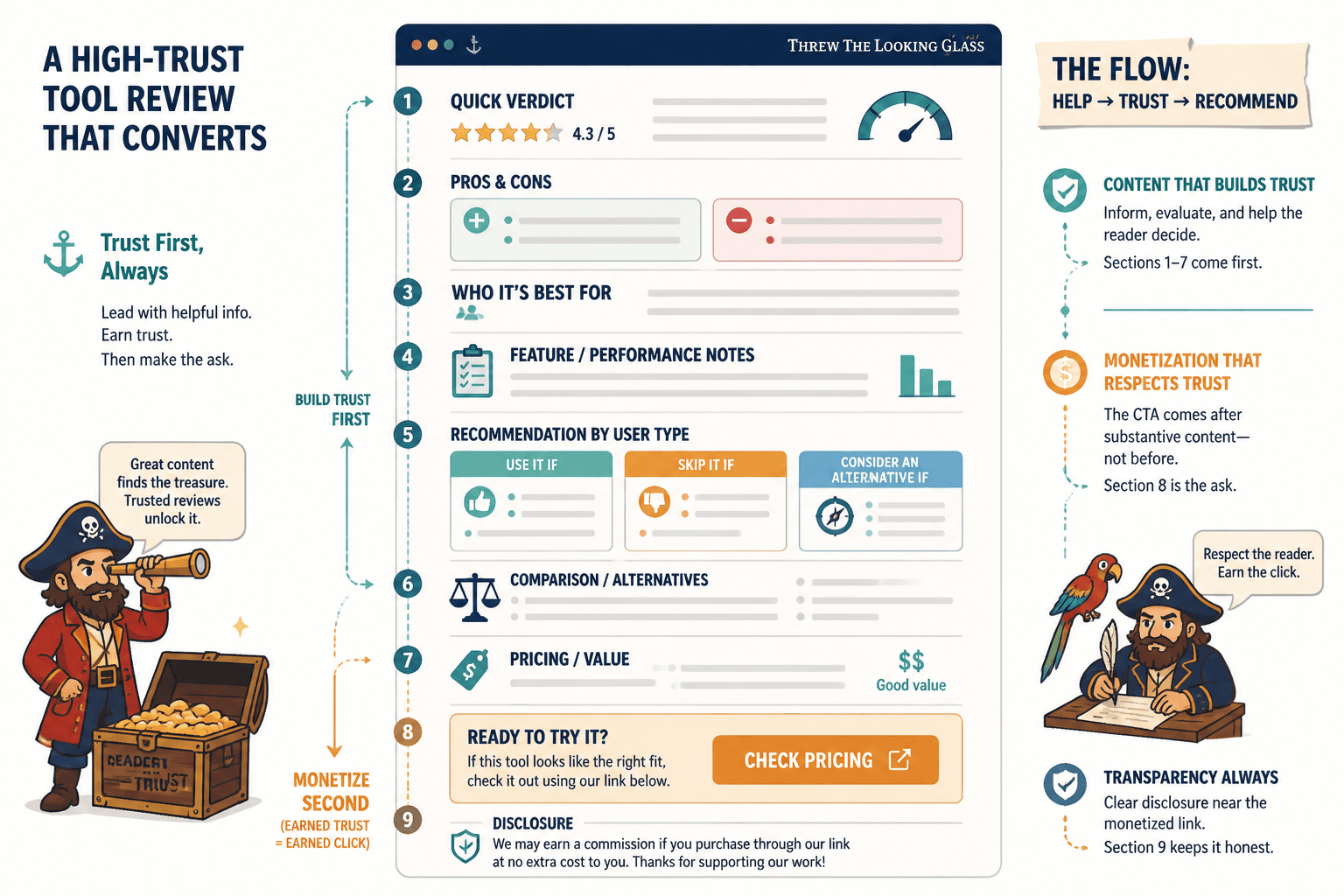
A better structure is simple:
- Lead with the decision context
- Explain who the tool is for
- Show what it does well
- Show where it disappoints or has tradeoffs
- Compare it against realistic alternatives
- Give a clear recommendation by user type
- Place the monetized next step where it feels earned
This works because it mirrors how people buy. They do not want to be sold before they feel oriented. They want help sorting the decision.
A practical review outline
- Opening: What this tool is, who should care, and what kind of buyer this review is for
- Quick verdict: Your short honest take
- Best for: Specific user categories
- Not ideal for: The people who should skip it
- What stood out in actual use: Workflow notes, friction points, setup experience, speed, usability, output quality, support, etc.
- Pros and cons: Real ones, not decorative ones
- Comparison section: Against two or three alternatives that readers are actually considering
- Pricing context: Not just cost, but whether the value makes sense for the use case
- Final recommendation: Clear decision guidance
- CTA: Try it, compare options, read a related article, or see how it fits into a larger workflow
That is not the only valid structure, but it is a strong one because it gives readers enough substance before asking them to click.
What to include so the review does not feel thin
If you want monetization without thinness, your review needs evidence of thought. Not just coverage. Thought.
Here are the elements that usually make the biggest difference.
1. A clear use case
Do not review the tool in the abstract. Review it in relation to a job.
Bad: “This platform offers templates, automation, and collaboration tools.”
Better: “This works well if you are a solo consultant who wants to send a weekly newsletter and one basic welcome sequence without getting dragged into an enterprise dashboard circus.”
2. Specific friction points
The fastest way to sound credible is to mention the stuff marketing pages smooth over.
Examples:
- The setup is easy, but the naming inside automations gets messy fast
- The interface looks clean until you need to find reporting
- The templates are fine, though some are clearly built for teams larger than one caffeinated human
- The mobile experience exists, which is different from being pleasant
You are not nitpicking. You are reducing buyer regret.
3. Tradeoffs, not fake balance
Readers do not need a ceremonial “cons” section filled with nonsense like “might be too powerful for some users.” That is not a con. That is a LinkedIn compliment in disguise.
Real tradeoffs look like this:
- Excellent feature depth, but a steeper learning curve than most solo operators will enjoy
- Very affordable early on, but pricing climbs sharply once your list grows
- Strong analytics, weaker writing environment
- Fast to start, harder to customize later
4. Comparisons that help someone decide
Comparison sections are where monetized reviews often make their money, because readers near a buying decision tend to compare. But comparisons only help if they clarify decision criteria.
Do not just say Tool A is “more robust” and Tool B is “better for beginners.” Explain what that means in practical terms.
| Decision factor | Tool A | Tool B |
|---|---|---|
| Best for | Creators who want fast setup and simple workflows | Teams that need more customization and segmentation |
| Main strength | Ease of use | Feature depth |
| Main downside | Can feel limiting as needs grow | Takes longer to learn and manage |
| Who should choose it | Solo operators who value speed | Businesses with more complex systems |
That kind of table is useful because it shortens the decision path.
5. A recommendation by user type
One of the strongest ways to avoid thinness is to stop pretending there is one universal verdict.
Try a simple recommendation block like this:
- Use it if: You want speed, simplicity, and a low-friction start
- Skip it if: You need advanced reporting or highly customized workflows
- Consider an alternative if: You are already juggling a bigger audience, team, or product stack
This creates confidence because it shows judgment instead of generic approval.
How to place monetization without making the review feel greasy
You do not need to hide that a review is monetized. In many cases, being clear about that is smarter. The problem is not monetization. The problem is premature monetization.
If the reader has not yet seen enough substance to trust your judgment, every link feels heavier.
Good monetization placement usually looks like this:
- A soft affiliate link after a useful quick verdict
- A stronger CTA after the recommendation section
- Comparison links in context, where the reader naturally wants alternatives
- A next-step CTA tied to the reader’s use case, not your commission hopes
Examples of better monetized CTAs
Weak CTA: “Click here to get started with Tool X today.”
Better CTA: “If you want a simpler setup and do not need heavy customization yet, Tool X is probably the better fit.”
Weak CTA: “Try Tool X now and transform your workflow.”
Better CTA: “If your main goal is getting this workflow running without a week of setup drama, Tool X is the one I would start with.”
The second version works better because it sounds like advice, not brochure residue.
If you want to build this out further, it helps to pair your reviews with a broader monetization strategy. These pieces work well together:
- Monetization Funnels
- Money Content
- Tool Reviews
- How to Turn Tool Reviews Into Affiliate Revenue
- How to Monetize Affiliate Articles Without Wrecking Trust
Use depth where it changes the buying decision
Not every review needs to be massive. But if you want it to monetize, it does need enough depth in the places buyers care about most.
This is where a lot of review writers get lazy. They add more words, but not more decision value.
Here is where added depth actually earns its keep:
- Setup experience: Was it smooth, clunky, confusing, or surprisingly fast?
- First-use payoff: How quickly can someone get a useful result?
- Workflow fit: Does it simplify the job or just relocate the complexity?
- Scaling pain: What gets harder as usage grows?
- Support and reliability: Is help accessible, and does the tool feel dependable enough for important work?
Notice that these are not random feature observations. They are purchase-relevant observations.
Sometimes a paragraph of honest context is more valuable than an extra 15 bullet points. If the tool has a hidden annoyance, explain it. If a supposedly premium feature is only useful for a narrow slice of users, say that. If the tool shines in one exact scenario, spell it out.
This is also where your review starts separating itself from AI-generated wallpaper. Most thin reviews can mimic coverage. They cannot mimic lived evaluation very well.
Monetize the review as part of a funnel, not a one-off article
If your only monetization plan is “rank review, get click, earn commission,” you are leaving a lot on the table and increasing pressure on each article to sell too hard.
A smarter model is to use tool reviews inside a broader creator funnel. That gives the reader multiple good next steps, not just one affiliate link waving from the corner like it pays rent.
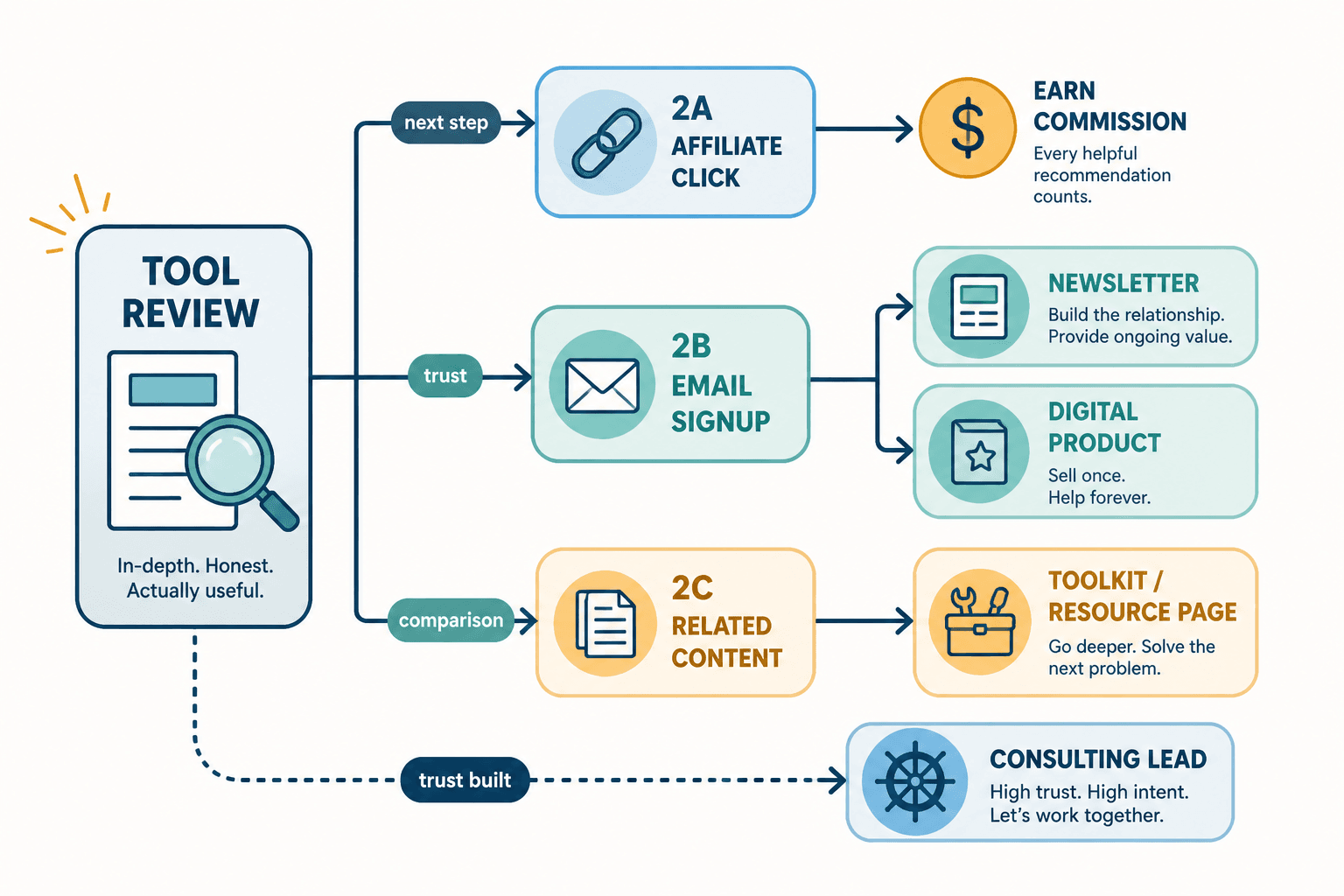
Useful review funnel paths can look like this:
- Review → comparison article → affiliate click
- Review → use-case guide → affiliate click
- Review → email signup → nurture → tool recommendation
- Review → workflow article → service offer or consulting call
- Review → toolkit page → multiple related recommendations
This matters because not every review reader is ready to buy now. Some need more context. Some are still comparing. Some trust your thinking enough that they want your broader process, not just your link.
That is why tool reviews can support more than affiliate revenue. They can feed:
- Newsletter growth
- Consulting leads
- Digital products
- Toolkits and resource pages
- High-intent internal traffic to related monetized content
If you want to expand beyond isolated reviews, these are worth linking into the journey:
- How to Write Tool Reviews Without Sounding Like Affiliate Fluff
- How to Use Tool Reviews in a Creator Funnel
What not to do if you want reviews that actually convert
A few habits keep wrecking review quality and conversion quality at the same time.
Do not write from the pricing page outward
If your review sounds like it was reverse-engineered from marketing copy, it will usually perform like it.
Do not sand off every criticism
Readers trust selective praise more than universal praise. If every tool is amazing, you are not reviewing. You are varnishing.
Do not compare five tools if two would do
More options do not always help. Sometimes they just create blur. Focus on realistic alternatives and real decision criteria.
Do not force every review to close the sale immediately
Some articles should convert now. Some should build trust and move the reader one step closer. Both have value.
Do not confuse word count with substance
A 3,000-word review can still be thin if it says the same seven points three different ways.
A simple framework for writing higher-converting, non-thin reviews
If you want a repeatable process, use this:
- Choose one buyer type. Not “everyone who needs this tool.” One clear kind of reader.
- Name the job they are trying to do. Be concrete.
- Evaluate the tool against that job. Not against marketing promises.
- Include at least three useful specifics. Friction, fit, tradeoff, setup, comparison, output quality, support, workflow impact.
- Make a recommendation with edges. Who should use it, skip it, or compare it.
- Add the next step that matches intent. Affiliate click, comparison article, email opt-in, or related guide.
That structure keeps your review grounded in utility. Utility is what makes monetization feel legitimate.
Quick FAQ
Can tool reviews be short and still monetize well?
Yes, if they are specific and decision-focused. Short is fine. Thin is the problem.
Should I disclose affiliate links?
Yes. Be clear and normal about it. Hiding monetization is a trust tax you do not need.
How many tools should I compare in one review?
Usually two or three realistic alternatives are enough. More than that often adds noise unless the article is built as a proper roundup.
What makes a review feel trustworthy?
Specific use-case framing, honest downsides, clear recommendations, and details that show actual evaluation instead of recycled copy.
Should every review try to get an affiliate click?
No. Some should route readers to related content, email, or a broader funnel first.
Make the review worth reading, then make the click make sense
If you want to master How to Monetize Tool Reviews Without Thin Reviews, the fix is not dressing up weak content with smoother CTAs. It is building reviews that genuinely reduce confusion, buyer hesitation, and regret.
That means more judgment, more specificity, better use-case framing, and less generic praise sprayed over every tool with a referral program.
A monetized review should feel like someone useful helped the reader think clearly. If it feels like an article trying to earn a commission before it earns belief, people can tell.
Write the review that helps the right person make the right call. Then the monetization has something solid to stand on.
The bigger point is simple: clearer structure and clearer writing make the piece more useful. That is usually what makes the ending land better too.