
People toss around ChatGPT, GPT, and LLM like they all mean the same thing. They do not. And that confusion creates a weird amount of nonsense, especially when someone is trying to compare tools, buy software, write about AI, or sound informed without accidentally saying “the ChatGPT model” when they actually mean something else.
The terms are related, sure. But they are not interchangeable. One is a product. One is a model family. One is a category. If you mix them up, you can still survive the conversation, but you will sound like someone calling every soda “Coke” and then trying to explain beverage strategy.
Here’s the clean version of ChatGPT vs GPT vs LLM: What Each Term Means, when to use each term, and how to stop muddying the distinction when you’re writing, talking, or comparing AI tools.
If you want the bigger picture, start with the parent guide.
Start with the simple version
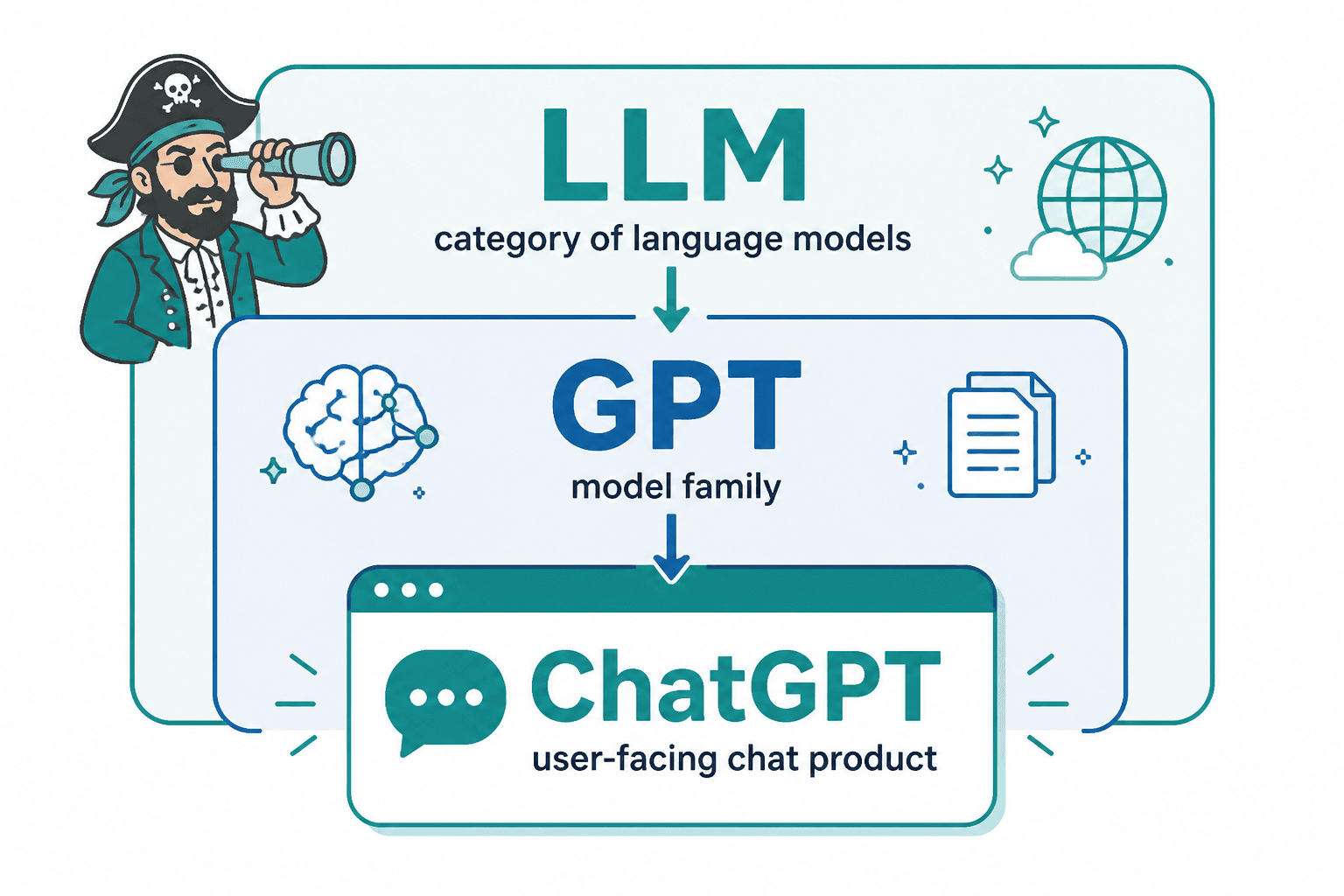
- LLM = a broad type of AI model that works with language.
- GPT = a specific family of language models.
- ChatGPT = a product or app built around GPT models for chat-based use.
That is the basic hierarchy most people need.
If you want the fast mental model, think of it like this:
- LLM is the category
- GPT is a brand/model family inside that category
- ChatGPT is the user-facing product people interact with
Or even simpler:
- LLM = type of engine
- GPT = specific engine line
- ChatGPT = the car you drive that uses that engine
Not a perfect analogy, but close enough to stop most confusion.
What an LLM actually means
LLM stands for large language model.
That term describes a class of AI systems trained on large amounts of text so they can predict and generate language. They can answer questions, summarize documents, write drafts, extract information, classify text, and do plenty of other language-heavy tasks.
The important part is this: LLM is a general category, not one specific tool.
So when someone says, “We use an LLM for support automation,” they are usually talking about the underlying type of model, not necessarily a specific consumer app.
Plenty of systems count as LLMs. Some are built for chat. Some are used behind the scenes in software. Some are tuned for coding, research, search, summarization, or enterprise workflows. Some are open-source. Some are proprietary. Some are wrapped in slick products. Some sit in the background doing useful work without a shiny interface.
That is why saying “LLM” can be useful when you want to stay broad. It helps when you are discussing the category itself, comparing architectures, talking about industry trends, or describing how a system works at a high level.
Use “LLM” when you mean the category
- “Our product uses an LLM to summarize call transcripts.”
- “This workflow works with most modern LLMs.”
- “Different LLMs vary in speed, reasoning, context handling, and cost.”
That wording is clean because it does not pretend every AI text system is ChatGPT. A low bar, but one worth clearing.
What GPT means
GPT usually refers to a specific family of language models. The acronym stands for Generative Pre-trained Transformer.
You do not need to memorize the full phrase unless you enjoy making simple concepts sound harder than they need to be. What matters is that GPT is not the generic name for all AI writing systems. It refers to a particular model line.
When people mention GPT-4, GPT-4o, or earlier versions like GPT-3.5, they are talking about versions within that model family. Those are models. They are not the same thing as the app interface where people chat with them.
This is where the confusion usually starts. A lot of people use “GPT” when they really mean “ChatGPT,” because GPT is the part they remember. That is understandable. It is also sloppy.
Use “GPT” when you mean the model family or model version
- “This tool is powered by a GPT model.”
- “We tested the prompt on two GPT versions.”
- “GPT models are one type of LLM.”
If you are discussing model performance, capability differences, API usage, prompt behavior, or version comparisons, “GPT” is often the right term.
Put differently: if the conversation is about the underlying model, not the consumer-facing product, GPT may be the better word.
What ChatGPT means
ChatGPT is the chat-based product people use directly.
It is the interface, experience, and product layer wrapped around GPT models and related features. That includes things like the chat environment, file uploads, conversation history, custom behaviors, and whatever product features are available inside the app at a given time.
So if someone says, “I used ChatGPT to draft this outline,” they are talking about the actual app or product they used. That is different from saying, “This was generated by a GPT model,” which points more toward the underlying model.
This distinction matters more than it seems. A product can include multiple models, settings, tools, and features. The model is one layer. The app experience is another. Confusing the two leads to messy comparisons and bad explanations.
Use “ChatGPT” when you mean the product people interact with
- “I asked ChatGPT to rewrite the intro.”
- “Our team uses ChatGPT for brainstorming.”
- “The issue was in ChatGPT’s interface, not the prompt itself.”
If the thing being discussed is the app, account experience, chat interface, or user workflow, “ChatGPT” is the right term.
ChatGPT vs GPT vs LLM: the hierarchy that clears this up fast
| Term | What it is | Best used for |
|---|---|---|
| LLM | A broad category of AI language models | Talking generally about language-model systems |
| GPT | A specific family of language models | Talking about model versions, capabilities, or architecture |
| ChatGPT | A chat-based product built around GPT models | Talking about the app or user experience |
If you remember nothing else, remember that table.
Why people keep mixing them up
Because normal people do not spend their day carefully separating product layers from model architecture, and honestly, fair enough.
Still, there are a few specific reasons this gets muddled:
- ChatGPT became the household name. People use it as shorthand for AI text generation in general.
- GPT is in the name ChatGPT. So people naturally blur the product and the model family.
- LLM is technical jargon. It is accurate, but less familiar to casual users.
- AI companies market products more than architecture. Most users meet the app first, not the technical stack behind it.
That said, if you are writing articles, selling services, teaching clients, building workflows, or comparing tools, precision helps. You do not need to sound like a lab manual. You do need to stop using every term as a catch-all blob.
When the distinction actually matters
In casual conversation, people will usually understand what you mean. In practical work, the distinctions matter more.
1. When you are comparing tools
If you are reviewing software, “ChatGPT” and “LLM” are not interchangeable. One is a product. The other is a technology category.
Example:
- Messy: “This app is better than ChatGPT because it uses an LLM.”
- Better: “This app uses an LLM too, but its workflow is better suited for research and document analysis than ChatGPT’s chat-first interface.”
2. When you are buying or implementing AI tools
If a vendor says they use an LLM, that does not automatically tell you which model, which capabilities, what limitations exist, or how the product behaves.
“Uses AI” is already doing too much unpaid labor in most software copy. “Uses an LLM” is only slightly better unless they explain what it actually does for the user.
3. When you are creating content about AI
If you teach people how to use AI for writing, research, content workflows, or automation, clean language builds trust. If you say “ChatGPT” every time you mean “language model,” you flatten useful distinctions.
That matters because the advice can change depending on the layer:
- Product advice might be about interface features, saved prompts, file uploads, or team workflows.
- Model advice might be about prompting style, quality differences, speed, or output behavior.
- Category advice might be about what LLMs are good at, where they fail, and how to use them responsibly.
4. When you are trying to sound competent in front of clients
You do not need to overcomplicate your language. But if you are selling AI strategy, training teams, or recommending tools, the terms should match what you mean.
Clients do not need jargon confetti. They do need confidence that you understand the difference between the engine, the model family, and the product sitting on top of it.
Common mistakes people make with these terms
Mistake 1: Using ChatGPT as the name for all AI
This is the most common one. It is a bit like calling every video platform YouTube. People get the gist, but it is still wrong.
Better: Use “ChatGPT” for the product, and “AI model” or “LLM” when you mean the broader technology underneath many different tools.
That small distinction makes your explanations sound much clearer. It also helps other people understand whether you are talking about one brand, one model family, or the wider category of systems behind them.