
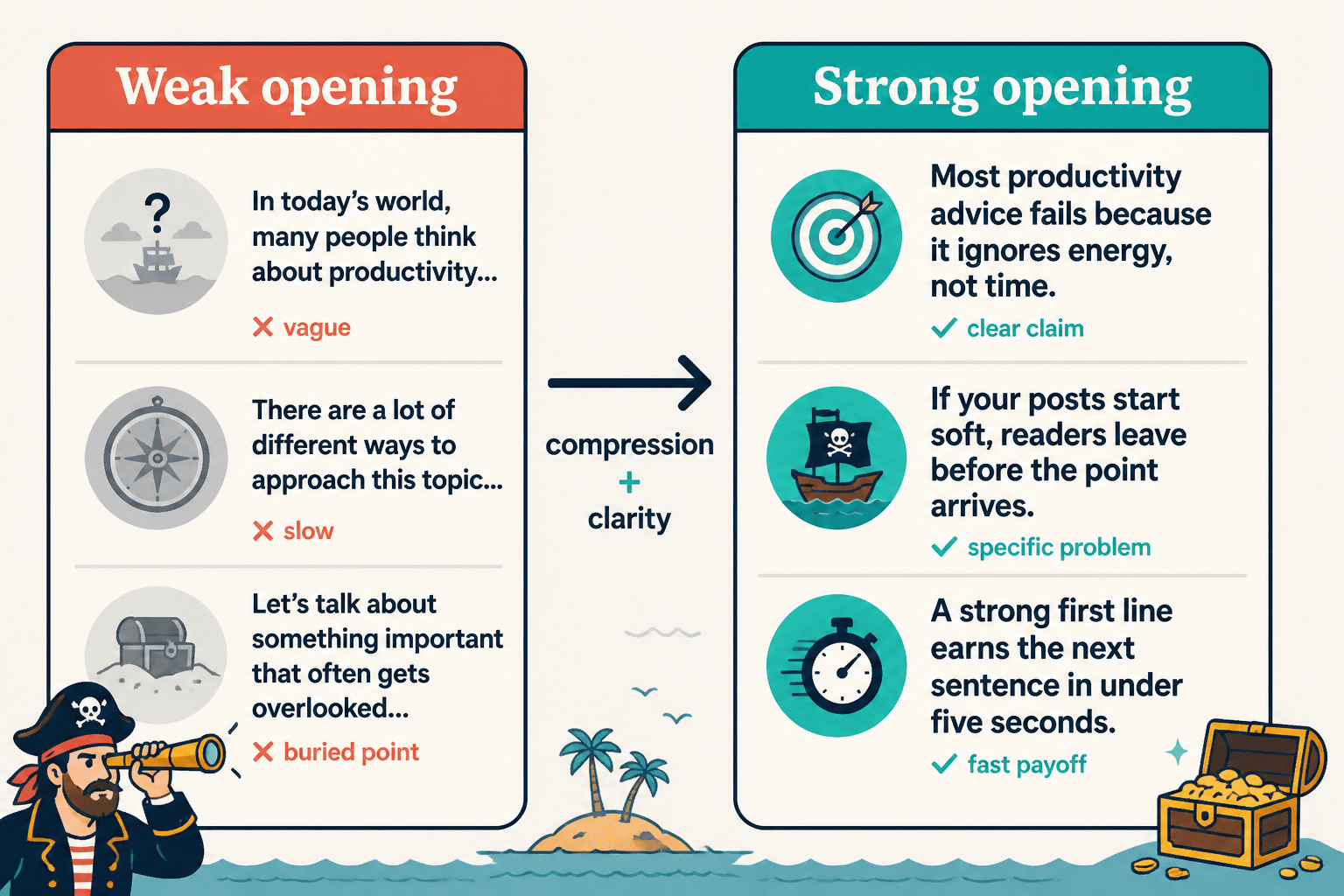
Weak X openings usually do not fail because they are too short.
They fail because they spend the most valuable part of the post saying almost nothing.
You get one small window to make someone stop scrolling. If your first line opens with “Just thinking about this…” or “A quick reminder that…” or some foggy setup that takes forever to arrive anywhere, the post is already limping.
How to Start X Posts Without a Weak Opening comes down to one thing: lead with the point people can actually react to. Not the warm-up. Not the disclaimer. Not the polite runway speech.
If you write on X to build attention, trust, leads, or just a sharper online presence, your opening matters more than almost anything else in the post. Here’s how to make those first lines tighter, clearer, and much harder to ignore without turning into clickbait sludge.
If you want the bigger picture, start with the parent guide.
Why most X post openings feel weak
X is not generous with attention. People are moving fast, half-reading, and deciding in a second whether something is worth their time.
That means your opening has one job: create enough interest, relevance, tension, clarity, or force that someone keeps reading.
Most weak openings miss because they do one of these:
- They clear their throat instead of making a point
- They sound vague and interchangeable
- They hide the interesting part until line four
- They try to sound wise instead of useful
- They open softly when the idea needs a sharper edge
- They read like someone trying not to offend a houseplant
X rewards compression. Not random bluntness. Not faux confidence. Compression. The strongest openings say something real with less wasted motion.
What a strong X opening actually needs to do
A strong opening does not need to be dramatic. It needs to be clear enough and specific enough to trigger curiosity, recognition, disagreement, or immediate value.
Usually, a good first line does at least one of these well:
- Makes a sharp claim
- Names a problem people recognize
- Creates contrast
- Challenges a lazy assumption
- Offers a useful takeaway fast
- Sets up a clear payoff
That is it. You do not need fake suspense. You do not need “nobody talks about this” theater. You do not need to act like a life-changing revelation is about to happen because you discovered line breaks.
A simple test for your first line
Read your opening and ask:
- Does this say something, or just announce that I am about to say something?
- Would the same line fit 5,000 other posts?
- Is the interesting part buried lower down?
- Would someone in my audience immediately know why they should care?
If the answer is bad, the opening is bad. Conveniently simple.
Stop opening with throat-clearing
Throat-clearing is all the stuff writers add before they get to the point. It feels natural when you are drafting. It reads terribly on X.
Common throat-clearing openings include:
- “Just a quick thought…”
- “I have been reflecting on…”
- “This might be controversial, but…”
- “Not sure who needs to hear this…”
- “A reminder that…”
- “Hot take:” followed by room-temperature oatmeal
These lines are not evil. They are just weak. They waste prime real estate on setup instead of substance.
Here is the fix: cut the preamble and start where the post actually starts.
Before and after: removing the weak setup
- Weak: “Just a quick thought on content strategy for creators.”
- Better: “Most creators do not need more content ideas. They need better packaging.”
- Weak: “I have been thinking a lot about why some posts perform better than others.”
- Better: “Good posts usually win before the second line.”
- Weak: “Not sure who needs to hear this, but being consistent matters.”
- Better: “Consistency does not fix boring posts. It just helps you publish boring posts more often.”
See the pattern? The better versions begin with the actual thought. That one shift alone can rescue a lot of posts.
Five stronger ways to start X posts
You do not need one perfect formula. You need a handful of opening styles that fit your voice and the kind of posts you write.
1. Start with a clear opinion
X is a great platform for compact opinions. Not fake-edgy nonsense. Just actual perspective.
Examples:
- Most “authority-building” content sounds like it was assembled by committee.
- You do not need to post more on X. You need fewer softer openings.
- Threads are overrated when the core idea could have been one strong post.
This works because opinion creates friction. Friction creates attention. Attention gets the read.
2. Start with a specific problem
If your reader feels the problem immediately, they will usually keep going.
- Your posts are probably not too short. They are too vague.
- If people ignore your content, the issue is often the first line, not the whole idea.
- Most low-engagement posts die because they ask the reader to care too late.
This is especially useful if you write for creators, consultants, founders, or service businesses trying to improve results from content.
3. Start with contrast
Contrast is one of the cleanest ways to create interest fast. Show the gap between what people assume and what tends to be true.
- Long posts do not lose attention. Slow starts do.
- Being clear is not the same as being boring.
- Posting daily is easier than learning how to say one sharp thing well.
Contrast gives the reader a reason to mentally lean in. It suggests there is a useful correction coming.
4. Start with a useful observation
This is a quieter opening style, but it works well if the observation is crisp.
- The strongest X posts often sound more like spoken language than polished content.
- People trust writers who get to the point faster.
- Vague openings usually come from writers trying to protect the idea from judgment.
This style works nicely when you want authority without sounding theatrical.
5. Start with the payoff
If your post contains a useful lesson, framework, or tactic, lead with the result or insight instead of the backstory.
- Here is the fastest way to fix a dull X post: rewrite the first line until it says one thing clearly.
- A better hook usually beats a better body.
- If your post opens vaguely, the rest of it has to work twice as hard.
Backstory can come later if it helps. On X, the opening earns the right to keep talking.
How to Start X Posts Without a Weak Opening: a simple rewrite process
If your first lines tend to come out soft, overexplained, or sleepy, use this process. It is quick, and it catches most of the usual problems.
- Find the actual point. What is the sharpest true thing in the post?
- Cut the runway. Remove any line that only announces the topic.
- Add specificity. Replace broad words with a real problem, claim, or contrast.
- Increase tension. What assumption are you challenging? What mistake are you naming?
- Read it aloud. If it sounds like formal content mush, tighten it again.
Here is that process in action.
Example 1
- Draft opening: “I wanted to share something I have noticed about writing better posts on X.”
- Actual point: Most people bury the strongest line.
- Rewrite: “Most X posts would improve immediately if the first line stopped stalling.”
Example 2
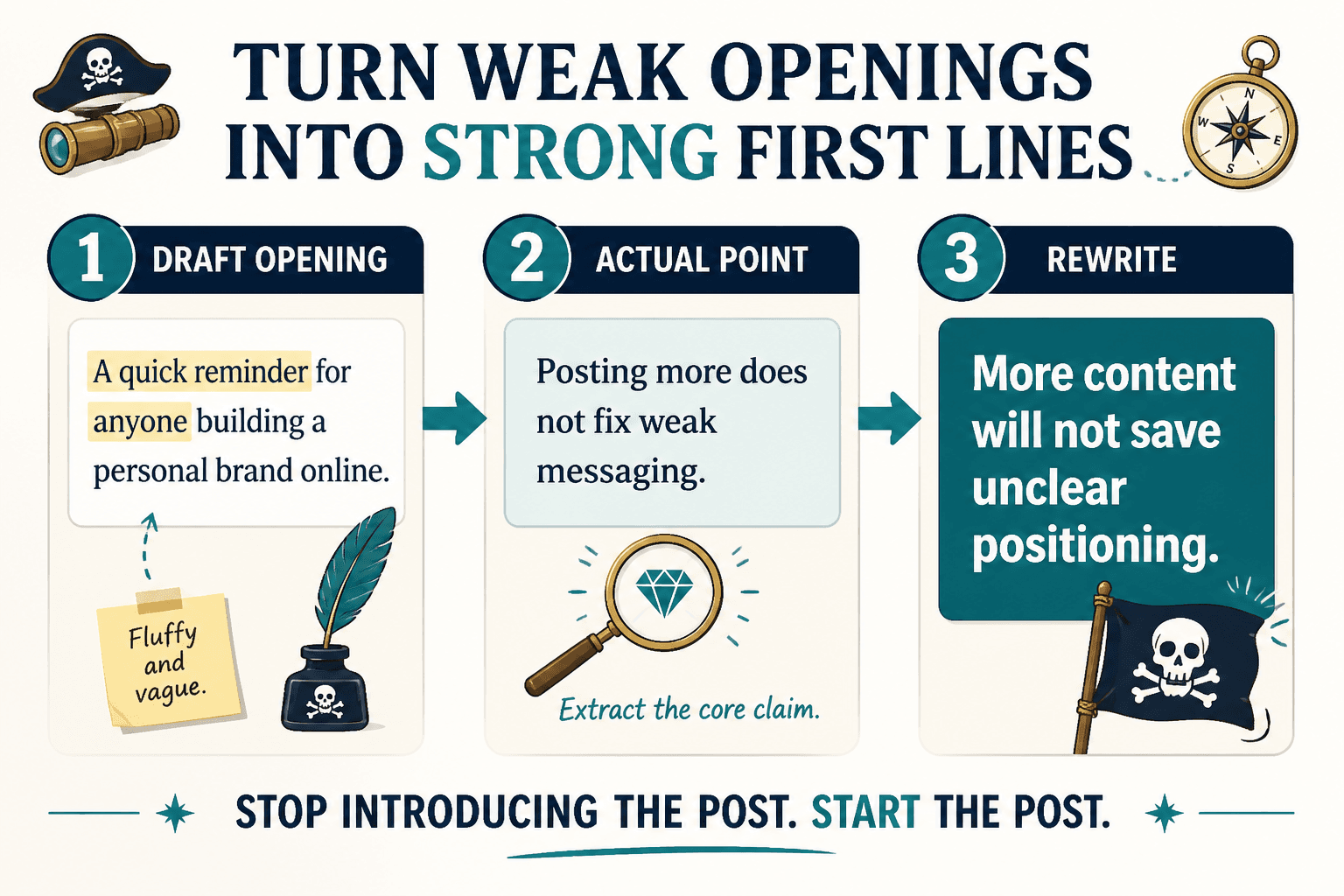
- Draft opening: “A quick reminder for anyone building a personal brand online.”
- Actual point: Posting more does not fix weak messaging.
- Rewrite: “More content will not save unclear positioning.”
Example 3
- Draft opening: “Something I have learned over time is that hooks really matter.”
- Actual point: Weak openings kill strong ideas.
- Rewrite: “A strong idea with a weak opening still gets ignored.”
That is the move. Stop introducing the post. Start the post.
What to avoid if you want stronger first lines
Some opening styles look tempting because they feel easy. They are also wildly overused, low-energy, or suspiciously close to content cosplay.
Vague profundity
Examples like “Growth begins when comfort ends” are technically sentences, but that does not mean they are worth posting. They sound polished and say nothing.
Fake suspense
“Nobody talks about this…” is usually followed by something plenty of people have talked about, often better. If the idea is good, it does not need this kind of costume.
Soft disclaimers
“This might be obvious, but…” is a confidence leak. If the point is worth posting, post it properly.
Generic emotional bait
“I almost gave up.” “This broke me.” “No one sees this part.” Fine if true and relevant. Usually used as cheap tension around thin ideas. Readers can smell it.
Overexplaining in line one
X is not the place for a 43-word opening that tries to include background, nuance, context, fairness, and legal protection. Make the point first. Add nuance second.
Opening templates that actually work on X
Templates are useful when they give structure without flattening your voice. Here are a few that work because they force clarity.
The sharp claim
Template: Most [people in niche] are wrong about [specific thing].
Example: Most creators are wrong about why their posts flop. It is usually not the idea. It is the opening.
The problem-first opener
Template: If [painful outcome], the problem is probably [real cause].
Example: If your X posts get ignored, the problem is probably not your expertise. It is how softly you package it.
The contrast opener
Template: [Common belief] does not [expected result]. [Real thing] does.
Example: Posting more does not build authority. Posting clearer ideas does.
The useful takeaway opener
Template: The fastest way to improve [thing] is to [specific action].
Example: The fastest way to improve your X posts is to rewrite the first line until it can stand on its own.
The audience recognition opener
The bigger point is simple: clearer structure and clearer writing make the piece more useful. That is usually what makes the ending land better too.
X posts tend to work better when the line gets sharper and the ending earns the reaction. Cleaner payoff usually beats louder phrasing.