
Most audience-to-offer journeys are not broken because the funnel software is wrong. They are broken because the journey reads like it was assembled by a committee of mildly anxious marketers who have never met a real person.
You’ve seen the pattern. A vague post. A limp lead magnet. A thank-you page that says nothing. Three emails that sound like they were written by a chatbot in a blazer. Then, out of nowhere, a sales pitch with the emotional warmth of a parking receipt.
That is why people “have an audience” and still do not get many leads or sales. The path from attention to action is boring, generic, and way too easy to ignore.
How to Rewrite Boring Audience-to-Offer Journeys is really a question of translation. You are translating interest into trust, trust into relevance, and relevance into action. If that translation is clunky, people drift. If it’s sharp, people move.
Here’s how to rewrite the journey so it feels clearer, more specific, less robotic, and much more likely to turn attention into actual business.
For the main guide behind this topic, visit the parent guide.
Why most audience-to-offer journeys feel flat
Boring journeys usually have one of four problems.
- They start too wide.
- They sound like everyone else.
- They jump to the offer before trust exists.
- They never build momentum from one step to the next.
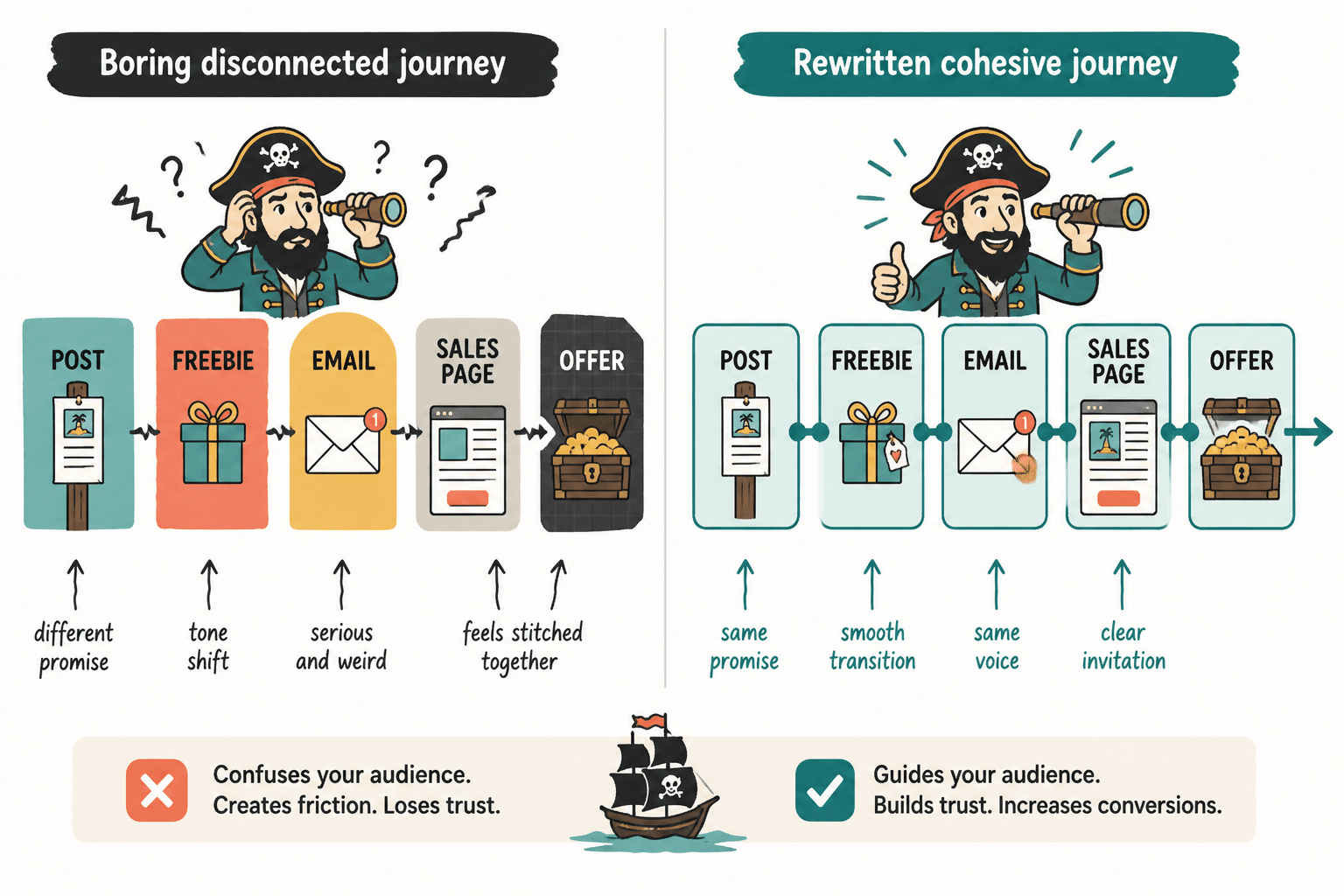
In other words, the issue is not just “bad copy.” The issue is that each piece of the journey was written in isolation. The post says one thing. The freebie says another. The email sequence sounds like a different person. The sales page suddenly gets serious and weird. No wonder conversion rates sulk in the corner.
A good audience-to-offer journey should feel like one conversation with a brain, not six disconnected assets stitched together by duct tape and optimism.
If you need the bigger strategic picture first, it helps to review audience-to-offer journeys as a full system before rewriting individual pieces.
What you are actually rewriting
When people say they need to improve a funnel, they often mean they need to tweak copy on one page. Sometimes that helps. Often it does not.
What usually needs rewriting is the full chain:
- The entry point
- The promise
- The transition
- The proof
- The invitation
If any one of those is weak, the whole thing gets mushy.
| Journey Part | What it should do | What boring versions do instead |
|---|---|---|
| Entry point | Grab relevant attention | Talk in vague “value” language |
| Promise | Make a clear next-step benefit | Offer something broad and forgettable |
| Transition | Connect content to offer naturally | Change tone and suddenly pitch |
| Proof | Reduce doubt | Make claims with no texture |
| Invitation | Make action feel sensible | Push too hard or ask too vaguely |
That is the rewrite lens. Not “how do I make this sound better?” but “how do I make each step pull its weight?”
Start by finding the actual journey underneath the words
Before you rewrite anything, map the current path your audience takes.
- Where do they first see you?
- What makes them curious enough to click?
- What do they get next?
- What belief are you trying to build there?
- What action do you want after that?
- What makes that action feel worth taking?
Now be honest. If you stripped away your branding and put the journey next to ten competitors, would anyone be able to tell it is yours?
If not, you do not have a compelling audience-to-offer journey. You have a sequence of normal marketing assets saying normal marketing things. Which, to be fair, is how many people end up with normal marketing results.
A quick diagnostic
- Does the first piece target a specific pain, desire, or moment?
- Does the next step logically continue that topic?
- Does the journey build belief before asking for commitment?
- Does the offer feel like the next obvious move, not a surprise attack?
- Does the language sound like a person who understands the problem, not a funnel template pack?
If you answered “not really” to two or more, there’s your rewrite brief.
Rewrite the entry point so it attracts the right attention
Audience-to-offer journeys often fail at the top because the content tries to appeal to everyone vaguely interested in growth, business, confidence, productivity, or visibility. That kind of content gets nods. It does not get movement.
Your top-of-journey content needs a sharper job. It should attract people who are close enough to the problem that your next step feels relevant.
Boring entry point
If you want better results in your business, consistency is key.
True, maybe. Useful, barely. Memorable, absolutely not.
Rewritten entry point
Posting consistently is not helping if every post sounds like it could belong to 400 other consultants.
That version creates tension. It speaks to a recognizable frustration. It also naturally sets up a next step around messaging, positioning, or conversion.
The best entry points do at least one of these:
- Name a specific mistake
- Challenge a lazy assumption
- Call out a familiar frustration
- Frame the cost of staying stuck
- Show a better way without overexplaining it yet
If your first touchpoint is bland, the whole journey starts half-asleep.
Rewrite the promise so the next step feels worth it
A lot of lead magnets, low-ticket offers, consult invites, and nurture assets are not weak because they are badly formatted. They are weak because the promise is too broad to care about.
“Get better leads.” “Grow your brand.” “Improve your messaging.” Fine. But why this, why now, and for whom?
Specific promises convert better because they help the reader picture the payoff. That payoff does not need to be huge. It needs to be concrete.
Before and after promise rewrites
- Before: Free guide to improve your content strategy
After: Free guide to turn expert content into a cleaner path from post to inquiry - Before: Book a clarity call
After: Book a 20-minute funnel review and I’ll show you where your audience is losing momentum before the pitch - Before: Download the engagement checklist
After: Download the checklist I use to spot where “valuable” content is attracting attention but not moving people toward an offer
See the pattern? Better promises do not just say the category of the thing. They describe the result, the context, and the reason it matters.
If your current next step sounds like a generic freebie that was made to justify an email signup form, rewrite the promise first. That is usually where the rot starts.
Rewrite transitions so the offer does not appear out of nowhere
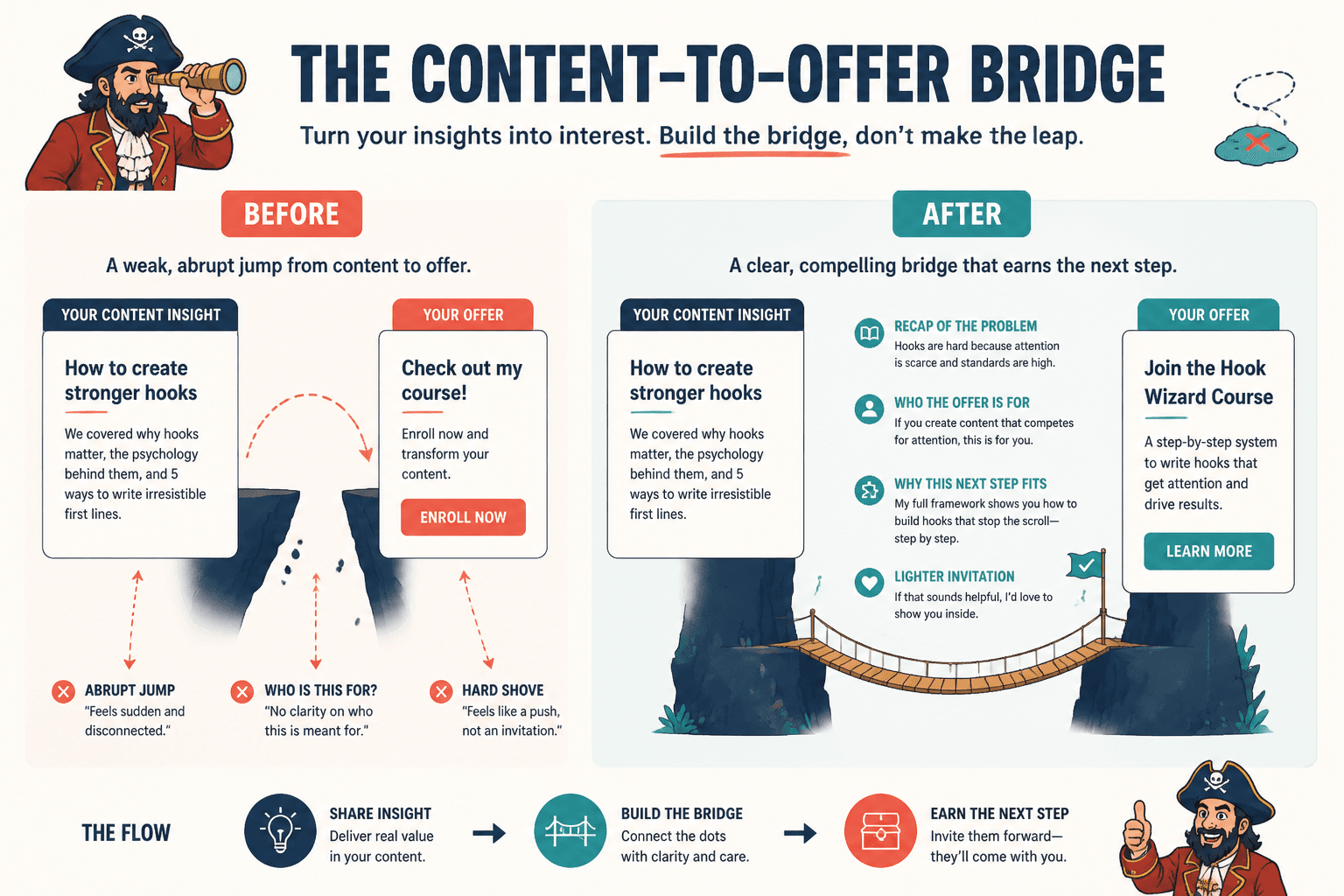
This is where many creators get awkward. They can write content. They can describe offers. But the bridge between the two sounds abrupt, needy, or suspiciously polished.
A transition should answer one quiet question in the reader’s head: why am I seeing this next?
If your offer appears without context, people feel the pitch before they feel the relevance. That is a conversion killer.
A weak transition
If you liked this post, grab my program below.
That says nothing. Liking a post and buying a program are not remotely the same level of commitment.
A stronger transition
If this exposed why your content gets attention but stalls before inquiries, that’s exactly the gap I help clients fix inside my messaging and funnel audit.
Now the offer feels connected. The jump makes sense.
Good transitions often include:
- A recap of the problem just surfaced
- A clear statement of who the offer is for
- A reason this next step matches that problem
- A lighter invitation instead of a hard shove
If this is a consistent struggle, you’d probably also want to read how to write audience-to-offer journeys without sounding salesy or robotic. The tone of the bridge matters more than people think.
Rewrite proof so it sounds believable, not polished
One reason journeys feel boring is that the proof is bland. People toss in testimonials, generic outcomes, or “trusted by” language and assume that will do the job.
It usually does not. Because vague proof has the same problem as vague promises: it gives the reader nothing to hold onto.
Weak proof
I help clients grow online and get amazing results.
Stronger proof
Most of my clients do not need more content ideas. They need a sharper path from useful posts to clear offers. That is usually where we fix the leak first.
That second version is not a chest-thumping case study. It is still proof because it signals pattern recognition and practical expertise.
You can also improve proof by adding texture:
- What changed?
- What was broken before?
- What kind of client or audience was involved?
- What specific friction got removed?
- What result became easier after that?
Believable proof is often quieter than people expect. Less “I’m amazing.” More “here is the exact problem I know how to solve.”
Rewrite the invitation so it feels easy to act on
Bad invitations tend to fail in one of two ways. They are either too aggressive, or too vague to matter.
“Buy now” is often too early. “Reach out if this resonates” is often too soft. One shoves. The other shrugs.
A better invitation makes the next action feel proportionate to the current level of trust.
Examples of better invitations
- If you want to see where your current journey goes vague, download the checklist and review it against your last five posts.
- If your content is getting attention but your offer path feels clunky, book a short audit and I’ll show you the friction points.
- If you’re still relying on random posts and hope, start with the framework here, then come back when you want help tailoring it.
Notice that these do not scream. They guide. They reduce uncertainty. They make the next step easier to understand.
The right invitation depends on timing too. If your offer timing is off, even strong copy can feel weird. That is worth fixing separately in how to improve audience-to-offer journeys offer timing without sounding generic.
A simple rewrite process for boring audience-to-offer journeys
If you want something repeatable, use this process.
1. Find the strongest real problem
Not the broad market problem. The useful one. The one a reader would actually recognize in their work or results.
Example: not “struggling with content,” but “posting useful advice that never creates a clear next step.”
2. Cut vague claims
Delete phrases like “build authority,” “grow your brand,” “attract ideal clients,” and “scale with content” unless you immediately explain what they mean in practical terms.
These phrases are not evil. They are just empty unless anchored.
3. Make each step lead naturally to the next
Your content should set up the freebie, consult, email, product, or service. Your freebie should set up the belief. Your emails should set up the buying logic. If each piece feels independent, rewrite the transitions until the path feels obvious.
4. Add real-world texture
Examples, patterns, mini case points, common mistakes, specific moments, sharper wording. All of that makes the journey feel less synthetic and more trustworthy.
5. Match the CTA to trust level
Cold readers do not need a dramatic pitch. Warm readers do not need endless nurturing. Rewrite the invitation based on where the person is in the relationship, not based on what your template says comes next.
Before and after: a full mini rewrite
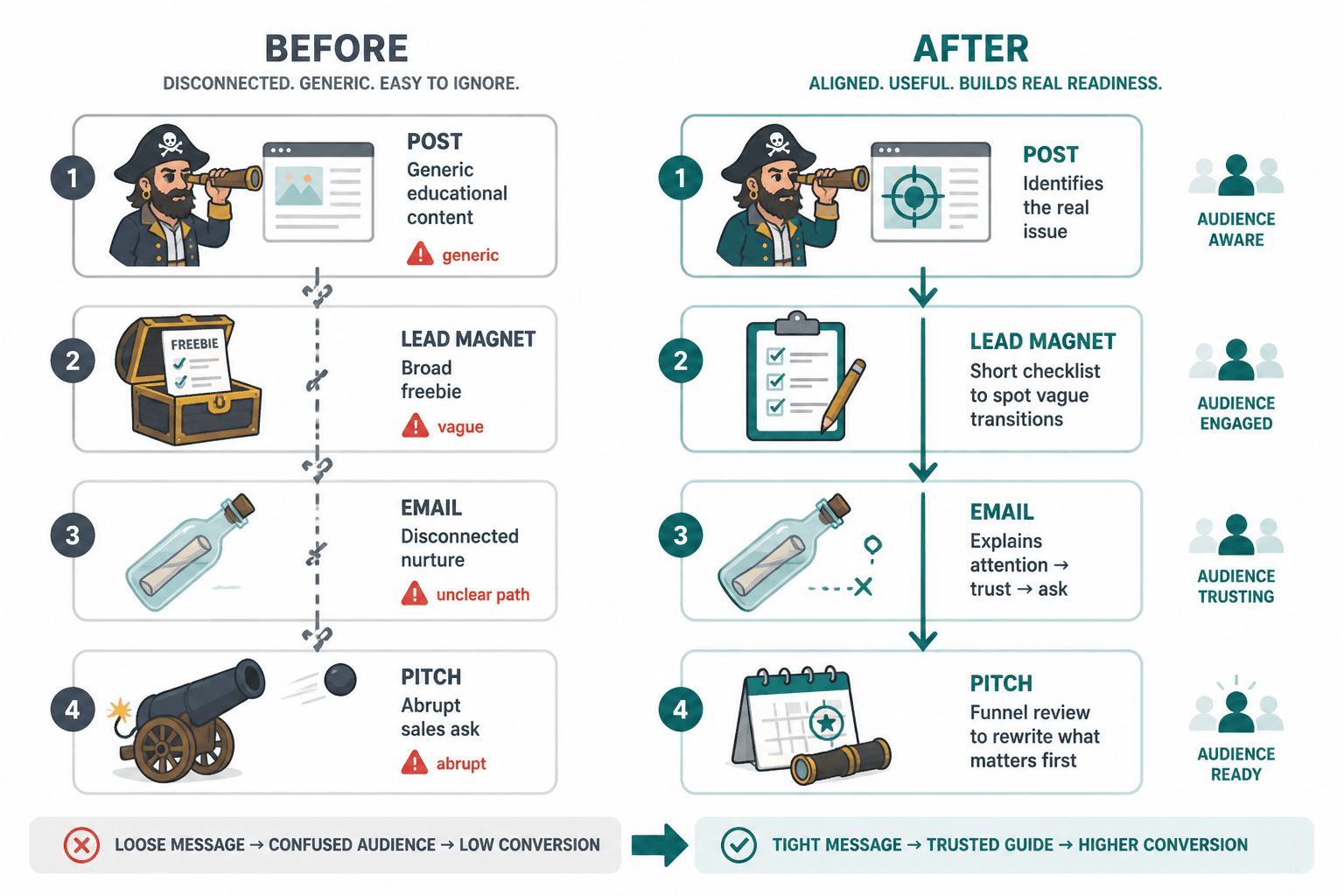
Before
- Post: Consistency is important if you want to grow your business
- Lead magnet: Free content strategy guide
- Email: I’m passionate about helping entrepreneurs succeed
- Pitch: Join my program to unlock growth
That journey is not offensive. It is just fog. No sharp problem. No clear through-line. No real reason for someone to care right now.
After
- Post: Posting regularly is not your issue. The issue is that your content educates people without moving them any closer to your offer.
- Lead magnet: A short checklist to spot where your content-to-offer path goes vague, generic, or too abrupt
- Email: Most creators do not need more content ideas. They need cleaner transitions between attention, trust, and the ask. Here are three places that usually break first.
- Pitch: If you want help tightening that path around your actual offer, book a funnel review and I’ll show you what to rewrite first.
That version has shape. Each step deepens the same conversation. That is the goal.
Common things people keep doing wrong
- Starting with content themes instead of buyer tension. You do not need more pillars. You need better entry points.
- Making every lead magnet broad. A smaller, sharper promise usually wins.
- Switching voice halfway through. If your posts sound human and your emails sound like legal-approved funnel paste, that gap hurts trust.
- Pitching because the calendar says to. Timed launches are fine. Random tonal whiplash is not.
- Using proof that says nothing. Specific beats impressive.
- Assuming interest equals readiness. Attention is not consent to be sold at immediately.
If you want the business outcome side of this rewrite process, how to turn audience-to-offer journeys into more leads or sales is the next useful read. And if you already have a pile of decent content that goes nowhere, how to turn old content into better audience-to-offer journeys will help you rebuild from assets you already have.
How to know the rewrite is working
You do not just judge this by whether a sentence sounds nicer. You judge it by whether the journey creates more movement.
- Are more of the right people clicking through?
- Are they spending more time with the next step?
- Are replies, inquiries, or consult requests sounding more informed and relevant?
- Are fewer people ghosting between interest and action?
- Does the offer feel easier to introduce without sounding forced?
Good rewrites usually improve signal quality before they improve raw volume. That matters. A smaller number of better-fit leads beats a bigger number of confused, lukewarm ones every day of the week.
For broader strategy around this category, you can also explore related monetization funnel and funnel system resources.
FAQ
How long should an audience-to-offer journey be?
Long enough to build the belief needed for the ask. Shorter if the offer is simple and low-friction. Longer if the buyer needs more context, trust, or proof.
The bigger point is simple: clearer structure and clearer writing make the piece more useful. That is usually what makes the ending land better too.