
Most audience-to-offer journeys sound weird for one of two reasons.
Either they jump from “here’s a useful post” to “book a call” with the grace of a folding chair, or they drag people through such a stiff, over-automated sequence that the whole thing feels like it was written by a funnel template that has never met a human being.
That is usually the real problem behind How to Write Audience-to-Offer Journeys Without Sounding Salesy or Robotic. It is not that you need more emails, more steps, or more persuasion tricks. It is that the path between attention and action has no emotional logic. It does not feel like a natural next step. It feels engineered.
What you want instead is a journey that makes the reader think, “Yeah, that makes sense,” not “Ah, here comes the pitch sequence.”
Here’s how to build that kind of journey: one that moves people from audience to offer with clarity, trust, and timing, without sounding needy, robotic, or suspiciously polished.
For the main guide behind this topic, visit the parent guide.
The job of an audience-to-offer journey is not to impress people
A lot of people overcomplicate this.
Your audience-to-offer journey does not need twelve touchpoints, a dramatic “nurture arc,” and a CTA strategy that sounds like it came from a webinar hosted in front of a fake bookshelf. It needs to do something much simpler.
It needs to help the right person move from:
- not knowing who you are
- to understanding what you help with
- to trusting your perspective
- to seeing your offer as relevant
- to taking a reasonable next step
That is it.
The problem is that many creators try to force belief before they’ve earned clarity. They pitch before they’ve established relevance. Or they hide the offer for so long that the audience gets educated, mildly entertained, and then wanders off to hire someone else.
A strong journey feels like progress, not manipulation.
If you want more depth on structure, this can pair well with how to write better audience-to-offer journeys and the broader audience-to-offer journeys hub.
Why most journeys sound salesy or robotic
If your funnel feels off, the issue is usually not “tone.” Tone is the symptom. The structure is the disease.
Here are the usual problems:
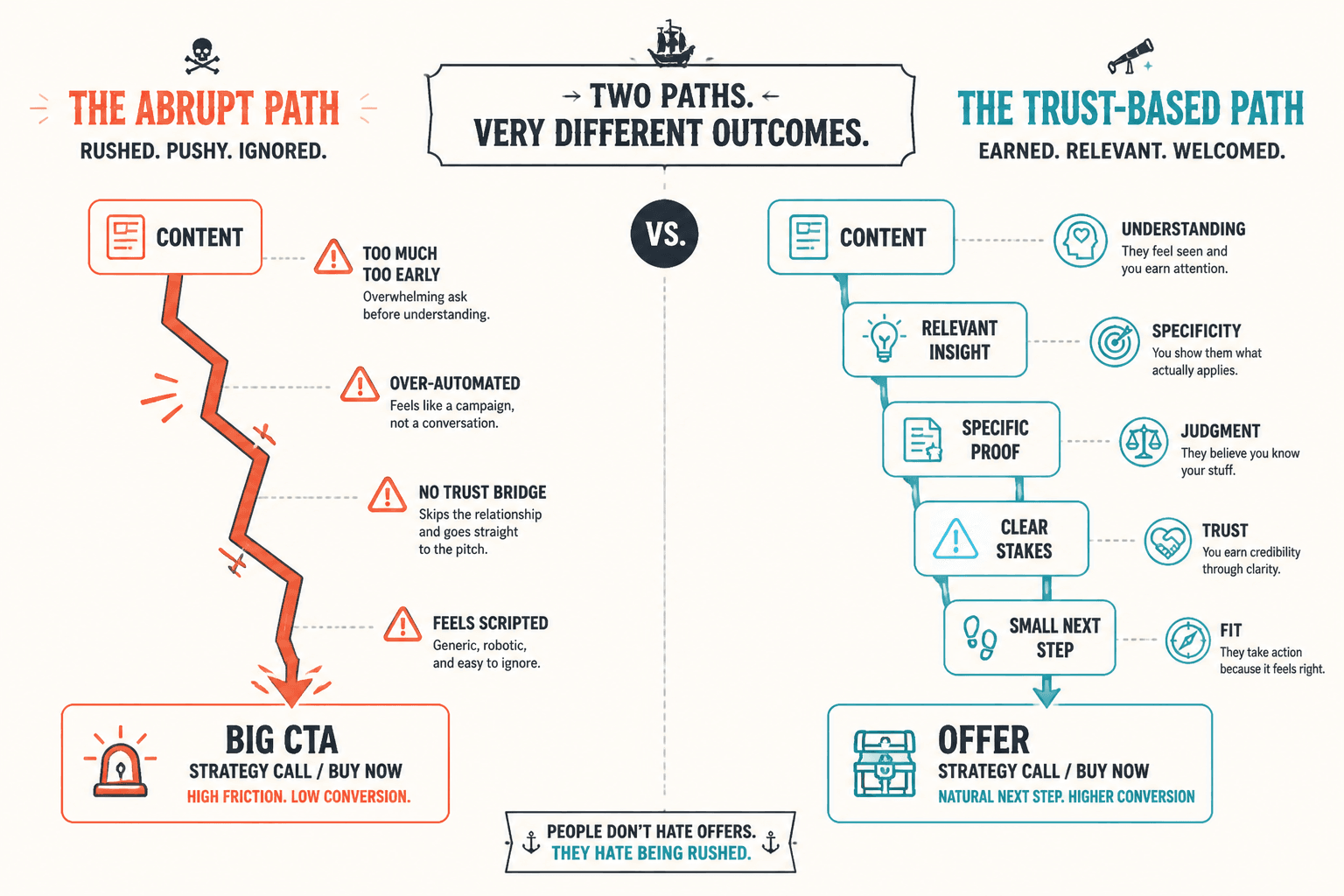
- The content and offer do not match. You attract one kind of attention, then pitch something else.
- The transition is too abrupt. You go from helpful to hungry in one step.
- The language is generic. Everything sounds like “I help purpose-driven entrepreneurs scale with authenticity.” Nobody knows what that means.
- The sequence is over-automated. Every message feels preloaded and weirdly polished.
- The CTA asks for too much too early. A stranger does not want your 45-minute strategy call because they liked one post.
- There is no trust bridge. You have not shown proof, judgment, specificity, or stakes.
People do not mind being sold to nearly as much as they mind being rushed, flattened, or talked at like they are a lead-shaped object in a spreadsheet.
That’s the distinction worth keeping. Salesy does not mean “contains an offer.” Salesy usually means “this person is more interested in moving me than understanding me.” Robotic means the same thing, just with better formatting.
Start with audience state, not funnel steps
A better audience-to-offer journey starts with a very unsexy question:
What does this person need to believe, understand, or notice before my offer makes sense?
Not “what content should I post on Tuesday.” Not “how many emails should be in the nurture sequence.” Start with the audience’s state of mind.
For example, if you sell messaging strategy to consultants, your audience may need to move through these stages:
- They realize their content is not converting.
- They understand the problem is not just consistency. It is positioning and message clarity.
- They start trusting your diagnosis because your examples are sharp and specific.
- They see that fixing this alone may take too long or stay too messy.
- Your offer becomes the obvious shortcut, not a random pitch.
That sequence feels human because it follows thought, not just marketing mechanics.
When you build from audience state, your messaging gets better fast. Your posts stop sounding like content for content’s sake. Your emails stop repeating the same vague promise. And your offer arrives at the moment when it answers a live tension instead of interrupting the room.
A simple framework for mapping the journey
- Attention: What problem, frustration, desire, or mistake gets their attention?
- Recognition: What helps them see the problem more clearly?
- Trust: What proof, perspective, or usefulness makes them trust you?
- Relevance: What connects your offer to the problem in a natural way?
- Action: What is the easiest sensible next step?
If any of those steps are weak, the journey starts sounding pushy. Usually because you are trying to borrow force from the CTA to make up for missing trust upstream.
Write the journey like a conversation, not a campaign
This is where a lot of “funnel copy” goes wrong. It sounds like nobody involved has ever had a normal conversation.
Real people do not move from mild interest to purchase because they read seven stacked benefits and a line about “spots filling fast.” They move because the message keeps feeling accurate, useful, and timely.
So write your journey in a way that sounds like one coherent conversation.
That means:
- using the same core problem language across content, landing pages, emails, and CTAs
- keeping your tone human instead of hyper-performative
- making each step answer the obvious question created by the previous one
- not suddenly switching into “marketing voice” when the offer appears
Here is a simple example.
| Weak journey | Stronger journey |
|---|---|
| Post about content tips → “DM me SCALE for my premium system” | Post showing why useful content still fails → free breakdown of messaging gaps → case study showing fix → invite to paid strategy offer |
| Audience learns something random | Audience sees the exact problem your offer solves |
| CTA feels bolted on | CTA feels like the next logical move |
The stronger version is not less strategic. It is more strategic. It respects sequence.
Use content to create readiness, not just attention
A lot of creators know how to get attention. Fewer know how to prepare people to buy.
Attention content gets clicks, likes, and maybe a few saves. Readiness content makes the offer make sense. You need both.
Attention content says:
- here is a mistake
- here is a sharp opinion
- here is a pain point you recognize
- here is a useful insight
Readiness content says:
- here is why this problem keeps happening
- here is what most people misdiagnose
- here is what fixing it actually involves
- here is why my method or offer exists
If all your content stays in attention mode, your audience gets stuck at “interesting.” That is better than invisible, sure, but it is not a business model.
Readiness content is where your authority starts doing real work. This can be a post, article, email, short case study, breakdown, FAQ, or even a strong profile page. The format matters less than the function.
And yes, this is one reason many people think their audience “just isn’t buying.” Sometimes the audience is fine. The journey is simply underbuilt.
For more on connecting trust and monetization without making everything feel like a trapdoor to a pitch, see how to monetize audience-to-offer journeys without wrecking trust.
Make the offer show up earlier, but lighter
One common overcorrection is hiding the offer because you are afraid of sounding salesy.
That usually creates another problem: people consume your content for weeks, maybe months, and still have no idea what you actually sell or when it is relevant. Then when you finally do pitch, it feels abrupt because you trained them to expect education without direction.
The fix is not harder selling. It is earlier, lighter selling.
That can look like:
- mentioning the offer in your bio with clear positioning
- referencing your process when relevant in content
- including soft CTAs like “if you want help fixing this, here’s where to start”
- sharing small proof points that connect your advice to real outcomes
- using examples from client work without turning every post into a chest-thumping case study
The offer should not appear like a jump scare.
It should feel familiar by the time somebody is ready for it.
If timing is your weak spot, read how to improve audience-to-offer journeys offer timing without sounding generic. Bad timing makes decent copy sound pushy faster than almost anything else.
How to write transitions that do not feel like pitches in a trench coat
The transition from content to offer is where the robotic feeling usually spikes.
You were being helpful. You were being normal. Then suddenly the copy starts talking about transformations, frameworks, and taking your business to the next level. Grim.
Better transitions do three things:
- they connect the offer to the problem already being discussed
- they explain who the offer is for
- they lower pressure by making the next step feel proportional
Weak transition
“If this resonates and you’re ready to scale, book a free discovery call today.”
Stronger transition
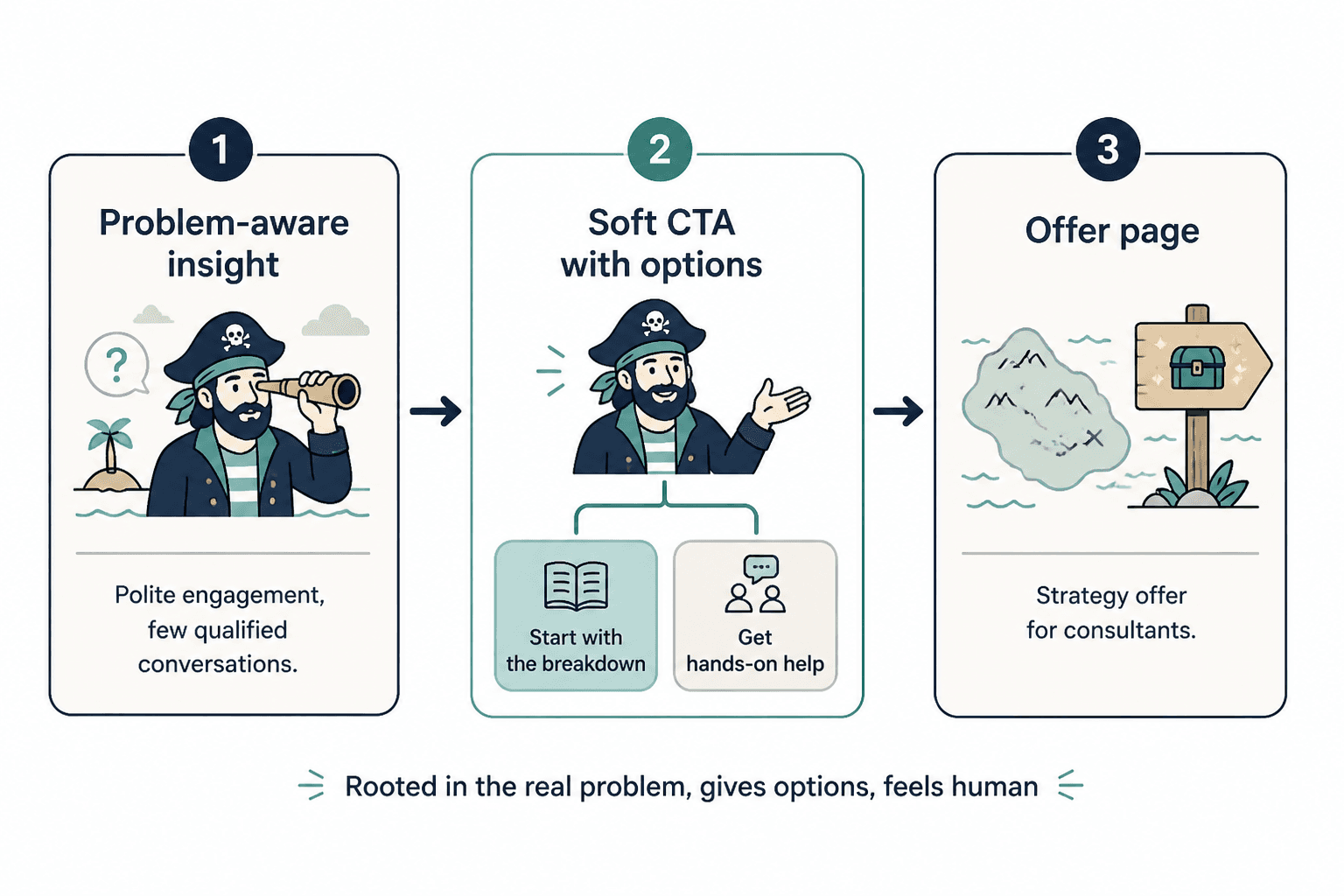
“If your content is getting polite engagement but not turning into qualified conversations, that is exactly the kind of messaging gap I help consultants fix. You can start with the breakdown here, or if you already know you want hands-on help, the strategy offer is here.”
The stronger version works because it stays rooted in the actual problem. It does not leap into generic aspiration language. It gives the reader options. It sounds like a person who understands where they are, not a funnel trying to close.
A practical audience-to-offer journey you can adapt
Here is a clean structure that works well for creators, consultants, coaches, and service businesses.
Step 1: Publish problem-aware content
Write posts and articles that speak to a specific frustration, false assumption, or costly mistake your audience already recognizes.
Example angle: “Your posts are useful, but they still are not generating leads because they teach without positioning.”
Step 2: Deepen the diagnosis
Create content that explains the mechanics behind the problem.
Example angle: “Three reasons useful content fails to move readers toward offers.”
Step 3: Show your thinking
Use case studies, rewrites, mini audits, frameworks, or examples to prove that your perspective is not just clever wording. It actually works in practice.
Step 4: Introduce the offer in context
Reference the offer as the logical solution for people who want the outcome faster, deeper, or with support.
Example: “If you want help building that path instead of guessing through it, that is what my messaging intensives are for.”
Step 5: Give a low-friction next step
Offer one clear action:
- read the related article
- download the resource
- reply to the email
- book the consult
- view the offer page
Do not make people choose between nine paths. A confused lead is not “considering options.” They are leaving.
Language that sounds human instead of funnel-shaped
If your words sound robotic, fix the language before you fix the sequence software.
Here are some common lines to retire:
| Sounds robotic | Sounds human |
|---|---|
| Unlock the strategy to scale your brand | Build a clearer path from content to client |
| Book a free discovery call to transform your business | If you want help applying this to your business, you can book a consult here |
| This offer is for ambitious entrepreneurs ready to level up | This is for consultants and service businesses whose content gets attention but not qualified leads |
| Nurture your audience with value-driven touchpoints | Give people useful reasons to trust your thinking before you ask them to buy |
The more specific you are, the less salesy you sound. That is one of the stranger but more reliable rules in content strategy.
Vague language creates suspicion because it sounds detached from reality. Specific language creates trust because it sounds like lived understanding.
What to check before you publish the journey
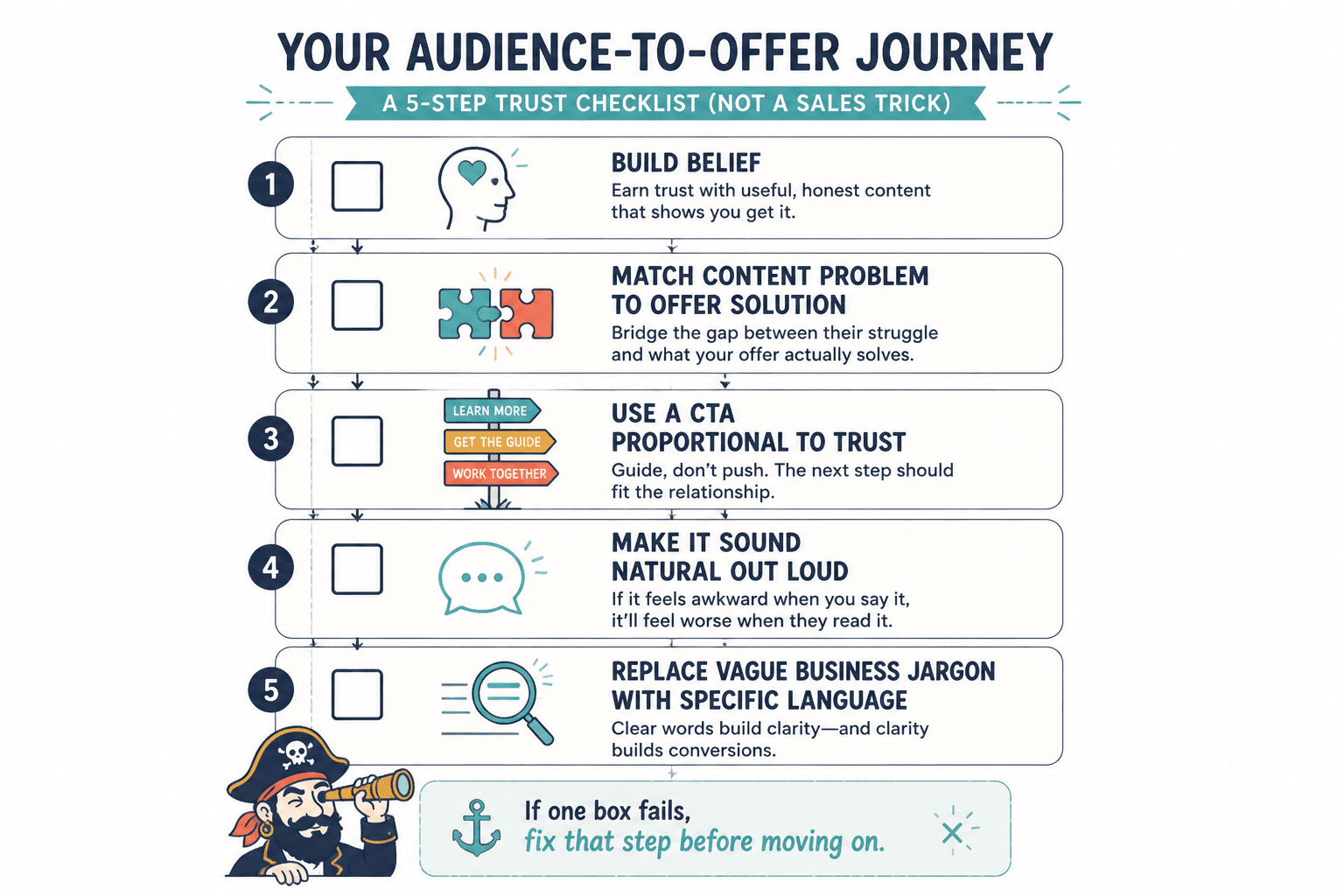
Before you send the email, publish the article, or build the sequence, run this quick check:
- Does the opening speak to a real problem the audience already feels?
- Does each piece build belief instead of just dumping advice?
- Does the offer solve the problem the content brought up?
- Does the CTA feel proportional to the trust level?
- Would this still sound normal if you said it out loud?
- Have you used specific language instead of recycled business wallpaper?
If the answer to that last one is no, good news: you found the problem before your readers did.
And if your openings are weak, fix that first. The cleanest funnel in the world cannot rescue a limp entry point. This is where how to start audience-to-offer journeys without a weak opening can help.
Where this fits in a bigger funnel system
If you are building out a full content-to-conversion system, this article sits in the middle of that work.
You still need visibility. You still need positioning. You still need an offer people actually want. No sentence can save a bad offer, and no CTA can compensate for a weak fit.
But the audience-to-offer journey is the bridge. It is what turns scattered attention into something usable.
To go broader, explore the monetization funnels and funnel systems collection. If you want the pillar view first, start with audience-to-offer journeys.
FAQ
How long should an audience-to-offer journey be?
Long enough to create clarity and trust. Short enough to keep momentum. For some offers that is one post and one landing page. For others it is a post, article, email, case study, and consult page.
The bigger point is simple: clearer structure and clearer writing make the piece more useful. That is usually what makes the ending land better too.