The common mistake is thinking an audience-to-offer journey fails because the offer is weak. That is sometimes true, but usually it is just flattering the wrong problem. The real issue is that the path from attention to action is vague, rushed, or built like it was designed by three separate tools that never exchanged names.
A better journey does one boringly important thing: it gives a reader a reason to keep moving. Not forever. Just far enough for the offer to make sense. That means the content, the trust signals, the timing, and the next step all need to point in the same direction.
If you want the broader system view, the parent guide on audience-to-offer journeys lays out the funnel structure underneath this page.
What an audience-to-offer journey actually is
An audience-to-offer journey is the sequence that moves someone from first contact to a relevant next step and, eventually, to a purchase or inquiry. It is not just “content plus CTA.” It is the logic connecting what the person needs at each stage to what you ask them to do next.
That sequence might be short or long. It might run through social content, email, a lead magnet, a consultation page, or a product page. The shape matters less than the fit. If the journey matches the reader’s state, the offer feels like a next step. If it does not, it feels like a sales interruption in a nice outfit.
Why most audience-to-offer journeys fail
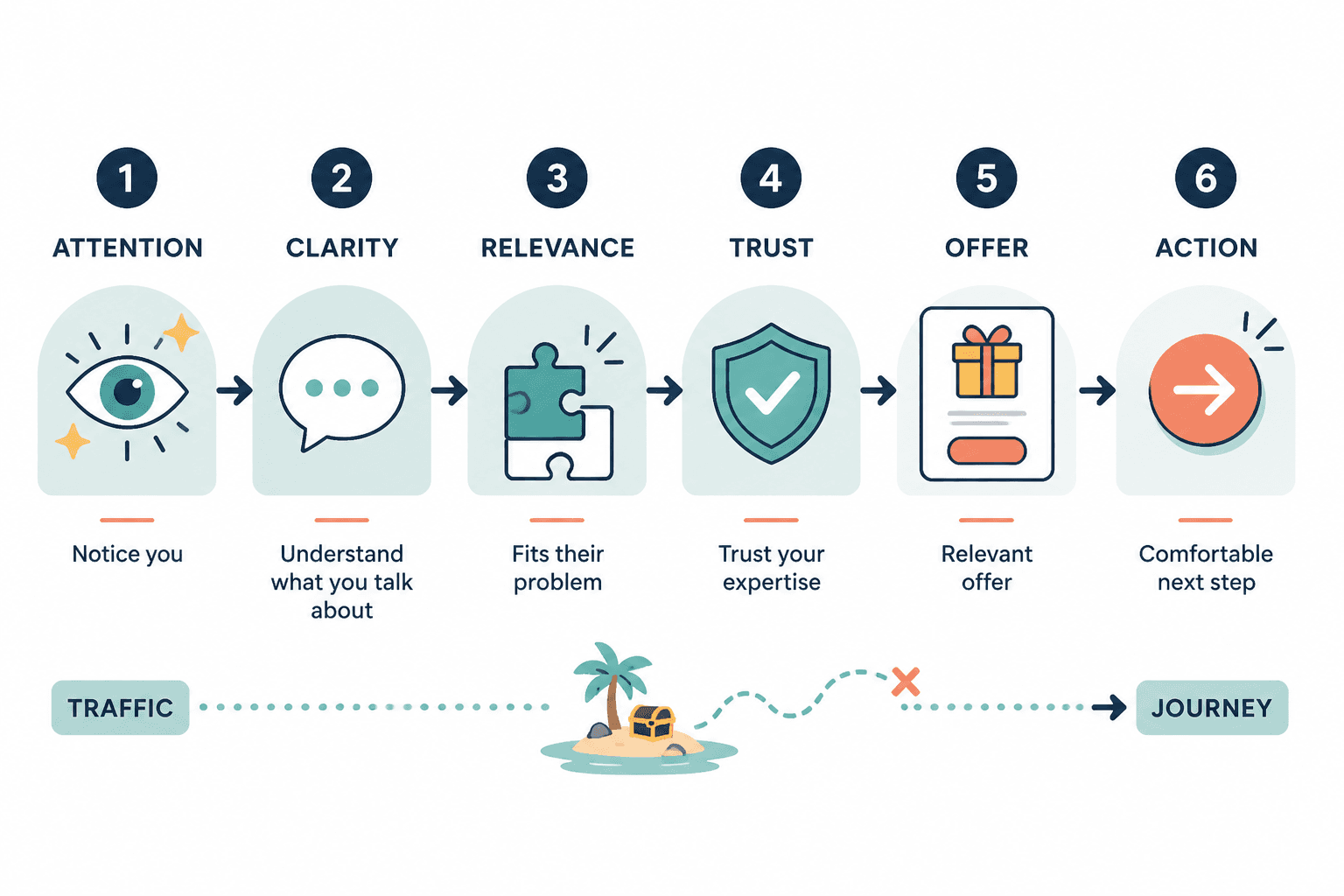
Most failures come from one of five problems: the content and offer do not match, the profile or page gives no clear next step, the ask comes too early, there is no middle step, or everything depends on one post doing all the conversion work.
1. The content and the offer do not match
If someone arrives because you helped them solve a narrow problem, and the offer is for a broad transformation they are nowhere near ready for, the handoff breaks. The content may be useful, but the next step feels random.
Better: make the offer the natural continuation of the problem the content just exposed. That is the whole game. Not bait. Not surprise. Continuity.
2. The profile or page gives no next step
A reader should not have to play scavenger hunt with your bio or page header. If there is no obvious next step, interest leaks out through the floorboards.
Better: put one clear action in the path. One. Not four. Nobody needs a menu when they are already trying to understand whether you are relevant.
3. The ask comes too early
Asking for a sale before trust exists is like proposing on the first coffee. It is technically a move, but the social context is doing a lot of heavy lifting.
Better: earn the right to ask by showing the reader that you understand their problem and can move them one stage forward before you request a bigger commitment.
4. There is no middle step
Many journeys jump from “nice post” to “book a call” with no bridge. That is a large gap to expect a stranger to cross with enthusiasm and perfect posture.
Better: add a bridge step when needed. That could be a checklist, a short diagnostic, a focused email sequence, a case-study page, or a low-friction inquiry form. The point is not volume. The point is momentum.
5. Everything relies on one post converting
One post can start a journey. It should not have to carry the whole business on its back like a gym coach with a spreadsheet.
Better: think in sequences, not miracles. Some content creates attention. Some creates relevance. Some creates trust. Some creates action. When one piece tries to do all four badly, it usually does none of them well.
The 5 stages of a strong audience-to-offer journey
A clean journey usually has five stages: attention, relevance, trust, transition, and offer. You do not always need a separate asset for each one, but you do need each job covered somehow.
1. Attention
This is the first point of contact. The job here is not persuasion. The job is to earn a second glance.
Useful attention content is specific enough that the right reader notices and the wrong reader moves on without drama.
2. Relevance
Once you have attention, the reader needs to know, “Is this about me?” If the answer is fuzzy, the journey drifts.
Relevance comes from naming the problem clearly, describing the situation accurately, and avoiding generic positioning language that could belong to anyone with a laptop and ambition.
3. Trust
Trust is built by showing your thinking, not just your conclusion. Readers want to see that you understand the problem well enough to help with it.
That can come from examples, frameworks, diagnostics, explanations, or a calm, specific point of view. It does not come from yelling certainty into the void.
4. Transition
This is the middle step that moves someone from insight to action. It is where the journey stops being purely educational and starts pointing somewhere useful.
Good transition content makes the next step feel proportionate. It says, in effect, “If this is the problem, here is the most sensible thing to do next.”
5. Offer
The offer is the end of the journey, not the beginning of the conversation. By the time someone gets here, the ask should feel like the obvious continuation of what came before.
For more conversion-focused detail, see how to turn audience-to-offer journeys into more leads or sales.
How to write a better journey
The cleanest way to improve a journey is to write from the reader’s state forward, not from your offer backward.
Start with reader state, not funnel ambition
Ask what the reader knows, feels, and is willing to do at the start of the journey. If they are barely aware of the problem, a high-commitment CTA will feel premature. If they already know the issue and are comparing options, vague content will feel lazy.
That shift matters because a journey only works when the next step fits the current stage. A mismatch is not bold. It is just misaligned.
Match the promise to the next step
The opening promise and the call to action should belong to the same conversation. If the post promises clarity, the next step should deliver more clarity. If it promises diagnosis, the next step should deepen the diagnosis. Do not promise one thing and then ask for another.
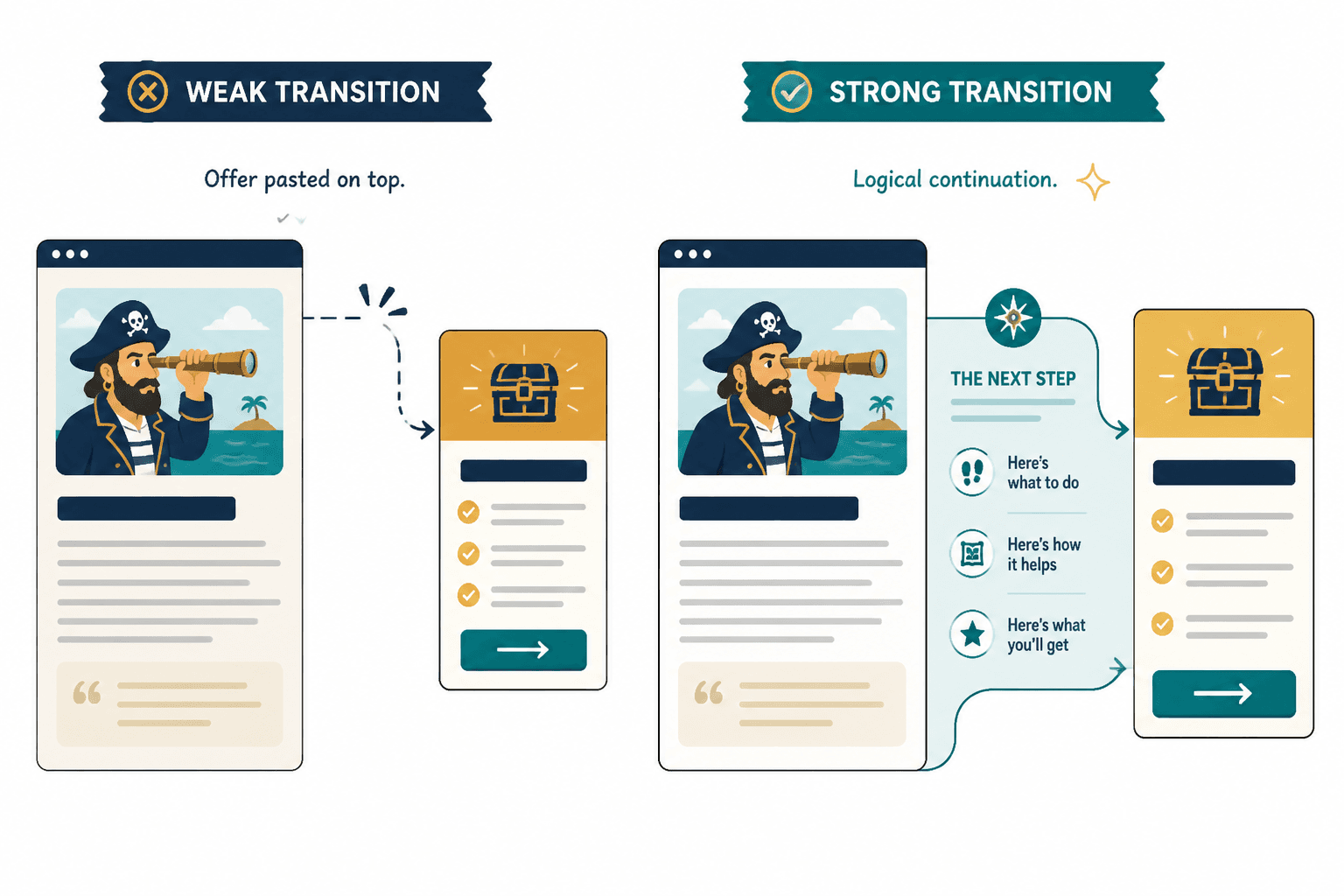
Use a bridge instead of a leap
When the path from content to offer is too wide, build a bridge. The bridge can be simple: a worksheet, a teardown, a short sequence, a decision guide, a brief audit, or a sample result that shows how the offer works.
The bridge is not there to be clever. It is there to reduce friction.
Make timing feel natural
Good timing is not about waiting forever. It is about asking after the reader has enough context to understand why the offer exists.
That is why offer timing pages matter. If the ask appears before attention, trust, and relevance have done their job, the journey starts sounding generic or pushy. For a deeper timing discussion, see how to improve audience-to-offer journeys offer timing without sounding generic.
Choose the right journey length
Some journeys should be short. Some should not. The right length depends on trust, urgency, complexity, and risk. A simple, obvious offer with existing trust can move faster. A more complex or higher-stakes offer usually needs more runway.
The point is not to make the funnel long because long feels strategic. The point is to make it as short as it can be without becoming implausible.
If you need the length question in more detail, see how long audience-to-offer journeys should be in 2026.
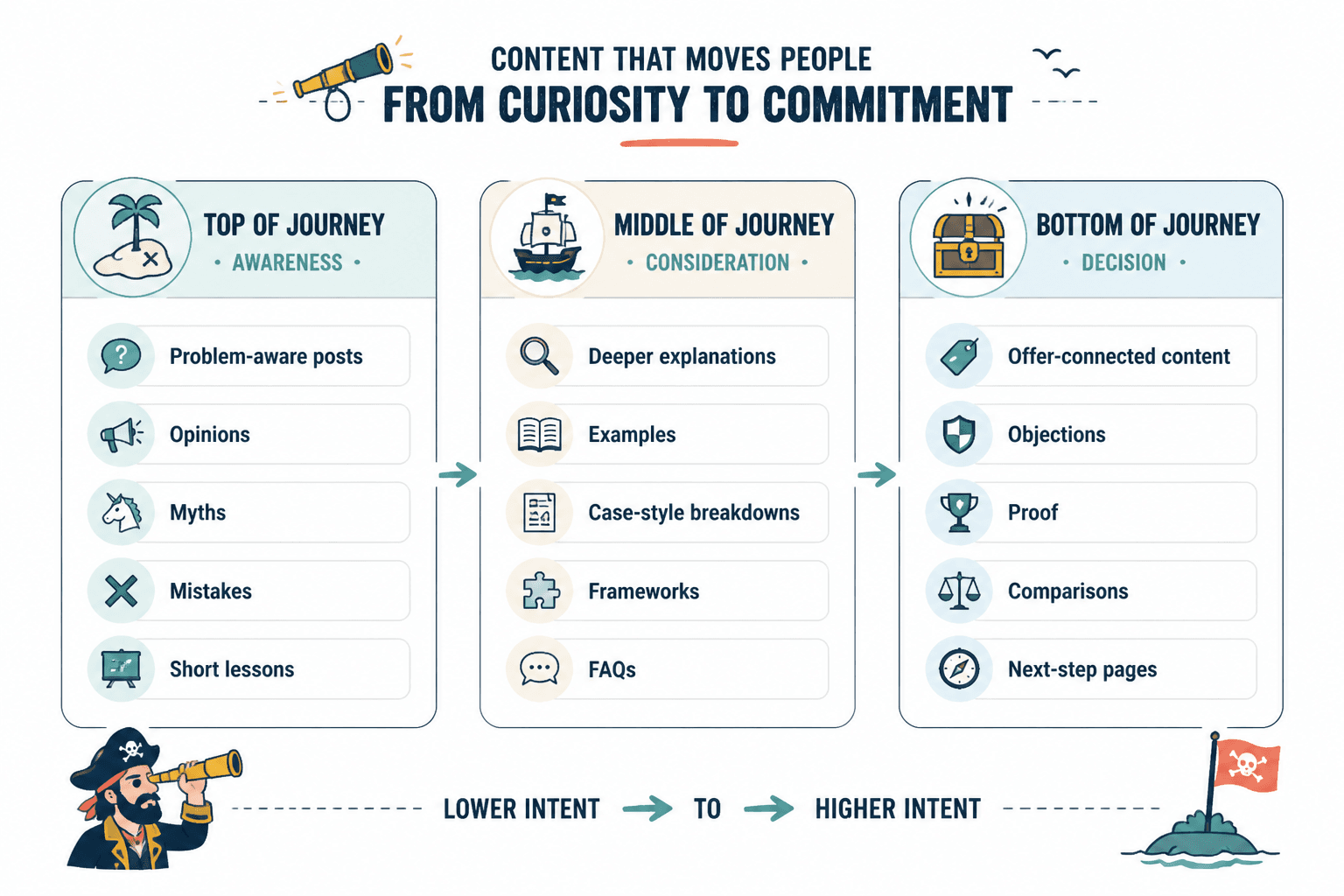
Weak journey versus stronger journey
Here is the difference in plain terms:
- Weak: a generic post about a broad pain point with a vague “DM me” ending.
- Stronger: a specific problem-led post that explains the issue, shows the consequence, offers a useful next step, and points to one relevant action.
Or:
- Weak: “Here is my service.”
- Stronger: “If this is the kind of problem you are dealing with, here is the simplest way to move forward.”
The stronger version works because it respects the reader’s stage. It does not force urgency where none exists, and it does not make the reader do translation work just to understand why the offer belongs here.
A simple diagnostic for your own journey
Before publishing or revising a journey, check these points:
- Does the content speak to a specific reader state?
- Does the next step clearly match the content that brought them in?
- Is there a bridge between insight and offer if one is needed?
- Does the timing feel earned rather than automatic?
- Would a new reader know what to do next without detective work?
If the answer to any of those is no, the journey probably needs less polish and more alignment.
For example patterns and structural references, the sibling guide on audience-to-offer journey ideas and examples is a useful companion.
What to remember
Audience-to-offer journeys improve when the path becomes easier to follow, not when the language gets louder. The reader should feel guided, not managed. The offer should feel like the logical next step, not the plot twist.
If you want the practical commercial side of the system, the next read is how to turn audience-to-offer journeys into more leads or sales. If you want the structure underneath all of this, go back to the parent guide and treat the funnel like a sequence instead of a personality test.
That is usually where the improvement starts: not with more pressure, but with a clearer path.