
Most audience-to-offer journeys are not broken because they’re too short or too long. They’re broken because the timing makes no sense.
People either pitch absurdly early, before trust exists, or they keep “nurturing” forever like the offer is a state secret that must never be mentioned. Both approaches waste attention. One feels pushy. The other feels pointless.
If you’re trying to figure out how long audience-to-offer journeys should be in 2026, the honest answer is: long enough to create clarity, trust, and relevance, but short enough to avoid drift, confusion, and content purgatory.
That sounds obvious. It is also where most people still get it wrong.
This article will help you decide the right journey length based on your offer, audience awareness, price point, trust level, and content environment. Not based on some recycled funnel rule from 2019 that assumes every buyer wants a 14-email courtship before clicking anything.
For the main guide behind this topic, visit the parent guide.
There is no magic number, but there are useful ranges
Let’s kill the fantasy first: there is no universal “correct” number of touchpoints, days, emails, posts, or steps.
Audience-to-offer journeys in 2026 are usually getting shaped by five things:
- How expensive or risky the offer feels
- How aware the audience already is of the problem
- How much trust you’ve already built
- How specific your positioning is
- How much friction exists between interest and action
That means a low-ticket template pack sold to warm followers can convert from a very short journey. A high-trust consulting offer for skeptical buyers will usually need a longer one. Not because longer is morally superior. Because buyers need enough proof and context to make a sane decision.
Here are practical ranges that are actually useful.
| Offer type | Typical journey length | What usually matters most |
|---|---|---|
| Low-ticket digital product | 1 to 5 touchpoints | Clarity, relevance, low friction |
| Workshop or mini offer | 2 to 7 touchpoints | Specific problem, fast trust, obvious payoff |
| Course or group program | 4 to 12 touchpoints | Belief shift, proof, offer fit |
| 1:1 service or consulting | 3 to 15 touchpoints | Credibility, authority, specificity, trust |
| High-ticket advisory or done-for-you offer | 5 to 20+ touchpoints | Risk reduction, case evidence, conversation quality |
These are not laws. They’re guardrails. If your audience already knows you, has a painful problem, and sees a clear fit, the journey can be short. If the market is skeptical, the offer is nuanced, or the price is significant, the path usually needs more steps.
The better question is not “how long?” but “what needs to happen before the offer?”
People get weirdly attached to funnel length because it feels measurable. Seven emails. Three webinars. Two weeks of nurture. Nice and tidy. Unfortunately, buyers do not care about your tidy sequence.
Before an offer feels timely, a few things usually need to happen. Not always all of them, but enough of them.
- They understand the problem clearly
- They believe the problem is worth solving now
- They trust your framing of the problem
- They see why your solution is different or more suitable
- They believe you can help someone like them
- They know what to do next without friction
If your content or funnel gets those jobs done quickly, the journey can be short. If it doesn’t, adding more steps won’t magically save it. You just end up with a longer route to the same shrug.
This is why so many creators and consultants build overlong journeys that still underperform. The sequence has length, but no progression. It keeps talking without moving the buyer toward a decision.
What changed about audience-to-offer journeys in 2026?
The fundamentals did not change. Trust still matters. Clarity still matters. Relevance still matters. But a few conditions around buyer behavior have made journey length feel different.
Attention is faster, patience is lower
People will absolutely spend money quickly when the fit is obvious. They just won’t spend much time tolerating vague nurturing. If your content says the same blurry thing twelve different ways, expect drop-off.
Trust is built in public before the funnel starts
For creators, consultants, and personal brands, the journey often starts long before someone joins your email list. Posts, comments, profile copy, articles, and conversations all count. Which means some “short” journeys are only short on paper. In reality, the audience has been quietly evaluating you for weeks or months.
Buyers are better at spotting empty nurture
People have seen enough funnels to recognize when they’re being dragged through a sequence that exists mainly because somebody read a launch playbook and got emotionally attached to timers and teaser emails.
If a step does not increase clarity, confidence, or urgency in an honest way, it’s not nurture. It’s padding with a CRM.
Shorter can work better when positioning is strong
Strong positioning compresses journeys. If the right person lands on your profile, reads a sharp post, sees a clear offer, and immediately thinks, “That is exactly my problem,” you don’t need a dramatic 19-part trust opera.
If positioning is weak, though, even a long journey struggles. More touchpoints cannot compensate for a fuzzy promise.
How to decide the right journey length
If you want a practical way to decide how long your audience-to-offer journey should be, use this five-part filter.
1. Measure buyer awareness
The more aware the audience is, the shorter the journey can be.
- Highly aware: They know the problem, want a solution, and are comparing options
- Problem aware: They feel the pain, but don’t know what kind of solution is right
- Unaware or vaguely aware: They don’t yet see the cost of staying stuck
Highly aware buyers often need less education and more proof. Less persuasion, more fit. Unaware buyers need better framing before they’ll care about your offer at all.
2. Look at perceived risk, not just price
Price matters, but it is not the only variable. A relatively cheap offer can still feel risky if it asks for a lot of time, implementation, team buy-in, or identity change.
A consultant selling a $300 audit to the wrong audience might need a longer trust path than a creator selling a $1,000 workshop to a warm community that already trusts their work. Risk is emotional, practical, and contextual.
3. Audit existing trust outside the funnel
If someone has read your posts for three months, seen client wins, liked your perspective, and visited your profile twice, do not treat them like a stranger who needs a full introductory saga.
This is one of the biggest mistakes in funnel design. People build journeys as if all buyers enter at zero trust. Many do not. Your visible body of work shortens the path for warm readers.
If you need help designing stronger entry points, it’s worth reading how to start audience-to-offer journeys without a weak opening.
4. Check how much belief shift your offer requires
Some offers fit beliefs people already have. Others require the audience to rethink how results happen.
If you’re selling something straightforward, like “we’ll rewrite your LinkedIn profile so it attracts better leads,” that can be a short path. If you’re selling a strategic service that asks buyers to abandon old assumptions, expect a longer path. Not because they are slow. Because the decision requires a mental shift.
5. Remove friction before adding more steps
Sometimes the journey feels too short only because the next action is messy.
- The CTA is vague
- The offer page is confusing
- The booking process is annoying
- The profile does not explain what you do
- The lead magnet attracts the wrong people
In those cases, adding “nurture” is just a polite way of avoiding the real issue. Fix the friction first.
Short, medium, and long journeys: when each one makes sense
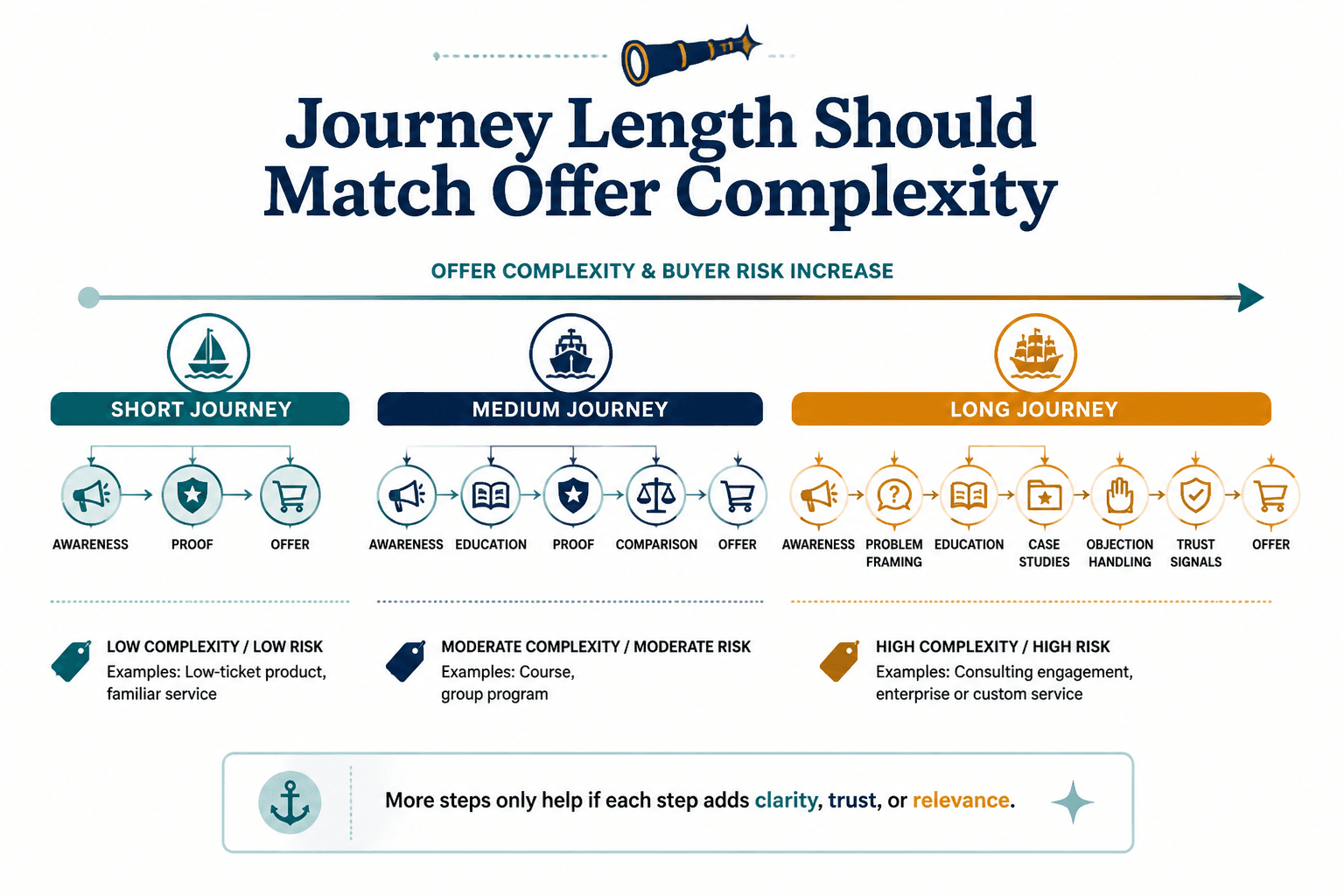
Short journeys work when the problem is clear and the fit is obvious
Short journeys usually work best when:
- The audience already trusts you
- The offer solves an immediate, specific problem
- The CTA is low friction
- The price or commitment feels manageable
- The offer matches what your content already proves
Example:
- Post about a common profile mistake
- Profile visit with clear positioning
- CTA to a profile audit service
- Booking or purchase
That can be enough. No giant nurture sequence required.
For a deeper look, see when short audience-to-offer journeys beat long ones.
Medium journeys work when buyers need proof and context
This is probably the sweet spot for many solo businesses in 2026.
The audience knows they have a problem, but they need a bit more confidence before acting. That usually means a sequence like this:
- Discovery content
- Profile or article visit
- Lead magnet or newsletter opt-in
- 2 to 5 trust-building follow-ups
- Offer invitation
This kind of journey works well for coaches, consultants, writers, and service providers selling moderate-commitment offers. It gives you enough space to show thinking, proof, and fit without trapping people in a month-long tunnel.
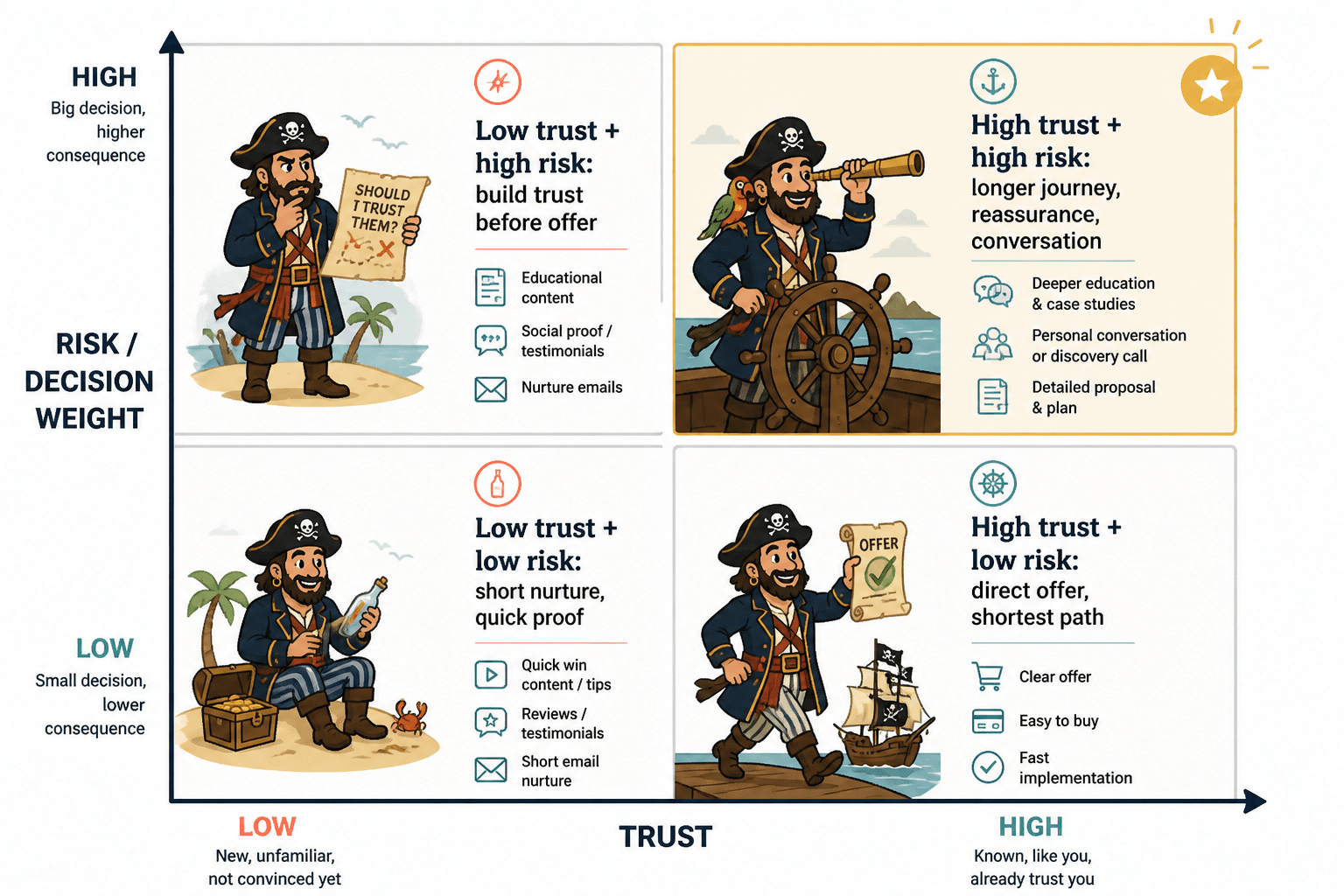
Longer journeys work when trust and risk are both high
Longer journeys make sense when the buyer is making a more consequential decision.
- High-ticket consulting
- Done-for-you services
- B2B advisory work
- Offers that affect revenue, reputation, or team operations
In these cases, buyers may need multiple forms of reassurance:
- Clear positioning
- Thoughtful content
- Case studies
- Objection handling
- Email follow-up
- Sales conversation
- Possibly a proposal or custom scope
That does not mean making the path bloated. It means respecting the decision weight. There is a difference.
What makes a journey feel too long
A journey is too long when the buyer has enough information to act, but your system keeps stalling the moment.
Common signs:
- You keep sending “value” but rarely make a clear offer
- Every email sounds helpful but none move toward a decision
- People engage with content but do not know what you sell
- Your CTAs stay soft forever because you’re afraid of sounding salesy
- You’re adding steps because conversion is weak, but not fixing message quality
Long journeys often become a hiding place for weak confidence. Harsh, yes. Still true.
If the offer is strong and relevant, you’re allowed to mention it before the moon enters its third trust-building phase.
What makes a journey feel too short
A journey is too short when the offer arrives before the audience understands the problem, trusts you, or sees why your solution matters.
Common signs:
- Your posts jump from tip to pitch with no bridge
- People click but do not convert because they’re not ready
- You get polite interest but little commitment
- The audience says “this sounds great” and then disappears
- Your content attracts attention but not buying intent
This is where better offer timing matters more than more traffic. If you pitch before belief catches up, your audience-to-offer journey feels abrupt, even if the offer itself is good.
If timing is the issue, read how to improve audience-to-offer journeys offer timing without sounding generic.
A simple way to map your audience-to-offer journey
If you want to improve journey length without overcomplicating it, map the buyer path in five steps.
- Entry: Where do people first discover you?
- Trust: What makes them believe you know what you’re doing?
- Relevance: What shows the offer is for someone like them?
- Decision: What proof or clarity helps them feel ready?
- Action: What is the next step, and how easy is it?
Then ask one brutal but useful question at each step: does this move the buyer forward, or is it just there because funnels are supposed to have things in them?
If a touchpoint builds trust, earns attention, answers objections, or creates urgency honestly, keep it. If it just fills time, cut it.
A practical benchmark for 2026
For many creators, consultants, and solo businesses in 2026, the healthiest audience-to-offer journeys are somewhere in the middle:
- Short enough that the offer appears before interest cools
- Long enough that trust and fit feel obvious
- Structured enough that each step has a job
- Flexible enough that warm buyers can move faster
That usually means avoiding both extremes:
- The instant pitch to cold people who barely know you
- The endless content maze where no one knows when they’re allowed to buy
If you need a broader framework around this, the parent guide on audience-to-offer journeys is a good next step. You can also browse more related strategy inside these monetization funnel resources.
How to shorten or lengthen your journey without making it weird
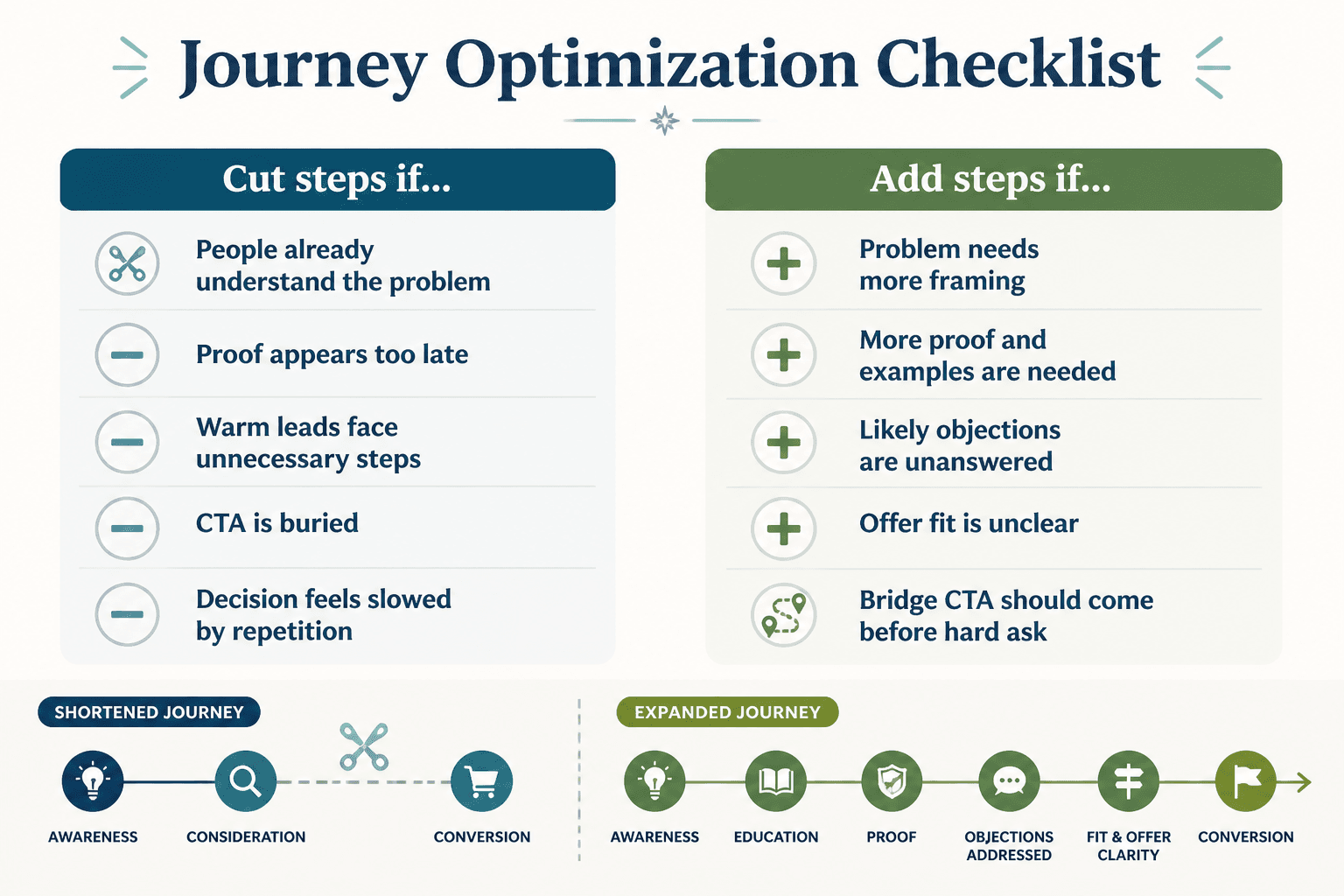
If your journey is too long
- Move the offer mention earlier
- Cut repetitive nurture emails or posts
- Make the CTA more specific
- Use stronger proof sooner
- Let warm leads skip unnecessary steps
If your journey is too short
- Add content that frames the problem better
- Show more proof and examples
- Answer likely objections before pitching
- Clarify who the offer is for and not for
- Use softer bridge CTAs before hard conversion asks
The goal is not “more content.” The goal is the right content in the right order.
And if your real problem is not the journey itself but what happens after attention turns into interest, read how to turn audience-to-offer journeys into more leads or sales.
Quick FAQ
The bigger point is simple: clearer structure and clearer writing make the piece more useful. That is usually what makes the ending land better too.