
Most Substack monetization advice falls into two bad camps.
The first says, “Just write great posts and the right people will magically buy.” Lovely thought. Not how most businesses work.
The second turns every post into a twitchy little sales trap. Read one thoughtful essay, get shoved toward a call, a course, a paid upgrade, a download, and somebody’s calendar link before you’ve even finished your coffee. Also not great.
If you want the Best Funnel Ideas to Pair With Substack Posts and Series, the real answer sits in the middle: build simple paths that match the post, match the reader’s intent, and do not torch trust on the way out.
That’s what this article covers. Not bloated funnel diagrams. Not bro-marketer nonsense. Just practical funnel ideas you can pair with Substack posts and series so your content leads somewhere useful: email subscribers, inquiries, consultations, paid products, memberships, or a stronger relationship with the right readers.
If you are still shaping your publication strategy, start with Substack posts and series. And if you want stronger content topics before you build funnels, this guide on Substack posts and series ideas and examples for creators will help.
For the full path around this topic, head to the parent guide.
What makes a good Substack funnel
A good Substack funnel does not feel like a funnel while the reader is inside it.
It feels like a logical next step.
Someone reads a post, gets value, wants more depth, more structure, more help, or a clearer way to act on what they just learned. Your job is to make that next step obvious and low-friction.
That means the best funnels usually have a few things in common:
- The offer matches the topic they just read
- The CTA is specific, not vague
- The step feels proportionate to the trust level
- The reader understands what happens next
- The path is simple enough that a tired human will actually take it
That last point matters more than people think. A lot of creators do not have a funnel problem. They have a “why are there six steps between reading my post and doing the useful thing” problem.
If your funnel needs a whiteboard to explain it, it probably needs fewer moving parts.
Start with reader intent, not your revenue goal
This is where a lot of Substack funnels get weird. The writer wants sales, so every post points to the same offer regardless of what the reader actually wants next.
Someone reads a tactical how-to piece and gets pushed toward a high-ticket strategy call. Someone reads a personal story and gets hit with a hard pitch for a template bundle. Someone joins for thoughtful essays and gets funneled into a generic coaching page that sounds like it was assembled by committee.
Instead, ask one better question: what would this specific reader naturally want after this specific post or series?
Usually that next step is one of five things:
- More depth
- More structure
- More personalization
- More ongoing support
- A way to apply the idea quickly
Once you know which one they want, the funnel gets much easier to build.
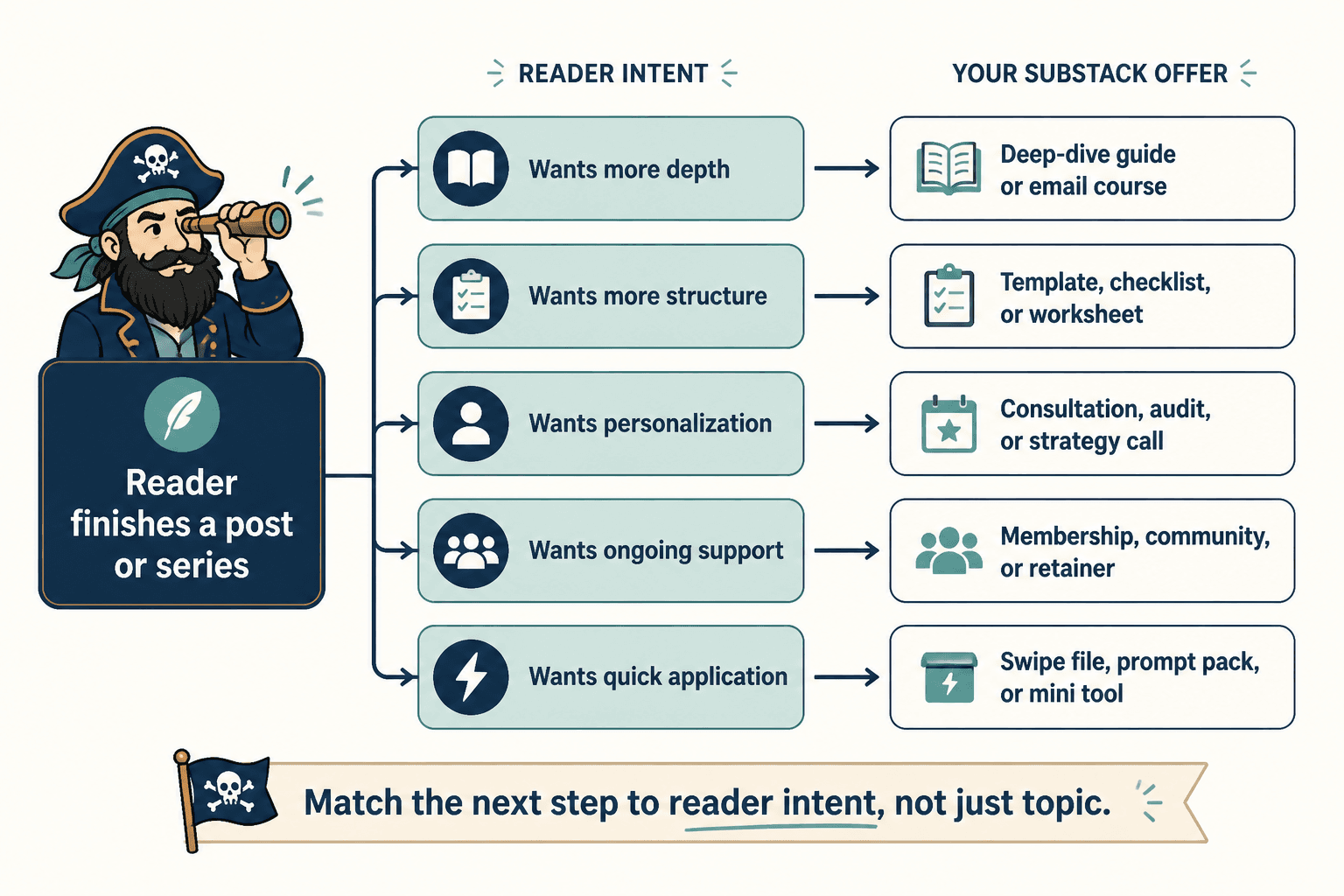
Best funnel ideas to pair with Substack posts and series
Here are the funnel models that tend to work best for creators, consultants, coaches, solo founders, and personal brands using Substack seriously.
1. Post to lead magnet
This is one of the cleanest options when your post teaches part of a process but the reader would benefit from a practical asset.
Good examples:
- A post about writing better welcome emails leads to a welcome email checklist
- A post about content positioning leads to a messaging worksheet
- A series on audience growth leads to a 30-day prompt pack
The key is relevance. Do not staple a random freebie onto every article and call it strategy. If the post is about fixing weak hooks, the lead magnet should help them write hooks, not invite them to your “entrepreneur mindset masterclass.”
Best for: list growth, lead capture, segmenting interest
Simple CTA: “If you want the worksheet version of this process, grab it here.”
2. Post to email nurture sequence
Sometimes the post itself should not do the selling. Fair enough. Let it do the trust-building, then move the reader into a short nurture sequence that deepens the topic and introduces the offer with a little more grace.
This works well when:
- Your offer needs context
- The buying decision is not instant
- The reader needs proof, examples, or objections handled
- You want to warm up cold readers without sounding desperate
A simple nurture sequence might look like this:
- Deliver the free resource promised in the post
- Send a short email clarifying the core problem
- Share an example or case study
- Offer the next paid or booked step
Not every reader needs to be sold immediately. In fact, forcing that usually makes the whole thing perform worse.
3. Post to paid newsletter upgrade
If you run free and paid Substack tiers, this is the most obvious built-in funnel. It can work very well, but only if the gap between free and paid is clear.
“Support my work” can bring in some paid readers. But “get deeper breakdowns, templates, teardown posts, monthly office hours, or premium strategy series” is stronger because it answers the obvious question: what do I actually get?
This model works best when your free posts create appetite for:
- Deeper analysis
- More specific examples
- Members-only series
- Practical tools and templates
- Access, feedback, or Q&A
Weak CTA: “Upgrade to support this publication.”
Stronger CTA: “If you want the full teardown, swipe file, and paid-only breakdown of how this works in practice, that’s inside the subscriber tier.”
4. Series to consultation or service inquiry
This is one of the best funnel ideas to pair with Substack posts and series if you sell expertise.
A single post can spark interest. A well-built series can do much more. It can demonstrate your thinking, your process, your standards, and your ability to diagnose a problem clearly. That is what makes someone think, “Right, I should probably hire this person.”
The mistake is pitching the service too early or too vaguely.
After a strong series, the CTA should connect the dots:
- Who the service is for
- What problem it solves
- What kind of outcome it helps create
- How to take the next step
Example: If you just published a 4-part series on fixing weak B2B newsletter positioning, your CTA might be: “If your newsletter is publishing consistently but still feels fuzzy, forgettable, or impossible to monetize, I help founders and consultants tighten positioning, content angles, and conversion paths. You can inquire here.”
That works because it grows directly out of the series. It is not a random “book a call” dropped from the ceiling.
5. Post to low-ticket product
If your readers want quick implementation more than deep support, a low-ticket product can be a very clean next step.
Think:
- Template packs
- Prompt libraries
- Swipe files
- Mini-guides
- Diagnostic checklists
- Short workshops
This is especially useful when your content teaches a repeatable skill. You show the principle in the post, then offer a practical shortcut that helps the reader apply it faster.
But please keep the product tight. Nobody wants a “mini-product” that is somehow still 87 slides of warmed-over internet advice.
6. Post to workshop or live training
This works well when your post opens a problem, but the actual transformation is easier to deliver in a live format.
For example, a post on fixing your content funnel might naturally lead to a workshop where attendees map their own funnel in real time. A post on writing better sales emails might lead to a live teardown session.
Best for:
- Consultants and coaches who sell expertise
- Creators building authority before a larger offer
- Audience segments that need interaction before they buy
This is also a nice bridge between “reader” and “lead” because it is more committed than reading but less intense than a direct sales call.
7. Series to cohort, membership, or community
If your Substack series creates ongoing discussion, repeated problems, or a need for accountability, a membership or community offer can make sense.
Notice the important phrase there: can make sense. Not every audience wants community. Not every business needs one. And not every creator should build a “paid circle” just because recurring revenue sounds nice on a spreadsheet.
This path works best when readers benefit from:
- Ongoing discussion
- Shared implementation
- Peer learning
- Regular feedback
- Access to recurring resources
If your publication covers ongoing practice, not just isolated tactics, this can be powerful.
8. Post to case study to offer
This is an underrated path for service businesses and consultants.
The first post introduces the idea. The next piece, often linked in the CTA or follow-up sequence, shows how that idea worked in practice. Then the offer becomes much easier to believe because the reader has seen proof, not just opinion.
This works especially well for topics where readers are skeptical, burned by bad advice, or allergic to vague expertise claims.
A simple flow:
- Educational post
- Case study or teardown
- Invitation to work together or buy the tool/process
If you want more on turning content into real business outcomes, read how to turn Substack posts and series into more leads or sales.
9. Post to reply conversation to soft DM or inquiry
Not every funnel has to be automated into a polished little machine. Sometimes the best next step is conversation.
If your post invites responses from the right kind of reader, you can turn those replies into useful follow-up. Not weird follow-up. Useful follow-up.
For example:
- Invite readers to reply with their biggest issue on the topic
- Respond thoughtfully
- Notice patterns
- If relevant, offer the right next step privately or directly
This works well for smaller audiences too, sometimes better than broad-scale funnels. If that is your situation, read Substack posts and series for creators with small audiences. Small, relevant audiences often convert well because trust builds faster and conversations stay human.
10. Post to resource hub to segmented offers
If you cover several related topics, a resource hub can help route different readers to different next steps.
Say your Substack covers messaging, email strategy, funnels, and productized services. A post on welcome emails should not push every reader to the same generic offer. Instead, it can point them to a curated resource page where they can choose the next most relevant path.
This is particularly useful if your audience has mixed needs or sits at different sophistication levels.
Best for: broader creator businesses, multi-offer ecosystems, stronger segmentation
It is slightly more work, yes. But it is also much more intelligent than forcing one CTA onto every post like a motivational fridge magnet.
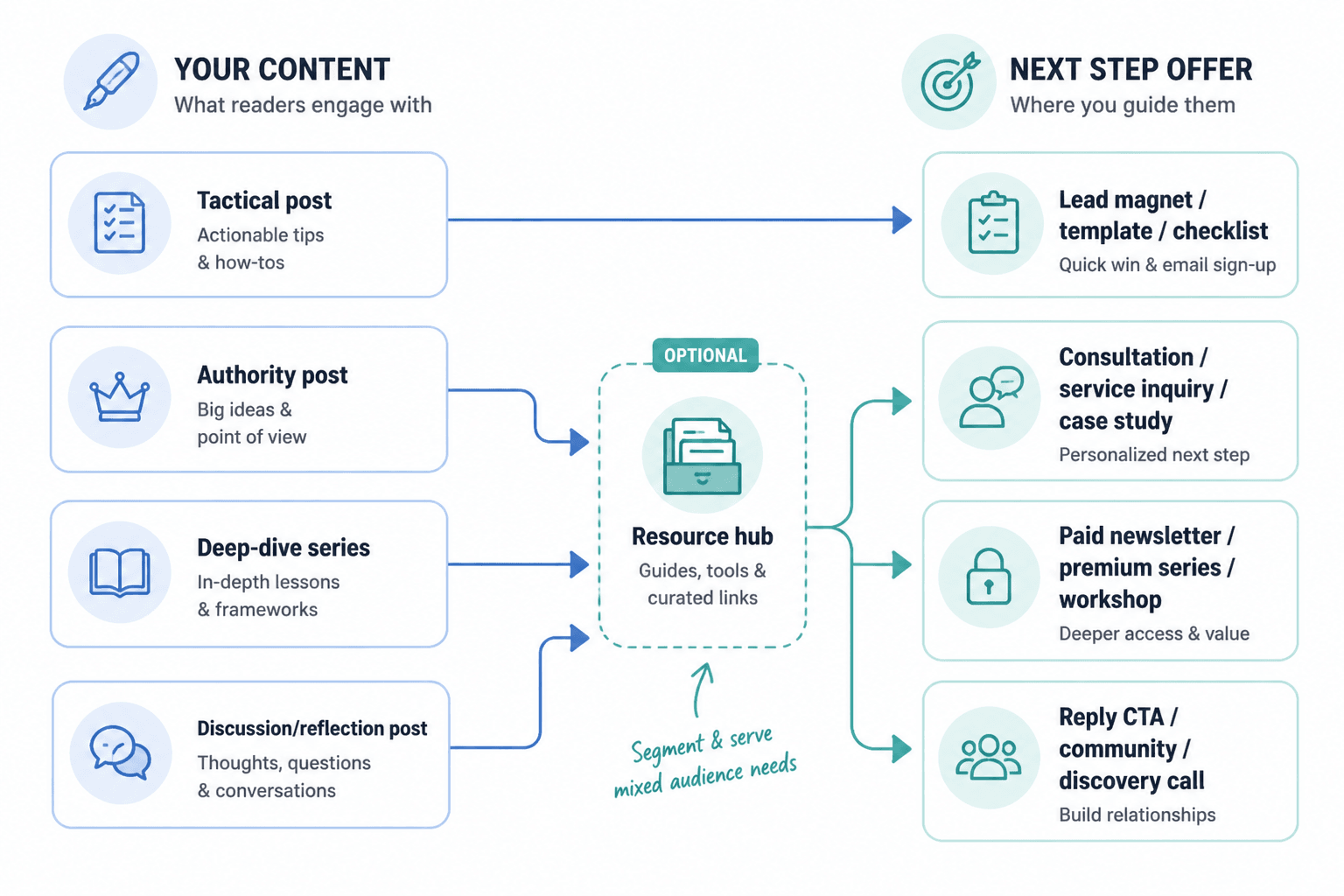
How to choose the right funnel for a Substack post or series
You do not need ten funnels running at once. You need the right one for the content and the business model.
Use this quick decision filter.
| If the post does this | A strong next step is often this |
|---|---|
| Teaches a tactical process | Lead magnet, template, checklist, low-ticket product |
| Builds authority on a business problem | Consultation, service inquiry, case study sequence |
| Introduces a nuanced idea that needs depth | Paid newsletter upgrade, premium series, workshop |
| Sparks discussion and personal reflection | Reply CTA, community, soft DM conversation |
| Builds an ongoing theme over multiple posts | Series-to-offer funnel, membership, nurture sequence |
And ask yourself:
- Is the reader ready for this next step, or am I rushing it?
- Does this offer naturally continue the post?
- Would the CTA still make sense if the reader actually read the piece carefully?
- Am I asking for too much commitment too soon?
- Can I make the path simpler?
How to write CTAs that do not wreck the post
A lot of decent Substack posts get kneecapped by clunky endings.
The post is smart. The reader is engaged. Then the CTA arrives sounding like a webinar bot that escaped from 2021.
The fix is simple: make the CTA feel like continuation, not interruption.
Weak CTA style
- Too broad
- Too salesy
- Not clearly connected to the post
- Asks for too much too soon
Example: “If you are ready to scale your business to the next level, book a call today.”
Stronger CTA style
- Names the reader type
- Matches the topic they just read
- Offers a logical next step
- Says what happens next
Example: “If your newsletter is getting opened but not converting, I put together a short teardown checklist you can use before your next send.”
Or:
Example: “This piece covered the strategy. If you want help applying it to your own publication, that’s the work I do with clients.”
That sounds like a person. Helpful difference.
Funnels that work especially well for Substack series
Series give you a big advantage over standalone posts: they create momentum.
A reader who follows a 3-part or 5-part series is more invested than someone who skimmed one post between errands. That means you can usually offer a slightly deeper next step at the end of a strong series.
Some of the best pairings:
- Educational series → paid deep-dive or premium archive
- Problem-solution series → consultation or audit
- Tactical series → toolkit or template pack
- Perspective series → workshop or live session
- Ongoing practice series → membership or community
The secret is not fancy automation. It is coherence. The series should set up the offer naturally enough that the reader does not feel ambushed.
Common Substack funnel mistakes
You can avoid a lot of mess by not doing the obvious bad things.
- Using one generic CTA on every post. Different topics create different kinds of buying intent.
- Pitching too early. One decent post does not automatically earn a big ask.
- Sending readers to messy pages. A strong post can still die at a vague landing page.
- Offering the wrong next step. Readers want progress, not whatever you happen to be selling this week.
- Confusing attention with readiness. Opens and likes are not the same as buying intent.
- Making the funnel more complicated than the offer itself. This happens a lot, and it is never charming.
One more thing: tools help, but they are not the strategy. If you need help organizing delivery, automation, or creator workflows, this guide to best Substack tools and creator monetization tools for Substack posts and series is worth a read. Just do not expect software to rescue fuzzy positioning.
A simple 4-step funnel framework for most Substack creators
If you want something practical you can apply this week, use this.
The bigger point is simple: clearer structure and clearer writing make the piece more useful. That is usually what makes the ending land better too.