If your Substack audience is small, the worst move is trying to sound bigger than you are.
That usually looks like bloated essays, vague “big ideas,” forced authority, and series that die after two installments because they were built to impress strangers instead of help actual readers. A small audience does not need more performance. It needs more precision.
Substack Posts and Series for Creators With Small Audiences work best when they are specific, consistent, and easy to return to. You do not need a huge list to build momentum. You need posts people can trust, series people can recognize, and a publishing rhythm you can actually maintain without becoming weirdly resentful of your own newsletter.
This is where smaller creators can quietly do very well. You can write closer to the reader. You can test angles faster. You can build a sharper point of view before you are trapped performing for a crowd that barely knows what you do.
To see how this fits into the wider strategy, open the parent guide.
Why small-audience creators should care about series, not just single posts
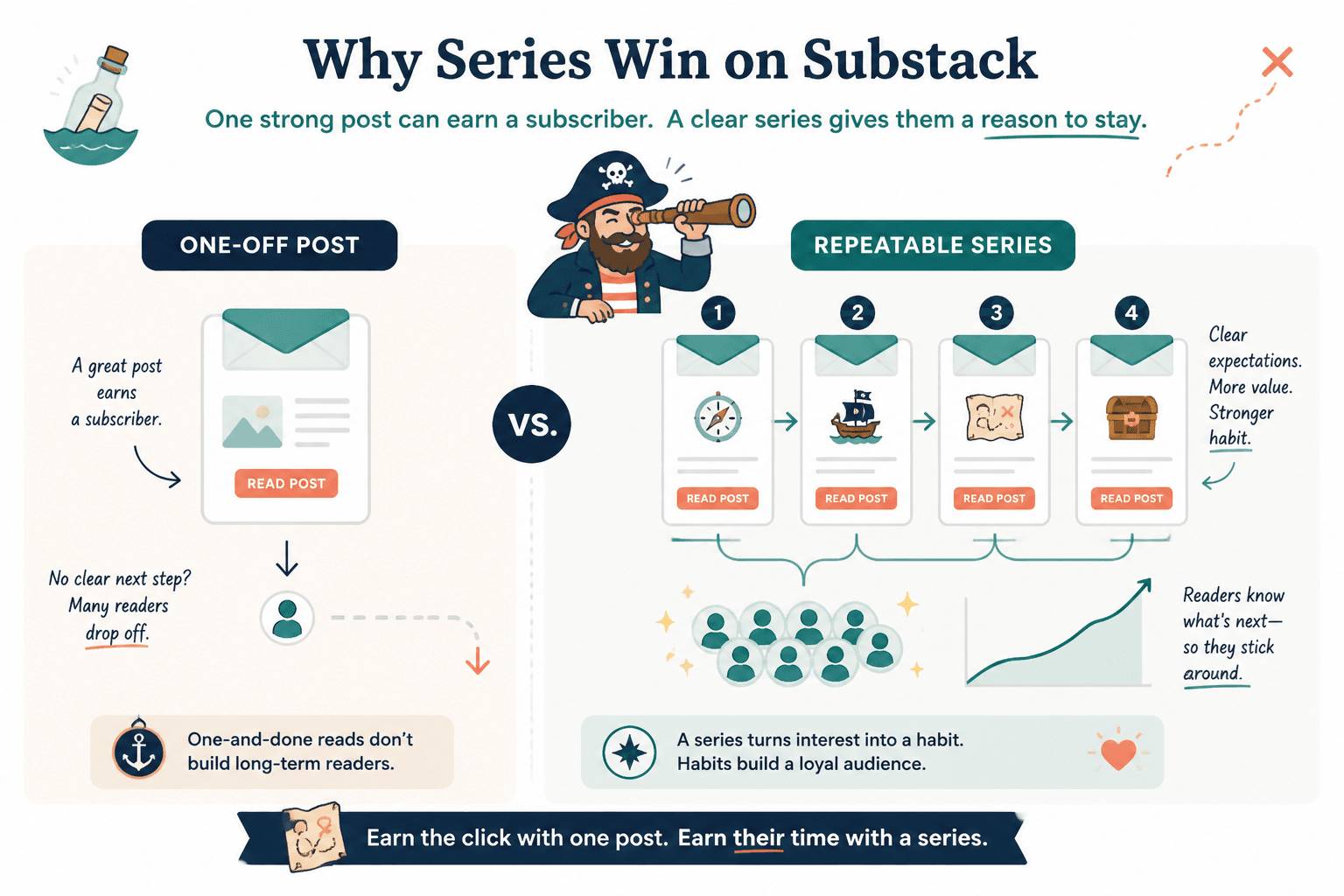
Single posts can attract attention. Series build expectation.
That matters on Substack because readers are not just skimming a feed and vanishing. They are subscribing to a voice, a lens, and a reason to keep opening emails. One strong post might get a subscriber. A clear series gives them a reason to stay.
Series also solve a very common creator problem: publishing from scratch every time. When each issue has to be invented from nothing, your newsletter gets slower, fuzzier, and more dramatic than it needs to be. A series gives you structure. Structure gives you consistency. Consistency makes you look more credible than “I send something when inspiration strikes.”
And no, that line still is not charming.
For a broader look at newsletter strategy, you can also explore email newsletter writing and the site’s newsletter writing resources.
What small Substack audiences actually need from you
Not more content. Better reasons to care.
If you have 83 subscribers, or 312, or 900, your job is not to mimic newsletters with massive built-in audiences, media teams, and endless social proof. Your job is to make the right readers think, “This is for me, and this person knows what they are talking about.”
That usually comes from four things:
- Specific relevance: talk to a real type of reader, not “anyone interested in growth.”
- A recognizable format: recurring sections or series make you easier to remember.
- Useful perspective: not just information, but interpretation.
- Reliable cadence: readers do not need daily. They do need believable.
Small audiences respond well to intimacy and clarity. They do not need every issue to be epic. They need enough signal to know opening your email is worth the click.
Best types of Substack posts for creators with small audiences
You do not need a dozen formats. You need a handful that fit your expertise, voice, and stamina.
1. Practical breakdown posts
These are simple, useful, highly readable issues that solve one narrow problem well.
Examples:
- How I turn one client insight into three newsletter ideas
- The easiest way to tighten a weak CTA in your email
- Why your newsletter intro is doing too much
- A simple structure for teaching without rambling
This format works because it respects reader intent. Someone subscribed because they want a clearer brain, a better process, or stronger content. Give them one win per issue.
2. Opinion posts with receipts
Small creators often avoid having opinions because they think authority comes later. It does not. Clear thinking is part of authority.
But opinion alone is cheap. The useful version is: point of view plus reasoning plus examples.
For example:
- Why most creator newsletters are too broad to grow
- Why publishing more often is not your first problem
- Why “personal storytelling” is overrated when the lesson is weak
This kind of post works especially well when your audience is small because strong positioning travels. Readers remember specific arguments more than generic advice.
3. Behind-the-work posts
These show how you think while building, writing, coaching, consulting, designing, or selling. Not “build in public” cosplay. Actual process.
Examples:
- How I planned this month’s newsletter topics in 25 minutes
- The content system I use when client work eats my week
- What I cut from my drafts and why
- How I decide if an idea deserves a full series
This works because readers do not just want conclusions. They want judgment. Process reveals judgment.
4. Reader-response posts
If your audience is small, use that. You can actually hear them.
Turn recurring questions, replies, or objections into issues. That gives your content built-in relevance and makes subscribers feel like the newsletter is alive, not broadcast from a content bunker.
Examples:
- A reader asked how long a newsletter should be. Here is the real answer.
- Three questions I keep getting about newsletter monetization
- What to do when your list is growing slowly but the right people are joining
5. Curated link-and-commentary posts
You do not always need to produce an original manifesto. Sometimes your job is to help your reader notice what matters.
A curated issue can include:
- 3 useful articles or examples
- Your commentary on each one
- One takeaway readers should apply this week
The key is that your commentary matters more than the links. Otherwise you are just forwarding the internet with nicer formatting.
What makes a Substack series work when your audience is small
The best small-audience series are not huge. They are clear.
A good series gives readers a recurring promise. It says, “If you liked this angle, I will keep delivering on it.” That is much stronger than random newsletter roulette.
Strong series usually have these traits:
- A narrow theme
- A repeatable structure
- A distinct reader benefit
- A realistic number of installments
- A title people can remember without squinting
Weak series tend to fail for the opposite reasons. They are too broad, too ambitious, too irregular, or too dependent on inspiration. “My thoughts on creativity and business” is not a series. That is a category crisis.
A simple series formula
Use this:
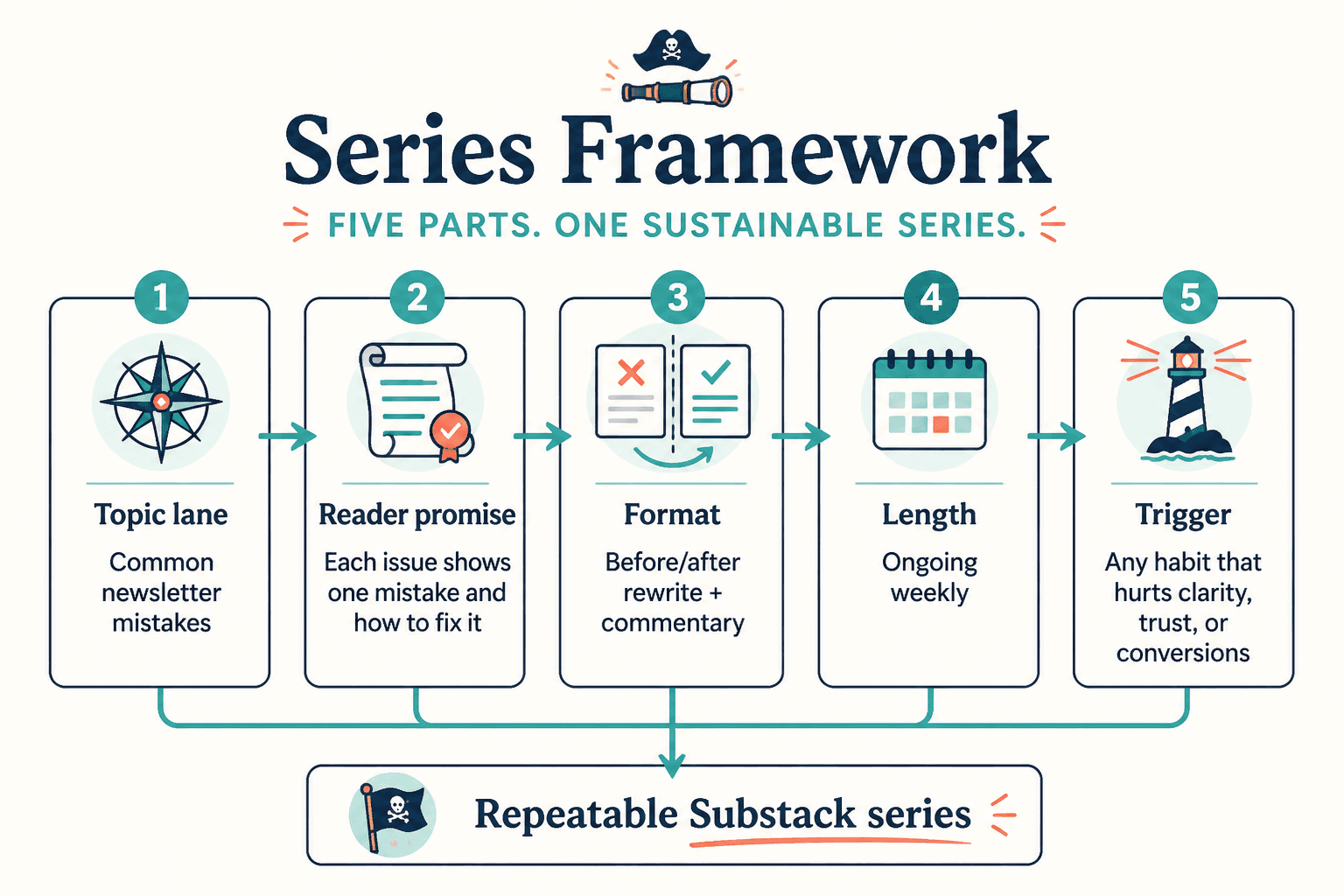
- Topic lane: What is the series about?
- Reader promise: What will readers get from it?
- Format: Breakdown, essay, case study, Q&A, teardown, curation?
- Length: 3 parts, 5 parts, ongoing weekly, monthly?
- Trigger: What makes an idea fit this series?
Example:
Series: Fix the Newsletter
Topic lane: Common newsletter mistakes
Reader promise: Each issue shows one mistake and how to correct it
Format: Before/after rewrite with commentary
Length: Ongoing weekly
Trigger: Any real newsletter habit that hurts clarity, trust, or conversions
That is useful. It is memorable. It is easy to continue.
If you want more structure ideas, this guide on Substack posts and series for better results is a helpful next read.
Substack series ideas that are actually sustainable
The best series idea is not the smartest one. It is the one you can keep publishing without your standards collapsing by issue three.
Here are strong options for creators with small audiences:
The teardown series
Each issue breaks down one asset, tactic, or mistake.
- A welcome email teardown
- A landing page teardown
- A bio rewrite teardown
- A weak post opening teardown
This is practical, skimmable, and easy to position.
The field notes series
Short observations from your week of work, framed around what they mean.
This works well for consultants, coaches, writers, and service providers because it turns real experience into content without pretending every thought is a TED Talk.
The question series
One issue, one useful question answered well.
Great for small audiences because it is naturally aligned with reader curiosity and keeps your writing grounded in actual needs.
The mini-case-study series
Show what changed, what was tried, what worked, what did not, and why.
You do not need giant famous clients for this. Small, honest case studies are often more credible than inflated victory laps.
The recurring toolkit series
Each issue shares one framework, checklist, prompt set, template, or decision aid.
This is especially good if your readers want practical assets they can apply immediately.
For more examples, see these Substack post and series ideas and examples and these adaptable Substack series ideas for creators.
How often should you publish posts or series on Substack?
Less often than your guilt says. More consistently than your excuses prefer.
Most small creators do better with a calm, durable cadence than an ambitious one. Weekly is strong if you can sustain quality. Every other week is completely respectable. Monthly can work if the content is genuinely worth waiting for and the format is strong.
The problem is not usually low frequency. It is broken expectation. If readers cannot tell when or why your newsletter shows up, your habit feels fragile. Fragile newsletters are easy to forget.
A simple cadence might look like this:
- Week 1: practical breakdown
- Week 2: series installment
- Week 3: reader Q&A or field notes
- Week 4: curated links with commentary
That is enough variety to stay interesting and enough structure to stay sane.
If you want a cleaner planning system, check out these simple Substack issue cadence templates.
Common mistakes small creators make with Substack posts and series
Writing too broadly
Broad sounds ambitious, but usually reads blurry. “Thoughts on audience growth” is weaker than “Why your newsletter content is too general to earn replies.”
Starting a series with no format
If every installment feels structurally different, readers do not feel continuity. They feel confusion.
Making every issue too long
Depth is good. Padding is not. Some ideas need 1,500 words. Some need 500 and a little self-control.
Being useful without being distinct
The bigger point is simple: clearer structure and clearer writing make the piece more useful. That is usually what makes the ending land better too.
Stronger Substack posts usually come from a clearer point, tighter structure, and a more deliberate series flow. Better pacing often matters more than more volume.