
Most Substack publishing plans fail for a very boring reason: they ask a busy person to act like they have an editorial team, a content manager, and suspiciously high emotional stability every Tuesday at 7 a.m.
You do not need a heroic content calendar. You need a cadence you can actually keep without turning your newsletter into another guilt hobby.
That is the real point of using simple Substack issue cadence templates for busy creators. Not to look impressively organized. To publish often enough that readers trust you, while keeping the process light enough that you do not disappear for six weeks and come back with an apology essay nobody asked for.
Here’s how to choose a cadence that fits your time, energy, and content style, plus a few practical templates you can steal immediately. If you write Substack posts and series while juggling client work, a business, content on other platforms, or life in general, this should save you from overcommitting and underdelivering.
If you want the broader strategy behind planning Substack posts and series, that guide pairs well with this one. This article is more about rhythm: how often to publish, what each issue should do, and how to make the whole thing sustainable.
For the full path around this topic, head to the parent guide.
Why cadence matters more than ambition
A lot of creators pick a publishing cadence based on ideal-self logic.
Ideal self says: “I’ll publish three strong issues a week, rotate between essays, analysis, curated links, mini case studies, and premium exclusives, then repurpose all of it to social.”
Actual self says: “I have two calls, a client deadline, a half-written draft, and exactly fourteen minutes of brain function left.”
So the plan collapses.
A good cadence does three jobs:
- It gives readers a reliable expectation.
- It gives you enough repetition to improve.
- It does not require constant reinvention.
That last one matters more than people admit. Busy creators usually do not need more ideas. They need fewer moving parts.
Simple Substack issue cadence templates work because they reduce decision fatigue. Instead of asking, “What should I publish this week?” you ask, “Which issue type fits this slot?” Much better. Less drama. More shipping.
Pick your cadence based on capacity, not guilt
Before choosing a template, be honest about your actual publishing capacity. Not your best week. Your normal week.
Look at four things:
- Available writing time: How many hours can you realistically give this each week?
- Content depth: Are you writing thoughtful essays, quick observations, curated resources, or a mix?
- Business model: Is your newsletter there for audience growth, authority, leads, paid subscriptions, or all of the above?
- Energy consistency: Can you produce steadily, or do you work in bursts?
If your energy is unpredictable, a daily plan is not “ambitious.” It is self-sabotage with a stationery addiction.
Use this rough rule:
- 1 issue per week: best for depth, consistency, and creators with limited time
- 2 issues per week: best for growth plus authority if you can separate lighter and heavier formats
- 3+ issues per week: best for operators with strong systems, fast idea generation, or intentionally short formats
You can always earn your way into a faster cadence. Starting too big usually just teaches your audience that your schedule is fictional.
Simple Substack issue cadence templates for busy creators
These templates are built for real people with limited time. They are simple on purpose. You can layer complexity later if you want. Most people should not.
Template 1: The one-issue weekly anchor
Best for: solo creators, consultants, coaches, freelancers, and anyone building consistency from scratch
Cadence: 1 issue every week, same day
Format: one reliable signature issue
- Tuesday: practical essay
- Or Thursday: personal insight plus lesson
- Or Sunday: roundup with one main idea, three links, one recommendation
This is the safest and most underrated setup. One issue. One format family. One clear expectation. It is enough to build trust if the writing is useful and specific.
The trick is not making every issue feel like a magazine feature. Give yourself a repeatable shape:
- strong opening observation
- one core lesson
- two to four practical takeaways
- short closing CTA or reply prompt
Example weekly promise: “Every Thursday, one practical note on writing, positioning, or creator marketing you can use that week.”
That’s enough. Clear beats ornate.
Template 2: The depth plus lighter touch combo
Best for: creators who want more touchpoints without doubling their workload
Cadence: 2 issues per week
- Issue 1: one deeper piece
- Issue 2: one lighter, faster issue
Example rhythm:
- Tuesday: deep-dive article or essay
- Friday: short note, examples list, links, or behind-the-scenes commentary
This works well because not every issue has to carry the full weight of your authority, personality, originality, and inner child. One issue can do the heavy lifting. The other can keep the relationship warm.
Good lighter issue formats include:
- 3 things I’m noticing this week
- 1 tactic, 1 example, 1 mistake to avoid
- reader question of the week
- tiny case study
- curated links with commentary
- draft idea I’m testing
This is often a better move than trying to produce two deep essays every week and then resenting your own newsletter.
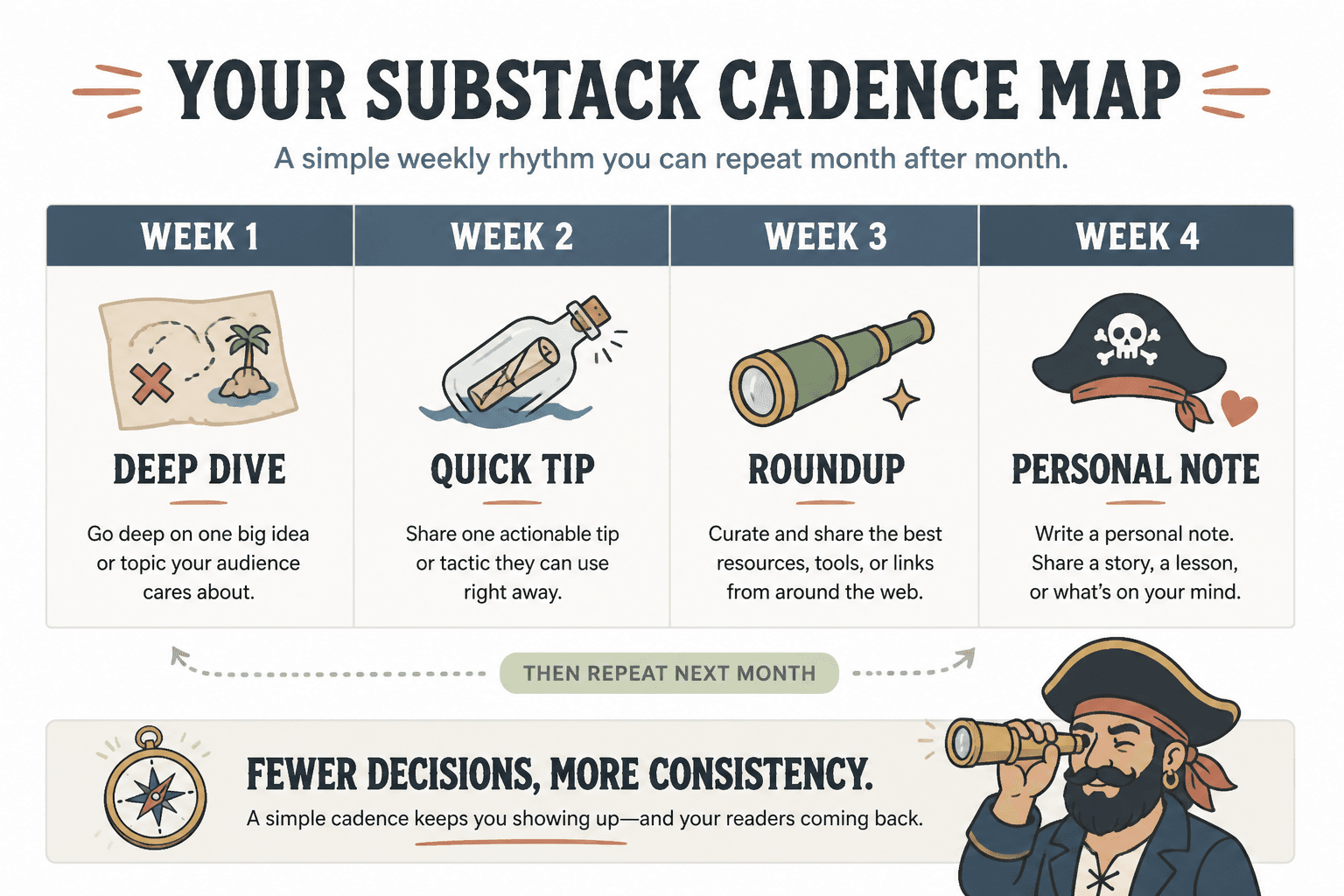
Template 3: The monthly series with weekly support posts
Best for: creators who like structure, themes, and content repurposing
Cadence: 4 issues per month
- Week 1: series kickoff
- Week 2: example or application
- Week 3: common mistake or myth
- Week 4: Q&A, summary, or action plan
This is one of the smartest simple Substack issue cadence templates if you hate staring at a blank page. A monthly theme gives you constraint. Constraint gives you speed.
For example, if the month’s theme is “better newsletter intros,” your four issues might be:
- why most intros lose the reader immediately
- 5 intro structures that actually work
- before-and-after intro rewrites
- reader Q&A plus checklist
This format also makes repurposing easier. One monthly series can feed LinkedIn posts, X threads, short videos, and future lead magnets without you creating from scratch every time.
If you need ideas to build those themes, see these Substack post and series ideas and examples and series ideas creators can adapt fast.
Template 4: The alternating essay and roundup
Best for: writers and creators who want consistency without writing a deep original piece every single week
Cadence: weekly, alternating formats
- Week 1: essay
- Week 2: curated roundup
- Week 3: essay
- Week 4: curated roundup
This is excellent if you have opinions, observations, and useful links, but not enough time to write four polished essays a month. Roundups are easier to sustain if they are not lazy link dumps.
A good roundup still needs a point. It should not read like, “Here are some things I found.” That is not curation. That is browser history with formatting.
Instead, give each roundup a lens:
- 3 ideas changing how I think about audience trust
- 5 useful content examples worth stealing structurally
- 4 creator business lessons hiding inside unrelated industries
Now the issue has editorial shape. Much nicer.
Template 5: The burst-friendly batch model
Best for: creators who work in intense bursts and struggle with weekly drafting from scratch
Cadence: publish weekly, batch monthly
This one is less about what readers see and more about how you work behind the scenes.
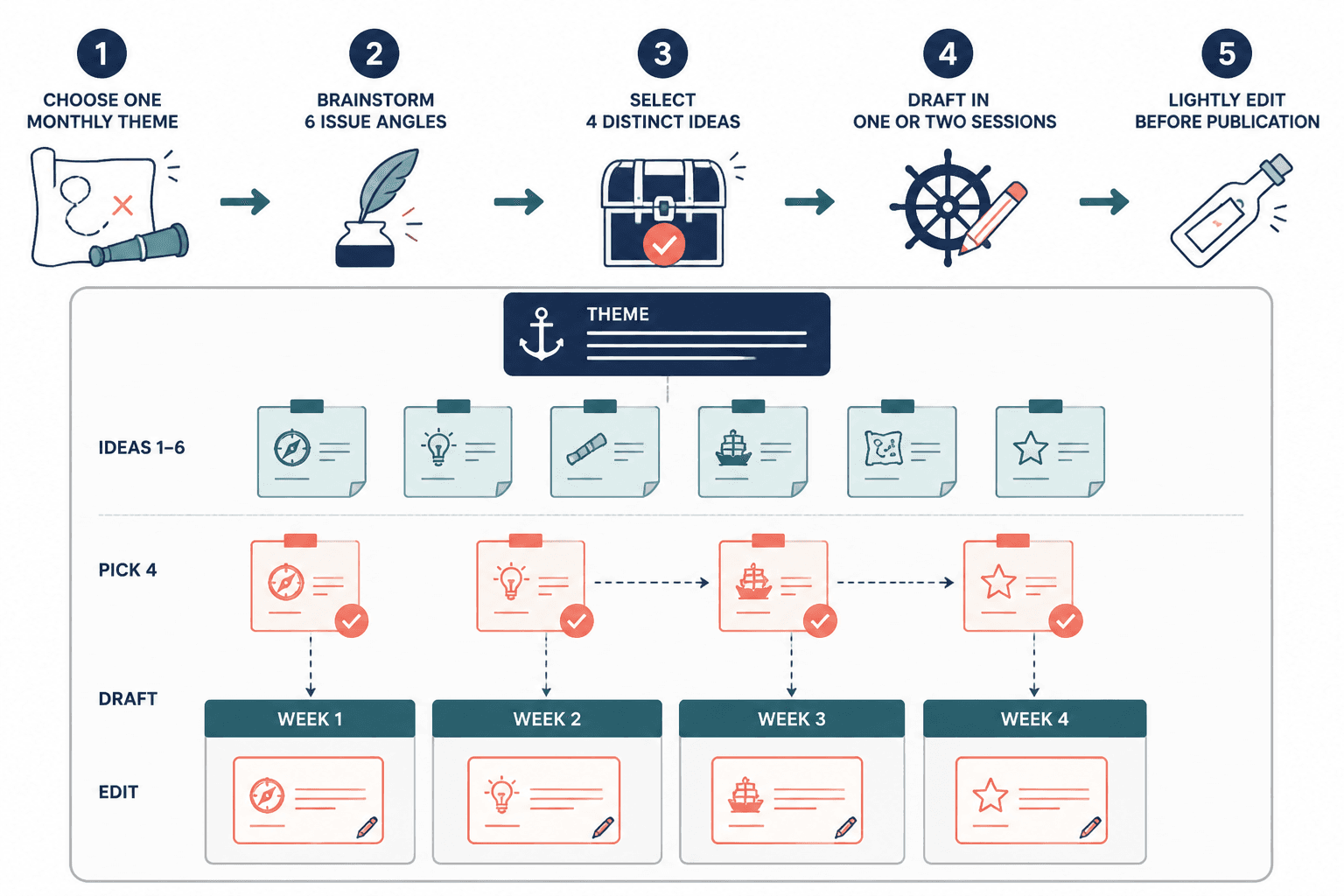
Use one planning session each month to outline or draft 4 to 6 issues. Then schedule them with light editing before publication. You still publish regularly, but you are not relying on fresh inspiration every week, which is generous in theory and useless in practice.
A simple monthly batching workflow:
- Pick one monthly theme or problem area.
- List 6 possible issue angles.
- Choose 4 that feel distinct.
- Draft rough versions in one session or two.
- Edit each one lightly before it goes out.
This model works especially well with templates and recurring sections. If that is your thing, these templates and tools for Substack posts and series can help you cut setup time.
How to choose the right issue types for your cadence
Your cadence gets easier when each issue type has a job. Do not just publish “content.” Decide what each kind of issue is supposed to do.
| Issue type | Main job | Best use |
|---|---|---|
| Essay or deep dive | Build authority | Teach, argue, explain, position |
| Roundup or curation | Stay consistent with lower effort | Share resources, examples, trends, commentary |
| Case study or teardown | Build trust through proof | Show how something worked, failed, or could improve |
| Q&A issue | Increase relevance | Answer audience questions and remove friction |
| Short note or field note | Keep connection warm | Share observations, lessons, or evolving ideas |
| Series installment | Create momentum | Develop a topic over several weeks |
A good cadence usually mixes one authority-building format with one lighter maintenance format. That balance keeps the newsletter useful without making every send feel like a thesis defense.
What busy creators keep getting wrong
They choose frequency before format
“Twice a week” is not a strategy. It is a number. First decide what kinds of issues you can make repeatedly without hating your life. Then assign frequency.
They make every issue too heavy
Not every newsletter needs to be a polished centerpiece. Some should simply be sharp, useful, and on time. Reliability is attractive. Chaos with good intentions is not.
They ignore reader expectation
If your audience subscribed for practical creator strategy and suddenly gets a sprawling life update, a trend recap, and three product links in random order, that is not range. That is drift.
They keep changing the cadence
A cadence only starts working once readers can feel the pattern. If you switch from weekly to daily to “when inspiration strikes,” you are training people not to expect you.
They confuse consistency with sameness
The bigger point is simple: clearer structure and clearer writing make the piece more useful. That is usually what makes the ending land better too.
Stronger Substack posts usually come from a clearer point, tighter structure, and a more deliberate series flow. Better pacing often matters more than more volume.