
Most blog posts do not underperform because the writer is bad at writing. They underperform because the edit made them blurrier, flatter, longer, safer, and somehow less useful than the draft had any right to become.
That is the annoying part about clarity edits. In theory, they are supposed to make a post easier to read. In practice, a lot of them sand off the sharp edges, remove the specifics, bury the point, and leave you with a professionally worded loaf of nothing.
If you are working on Blog Clarity Edit Mistakes That Hurt Performance, the real goal is not to make your article sound cleaner. It is to make it easier to understand, easier to trust, and easier to act on. Those are not always the same thing.
Here is how to spot the clarity-edit mistakes that quietly wreck performance, plus what to do instead if you want your rewrites and refreshes to actually help the piece pull its weight.
For the main guide behind this topic, visit the parent guide.
What a good clarity edit is actually supposed to do
A good clarity edit should make the article more obvious in the best way. The point should land faster. The structure should feel cleaner. The examples should work harder. The next step should be easier to take.
It should not make the post sound more “professional” if that just means more generic. It should not make the article longer if the added words do not add proof, context, or usefulness. And it definitely should not remove all personality until the piece reads like a committee wrote it during a mild sedation.
Clarity is not just about simpler wording. It is about reducing friction between your idea and the reader’s brain. That includes structure, emphasis, specificity, examples, pacing, and relevance.
If you are regularly updating older posts, this is where a proper refresh matters. A useful companion piece is blog rewrites and refreshes, especially if you are cleaning up content that used to rank or convert better than it does now.
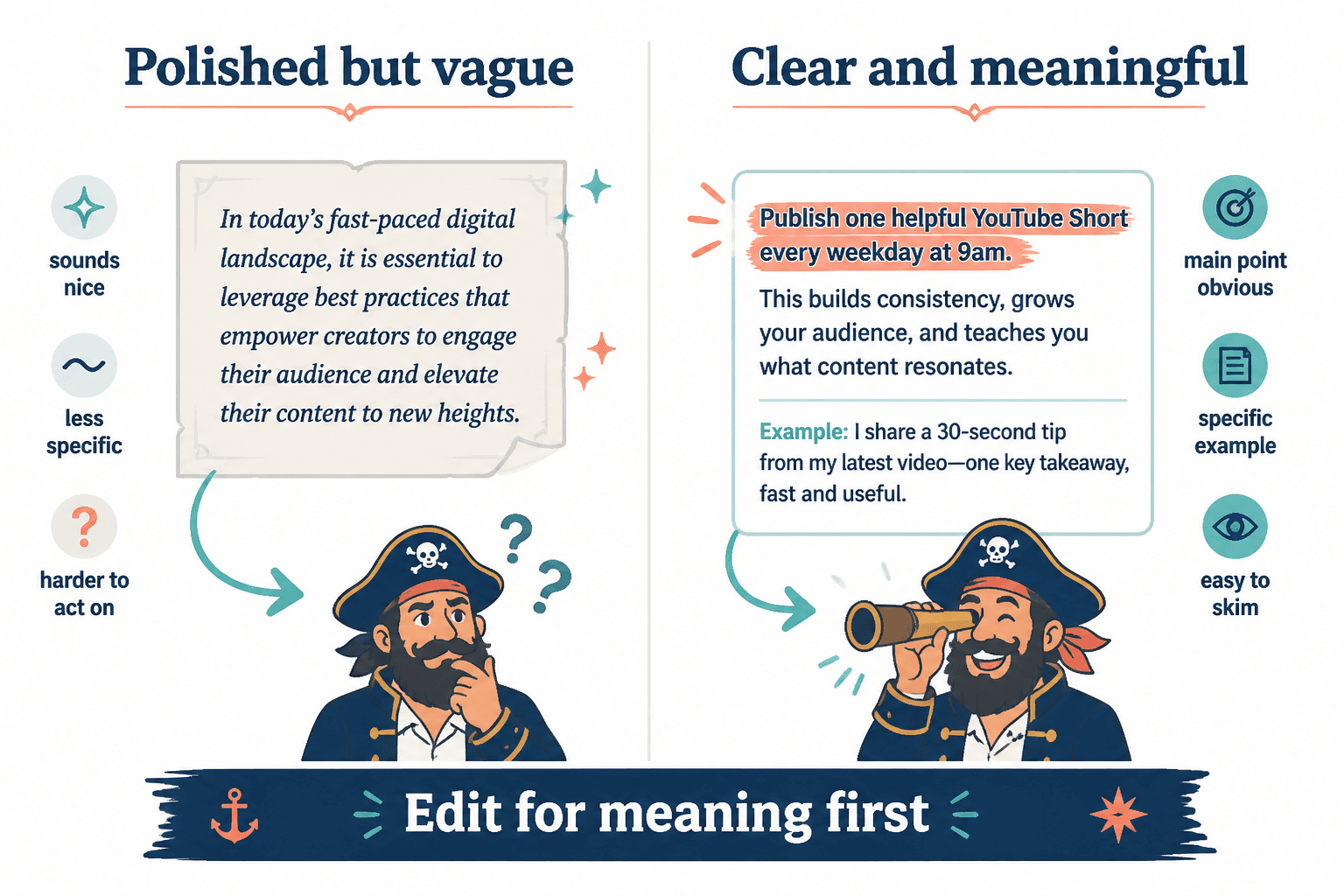
Mistake 1: Editing for neatness instead of meaning
This one is common because it feels productive. You fix sentence flow. You smooth transitions. You replace rough phrases with cleaner ones. You remove repetition. Lovely.
And yet the post still performs worse.
Why? Because neat writing is not the same as clear writing. A sentence can be polished and still say almost nothing.
If the edit makes the article tidier but less specific, you did not improve clarity. You improved cosmetics.
What this looks like
- Replacing concrete examples with broad summaries
- Swapping plain language for “smoother” business phrasing
- Cutting sharp opinions because they feel too direct
- Removing repeated points that were actually useful emphasis
- Prioritizing elegance over comprehension
Do this instead
Edit for meaning first. Ask:
- Is the main point obvious by the second or third paragraph?
- Does each section say something distinct?
- Would a skim reader still get the point?
- Did I replace a useful example with a vague summary?
- Did I make the writing nicer at the expense of force?
When in doubt, keep the sentence that actually says something. Even if it is a bit less polished.
Mistake 2: Cutting too much context and calling it concise
Some blog edits get drunk on brevity. Every supporting sentence gets cut. Every example gets trimmed. Every explanation becomes a one-liner. The editor steps back, nods proudly, and now the article reads like notes from a meeting nobody wanted to attend.
Concise writing is useful. Underexplained writing is not.
Readers do not need maximum compression. They need enough context to understand why your advice matters, when it applies, and how to use it without guessing. This is especially true for strategy posts, rewrites, and SEO refreshes, where the difference between “technically correct” and “actually helpful” is usually context.
Bad edit
“Improve readability by shortening sentences and simplifying language.”
Better edit
“Improve readability by shortening sentences that try to carry three ideas at once. Keep the useful detail. Cut the extra framing, filler transitions, and self-conscious throat-clearing that slow the point down.”
That second version is longer, yes. It is also much clearer.
If you tend to overcut older articles during a refresh, you may like how to improve blog rewrites and refreshes without sounding generic. Generic is often what happens when useful context gets stripped out in the name of efficiency.
Mistake 3: Leaving vague claims where proof should be
One of the biggest clarity problems is not sentence-level at all. It is claim-level. The article keeps making broad statements, but never shows the reader what those statements mean in real terms.
Things like:
- “Focus on quality”
- “Add more value”
- “Make your content engaging”
- “Refresh outdated sections”
- “Use a stronger structure”
None of that is technically wrong. It is also not very helpful on its own.
Clarity improves when abstract advice gets anchored in something visible: an example, a before-and-after, a checklist, a mini framework, or a specific decision rule. Without that, the reader has to do too much translation work.
A quick rewrite example
| Vague line | Clearer version |
|---|---|
| Use a stronger introduction | Lead with the mistake, tension, or false assumption the reader is dealing with. Do not spend the first paragraph circling the topic politely. |
| Improve readability | Break long sections, keep one main point per paragraph, and use subheads that tell the reader what they are about to get. |
| Refresh the content | Update outdated examples, remove dead advice, tighten weak sections, and add missing proof where claims feel airy. |
That is what readers mean when they say they want clear content. They want to be shown what you mean, not just handed a nicer-sounding instruction.
Mistake 4: Smoothing out the voice until the article sounds interchangeable
A lot of edits accidentally kill trust because they remove the writer’s actual cadence. The article becomes technically cleaner but emotionally flatter. It loses its point of view. It stops sounding like a person with judgment and starts sounding like a content appliance.
Readers notice this, even if they cannot explain it neatly. A bland article does not feel clearer. It feels less believable.
This is a big problem in blog rewrites, especially when older posts get “updated” with stiff SEO language and padded transitions. The result often sounds more optimized and less trustworthy. Not exactly the dream.
Signs your edit flattened the voice
- The article now uses generic marketing phrases you would never say out loud
- Every opinion got softened into a neutral suggestion
- The sharpest examples were cut because they felt too informal
- The rhythm became stiff and samey
- The whole piece sounds like it was approved by Legal and a beige cardigan
Clear writing still needs texture. A little personality helps readers stay with you, especially in crowded topics where dozens of articles say roughly the same thing.
If the draft had a real voice, your job is not to scrub it out. Your job is to make that voice easier to follow.
Mistake 5: Fixing sentences while ignoring structure
This one wastes a lot of time. People line-edit every paragraph while the article itself is still organized badly. That is like polishing the cutlery while the meal is still raw.
If a post is hard to follow, the problem may not be wording. It may be sequence.
Common structural issues:
- The introduction takes too long to reach the point
- The same idea shows up in three sections
- The advice is in the wrong order
- The examples appear before the concept is explained
- The article ends without a clear takeaway or next step
Sentence edits will not save a structure problem. In fact, they often hide it. You end up with an article that is easy to read line by line but still confusing as a whole.
A simple structural clarity check
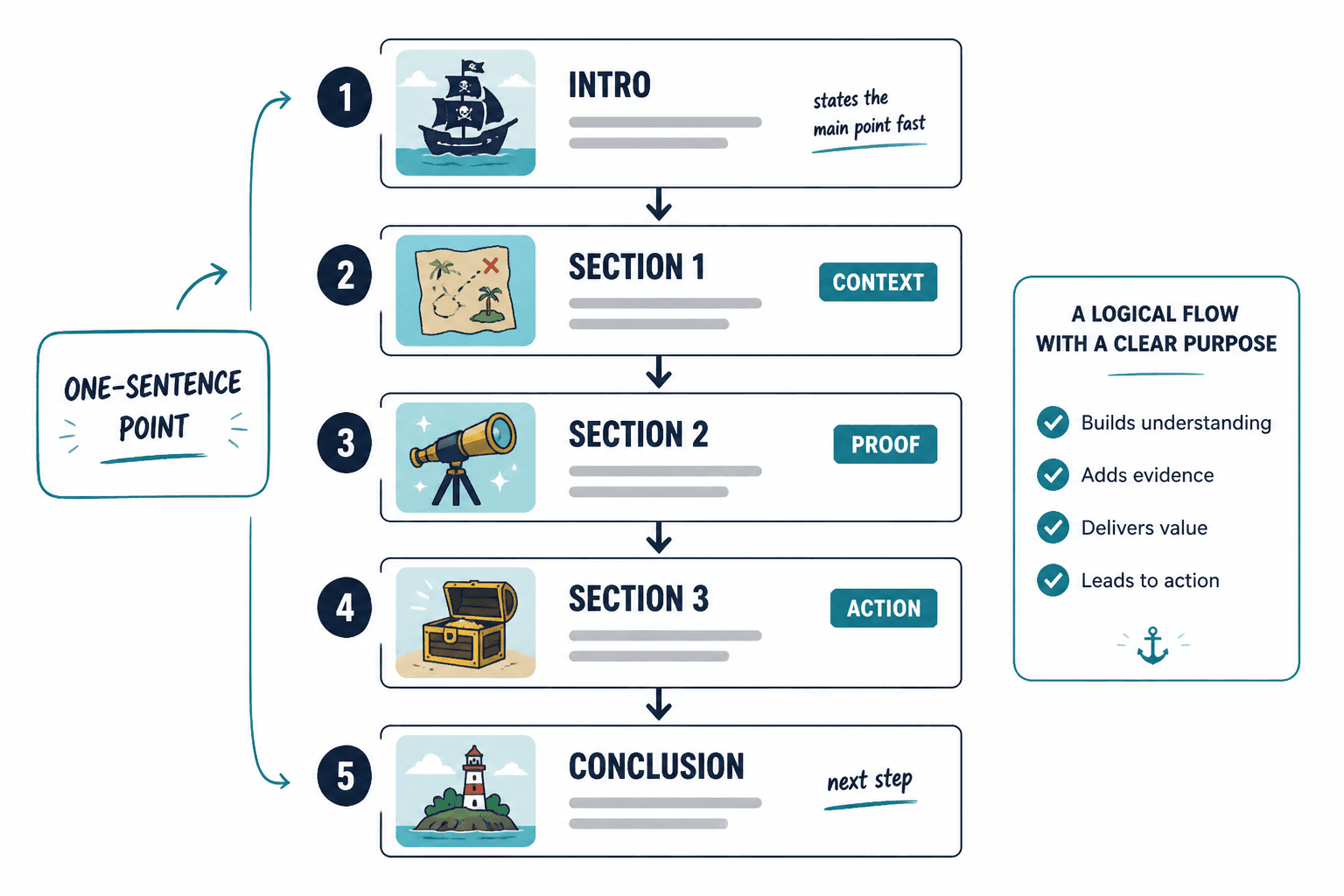
- Can you summarize the article’s point in one sentence?
- Does the introduction set up that point fast?
- Does each section have a distinct job?
- Do the sections build in a logical order?
- Does the ending help the reader do something next?
If the answer is no to any of those, stop tweaking commas and restructure first.
For broader help with stronger article construction, see how to write better blog rewrites and refreshes. A better refresh is usually a structural improvement before it is a wording improvement.
Mistake 6: Keeping the original intro even though it is the weakest part
Writers get sentimental about intros. They should not.
The intro is often the section most likely to survive untouched through multiple edits, which is funny, because it is also often the section doing the least work. It still has the old framing. It starts too wide. It does not match current search intent. It politely introduces a topic instead of addressing the real problem.
When performance drops, the intro deserves suspicion.
Weak intro pattern
“Blog clarity is an important part of content writing because readers want useful content that is easy to understand.”
True. Also painfully dull.
Stronger intro pattern
“Some blog posts get worse after editing. Not because the writer added mistakes, but because they cleaned the life out of the piece and called it clarity.”
That version starts with tension. It gives the reader a reason to keep going. It also frames the actual problem faster.
If you are refreshing old content, rewrite the intro more often than you think you need to. Search intent changes. Reader expectations shift. Your framing should too.
Mistake 7: Using filler transitions that slow everything down
A lot of blog edits add connective tissue that does not connect anything useful. It just makes the writing feel more formal.
Examples:
- “It is important to note that…”
- “With that being said…”
- “Another thing to keep in mind is…”
- “When it comes to…”
- “In order to effectively…”
These phrases are rarely clarifying. Mostly they are speed bumps.
Good transitions either create contrast, continue logic, or prepare the reader for a shift. Bad ones just announce that a sentence is about to happen. Thank you, sentence concierge.
What to do instead
- Cut the transition entirely if the sequence is already clear
- Use a sharper connector like “But,” “So,” “That matters because,” or “Here is the problem”
- Let subheads do more of the organizational work
- Keep paragraphs focused so they do not need elaborate bridges
Cleaner flow usually comes from better logic, not more phrasing.
Mistake 8: Refreshing for SEO while making the article worse to read
This is where blog refreshes go off the rails fast. Someone updates headings, adds related phrases, tweaks metadata, maybe expands a few sections, and now the post technically looks more search-aware. Lovely. Unfortunately, the article itself became harder to read, more repetitive, and less persuasive.
SEO-aware editing should support readability, not fight it. If keyword additions make sentences clunky, if subheads become robotic, or if sections are expanded just to hit some imaginary length target, performance can absolutely get worse.
Search visibility and reader experience are not enemies. But yes, people manage to make them enemies all the time.
Common SEO refresh mistakes
- Forcing exact-match phrases into awkward spots
- Adding repetitive sections that do not earn their space
- Writing headings for a tool instead of a human
- Expanding the article without adding new insight
- Ignoring intent and focusing only on keywords
The fix is pretty simple: optimize around the reader’s actual question. If the answer gets clearer, stronger, and more complete, the SEO side usually benefits too.
And if you want help with the tooling side without pretending software will save weak writing, there is best editing tools and SEO refresh tools for blog rewrites and refreshes.
Mistake 9: Not matching the edit to the article’s job
Not every blog post needs the same kind of clarity edit.
An opinion piece may need sharper framing and stronger argument flow. A search-focused how-to post may need better subheads, examples, and action steps. A conversion-focused article may need less wandering and a clearer CTA. A stale traffic post may need fresher examples and updated positioning.
But people often use the same editing habits on everything. They shorten paragraphs, clean up wording, maybe add some bullets, and call it done.
That is not a strategy. That is tidying.
Ask these before editing
- Is this post mainly for traffic, trust, leads, or sales support?
- What does the reader need by the end: understanding, confidence, action, or proof?
- What is currently getting in the way: weak framing, bloated wording, thin examples, bad structure, or no next step?
- What kind of edit would improve performance, not just readability?
Clarity is not a generic layer you spread on top of content. It should serve the actual purpose of the piece.
Mistake 10: Ending without helping the reader move
A lot of articles get cleaned up in the middle and abandoned at the end. The conclusion just restates the topic, nods vaguely at the value of clarity, and wanders off.
That is a missed opportunity.
A strong ending should do one of three things:
- Give the reader a clear next step
- Reframe the key idea in a memorable way
- Direct them to the most useful related action or resource
It should not just summarize. Readers know they reached the end. You do not need to tuck them in.
For example, if someone just read an article about clarity-edit mistakes, a smart ending might tell them to review one underperforming post and check the intro, section order, examples, and CTA before touching sentence polish. That turns the article into action.
If you also want a practical example of making dull content less dull, how to rewrite boring blog rewrites and refreshes is a useful next read.
A simple clarity edit process that actually helps performance
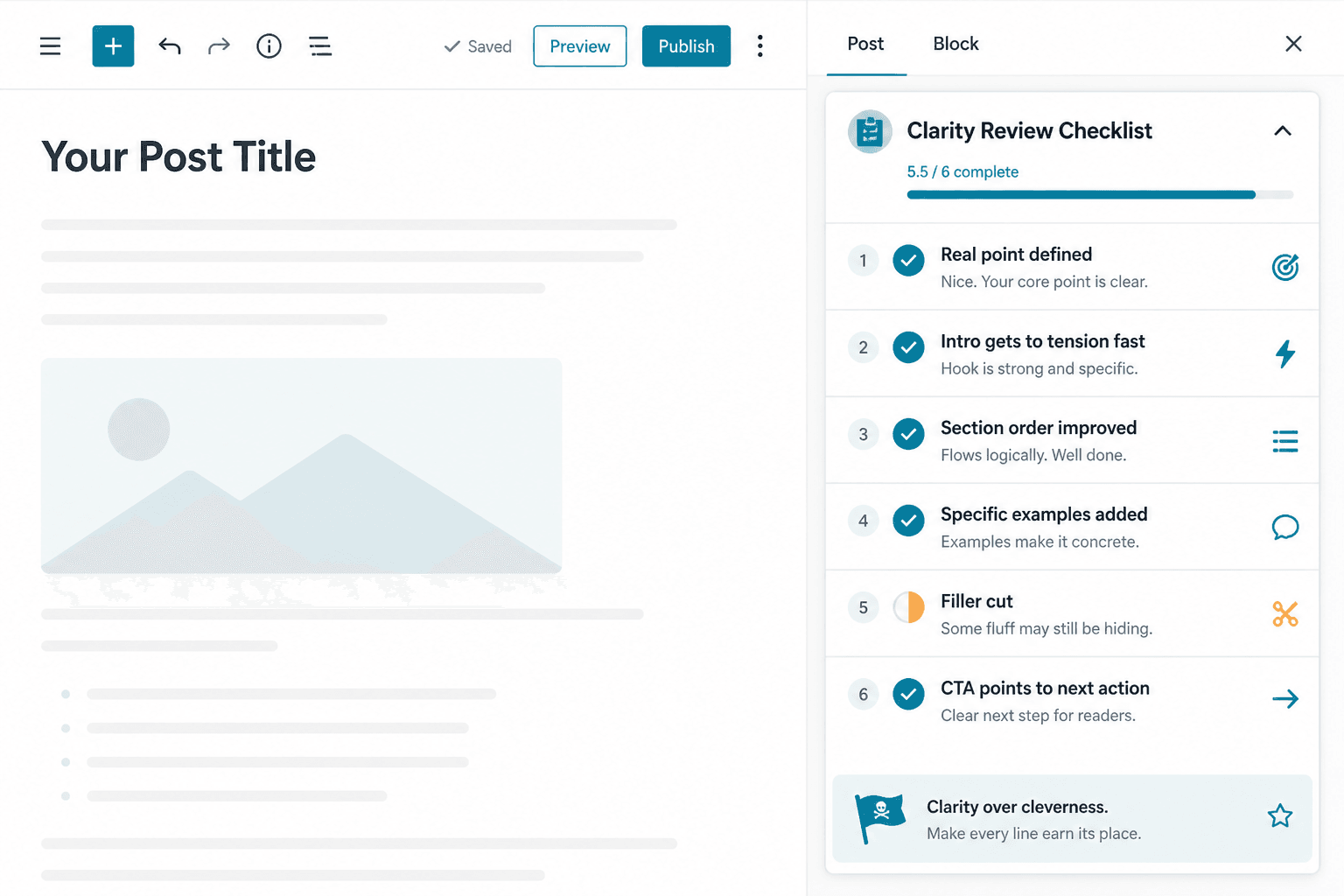
If you want a cleaner way to edit blog posts without accidentally flattening them, use this order:
- Find the real point. What is the article actually trying to help the reader understand or do?
- Check the intro. Does it get to the tension, mistake, or promise quickly?
- Fix the structure. Remove repeated ideas, reorder weak sections, and make each section earn its place.
- Add missing specifics. Examples, proof, decision rules, mini frameworks, and before-and-afters all help.
- Cut filler. Remove vague transitions, throat-clearing, and decorative fluff.
- Protect the voice. Keep the lines that sound like a smart human with a point of view.
- Tighten the ending. Give the reader a useful next move.
This order matters. If you start with line edits, you can spend an hour improving sentences in sections that should have been cut entirely.
Quick self-edit checklist for blog clarity
- Would a skim reader understand the main point?
- Is the introduction doing real work, or just being polite?
- Does every section say something distinct?
- Are there examples where the article makes important claims?
- Did I replace useful specifics with smoother but emptier language?
- Does the piece still sound like a person, not a content blender?
- Did I optimize readability without draining force?
- Does the ending help the reader do something next?
If several of those answers are shaky, the issue probably is not grammar. It is clarity in the deeper sense: understanding, trust, and momentum.
FAQ
The bigger point is simple: clearer structure and clearer writing make the piece more useful. That is usually what makes the ending land better too.
Better rewrites and refreshes make the article clearer, more current, and easier to act on. A sharper update usually beats a bigger but messier rewrite.