
Refreshing a blog post should make it sharper, more useful, and more likely to do its job.
Instead, a lot of refreshes turn into cosmetic nonsense. A few updated stats. A new subheading. Maybe a sentence gets swapped. The post is technically “updated,” but it still reads like warm printer paper. Same vague points. Same limp opening. Same bloated explanations that somehow say less the longer they go.
If you want to know how to rewrite boring blog posts during a refresh, the answer is not “add more words” or “optimize it harder.” The answer is to find the dead parts, figure out what the post is actually trying to do, and rewrite it so a real person would want to keep reading.
That means fixing the structure, the clarity, the specificity, the examples, and the rhythm. Sometimes it also means admitting the original draft had decent SEO intent and terrible actual writing. Painful, yes. Useful, also yes.
This guide will help you turn stale, generic blog content into something tighter, clearer, and much less forgettable. If you are working through a larger blog rewrites and refreshes system, this is the part where the post stops sounding recycled and starts sounding alive again.
For the main guide behind this topic, visit the parent guide.
Most blog refreshes fail because they fix freshness, not boredom
A stale post and a boring post are not always the same thing.
A stale post may have outdated examples, old screenshots, weak formatting, or missing context. A boring post has a deeper problem. The writing has no edge, no momentum, and no real point beyond “here is some information arranged into legal paragraphs.” You can update stale details all day and still leave the article lifeless.
That is why some refreshed articles still do nothing. They may be more current, but they are not more compelling. Searchers do not just want relevance. They want clarity fast, useful detail, and some sign that the writer has a functioning brain rather than a content template addiction.
When you refresh a post, you are not just maintaining it. You are re-earning attention.
A blog refresh that does not improve the reading experience is mostly paperwork.
Start by diagnosing why the post feels boring
Before you rewrite anything, identify the actual problem. “Boring” is usually a bundle of smaller issues pretending to be one big one.
- The opening takes too long to get anywhere. The post clears its throat for four paragraphs before saying anything useful.
- The advice is vague. It uses broad claims instead of sharp, usable specifics.
- The structure is flat. Every section has the same weight, rhythm, and level of detail.
- There is no tension. The post explains a topic without showing what people get wrong, why it matters, or what changes when they fix it.
- The examples are weak or missing. Readers are expected to magically apply generic advice to real situations.
- The writing sounds padded. The article says simple things in the longest possible way.
- The point is buried. The reader has to work too hard to find the useful part.
This diagnosis matters because each problem needs a different kind of rewrite. If the post is boring because it is vague, you need specificity. If it is boring because it rambles, you need structure. If it is boring because it sounds sterile, you need stronger language and sharper examples.
Do not just open the doc and start fiddling sentence by sentence. That is how people spend 90 minutes changing adjectives while the article still has the charisma of an office chair.
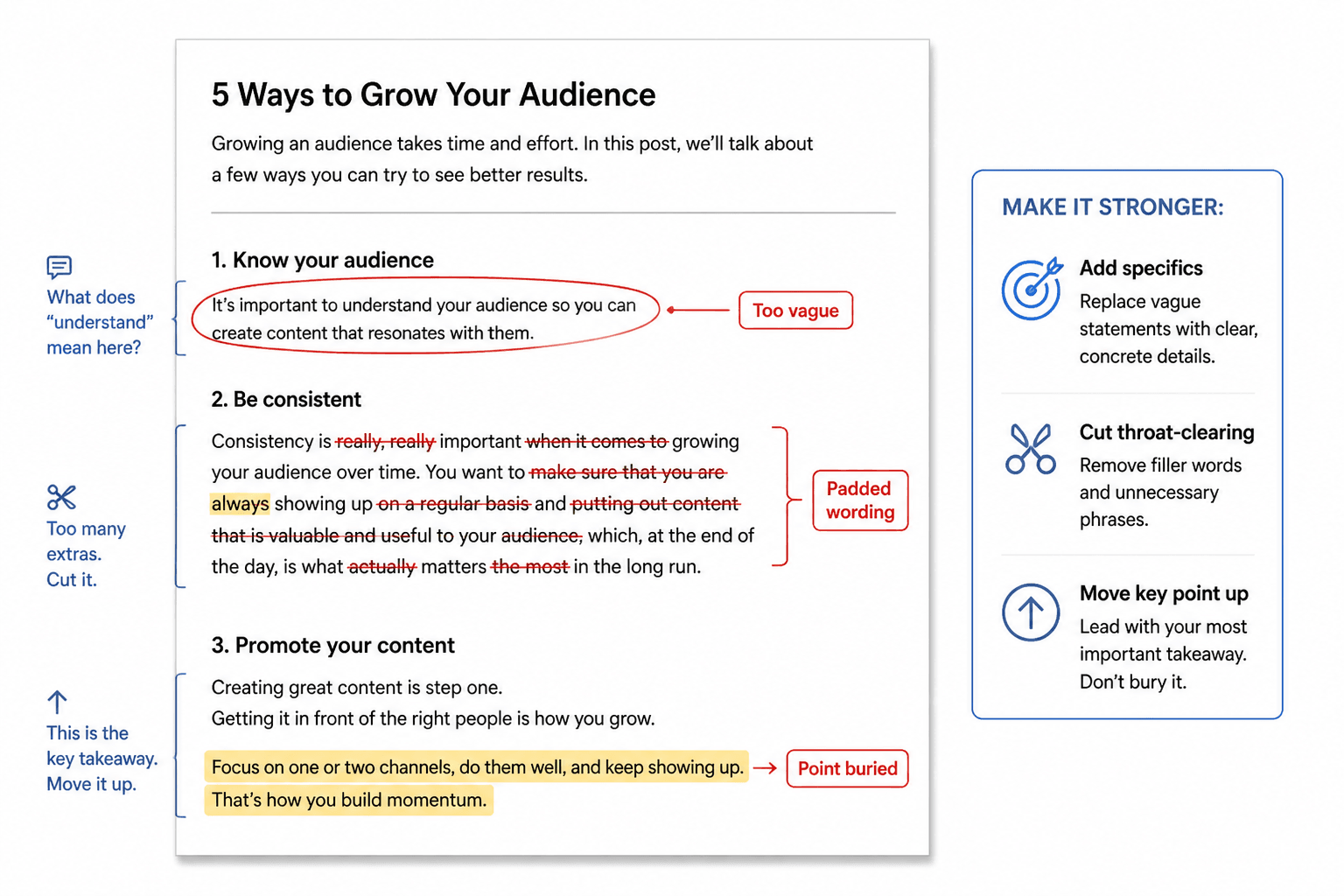
A simple rewrite process for boring blog posts
If you want a cleaner process, use this:
- Find the real point of the article.
- Cut the throat-clearing.
- Rebuild the structure around useful questions or decisions.
- Replace vague claims with specifics, examples, or contrast.
- Add tension, proof, or consequence.
- Tighten the language.
- Upgrade the CTA so it sounds like a next step, not a formality.
That is the short version. Here is how to actually do it without turning the rewrite into a mess.
1. Find the actual point before you touch the wording
A lot of dull blog posts are not poorly written at the sentence level. They are poorly aimed. The writer started with a keyword or topic, but never got clear on the central promise.
Ask:
- What is this post really helping the reader do?
- What is the sharpest useful point inside it?
- What misconception, mistake, or friction point should it address?
- What would make someone say, “That was actually helpful”?
If you cannot answer those quickly, the post probably needs more than a light refresh. It may need a real repositioning pass. That is where broader guides on how to write better blog rewrites and refreshes become useful, because the problem is not just line editing. It is strategic clarity.
2. Rewrite the opening first, not last
Boring posts often announce themselves immediately. You can feel it in the opening. It starts broad, says something obvious, and delays the actual point until the reader has mentally wandered off to make toast.
A strong refresh usually starts by fixing the intro. Not because intros are magic, but because they force you to clarify the article’s angle. If the opening gets sharper, the rest of the piece usually follows.
Weak opening:
Blog content is an important part of any digital marketing strategy. Over time, blog posts can become outdated and may need to be refreshed to remain relevant.
Better opening:
Some blog posts are outdated. Others are just dull. The first problem needs updates. The second needs a rewrite. If your post is technically accurate but still boring people into a mild coma, changing the publish date is not going to save it.
Notice what changed:
- It starts with the real problem.
- It creates contrast.
- It sounds like a human.
- It gives the reader a reason to keep going.
If your openings are consistently weak, this is worth a deeper read: how to start blog rewrites and refreshes without a weak opening.
3. Cut anything that exists only to sound “complete”
This is where a lot of boring blog writing hides. In the filler that looks responsible but contributes almost nothing.
- Definitions the target reader already knows
- Transition paragraphs that say the section title in softer words
- Repetitive reminders that the topic matters
- Generic statements everyone would agree with
- Long explanations of simple ideas
You do not need every section to have the same number of paragraphs. You do not need to explain every concept from first principles if the audience is already familiar with the space. You do not need to keep a sentence because it sounds polished. If it is not helping, cut it.
Refreshing does not mean preserving the old draft out of politeness. Some paragraphs deserve retirement.
4. Replace vague advice with specific, usable guidance
This is the rewrite move that improves boring content fastest.
Boring advice usually sounds like this:
Make sure your content is engaging and relevant to your audience.
That is technically fine. It is also useless on its own.
A sharper rewrite sounds more like this:
Do not just “make it engaging.” Show the reader what changed, what people keep getting wrong, or what to do differently in the next five minutes. Relevance is not a vibe. It is a tight match between the reader’s problem and the way you frame the answer.
Specificity makes writing feel more alive because it reduces mental fog. The reader can picture the idea. They can apply it. They can disagree with it, even. That is still better than shrugging through it.
When rewriting, look for abstract words and force them to earn their place:
- valuable
- engaging
- high-quality
- effective
- optimized
- compelling
- clear
Those words are not banned. They are just lazy when unsupported. Add examples, comparisons, and concrete outcomes.
How to rewrite boring sections without rewriting the entire article from scratch
Sometimes the post is not fully broken. It just has dead zones. A meandering middle section. A generic list. A conclusion that dissolves into oatmeal. In those cases, you can target sections instead of nuking the whole draft.
Rewrite by function, not just by paragraph
Each section should be doing a job. If it is not, it gets cut, merged, or rewritten.
| Section type | What it should do | What boring versions usually do |
|---|---|---|
| Opening | Frame the problem fast | Start broad and obvious |
| Explanatory section | Clarify a key idea | Repeat generic background |
| How-to section | Give concrete steps | Offer abstract advice |
| Example section | Make the advice real | Stay hypothetical or skip examples |
| Conclusion | Land the idea and prompt action | Summarize blandly and fade out |
When you review a section, ask: what is this supposed to do for the reader right here? If the answer is unclear, that is usually why the section drags.
Add contrast to wake the writing up
One of the easiest ways to make a section more readable is to build it around contrast.
- What people think vs what actually works
- Weak version vs stronger version
- Old approach vs updated approach
- Common mistake vs better move
Contrast gives the reader something to compare. It creates tension and movement. It also stops the article from becoming a flat pile of “here are some tips” with no hierarchy.
For example:
Weak refresh: add recent stats, keep the same bloated explanation, publish.
Better refresh: update the facts, rewrite the framing, tighten the structure, and replace vague claims with something a reader can actually use.
Use examples that solve interpretation problems
Examples are not there to make the article feel decorated. They are there to reduce ambiguity.
If you say “make the copy more specific,” many readers will nod and still have no idea what to change. If you show a before-and-after rewrite, the lesson clicks.
Here is a simple example.
Before: “Refreshing older content can improve search visibility and user engagement.”
After: “Refreshing an older post works best when you do more than swap dates and stats. Tighten the intro, cut stale sections, add fresher examples, and make the advice easier to act on. That is what gives the post a better chance of earning attention again.”
The second version is longer, but it is not more padded. It is more useful. Big difference.

What to rewrite first when a blog post feels flat
If time is tight, do not try to perfect everything equally. Some parts of a post influence readability far more than others.
- The title and intro
If these are vague, the whole article feels weaker. - The subheadings
Bad subheads make the structure feel generic even before the reader gets into the copy. - The first sentence of each section
These set pace and expectation. Weak ones make every section feel sleepy. - The examples
Thin or missing examples make the advice feel generic. - The conclusion and CTA
A strong article should not end like it ran out of batteries.
This prioritization is useful because not every refresh needs a total rewrite. But if the intro, subheads, and examples are all weak, then yes, you probably need a bigger overhaul. You may also want to review common blog rewrites and refreshes clarity edits mistakes that hurt performance, because many “boring” posts are really suffering from structural and clarity failures at the same time.
Before-and-after rewrites that make a boring post less boring
Here are a few common patterns.
Example 1: generic explanation
Before: “When refreshing blog content, it is important to consider SEO best practices and ensure the content remains aligned with user intent.”
After: “A decent refresh does two jobs at once: it improves the article for search and makes it less annoying to read. If the keyword is still right but the article is vague, bloated, or outdated, user intent is only half the problem.”
Example 2: weak how-to advice
Before: “Review the content and make necessary updates where needed.”
After: “Review the post with a meaner eye. Cut repeated ideas, replace old examples, tighten any section that takes too long to make its point, and rewrite generic lines that could fit literally any article on the internet.”
Example 3: padded conclusion
Before: “By following these best practices, you can improve your content over time and create a better experience for your audience.”
After: “If the post is accurate but forgettable, do not just update it. Rewrite the parts that make people glaze over. Better content is not always newer. Often, it is just clearer, tighter, and less full of fluff.”
These rewrites are not fancy. That is the point. Better blog writing is usually less about brilliance and more about removing the mush.
How to make the refreshed post feel sharper, not just newer
Once you have cleaned up the obvious weak spots, the next job is to improve the reading experience. This is where a lot of people stop too early. The article is technically better, but it still does not feel especially good.
What makes a refreshed post feel sharper is usually a combination of pace, precision, and confidence. Pace comes from moving briskly between points. Precision comes from saying exactly what you mean. Confidence comes from making the advice sound intentional instead of hedged into oblivion.
For example, compare these two lines:
It may be beneficial to consider revising sections that do not appear to be adding value for the reader.
Rewrite or cut sections that are wasting the reader’s time.
The second line is not rude. It is just awake.
This matters because most boring blog posts do not only have structural issues. They also have timid language. Everything is softened, qualified, and padded until the original point barely survives. A good refresh should restore some conviction.
Common mistakes people make when trying to rewrite boring posts
- They update facts but not framing. The stats are fresh. The writing is still stale.
- They add more sections instead of improving weak ones. More content is not the same as better content.
- They keep every legacy paragraph. Nostalgia is not a content strategy.
- They rewrite at sentence level before fixing structure. This wastes time and preserves bad foundations.
- They remove personality in the name of professionalism. Clear and useful does not need to sound robotic.
- They try to sound authoritative by sounding abstract. Usually, this just makes the article harder to care about.
If your refreshes tend to become cleaner but still generic, read how to improve blog rewrites and refreshes stale post fixes without sounding generic. That is often the next bottleneck after the obvious edits are done.
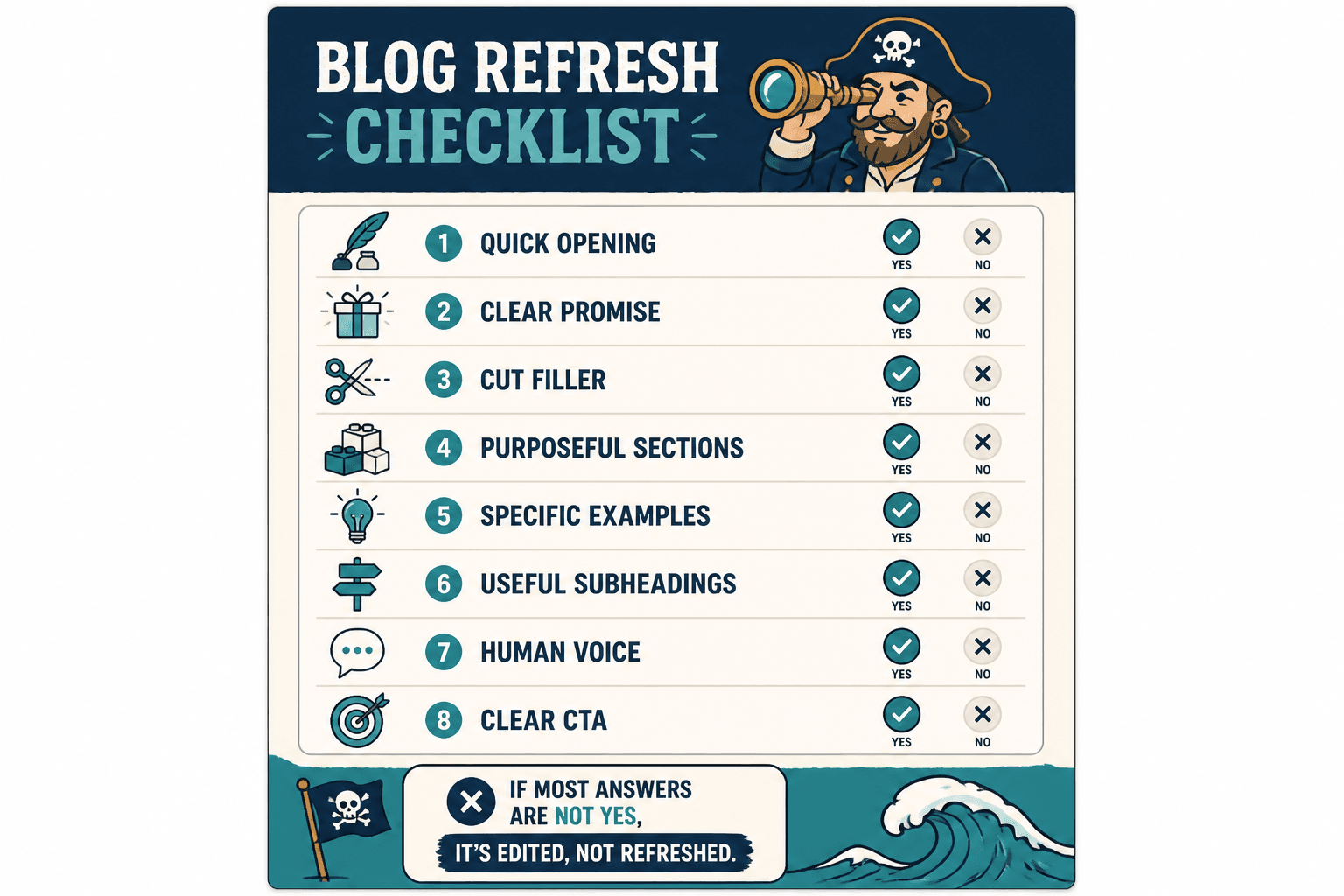
A practical editing checklist for boring blog refreshes
Use this before you republish:
- Does the opening get to the real problem quickly?
- Can the main promise of the article be understood within the first few paragraphs?
- Have you cut repeated ideas and low-value filler?
- Does each section do a clear job?
- Have you replaced vague advice with examples, specifics, or contrast?
- Do the subheadings sound useful rather than generic?
- Does the writing sound like a person with a point, not a compliance manual?
- Is the CTA or next step clear and relevant?
If you cannot say yes to most of these, the post is not refreshed yet. It is just edited.
When a “refresh” should really become a rewrite
Sometimes the honest answer is that the post should not be lightly updated at all.
The bigger point is simple: clearer structure and clearer writing make the piece more useful. That is usually what makes the ending land better too.