
Most stale post fixes fail for a very boring reason: they are technically updated, but still spiritually dead.
The stats get swapped. A few sentences get polished. Maybe someone adds a new subheading, a nicer intro, and a keyword variation they hope Google will salute. And yet the post still reads like it was assembled by a cautious committee that fears having an opinion.
If you want to know how to improve stale post fixes without sounding generic, the job is not just “refreshing content.” It is making the piece more useful, more specific, more current, and more readable without draining the personality out of it. That last part matters more than people think.
A rewrite should not feel like taxidermy. It should feel alive again.
This is where a lot of blog rewrites go sideways. They focus on surface cleanup instead of actual improvement. They patch sentences instead of sharpening the argument. They replace old words with newer boring words. They add “value” in the most generic way possible, which usually means more content and less point.
Here is how to fix stale posts so they actually improve: stronger angle, cleaner structure, fresher examples, clearer takeaways, and language that sounds like a person who knows what they are talking about. Not a help center article with trust issues.
For the main guide behind this topic, visit the parent guide.
What makes a stale post fix sound generic
Before fixing the problem, it helps to call it by its real name.
A generic refresh usually has one or more of these issues:
- The post says broadly correct things, but nothing memorable
- The examples are thin, dated, or interchangeable
- The intro takes too long to reach the actual point
- The advice sounds like it could apply to every audience and therefore helps none of them much
- The rewrite adds fluff instead of clarity
- The tone gets “cleaner” but less human
- The post chases keywords harder than it serves readers
- The conclusion says the same thing the rest of the article already said, just with less energy
That is why some refreshed posts are technically better and still worse to read.
Generic writing is not just vague writing. It is writing with no weight behind it. No stakes. No texture. No sense that the author has seen this problem in the wild and knows where people usually mess it up.
If your rewrite could be pasted onto fifty other blogs with almost no changes, it probably is not a rewrite. It is content wallpaper.
Start with the real reason the post went stale
Not every stale post is stale for the same reason, which is why “update and republish” is not much of a strategy on its own.
Usually, a post goes stale because of one of five things:
- The information is outdated. Stats, examples, screenshots, tools, or platform details no longer hold up.
- The structure is weak. The post rambles, repeats itself, or hides the useful part too deep.
- The search intent shifted. What readers want now is not what the article currently gives them.
- The tone is bland. The post might still be accurate, but it sounds flat, padded, or AI-sanded.
- The original piece was never that strong. This one hurts a little, but yes, sometimes the “refresh” is really a rescue mission.
If you do not identify the real problem first, you will apply the wrong fix. That is how people end up stuffing current examples into weak articles and calling it a rewrite.
Before touching the draft, ask:
- What still holds up here?
- What feels dated, thin, vague, or repetitive?
- What would a reader expect on this topic now that this article does not currently provide?
- What is the strongest idea in the piece?
- What is pure filler pretending to be context?
That audit gives you a real rewrite target instead of the fake productivity of “freshening it up.”
For a broader foundation on rewrite workflow, it helps to pair this with blog rewrites and refreshes and how to write better blog rewrites and refreshes.
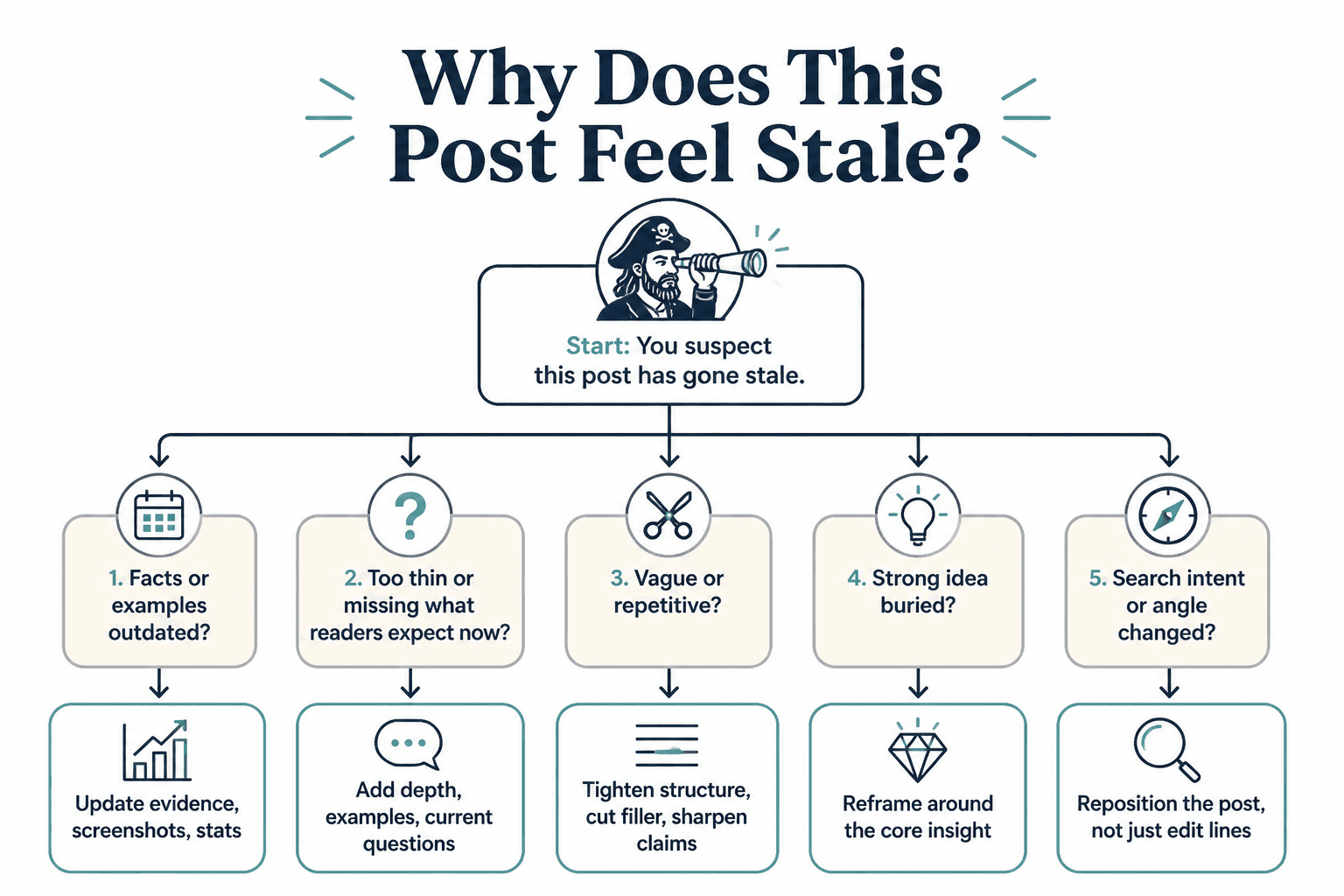
Do not just update the post. Reposition it.
One of the cleanest ways to improve stale post fixes without sounding generic is to stop thinking like an editor only and start thinking like a strategist.
A stale post often needs a better angle, not just better grammar.
Say your old article is called something like “Tips for Better Blog Rewrites.” Fine. Respectable. Also very likely to disappear into the beige swamp of every other article making the same noises. A stronger refreshed angle might be:
- How to Rewrite Old Blog Posts Without Making Them Longer and Worse
- What to Cut First When Refreshing a Blog Post
- How to Refresh Thin Content So It Actually Feels Better, Not Just Newer
- How to Improve Stale Post Fixes Without Sounding Generic
Notice what changed. The newer angles carry tension. They point to a specific pain. They imply the writer has seen bad rewrites and is not impressed by them. Good. That is usually a better starting point than “here are some helpful tips.”
Repositioning can include:
- Narrowing the audience
- Sharpening the problem
- Updating the promise
- Changing the framing from broad advice to practical diagnosis
- Turning a neutral topic into a more useful contrast piece
This does not mean becoming clickbaity. It means becoming clear enough to matter.
Weak angle vs stronger angle
| Weak refresh angle | Stronger refresh angle |
|---|---|
| How to update old blog posts | How to update old blog posts that still rank but no longer convert |
| Blog refresh best practices | What actually deserves rewriting in an aging blog post |
| Content refresh tips | How to refresh content without padding it into a worse article |
| Improve existing content | How to improve stale post fixes without sounding generic |
Cut the fake “helpful” stuff first
Here is a fun little truth: a lot of generic blog writing survives because nobody is ruthless enough to delete it.
When refreshing an older post, start by removing anything that creates drag without adding value. Usually that includes:
- Slow intros full of throat-clearing
- Definitions the reader did not need
- Obvious statements everyone already agrees with
- Repeated points in slightly different wording
- Generic tips with no examples
- Old filler added to hit a word count
- Conclusion paragraphs that just wave politely from the doorway
A lot of stale posts do not need more content. They need less sludge.
Example: boring rewrite vs useful rewrite
Before: “Refreshing old content is an important part of maintaining a successful blog strategy. By updating old posts regularly, businesses can stay relevant and provide value to their readers.”
After: “Most old posts do not need a ceremonial ‘refresh.’ They need a hard look. If the piece still gets traffic but feels dated, vague, or flimsy, fix the parts readers actually notice: the angle, the examples, the structure, and the next step.”
The second version says something. It has a point of view. It gives the reader a clearer diagnostic frame. It sounds less like a content calendar intern trying to be respectful.
Refresh the examples, not just the wording
One of the fastest ways to make a rewrite feel generic is to keep old examples or replace them with broad, bloodless ones.
Examples carry credibility. They show the advice can survive contact with reality. If your post says “be specific,” and then gives an example that sounds like it came from a template factory, readers can feel the gap immediately.
When updating examples, aim for three things:
- Recency: the example should feel current enough to trust
- Relevance: it should match the audience and problem
- Specificity: it should show what better actually looks like
That can mean replacing abstract examples with before-and-after rewrites, clearer use cases, more niche scenarios, or stronger comparisons.
For example, this is generic:
“Use a compelling headline to attract readers.”
This is better:
“If your original heading is ‘Tips for Updating Content,’ the problem is not just SEO. The heading gives nobody a reason to care. A stronger version might be ‘What to Fix First in an Old Blog Post That Still Gets Traffic.’”
See the difference? One is technically advice. The other is useful.
If your refreshed post still feels thin, the examples are often the place to push harder.
Make the article more specific at the sentence level
Generic writing is often built sentence by sentence. So the fix has to happen there too.
Look for these weak sentence patterns during a refresh:
- “It is important to…”
- “This can help businesses…”
- “There are many ways to…”
- “In order to improve results…”
- “A strong strategy includes…”
None of those are illegal. They are just usually signs that the sentence is avoiding the real point.
How to tighten them
- Replace broad nouns with real ones
- Swap “can” for a clearer claim when you have enough confidence to do it
- Name the mistake, not just the best practice
- Add contrast: what people think vs what works
- Use concrete outcomes instead of vague benefits
Examples:
- Generic: “It is important to optimize content for search engines.”
- Better: “If you update headings for search and ignore readability, the post may rank a little better and perform worse with actual humans.”
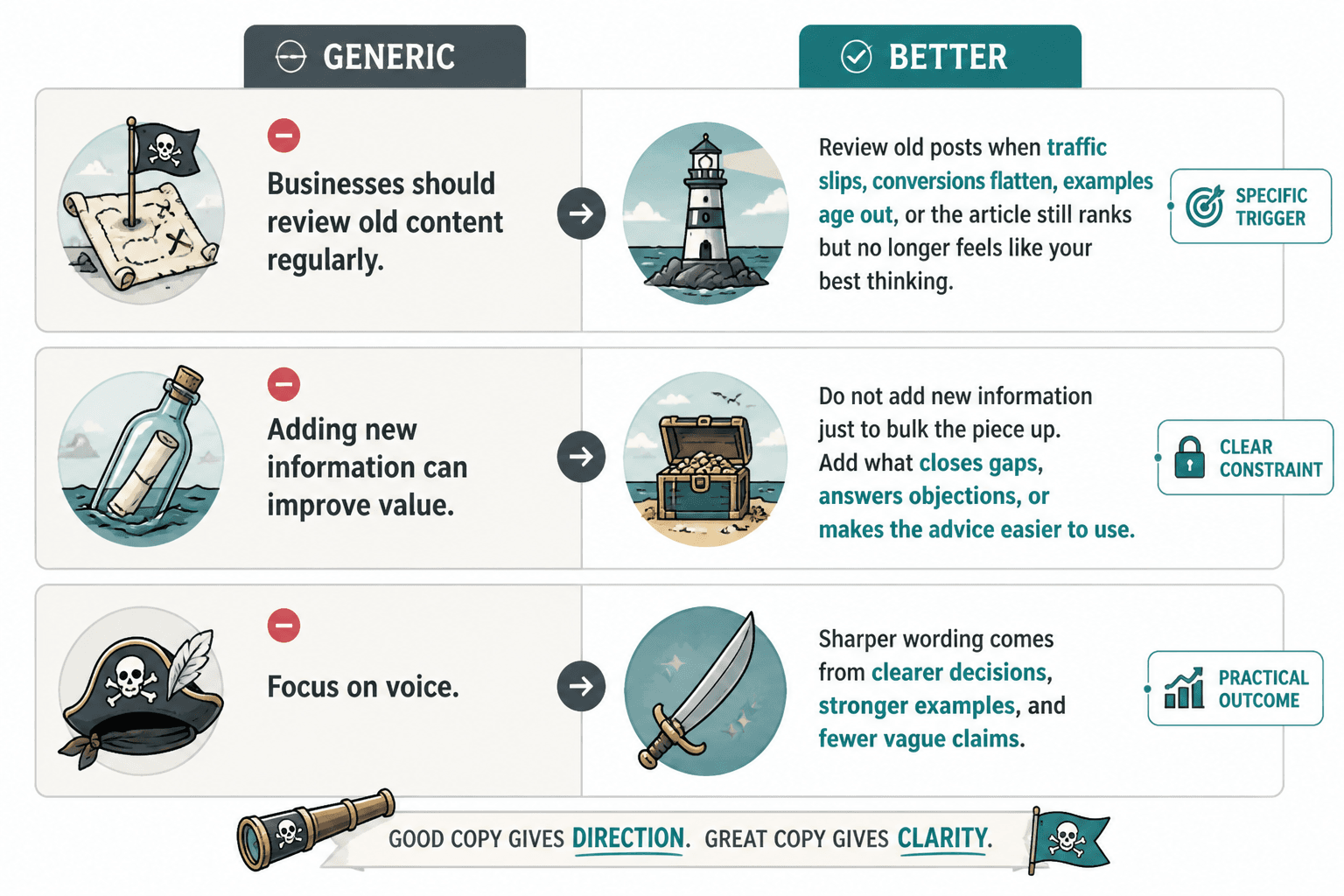
- Generic: “Businesses should review old content regularly.”
- Better: “Review old posts when traffic slips, conversions flatten, examples age out, or the article still ranks but no longer feels like your best thinking.”
- Generic: “Adding new information can improve value.”
- Better: “Do not add new information just to bulk the piece up. Add what closes gaps, answers objections, or makes the advice easier to use.”
That is how a rewrite starts sounding less generic: not through “voice” alone, but through sharper decisions in the actual wording.
Improve the structure so the useful part shows up sooner
A stale article often has the right ingredients and the wrong order.
If a reader has to dig through four intro paragraphs, two generic subheads, and a “why this matters” section before finding anything practical, the content does not feel authoritative. It feels padded.
When refreshing structure, try this:
- Move the core insight higher
- Combine overlapping sections
- Turn vague headings into promise-driven ones
- Lead with examples earlier
- Cut sections that only restate the title
- End each major section with a practical takeaway
Here is a useful test: if you skim only the H2s and first sentence under each one, does the article still make sense? If not, the structure probably needs work.
Weak heading vs stronger heading
| Weak heading | Stronger heading |
|---|---|
| Benefits of content updates | Why some content refreshes still feel dead on arrival |
| How to optimize blog content | What to fix first when a blog post is stale but still salvageable |
| Writing tips | How to make a rewrite sound sharper at the sentence level |
| Final thoughts | Refresh the post until it feels current, not just edited |
Stronger structure does not just help SEO and readability. It also helps tone. Generic writing often hides inside limp organization.
If you want more structural help, this article pairs well with how to rewrite boring blog rewrites and refreshes and how to turn old content into better blog rewrites and refreshes.
Add a clearer point of view
This is the part many “professional” rewrites skip because they are trying very hard to sound neutral and polished.
Polished is fine. Bland is not.
A stale post becomes more compelling when the refreshed version actually takes a stand on what matters, what gets overrated, what wastes time, or what most people do wrong. Not every article needs hot takes, obviously. But most benefit from a real editorial spine.
That can sound like:
- Calling out common but weak rewrite habits
- Explaining why a popular tactic is incomplete
- Choosing a more useful priority order
- Telling readers what not to waste effort on
- Separating surface improvements from meaningful ones
For example:
Flat version: “When refreshing content, it is important to update keywords, metadata, and examples.”
Stronger version: “Updating keywords and metadata is fine, but it is rarely the thing readers notice first. They notice when the article still opens slowly, says obvious things, and gives examples from a different internet.”
That slight edge makes the writing more readable because it feels believed, not assembled.
Use a simple refresh framework that does not flatten the voice
If your refresh process is too loose, you miss things. If it is too rigid, everything starts sounding machine-shaped. A good middle ground is a framework that checks the important boxes without scrubbing out the article’s personality.
A practical rewrite pass for stale posts
- Audit the original. Mark what is outdated, vague, repetitive, useful, strong, or skippable.
- Clarify the new angle. Decide what the refreshed version should really help the reader do.
- Rebuild the structure. Reorder sections so the article gets useful faster.
- Rewrite weak openings. Cut generic setup and get to the tension sooner.
- Upgrade examples. Add specifics, comparisons, rewrites, use cases, or current scenarios.
- Tighten sentence-level fluff. Remove filler phrases and vague claims.
- Add a point of view. Say what is overrated, what matters most, and what people keep getting wrong.
- Check the CTA or next step. Make sure the article leads somewhere useful without sounding pushy.
This process is especially helpful if you are refreshing a lot of content and trying not to turn it all into the same shiny loaf.
And yes, if you use AI anywhere in that workflow, this is where it tends to make a mess if you are not paying attention. It can help summarize, compare drafts, or suggest structural options. But if you let it do the whole rewrite unsupervised, it will often iron the article into safe, broad, respectable mush. Which is not the assignment.
Related reading: how to write blog rewrites and refreshes without sounding salesy or robotic.
Keep SEO in the room, but do not hand it the pen
SEO-aware refreshes are useful. SEO-led rewrites often become deeply annoying to read.
If the post is being updated partly for search performance, good. Just do not let the refresh become a keyword rearrangement exercise. Search visibility matters. So do clarity, flow, specificity, and reader trust. Turns out humans are still involved.
Use the target phrase naturally in the intro, in at least one heading if it fits, and in the conclusion if it makes sense. Fine. But the bigger gains usually come from making the post more aligned with intent, more useful, and easier to skim and act on.
Search-friendly does not need to mean sterile.
If you are building a smarter content system around this, the broader hubs at blog SEO writing and article systems can help connect the rewrite work to a bigger process.
Before-and-after rewrite pattern you can actually use
Here is a simple pattern for improving stale sections without making them sound generic.
Step 1: Find the mushy sentence
Example: “Updating older blog posts can improve website performance and provide value to readers.”
Step 2: Ask what the sentence is trying and failing to say
The bigger point is simple: clearer structure and clearer writing make the piece more useful. That is usually what makes the ending land better too.
Better rewrites and refreshes make the article clearer, more current, and easier to act on. A sharper update usually beats a bigger but messier rewrite.