
Most people do not struggle with Substack because they have nothing to say. They struggle because every post has to be invented from scratch, and that is a terrible system.
You sit down, stare at the blinking cursor, and suddenly your “newsletter strategy” becomes a weird little hope-based ritual. Maybe this week is a lesson. Maybe next week is a story. Maybe the week after that is a soft pitch wearing glasses.
A good series fixes that. It gives your ideas shape, gives readers a reason to come back, and saves you from writing one-off posts that disappear into the void five minutes after sending.
If you want better Substack Posts & Series: Series Ideas Examples Creators Can Adapt Fast, the goal is not to become more random with more energy. The goal is to create repeatable formats that your audience understands fast and you can produce without frying your brain.
Here’s how to do that, plus a stack of Substack series ideas and examples you can adapt quickly without sounding templated, stale, or suspiciously AI-marinated.
If you want the bigger picture, start with the parent guide.
What makes a Substack series actually work
A series is not just “posting about the same topic a few times.” That is a theme. Useful, sure. But not the same thing.
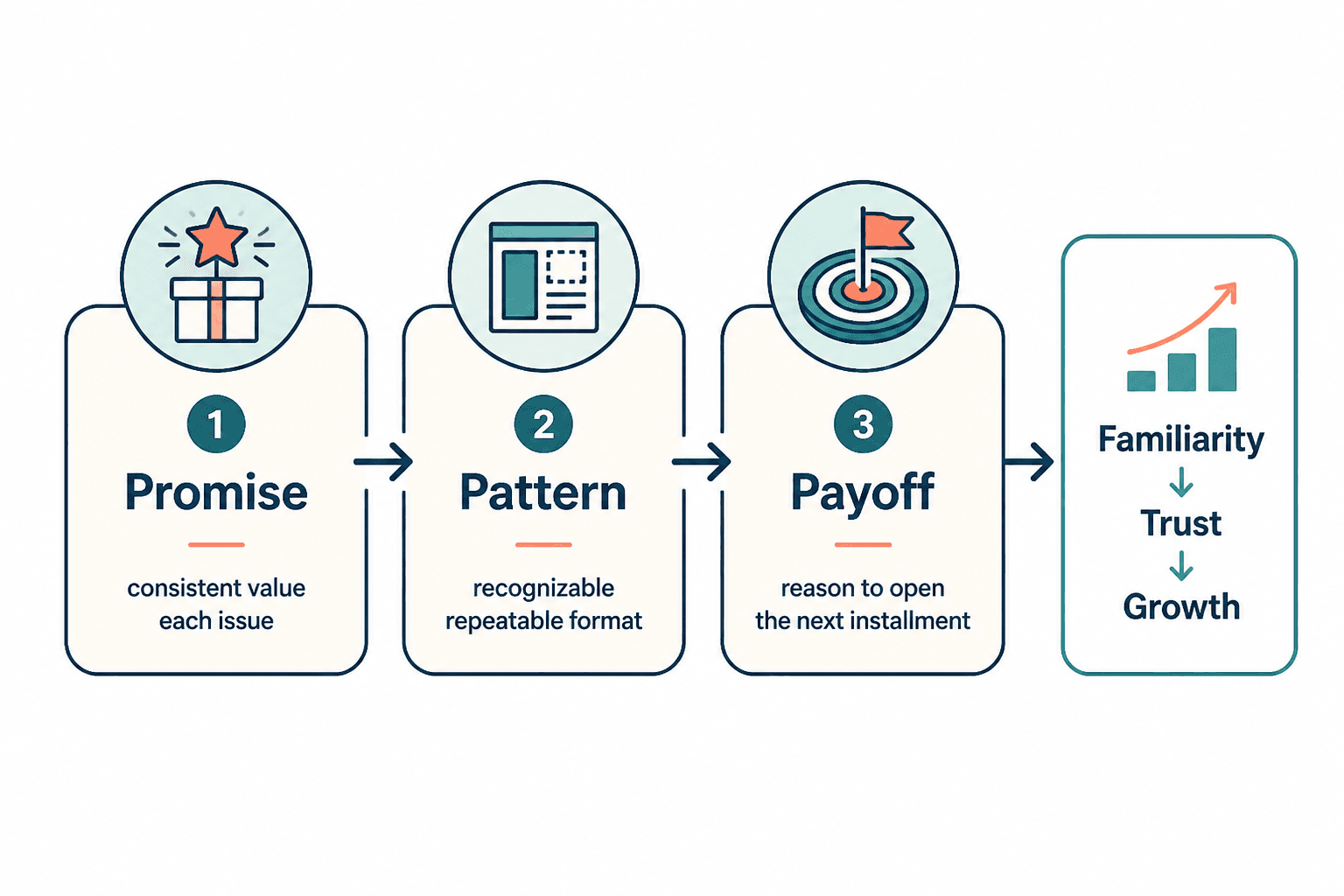
A real series has a clear promise, a recognizable structure, and a reason for the reader to open the next one. It lowers creative friction for you and decision friction for them.
- Promise: What kind of value will the reader get each time?
- Pattern: What format or structure makes it easy to recognize?
- Payoff: Why should they keep reading this series instead of skimming one issue and wandering off?
If your series has those three things, it starts building familiarity. Familiarity builds trust. Trust makes it easier to grow subscribers, earn replies, and eventually sell without acting like your newsletter is a funnel with emotional manipulation bolted on top.
Why series beat random standalone posts
Standalone posts can work well. Some should stay standalone. But if every issue is a brand new experiment with no connective tissue, readers have to keep re-deciding what you are for.
That gets expensive fast.
A strong Substack series helps you:
- build reader habits
- turn one topic into multiple issues without sounding repetitive
- develop authority through repetition and depth
- make your archive more useful
- write faster because the structure already exists
- spot what resonates based on replies, open rates, and subscriber growth
It also makes your newsletter easier to explain. That matters more than people think. “I write about business and mindset and creativity and growth and life” is not a positioning statement. It is a polite cry for help.
If you need a broader foundation for planning your publication, start with this Substack posts and series hub and then come back to build individual formats from there.
How to choose the right kind of series
Do not pick a format just because it looks clever. Pick one based on what you sell, what your readers need, and what you can realistically sustain.
Pick based on your strongest raw material
- If you have lots of opinions, use analysis or commentary series.
- If you have client experience, use case study or lesson series.
- If you have a method, use framework breakdowns.
- If you have strong observations, use trend or teardown series.
- If you have good stories, use narrative lesson series.
- If you have teaching depth, use workshop-style or mini curriculum series.
Pick based on reader intent
- Want more opens? Use curiosity-driven recurring formats.
- Want more trust? Use useful breakdowns and examples.
- Want more replies? Use opinion, questions, and reader participation formats.
- Want more leads? Use problem-to-solution series tied to your expertise.
- Want paid subscribers? Use premium depth, tools, and implementation series.
If your audience is still small, do not overcomplicate this. A tight, useful series for 150 right-fit readers beats a cinematic content universe for 11 confused strangers. Related reading: Substack posts and series for creators with small audiences.
12 Substack series ideas creators can adapt fast
Here is the useful part: actual formats. Each one includes what it does, why it works, and a fast example you can steal the shape of without cloning the wording.
1. The weekly teardown
What it is: Break down one example, campaign, post, offer, launch, trend, or piece of messaging each week.
Why it works: Readers get practical analysis. You get recurring source material from the real world instead of your own head.
Example angle: “Why this creator’s landing page converts better than prettier ones”
Simple structure:
- What we are looking at
- What works
- What does not
- What to copy carefully
- What to avoid
2. The mistake-of-the-week series
What it is: One recurring mistake your audience keeps making, with a fix.
Why it works: Specific mistakes are sticky. People recognize themselves fast.
Example: “The problem with newsletters that try to sound ‘premium’ and end up sounding embalmed”
This format is especially good for coaches, consultants, and service businesses because it naturally leads to your method without making every issue a brochure.
3. The before-and-after rewrite series
What it is: Take weak copy, content, headlines, bios, CTAs, or hooks and rewrite them.
Why it works: Transformation is easier to understand than theory. Readers can see the difference.
Example:
Before: “I help entrepreneurs reach their full potential with strategic solutions.”
After: “I help solo consultants turn vague expertise into clear offers, sharper content, and better leads.”
If your niche is writing, branding, sales, positioning, or design, this one has legs for a long time.
4. The tool-tested series
What it is: Try a tool, workflow, template, prompt, or system and report what happened.
Why it works: Readers like practical experiments. Also, you do not have to pretend tools are magical to make them useful.
Example angle: “I tested three newsletter ideation workflows. One was useful. One was fine. One made me want to close my laptop.”
Just keep it honest. People are tired of “10x your content with this unbelievable platform” writing. For more practical strategy around newsletter creation, you can also point readers toward this guide for creators who want better results.
5. The idea-in-progress series
What it is: Document a concept you are refining over time.
Why it works: This creates loyalty when done well because readers get to watch your thinking sharpen.
Example: “Building a simpler content offer: version 1, version 2, version 3”
This format is great for founders, strategists, and writers with strong thinking. It is bad for people who confuse “unfinished thought” with “interesting thought.” There is a difference.
6. The client lesson series
What it is: Share one useful lesson drawn from client work, anonymized where needed.
Why it works: It builds authority without chest-beating. Real work creates better content than generic advice most of the time.
Example angle: “A client doubled consult calls after changing one line in their profile. Here’s why it worked.”
If your audience overlaps with service providers and personal brands, pair this with these examples for coaches, consultants, and personal brands.
7. The mini masterclass series
What it is: A multi-part educational series that walks through one problem in sequence.
Why it works: Great for authority and paid conversion. It feels substantial without requiring a 4,000-word essay every week.
Example sequence:
- Part 1: Why your newsletter positioning is muddy
- Part 2: How to tighten the promise
- Part 3: Content pillars that are actually useful
- Part 4: CTAs that do not sound desperate
This format works best when each issue stands alone but also rewards readers who follow the whole run.
8. The unpopular opinion series
What it is: One contrarian take per issue, backed by reasoning and examples.
Why it works: Good opinions create attention and replies. They also sharpen your positioning.
Example: “Most content calendars are too neat to produce interesting writing”
The key is to have an actual argument. “Hot take: authenticity matters” is not an unpopular opinion. It is wallpaper.
9. The question box series
What it is: Readers submit questions, and you answer one or several each issue.
Why it works: It creates interaction and gives you a renewable source of relevant topics.
Example issue: “Three reader questions about newsletter growth that deserve better answers than ‘be consistent’”
This one is especially useful if you already get DMs, replies, comments, or client FAQs. If people keep asking it, there is probably a series there.
10. The field notes series
What it is: Short observations from recent work, experiments, conversations, or industry patterns.
Why it works: Fast to write. Great for consistency. Builds a voice people recognize.
Example structure:
- One thing I noticed
- Why it matters
- What I would do instead
Think of this as the crisp notebook version of a newsletter, not a random pile of scraps.
11. The myth-vs-reality series
What it is: Pick one belief in your niche and contrast the common claim with what usually happens.
Why it works: Strong contrast makes ideas easier to remember.
Example: “Myth: You need a giant posting schedule. Reality: You need stronger recurring angles.”
This format also helps with search and archive value because readers often look for answers to these exact misconceptions.
12. The swipe-and-adapt series
What it is: Give readers a format, prompt, template, structure, or framework they can adapt immediately.
Why it works: High utility. Easy to save. Easy to share. Good for building trust quickly.
Example issue: “A five-part welcome email structure for creators who hate fake nurture sequences”
This one overlaps nicely with broader collections like best Substack posts and series ideas and examples for creators.
The bigger point is simple: clearer structure and clearer writing make the piece more useful. That is usually what makes the ending land better too.