
Most creators do not have a content problem. They have a routing problem.
They have old posts, old emails, old threads, old lead magnets, old articles, old half-decent ideas sitting around like leftovers in the back of the fridge. Not unusable. Just badly organized, poorly connected, and doing absolutely nothing for the business.
That is usually the real issue behind weak funnels. Not a lack of content. Not a lack of effort. Just too much content that was published once, got a few likes or clicks, then quietly died instead of being turned into something that moves people toward trust, leads, or sales.
How to Turn Old Content Into Better Creator Funnels is really about this: taking ideas you already proved people care about and reconnecting them into a clearer path. A path from attention to interest, from interest to trust, and from trust to action.
If you do this well, you do not need to produce endless fresh content just to keep the machine wheezing. You need better sequencing, better packaging, and better next steps. That is a much cheaper fix.
If you want the bigger picture, start with the parent guide.
Old content is not the problem. Dead-end content is.
A lot of old content is still useful. It just was never built into a funnel.
Maybe it got reach but no next step. Maybe it taught something useful but did not connect to your offer. Maybe it attracted the wrong people. Maybe the CTA was vague, needy, or missing entirely. Maybe the content worked fine on its own but had no relationship to anything around it.
That is the difference between content and funnel content.
Content says something interesting. Funnel content helps the right person take the next step.
So before you start repurposing old material, stop treating everything as equally valuable. Some pieces should be updated, some should be split up, some should be merged, and some should be left in the content graveyard where they belong. Not every old post deserves a second life. Some of them were bad the first time.
Start by finding content with actual funnel potential
If you want to turn old content into better creator funnels, begin with a simple filter: what already proved demand, relevance, or trust?
Look for old content that did one or more of these things:
- Got strong engagement from the right audience
- Led to profile visits, replies, DMs, or email signups
- Explained a common problem clearly
- Presented an opinion people remember you for
- Answered a buying question or trust question
- Contained a useful framework, checklist, or example
- Matched your current offer or positioning
This matters because the goal is not to recycle content randomly. The goal is to identify pieces that can do a job inside a funnel.
A strong old post can become a top-of-funnel hook. A practical article can become your trust-building middle layer. An old email can become your call-to-action bridge. A buried case study can become the thing that finally makes someone book the call.
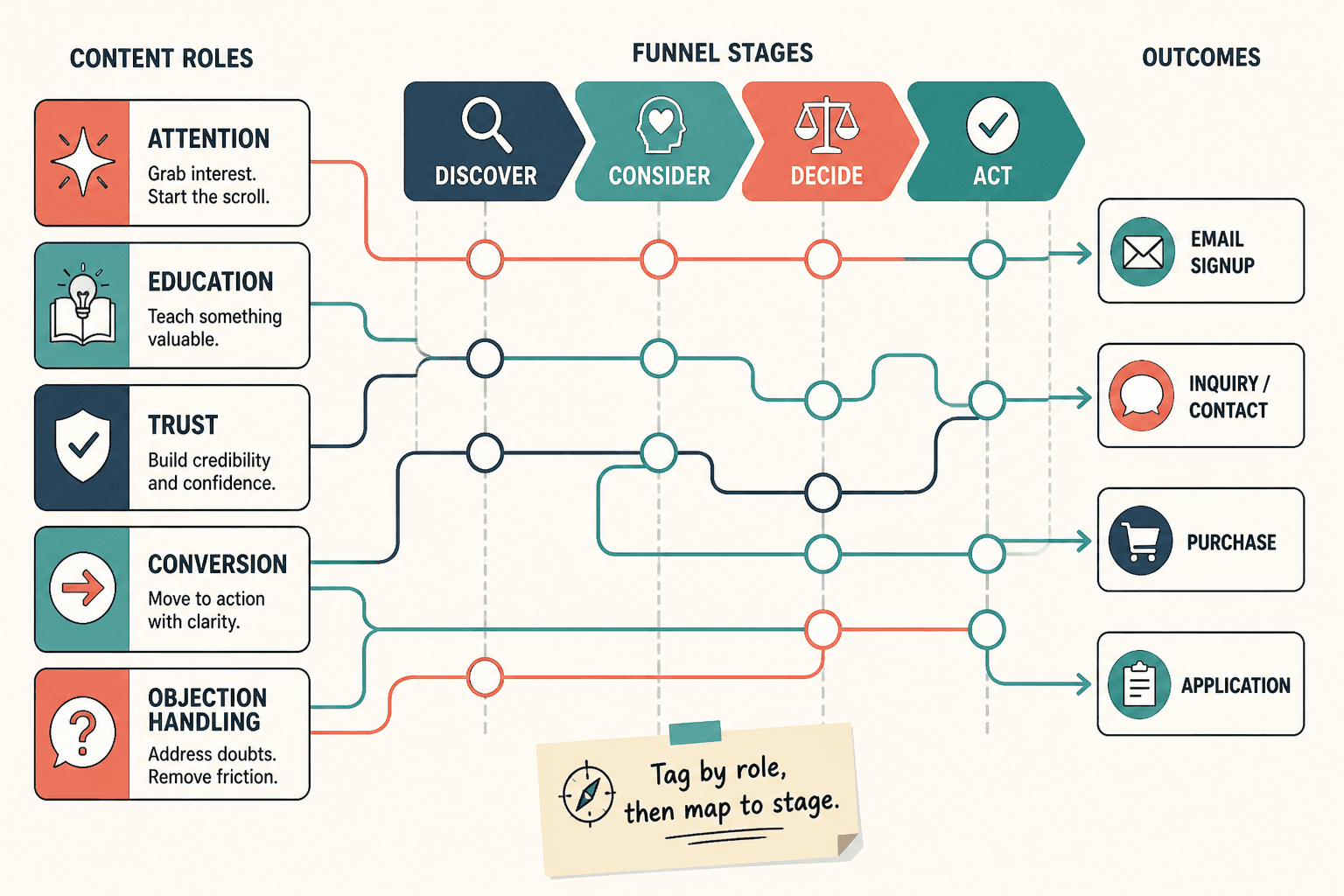
When you review old content, tag each piece by role, not format.
Useful role tags for old content
- Attention: grabs interest, gets clicks, starts conversations
- Education: explains the problem, the method, or the shift in thinking
- Trust: shows proof, experience, results, or sound judgment
- Conversion: points to the next step with a clear reason to act
- Objection handling: answers hesitation, confusion, or skepticism
Once you can sort your old content this way, you stop seeing a pile of disconnected assets and start seeing possible funnel parts.
Audit your old content like a strategist, not a sentimental hoarder
There is a weird creator habit of getting emotionally attached to content just because it took time to make. That is understandable. It is also not useful.
What matters is not whether you liked writing it. What matters is whether it still helps move the right person forward.
Run each old piece through these questions:
- Who was this actually for?
- What problem did it address?
- What stage of awareness did it fit?
- Did it attract the right people or just general attention?
- Did it lead anywhere useful?
- Does it still match my current offer, audience, and positioning?
- Can it be improved faster than creating something from scratch?
If the answer to most of those is no, do not force it into your funnel. Just because a post got applause from random peers does not mean it belongs anywhere near your sales path.
This is one of the most common mistakes in creator funnels: using content that performs socially but fails commercially. Lots of attention. No buyer fit. No trust progression. No useful next step. That is not a funnel asset. That is a vanity asset wearing business clothes.
If you want a broader look at how these systems fit together, the main creator funnels guide is a useful place to tighten the basics before you start rebuilding old pieces.
Map old content to a simple creator funnel
You do not need a bloated funnel with 14 pages, six automations, and a vibe of mild desperation. For most creators, a better funnel is just a cleaner sequence.
Here is a practical version:
- Top of funnel: old posts, threads, clips, or articles that earned attention
- Middle of funnel: deeper posts, lead magnets, guides, FAQs, case studies, newsletters, or profile pages that build trust
- Bottom of funnel: consultation page, service page, sales email, booking link, product page, or application flow
The useful question is not “How do I repurpose this?”
It is “Where should this lead?”
Here is a simple way to map it:
| Old content type | Best funnel role | Better next step |
|---|---|---|
| High-performing opinion post | Top of funnel attention | Link to a deeper article or profile CTA |
| Useful how-to thread | Top to middle bridge | Send readers to newsletter or lead magnet |
| Old article with strong substance | Middle of funnel trust | Add soft CTA to service, audit, or related resource |
| Case study email | Middle to bottom conversion | Point to booking page or product |
| FAQ post | Objection handling | Link to sales page or consultation step |
| Client lesson post | Trust building | Point to a method page or offer explainer |
Notice what is happening here. You are not just reposting old content. You are assigning it a job.
Upgrade the content before you plug it into the funnel
Do not drag old content into a new funnel without editing it. That is how you end up with stale messaging, awkward transitions, and CTAs that sound like they were copied from a webinar landing page in 2018.
Before reusing anything, tighten these five parts.
1. Update the positioning
Your old content may still be useful but aimed at the wrong audience, wrong problem, or old version of your offer. Fix that first.
If your business has changed from “general marketing support” to “content strategy for consultants,” the content needs to reflect that. General advice can still work, but the examples, framing, and CTA should point toward the audience you actually want now.
2. Sharpen the opening
Old content often starts with too much setup. Too much context. Too much throat-clearing. Readers do not need a warm-up lap.
Open with the actual pain, mistake, or tension. Get to the point faster.
Weak: “A lot of people ask me about content funnels, so I wanted to share some thoughts.”
Better: “Most creator funnels fail before the offer because the content never gives people a reason to take the next step.”
3. Add missing proof or specificity
Many old posts have the right general idea but not enough substance to build trust. Add examples, mini case studies, actual objections, practical details, or a clearer framework.
This is especially important for middle-of-funnel content. Once someone is beyond the first click, vague competence is not enough. They need to see that you understand the problem at a level deeper than “post consistently and be authentic.”
4. Fix the CTA
A lot of old content ends in one of three terrible ways:
- No CTA at all
- A generic “follow for more”
- An abrupt pitch that arrives like a salesman kicking open the door
Instead, match the CTA to the content’s role.
- Attention content should usually point to more depth
- Trust content should usually point to a relevant resource or next step
- Objection-handling content can point more directly to the offer
- Bottom-funnel content should make the action obvious and low-friction
If your CTA strategy needs work, read how to write better creator funnels alongside this one. The writing between steps matters just as much as the steps themselves.
5. Remove the AI oatmeal
If you refreshed old content with a lazy AI pass and now it sounds smoother but less human, congratulations, you made it worse.
Trim vague intensifiers. Cut fake polish. Replace generic statements with clearer ones. Keep your actual point intact. Funnel content needs trust, and trust does not usually arrive wrapped in suspiciously tidy phrasing.
Turn one strong old asset into multiple funnel pieces
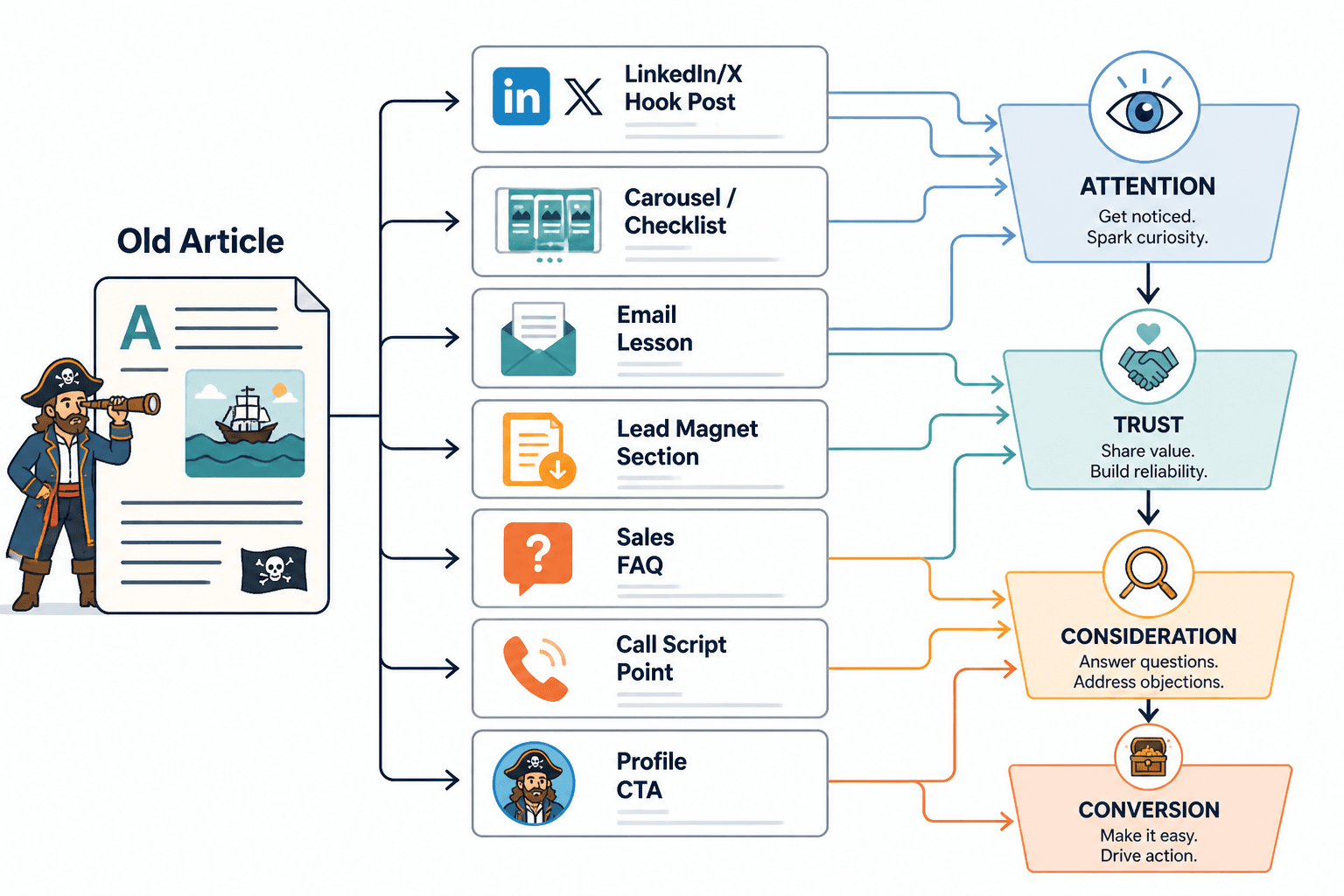
This is where old content becomes genuinely useful again. A solid article or thread can feed several parts of your funnel if you break it down properly.
Say you have an old article about why creators struggle to convert attention into clients. That one piece could become:
- A short LinkedIn or X post with the sharpest point as the hook
- A carousel or mini checklist summarizing the framework
- An email that expands one section into a practical lesson
- A lead magnet section or nurture email
- A sales page FAQ answer
- A call script talking point
- A profile CTA line that reflects the core promise
That is a smarter way to repurpose. Not just “same idea, different format,” but “same useful idea, deployed at multiple decision points.”
A simple repurposing workflow
- Choose one old piece with proven relevance
- Identify its strongest claim, lesson, example, or objection answer
- Decide which funnel stage it best supports
- Rewrite it for that stage, not just that platform
- Add a specific next step
- Connect it to one related asset already in your system
The connection part is what people skip. They publish the repurposed content, then forget to link it to anything useful. That is not a funnel. That is just recycling with extra optimism.
Use old content to fix weak middle-of-funnel trust
Top-of-funnel content gets the most attention because it is public and visible. Middle-of-funnel content is where the money usually starts acting serious.
If people see your posts, like your ideas, maybe even follow you, but still do not convert, there is a decent chance your trust layer is thin. This is exactly where old content can help.
Old content is especially useful for middle-of-funnel assets because it often contains richer thinking than your quick social posts. Buried in old articles, old newsletters, old client notes, and old workshop materials, you often already have:
- Explanations of your method
- Common mistakes your audience makes
- Examples of before-and-after improvement
- Proof through client patterns or repeated outcomes
- Answers to the questions people ask before buying
That material can become:
- A better welcome sequence
- A stronger lead magnet
- A resource hub linked from your profile
- A nurture email series
- A FAQ section on a service page
- A credibility-building article linked from your posts
If your funnels feel generic, that middle layer is often the culprit. You can also pair this article with how to improve creator funnels platform funnels without sounding generic if your current sequence feels technically fine but oddly lifeless.
Examples of turning old content into better creator funnels
Here are a few practical examples.
Example 1: Old LinkedIn post to lead magnet funnel
Old content: A LinkedIn post about why content with useful advice still gets ignored.
Problem: The post got engagement but ended with “Thoughts?” which is not exactly a serious business system.
Better funnel version:
- Rewrite the post hook with a sharper pain point
- Add one practical diagnostic framework
- Use a CTA to a lead magnet on improving hooks or packaging
- Send new subscribers into a short email sequence with examples and one offer-related CTA
Example 2: Old article to consultation funnel
Old content: A detailed article explaining why content strategy fails without positioning.
Problem: Good substance, but no bridge to services.
Better funnel version:
- Update examples to reflect your current audience
- Add internal links to related funnel content
- Insert a short section on signs your current funnel is misaligned
- End with a CTA to a strategy call or funnel audit page
If your next step is sales-focused, how to turn creator funnels into more leads or sales is the natural companion piece.
Example 3: Old email to objection-handling asset
Old content: An email answering why consistency alone does not grow a creator business.
Problem: It lives in your archive, unseen, while prospects keep having the same hesitation.
Better funnel version:
- Turn the core argument into a short FAQ article or sales page section
- Use one client-style scenario to make it concrete
- Link to your process or service page
- Reuse the same argument in DMs, calls, and nurture emails
Build paths, not piles
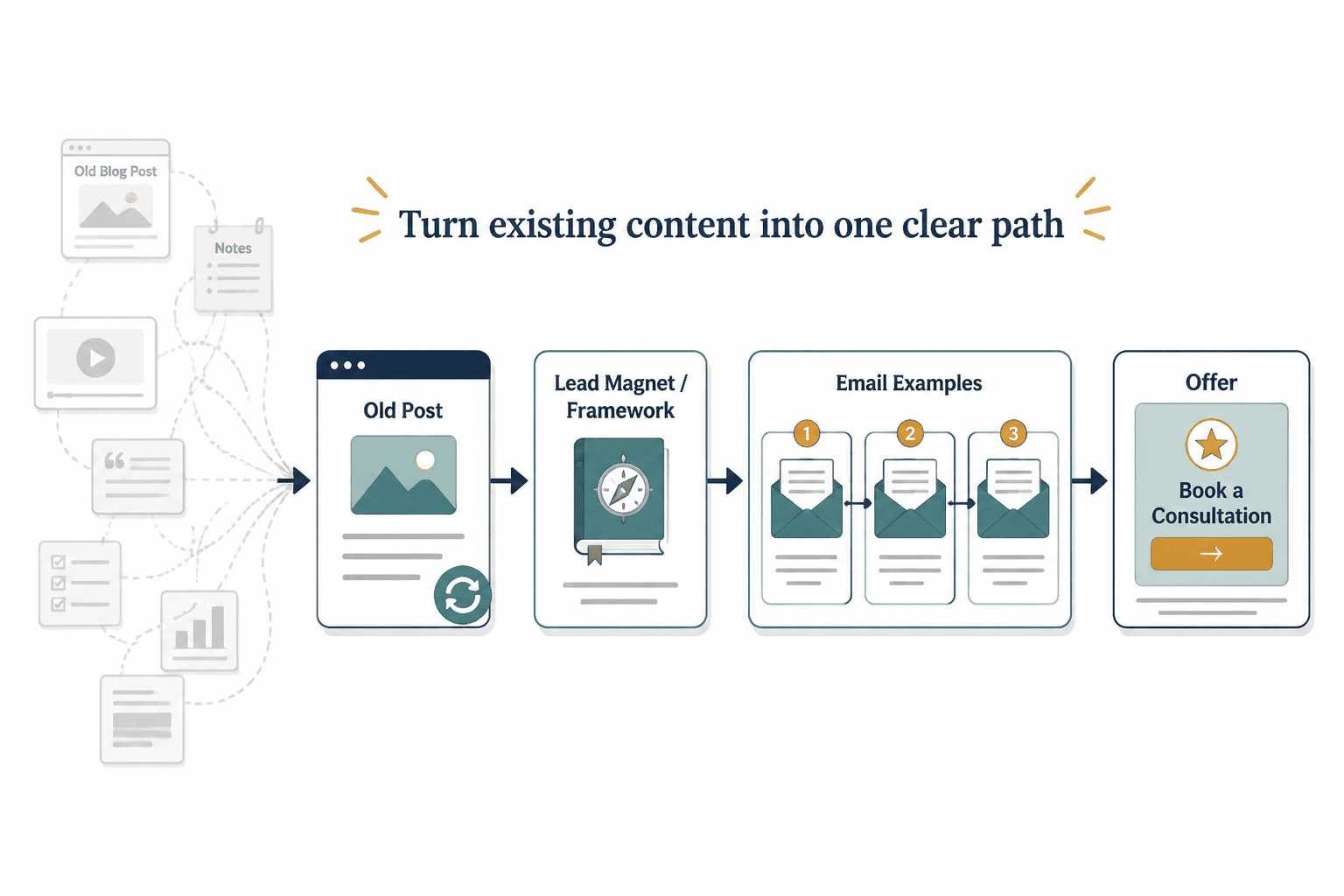
One of the cleanest ways to improve a funnel is to create small content paths around recurring audience problems.
For example, if your audience struggles with content that gets attention but not leads, you might build this path:
- Short post calling out the mistake
- Longer article explaining why it happens
- Lead magnet with a fix or framework
- Email sequence with examples
- Offer page or consultation CTA
Now do that using old content assets wherever possible.
This is much more effective than endlessly publishing disconnected tips and hoping someone eventually assembles your value in their head like a stressed IKEA customer.
And if you want to avoid the common structural errors while doing this, creator funnels content funnels mistakes that hurt performance is worth reading before you bolt random pieces together and call it strategy.
What to stop doing with old content
A few things make old-content funnels worse, not better.
- Blind reposting: If the content was weak, mismatched, or incomplete before, reposting it fixes nothing.
- Adding aggressive CTAs everywhere: Not every old asset should sell directly. Some should build trust first.
- Keeping outdated positioning: Old language can pull in old-fit leads.
- Using platform engagement as your only filter: Reach is helpful, but buyer relevance matters more.
- Repurposing without sequencing: Standalone assets are not a funnel.
- Over-automating too soon: Build the path first. Then automate the parts that actually work.
There is also a broader category worth mentioning: creators who keep making more content because fixing the funnel feels less fun. Fair enough. It is not glamorous. But neither is watching good ideas leak out of the business because nothing connects.
A practical weekly system for turning old content into better creator funnels
If you want this to become a repeatable process instead of a one-time cleanup sprint, use a simple weekly workflow.
Creator funnels get better when the path feels simpler and the writing makes each next step obvious. A cleaner message usually fixes more than extra funnel complexity ever will.