
Most newsletter monetization advice has one fatal flaw: it treats trust like a renewable resource.
It is not.
You can absolutely monetize newsletter sections and formats. You should, frankly. If your newsletter drives attention, authority, replies, leads, and sales, it should probably make money in a way that is not awkward, desperate, or vaguely coated in “support this creator” guilt. But the second every section starts feeling engineered to extract value, readers notice. Fast.
How to Monetize Newsletter Sections and Formats Without Wrecking Trust comes down to one thing: the monetization has to fit the role of the section, the expectations of the reader, and the relationship you have actually earned. Not the one you imagine you deserve because you showed up three Tuesdays in a row.
Here’s the practical version: which newsletter sections can carry offers, sponsorships, affiliate links, paid upgrades, and soft conversions; how to structure those placements so they feel useful instead of sticky; and what usually makes readers start mentally reaching for the unsubscribe button.
If you need the broader groundwork first, start with newsletter sections and formats. That will make the logic here even easier to apply.
For the full path around this topic, head to the parent guide.
The real mistake: monetizing every part of the newsletter the same way
A newsletter is not one blob of content. It is a sequence of reader expectations.
The intro does one job. The main lesson does another. The curated links section has a different rhythm. A case study section carries different credibility. A personal note creates intimacy. A resource block is naturally transactional. If you jam the same monetization move into all of them, you flatten the reading experience and make the whole thing feel like a sales document wearing a content mustache.
Good monetization works because it respects format.
That means:
- sponsored placements should look like they belong where they appear
- affiliate recommendations should be attached to actual relevance
- product mentions should solve the problem the section just raised
- paid upgrades should feel like a next step, not a trap door
- CTAs should match the energy of the section instead of barging in with funnel cologne
Readers are not offended by monetization. They are offended by bad fit.
That distinction matters. It means you do not need to hide the fact that your newsletter makes money. You just need to make the money-making logic feel fair, clear, and useful.
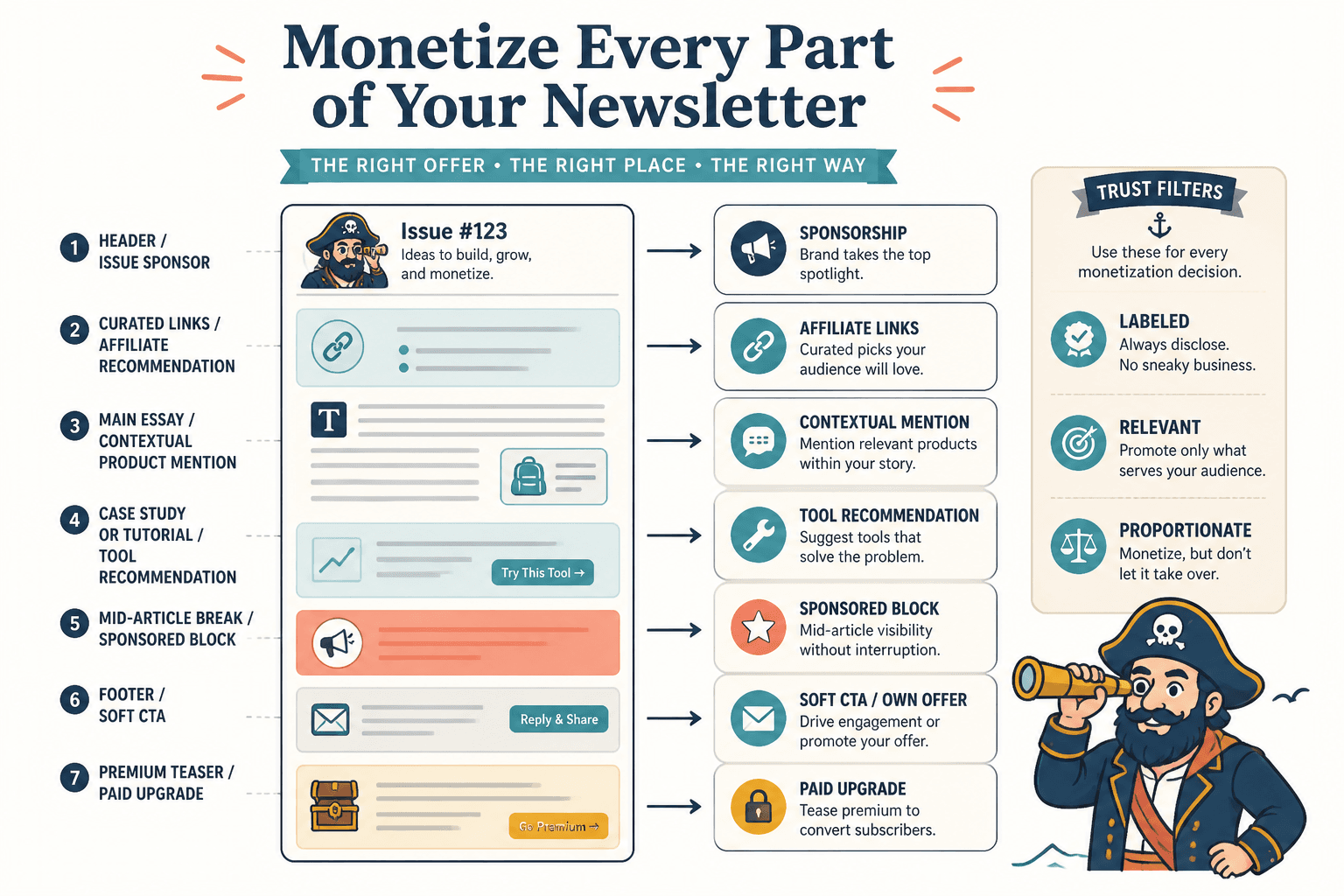
What readers will tolerate, welcome, and resent
A lot of newsletter writers act confused when monetization hurts engagement, but readers are pretty consistent.
They usually tolerate monetization when it is clearly labeled, proportionate, and relevant.
They often welcome it when it saves them time, gives them a vetted tool, points them to something useful, or helps them go deeper on a topic they already care about.
And they resent it when the newsletter starts feeling like a sequence of disguised asks. Especially if the editorial quality drops while the promotional density climbs. That shift is rarely subtle.
If the value feels thinner right before the pitch, readers know exactly what you are doing.
That is why trust-safe monetization usually follows a simple rule: the promotional moment should either extend the value or stay politely out of the way.
Best ways to monetize newsletter sections and formats without wrecking trust
Let’s get specific. Different sections support different monetization models better than others.
1. Intro section: use soft framing, not heavy selling
Your opening is where readers decide whether this issue is worth their attention. So this is not the place for a clumsy hard pitch unless your entire newsletter is explicitly sales-led or sponsor-led.
What works in the intro:
- a one-line sponsor mention
- a brief “this issue is brought to you by” note
- a soft reminder about your product, service, or paid tier when directly relevant
- a short teaser for a deeper paid version later in the email
What usually does not:
- starting with a discount code before saying anything useful
- three paragraphs about your offer before the editorial point arrives
- trying to “warm them up” with fake intimacy and then immediately selling
A clean intro monetization line might look like this:
This issue is sponsored by [brand], a tool I’d actually recommend if you need help organizing your content workflow without creating another chaotic dashboard to ignore.
Short. Framed. Human. Not pretending the sponsor is your best friend.
2. Main teaching section: monetize with extension offers
If the main section teaches something, the cleanest monetization move is to offer the next useful step.
That could be:
- a template
- a worksheet
- a deeper guide
- a paid workshop
- a service offer
- a consulting call
- a related product
The key is sequence. The monetization should feel like the natural continuation of the section’s promise.
For example, if the issue explains how to structure newsletter content for better conversions, the CTA can point to a swipe file, funnel, or offer audit. That works because the gap between free insight and paid next step is logical.
It does not work if the lesson is about writing better intros and the CTA suddenly asks readers to book a brand strategy package with no bridge at all. That kind of jump makes the monetization feel pasted on.
If you want help mapping editorial sections to revenue paths, this guide on turning newsletter sections and formats into more leads or sales is the next useful read.
3. Curated links or resource sections: ideal for affiliate monetization
This is one of the safest places to monetize because the reader already expects recommendations.
But there is still a difference between a curated recommendation and a commission farm.
Use affiliate links here when:
- the product is genuinely relevant to your audience
- you can explain why it is worth their time
- you disclose the relationship clearly
- you do not stack six mediocre recommendations just because each one pays
Bad affiliate writing sounds like this:
Check out this amazing platform that helps businesses streamline productivity and maximize outcomes.
That says nothing. It deserves nothing.
Better:
If your newsletter drafts live across six notes apps and one cursed Google Doc, this tool is useful for planning issues without losing half your ideas. Affiliate link, for transparency.
Specificity earns trust. Disclosure protects it.
4. Case study sections: strong place for service offers and consultations
Case studies are one of the best monetization-friendly newsletter formats because proof naturally supports conversion.
If you show how you solved a problem, improved an outcome, fixed a funnel, or reframed a content strategy, you have already built the bridge to a relevant offer. No dramatic pivot needed.
This is where a CTA like this works:
If your newsletter has good ideas but the structure keeps hiding them, I help clients fix that. You can reply with “audit” and I’ll send details.
That feels aligned because the reader just saw evidence.
What ruins trust is when the case study is obviously engineered as fake educational content with half the useful detail removed so the pitch can do all the work. Give enough substance that the free version still stands on its own.
5. Personal note sections: good for membership and paid newsletter upgrades
Personal note sections work best when they feel intimate, candid, and lightly filtered through actual thought. That makes them a natural fit for premium tiers, paid community offers, behind-the-scenes access, or subscriber-only extras.
The reason is simple: readers who value your perspective often pay for closer access to it.
That said, this section gets weird fast if every “personal reflection” is just a warm bath leading to a checkout link. Readers can smell manufactured vulnerability from orbit.
Use this section to:
- mention a paid tier with bonus commentary
- offer subscriber-only breakdowns
- invite readers into a paid community or workshop
- share that this topic continues in a premium edition
Keep the tone clean and honest. No emotional manipulation. No “I almost didn’t share this” nonsense unless you truly almost did not share it, which most people definitely did not.
6. Dedicated sponsor blocks: safest when clearly separated and tightly written
If you sell newsletter sponsorships, a dedicated sponsor block is often the least trust-damaging option because readers can see exactly what it is.
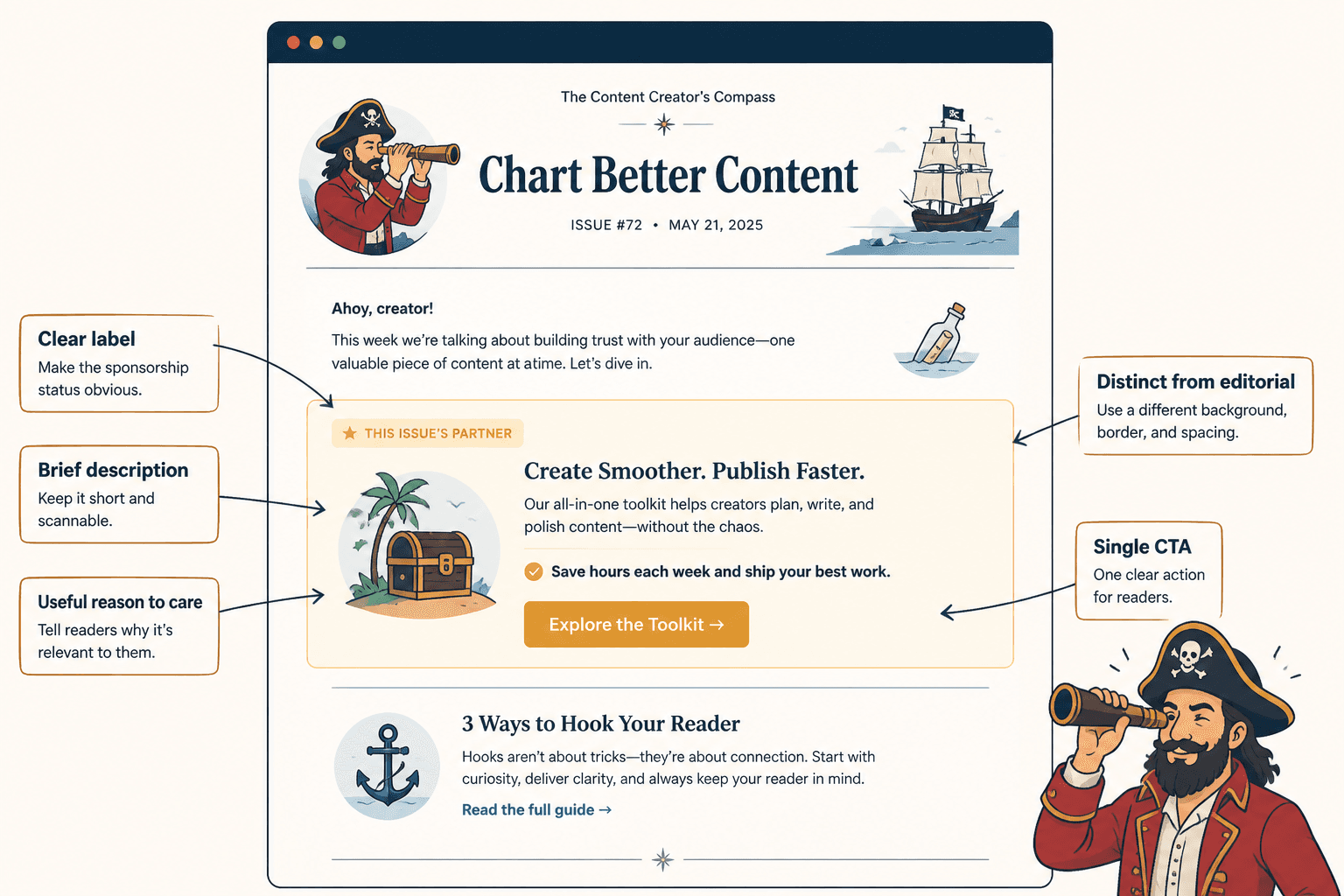
Clarity matters more than cleverness here. Label it. Keep it brief. Make it look distinct from the editorial voice without making it feel like a foreign object dropped into the middle of the issue.
A strong sponsor block usually includes:
- a clear label like “Sponsor” or “This issue’s partner”
- one concise explanation of what the brand helps with
- one useful reason your readers might care
- a single CTA
Do not let sponsor copy bloat your issue. Readers rarely enjoy scrolling through a miniature landing page they did not ask for.
7. End-of-email section: good for low-pressure offers and next steps
The end of the newsletter is where lower-friction monetization often belongs.
By this point, readers have either gotten value or they have not. So the closing area is a good place for:
- a soft product CTA
- a course mention
- a service inquiry link
- a paid subscription reminder
- a sponsor mention
- an affiliate recommendation tied to the issue
This works especially well if the closing CTA sounds like a next move, not a handoff to a pushy salesperson hiding behind your own email address.
Example:
If this issue helped you tighten your newsletter structure, the paid version of my template pack goes deeper with plug-and-play section layouts and conversion-focused examples.
That is plenty. You do not need a full launch sequence stuffed into the footer.
Formats that monetize well without feeling gross
Some newsletter formats are just easier to monetize cleanly because they create built-in relevance.
Problem → advice → tool
You identify a problem, explain the fix, then mention a tool or resource that helps implement it.
This works for affiliate products, templates, software, or your own paid resources.
Insight → example → service CTA
You teach a principle, show what it looks like in practice, then invite readers to work with you if they want help applying it.
This is especially useful for consultants, strategists, coaches, and service providers.
Roundup → recommendation → disclosure
You curate useful resources and include one or two monetized recommendations with clear disclosure.
Simple. Familiar. Low friction.
Free edition → paid continuation
You deliver a complete free idea, then offer a deeper continuation for paid subscribers.
The important bit is this: the free issue still has to feel complete. If the free version reads like a trailer pretending to be a newsletter, people will stop trusting both versions.
Case study → audit or consultation
You show what changed, why it worked, and who it is for, then invite readers with a similar problem to take the next step.
This is one of the cleanest trust-preserving monetization formats because proof does most of the persuading.
What makes newsletter monetization feel trustworthy
There is no magic line that makes a promotional section “authentic.” Usually, trust comes from a bundle of signals working together.
- Consistency: readers know what kind of newsletter they signed up for
- Relevance: the offer fits the topic or reader need
- Restraint: not every section is monetized
- Transparency: affiliate, sponsor, and paid relationships are obvious
- Specificity: you explain why something is useful instead of spraying vague praise at it
- Editorial quality: the value does not collapse the second money enters the room
This is where a lot of people get it wrong. They focus entirely on wording the CTA better when the actual issue is structural. If your issue is 40 percent content and 60 percent monetization machinery, no clever phrasing is going to save that.
And if your monetized sections already sound stiff or over-scripted, read how to write newsletter sections and formats without sounding salesy or robotic. That tone problem often does more damage than the promotion itself.
A simple framework for deciding what to monetize
If you are not sure where monetization belongs, use this quick filter before adding anything promotional to a section.
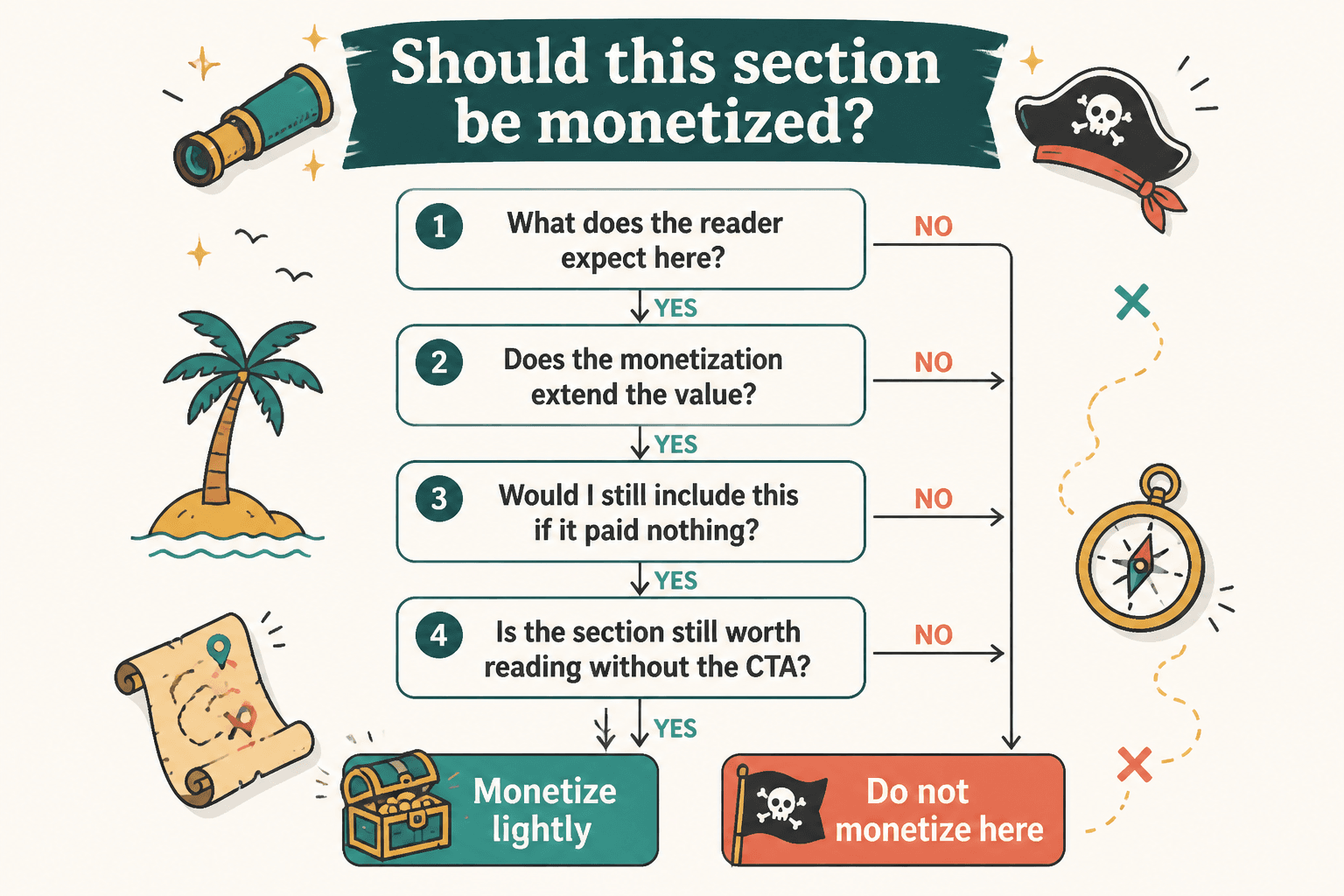
Ask these 5 questions
- What is this section supposed to do?
If the section’s job is trust-building or teaching, do not overload it with conversion pressure. - What does the reader expect here?
A resource section can handle recommendations. An opening reflection can handle a soft mention. A dense teaching section may need a more subtle transition. - Does the monetization extend the value?
If it feels like a logical next step, good. If it feels random, it probably is. - Would I still include this if it paid nothing?
This question is annoyingly effective. It reveals when you are recommending for usefulness versus commission. - Is the section still worth reading without the CTA?
If not, the promotion is probably cannibalizing the content.
That last one matters more than people think. A monetized newsletter still needs to be a newsletter, not an elongated pre-purchase sequence.
Common ways people wreck trust by accident
Usually by trying too hard to monetize “smartly” and ending up weird.
Hiding promotions inside editorial voice
If readers cannot tell what is content and what is an ad, that is not sophisticated. It is slippery.
Promoting things you clearly do not use or understand
You do not need to personally use every tool forever, but if your recommendation reads like you skimmed the homepage five minutes ago, trust takes the hit.
Overstuffing one issue with too many asks
Sponsor block. Affiliate recommendation. Paid tier pitch. Course CTA. Consultation CTA. Referral request. Survey. Social follow. That is not monetization strategy. That is newsletter clutter in a trench coat.
Using fake casual language to disguise a hard sell
Readers are not fooled by “just a little thing I wanted to share” when the next paragraph reads like checkout-page copy.
Letting sponsor copy take over the issue
If a sponsor wants a billboard, they can buy one. Your newsletter needs to stay readable.
Creating paid walls where there should be paid doors
This is a useful distinction. A paid wall blocks the actual value. A paid door opens into deeper value. Readers are far more willing to walk through a door than slam into a wall.
Examples of trust-safe monetization by newsletter type
For creators and writers
- paid archives
- premium breakdowns
- writing templates
- affiliate tools used in the workflow
- small sponsor blocks relevant to audience interests
For coaches and consultants
- case study to consultation CTA
- issue topic to workshop or audit offer
- tool recommendations tied to implementation
- invites to paid intensives or premium trainings
For solo founders and personal brands
Newsletter structure works best when each section has one clear job and supports the main point of the issue. Simpler formats usually outperform busier ones when the writing stays sharp.
Newsletter structure works best when each section has one clear job and supports the main point of the issue. Simpler formats usually outperform busier ones when the writing stays sharp.