
Most creator funnels do not fail because the tech is broken. They fail because the journey makes no sense.
Someone sees a post, clicks your profile, grabs a freebie, gets three vague emails, and then gets pitched something they do not want, do not understand, or do not trust yet. That is not a funnel. That is a confused scavenger hunt with a checkout link taped on the end.
If you want to know how to turn creator funnels into more leads or sales, the answer is not “add more automation” or “post harder.” It is usually much less glamorous. You need a tighter match between the content people see, the next step they take, and the offer waiting on the other side.
This is where a lot of smart creators, coaches, consultants, and solo founders quietly bleed money. They get attention, maybe even decent engagement, but the path from attention to action is foggy. The fix is not magic. It is structure, trust, and fewer weird jumps.
Here is how to build creator funnels that feel smoother, convert better, and do not make your audience feel like they just stepped into a 2019 webinar basement.
For the full path around this topic, head to the parent guide.
What actually makes creator funnels convert
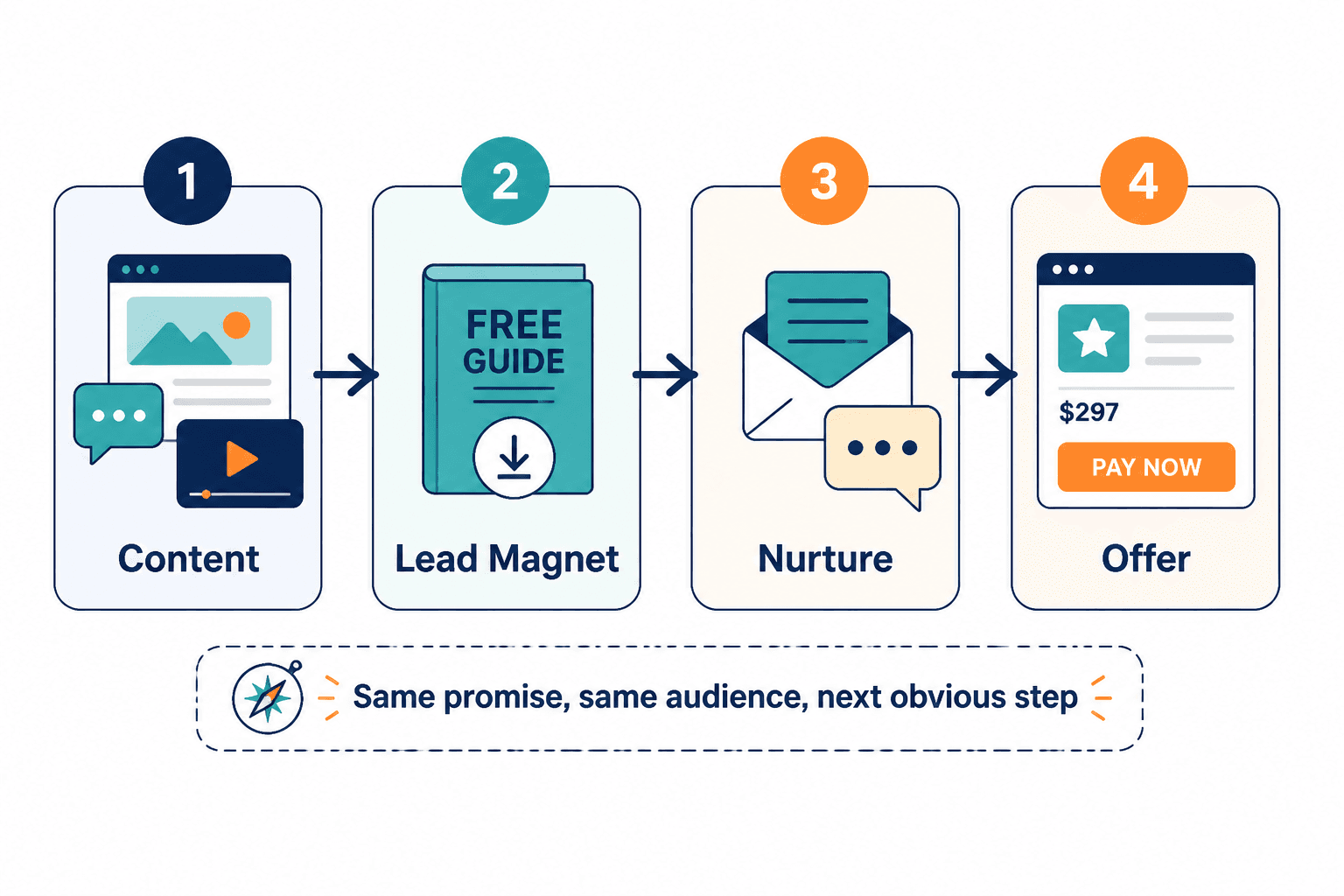
A creator funnel works when four things line up:
- The content attracts the right person
- The next step feels obvious
- The lead magnet, page, or offer matches the promise of the content
- The follow-up earns trust instead of speedrunning the pitch
That is it. Not easy, but simple.
A lot of funnels break because people treat each piece separately. The content team writes for reach. The lead magnet is a random PDF. The email sequence sounds like a different person wrote it during a mild identity crisis. Then the offer asks for way more commitment than the audience is ready to give.
The funnel does not need more pieces. It needs more continuity.
Start by fixing the offer-path mismatch
If your content brings in one kind of person and your offer is built for another, your funnel will stay weird no matter how many tools you duct-tape to it.
Example:
- You post beginner content about “how to grow on LinkedIn”
- Your lead magnet is “50 viral hook templates”
- Your paid offer is a high-ticket consulting package for established B2B founders with teams
See the problem? The top of funnel attracts one audience. The bottom asks for a totally different level of sophistication, budget, and need.
Good creator funnels do not just move people forward. They move the right people forward.
Ask these three alignment questions
- Who is this content actually attracting?
Not who you hope it attracts. Who would realistically click? - What problem are they aware of right now?
People convert faster when your next step matches the problem already in their head. - Is the offer a logical continuation?
If it feels like a leap, leads stall and sales die.
If you need help tightening that bridge, this guide on improving creator funnels without sounding generic pairs nicely with this one.
Use content that pre-sells the next step
Content should not just attract attention. It should filter, frame, and prepare.
That means the post, thread, article, or video should do at least one of these jobs:
- Highlight a costly problem
- Challenge a bad assumption
- Show the gap between effort and results
- Introduce your method or point of view
- Offer proof that your approach works
When content does this well, the CTA does not feel bolted on. It feels like the obvious next move.
Bad funnel content says, “Here are five random tips. Download my guide.”
Better funnel content says, “Most creators do X, which is why their funnel leaks attention before it becomes trust. Here is the fix. If you want the full system, grab this checklist.”
What pre-selling content usually includes
- A clear problem with stakes
- A useful idea or partial solution
- Some proof, logic, or example
- A CTA connected to that exact topic
This is one reason random lead magnets underperform. They may be decent resources, but they are not connected to the content strongly enough to earn the click.
Choose simpler funnel paths than you think you need
People love building elaborate funnels because it feels productive. More pages. More tags. More branches. More “if/then” logic. Wonderful. You have built a haunted house for leads.
For most creators, a simpler path converts better because it reduces confusion and friction.
Strong examples:
- Post → profile → lead magnet → nurture emails → low-friction offer
- Article → relevant CTA → email list → case study → consultation
- Thread → free template → nurture → workshop or service
- Post → comments conversation → soft DM → call or resource
Each step should answer one silent question: “Why this next thing?”
If you cannot explain that in one sentence, the path is probably too messy.
For more options, these funnel ideas to pair with creator funnels can help you choose a path that fits your business instead of copying somebody else’s.
Make the lead magnet solve a real micro-problem
A lead magnet does not need to be huge. It needs to be useful fast.
Too many creators offer broad, sleepy freebies like:
- “The ultimate guide to online success”
- “My 47-page branding workbook”
- “Everything you need to know about content”
Nobody wants homework disguised as value.
Better lead magnets solve one immediate problem that naturally leads toward your paid solution.
Examples of stronger creator lead magnets
- A profile audit checklist for consultants who are getting views but no inquiries
- Ten CTA rewrites for creators whose posts get engagement but no clicks
- A short funnel map template for coaches with too many offers and no clean next step
- A content-to-email workflow for founders who post consistently but never build a list
The best lead magnets create momentum. They do not try to replace the whole paid offer. They help the reader get a small win, understand the problem more clearly, and see why the bigger solution matters.
If your freebie is too complete, people consume it and leave. If it is too vague, they do not bother. The sweet spot is useful and incomplete in an honest way.
Improve conversion by reducing friction at each step
Every extra bit of friction costs you leads or sales. Not because your audience is lazy. Because attention is fragile and people are busy.
Look at each stage of the funnel and ask what might make a good-fit person hesitate.
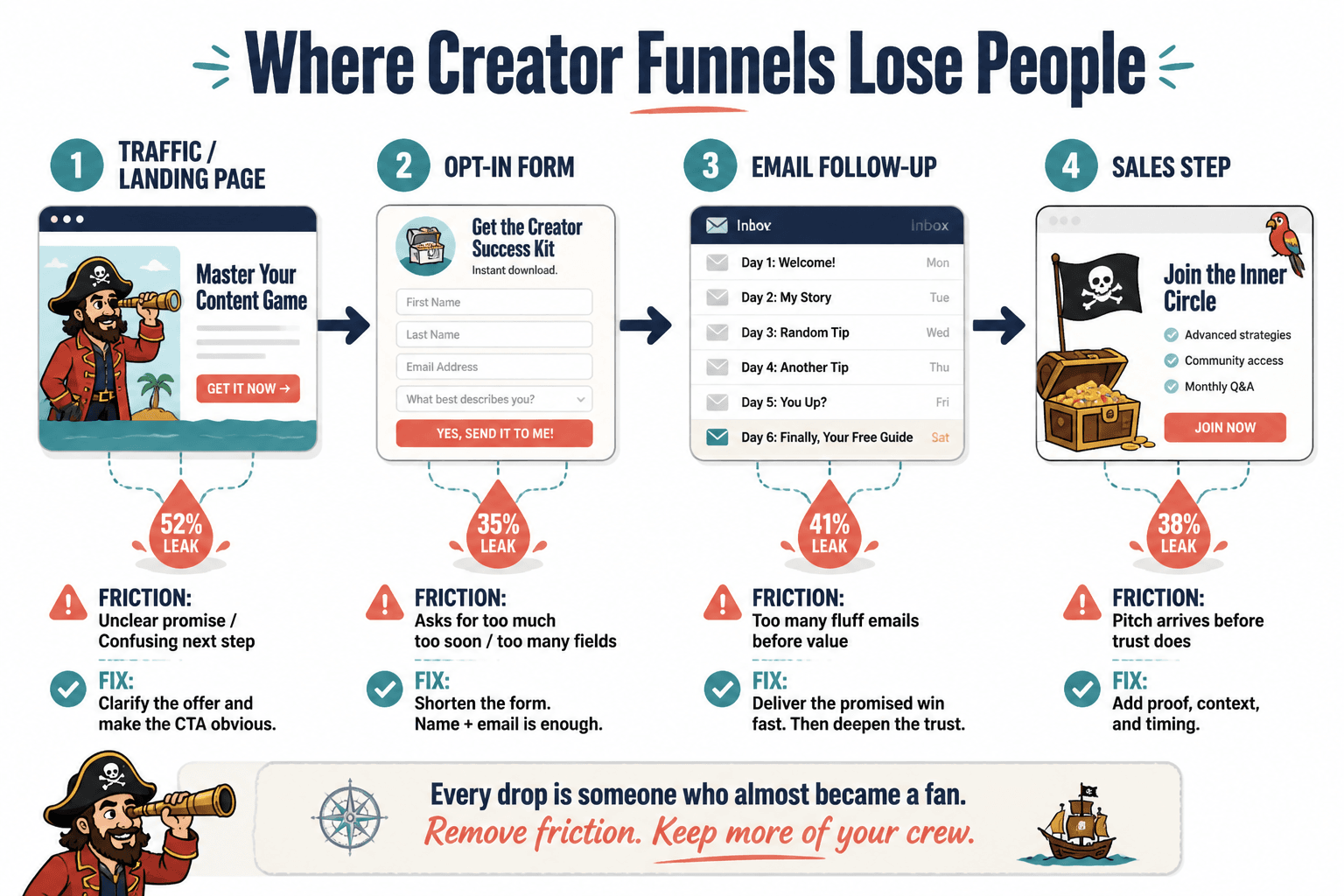
| Funnel stage | Common friction | Better move |
|---|---|---|
| Content CTA | Too vague or too many options | Use one clear next action |
| Profile | Unclear who you help | Tighten bio, proof, and CTA |
| Landing page | Long, generic, or visually messy | Lead with outcome, specificity, and clarity |
| Opt-in | Asks for too much too soon | Keep forms short unless the offer demands more |
| Email follow-up | Too many fluff emails before value | Deliver the promised win fast |
| Sales step | Pitch arrives before trust does | Use proof, context, and timing |
This part matters more than people think. A lot of funnels do not have a persuasion problem. They have a usability problem.
When a funnel underperforms, people often rewrite the copy first. Sometimes that is right. But often the bigger issue is that the person has to work too hard to understand what is happening, why it matters, and what they should do next.
Clarity converts because confusion leaks.
Nurture like a human, not a funnel gremlin
The follow-up sequence is where a lot of creators torch trust.
Somebody downloads a helpful resource, and two hours later they get an email that sounds like this:
You’re just one decision away from scaling to consistent 10k months. Spots are limited. Act now.
No, thanks.
Nurture works better when it feels like guided trust-building, not emotional mugging.
A simple nurture sequence that does not feel gross
- Delivery email
Give them the thing. Tell them how to use it. - Context email
Explain the mistake or pattern behind the problem. - Proof email
Show an example, case study, or before/after shift. - Objection email
Address hesitation, confusion, or common mismatch. - Offer email
Present the next step clearly and calmly.
That sequence can be short. It does not need 17 emails and a fake urgency tambourine.
If your audience is colder, trust takes longer. If the offer is more expensive, trust takes longer. If your niche involves personal risk, complexity, or real money, trust takes longer. This is not a bug. It is reality.
If you want a trust-first angle, this piece on monetizing creator funnels without wrecking trust is worth reading next.
Use offers with the right amount of commitment
One reason creator funnels stall is that the ask is too big for the stage of awareness.
If someone barely knows you, asking them to book a high-ticket strategy call may be too much. Not always, but often. A lower-friction bridge can work better.
Examples of lower-friction bridge offers
- Paid workshop
- Mini-audit
- Template pack
- Strategy session with a clear scope
- Short-term sprint offer
- Entry-level product tied to one problem
This is especially useful if your main offer is expensive, customized, or requires trust. A bridge offer can help qualify buyers, create momentum, and let people experience your thinking without a giant leap.
That said, not every business needs one. Sometimes a simple content → consultation path works beautifully, especially if the content is specific, your positioning is strong, and the problem is urgent enough.
The point is fit. Not funnel cosplay.
Track the right bottleneck before changing everything
When sales are weak, creators often panic-edit the entire funnel at once. New headline. New freebie. New emails. New offer. New platform. New font, probably.
That makes it much harder to diagnose what was actually broken.
Instead, find the narrowest bottleneck first.
Common creator funnel bottlenecks
- Low clicks from content: your CTA or content-to-offer match is weak
- Profile visits but low opt-ins: your positioning or lead magnet is off
- Opt-ins but no replies or sales: your nurture and offer path need work
- Calls booked but low close rate: your sales message, qualification, or offer fit is the issue
You do not need enterprise analytics to spot this. Basic numbers and a bit of honesty will do.
Ask:
- Where are people dropping?
- What are they clicking?
- What are they ignoring?
- What step gets the weakest response from good-fit people?
- Where does the message stop matching the intent?
Fix that step first. Then reassess.
Repurpose old content into better funnel entry points
You do not need to create an entirely new content engine every time you want more leads.
Quite often, the smarter move is to look at old content that already performed well and rebuild it with a stronger funnel path.
Find posts, articles, or threads that already got:
- Strong saves
- Meaningful comments
- Profile visits
- DMs
- Email signups
Then ask:
- What specific pain point did this content touch?
- What next step would fit that pain point better?
- Can I add a more relevant CTA?
- Can I turn this into a stronger article, thread, or email entry point?
This guide on turning old content into better creator funnels goes deeper on that process.
Repurposing works especially well because the topic is already validated. You are not guessing from scratch. You are improving the route.
Build funnel messaging around trust, not just attention
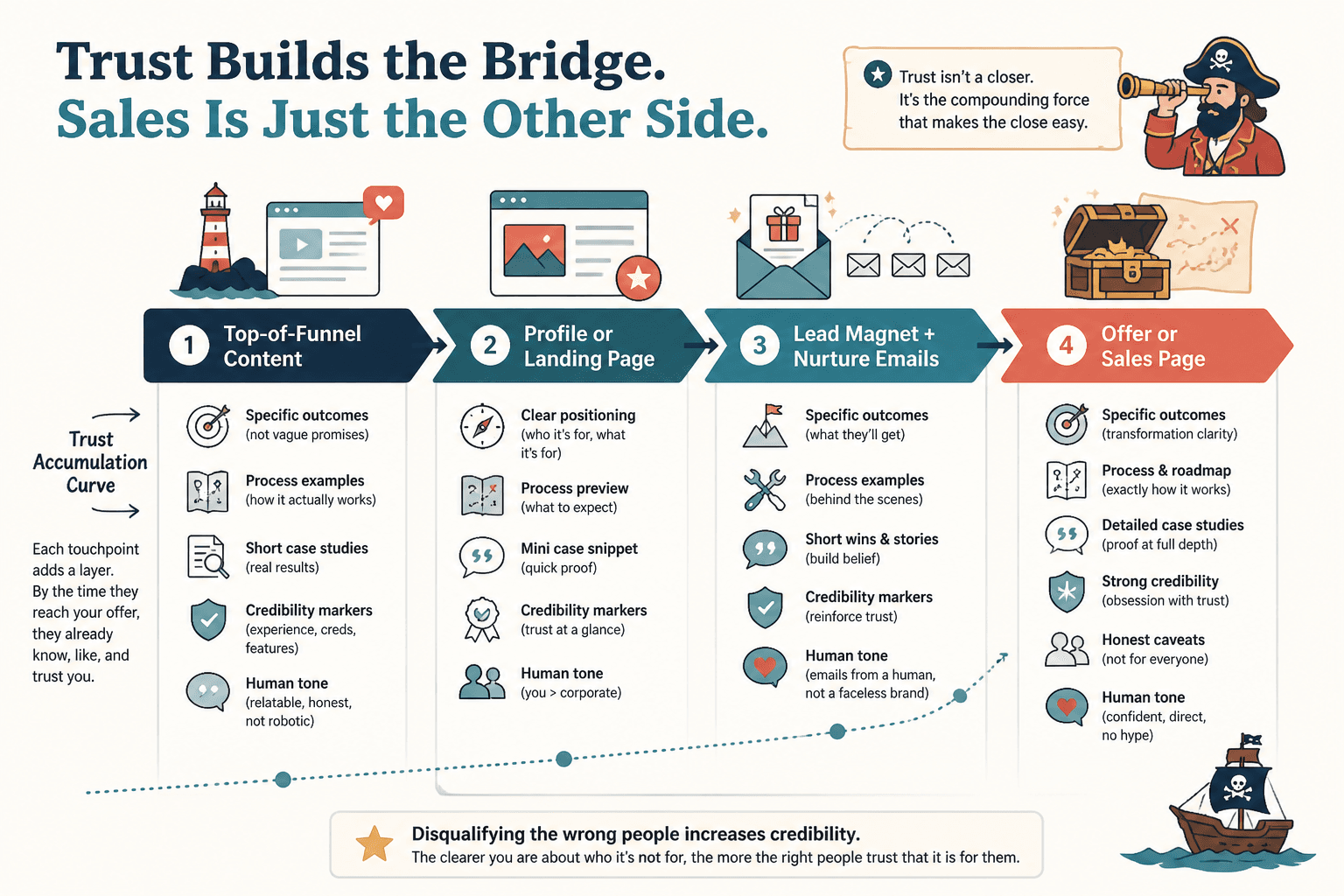
Attention gets people into the funnel. Trust gets them through it.
This sounds obvious, yet people still build funnels as if a decent hook and a landing page should be enough to close the deal. That works only when the offer is cheap, low-risk, or incredibly impulse-friendly. Most creator businesses are not selling novelty socks. They are selling expertise, judgment, transformation, access, or strategic help. People need reasons to believe you.
That means your funnel should include trust signals on purpose, not by accident.
Trust signals that actually help
- Specific outcomes instead of vague claims
- Examples of your process
- Short case studies
- Relevant credibility markers
- Clear positioning
- Honest caveats about fit
- Writing that sounds like a person, not a brochure in loafers
One underrated move is disqualifying the wrong people. It sounds counterintuitive, but it often increases conversion with the right people because your offer feels more credible. When you say who something is not for, your positioning sharpens and your trust rises.
Good funnels do not chase everyone. They make the right people feel understood.
A practical creator funnel audit
If your funnel is underperforming, do this quick audit before rebuilding the whole thing.
- Check the top-of-funnel content.
Is it attracting the right audience and framing the right problem? - Review the CTA.
Is the next action clear, relevant, and easy to take? - Audit the profile or landing page.
Can someone instantly tell who you help, what you help with, and what to do next? - Assess the lead magnet.
Does it solve one meaningful micro-problem tied to the offer? - Read the nurture sequence out loud.
Does it sound human, helpful, and coherent? - Look at the offer step.
Is the ask appropriate for the audience’s level of trust and awareness? - Identify the biggest drop-off.
Fix the bottleneck before touching everything else.
If you want broader context, the main creator funnels page is a good hub, and you may also want the broader monetization funnels section if you are mapping the bigger system around it.
FAQ
What is the best creator funnel for leads?
A simple one: content to profile or landing page, then a relevant lead magnet, a short nurture sequence, and a clear consultation or service offer. It works best when each step matches the same problem.
What is the best creator funnel for sales?
Usually the one that matches your audience’s trust level. For warmer audiences, content straight to offer can work. For colder audiences, use a bridge like a lead magnet, case study, workshop, or short email sequence first.
Why do creator funnels get leads but not sales?
Usually because the leads are not qualified enough, the nurture is weak, or the offer asks for too much too soon. Sometimes the top-of-funnel content attracts the wrong people entirely.
Should every creator use a lead magnet?
No. If your content, profile, and offer are tight enough, you may not need one. But lead magnets can help when you need to build trust, capture demand, or move people toward a more complex offer.
How long should a creator nurture sequence be?
Long enough to build trust and create clarity. For many creators, 3 to 5 emails is enough to test a simple sequence before making it more elaborate.
Turn creator funnels into a cleaner path, not a louder machine
If you want to know how to turn creator funnels into more leads or sales, start by removing the nonsense.
Make the content attract the right people. Make the CTA make sense. Make the lead magnet actually help. Make the nurture sequence sound like you respect the reader’s intelligence. Make the offer feel like a natural next step instead of a trapdoor.
That is what better creator funnels usually are: not more complicated, just more coherent.
Pick one funnel you already have, find the biggest disconnect, and fix that first. You do not need a funnel empire. You need a path people actually want to keep walking.
Creator funnels get better when the path feels simpler and the writing makes each next step obvious. A cleaner message usually fixes more than extra funnel complexity ever will.