
Most personal brand blogs do not have a traffic problem first. They have a freshness problem.
The post was decent once. It may have even ranked. Then time did what time does. The examples got old, the framing got fuzzy, the search intent shifted a bit, and now the article is sitting there like a former overachiever coasting on a 2019 résumé.
That is where better search refreshes for personal brands come in. Not random edits. Not changing three words and calling it content strategy. A real refresh tightens the angle, improves usefulness, updates proof, and gives search engines and actual humans a reason to care again.
If you are a coach, consultant, creator, or solo founder, this matters more than publishing endless new posts nobody asked for. A strong refresh can revive rankings, improve conversions, sharpen your positioning, and save you from feeding the content machine with your remaining life force.
Here is how to refresh older blog content in a way that actually helps your visibility and makes your personal brand look more current, credible, and useful.
To see how this fits into the wider strategy, open the parent guide.
What a search refresh actually is
A search refresh is not just editing for grammar or swapping in a newer date. It is the process of improving an existing article so it better matches current search intent, current reader expectations, and your current expertise.
Think of it as part SEO maintenance, part editorial cleanup, part strategic repositioning.
For personal brands, that last part matters a lot. Your older articles often reflect an earlier version of your thinking, your audience, or your offers. If the article still gets impressions, it is not just a traffic asset. It is a first impression asset. Which means if it is outdated, vague, or padded, it is quietly making you look less sharp than you are.
A proper refresh usually includes a mix of:
- Updating the angle or promise
- Improving the title and opening
- Adding missing examples, proof, or steps
- Removing fluff and repetition
- Fixing weak structure and headings
- Aligning the post with current keywords and reader intent
- Adding better internal links
- Making the CTA more relevant to what you offer now
That is a refresh. Everything else is mostly housekeeping.
Why personal brands should care more about refreshes than they usually do
Bigger sites can get away with publishing at volume. Personal brands usually cannot. You do not need 400 mediocre articles drifting around your site like abandoned shopping carts. You need a smaller set of useful pages that still earn trust and still pull their weight.
Refreshing old content is one of the few SEO moves that is both practical and sane for small teams. You are not starting from zero. You are improving an asset that already has some age, some signals, and maybe some rankings. That is often a much better bet than publishing another generic “top tips” article into the void.
It also helps with the business side, not just the traffic side. Better search refreshes can:
- Bring your old content in line with your current positioning
- Improve conversion paths from article to offer
- Reduce bounce from visitors landing on stale posts
- Make your site feel more consistent and credible
- Help you reuse strong ideas instead of inventing endless new ones
If you have been treating old blog posts like dead files instead of reusable assets, that is probably costing you more than you think.
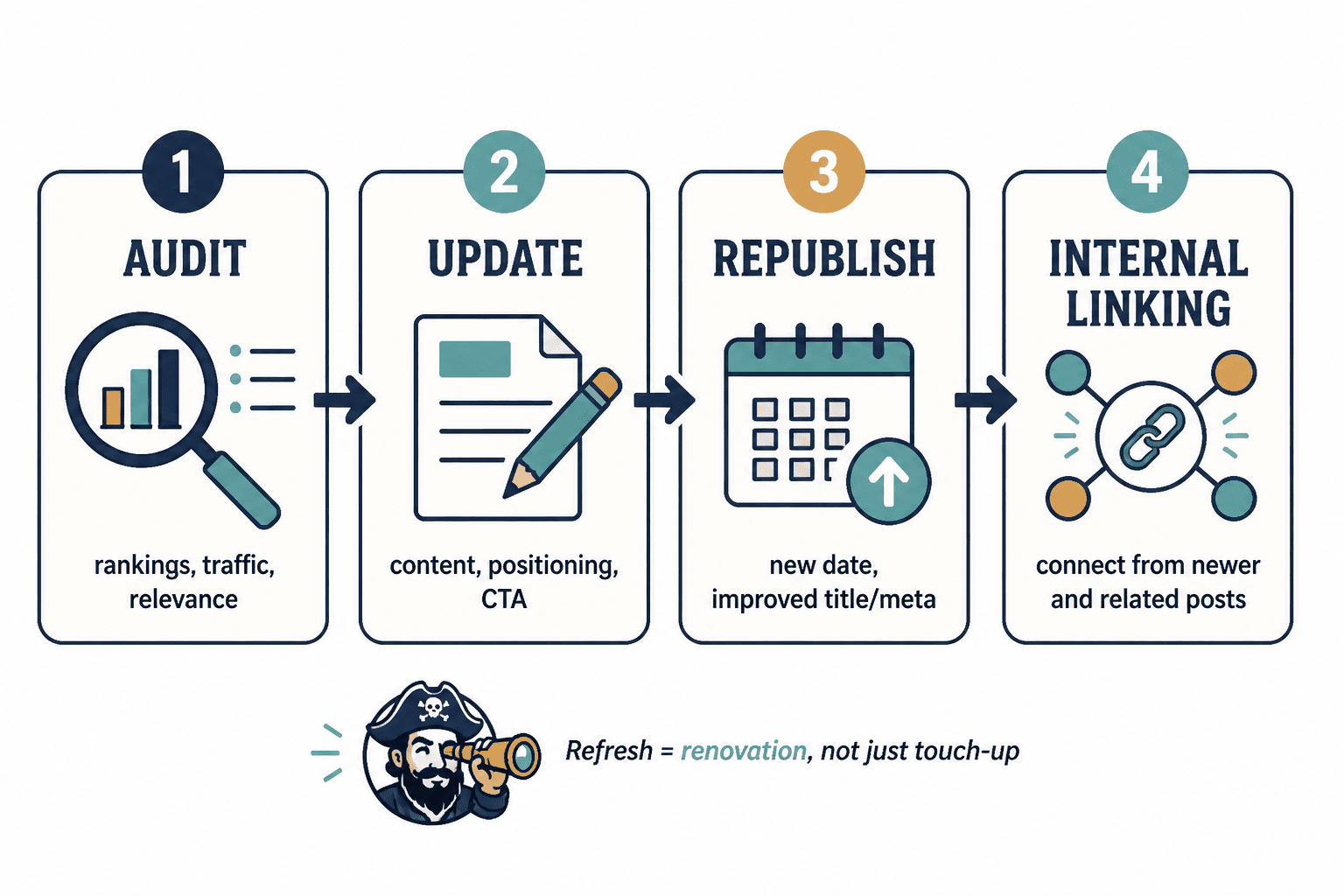
And yes, sometimes the right move is to rewrite heavily, merge posts, or retire weak pages entirely. A refresh is not always a polite little touch-up. Sometimes it is a renovation because the original structure was held together by vibes.
How to decide which posts deserve a refresh
Do not refresh everything. That is how you end up busy without being useful.
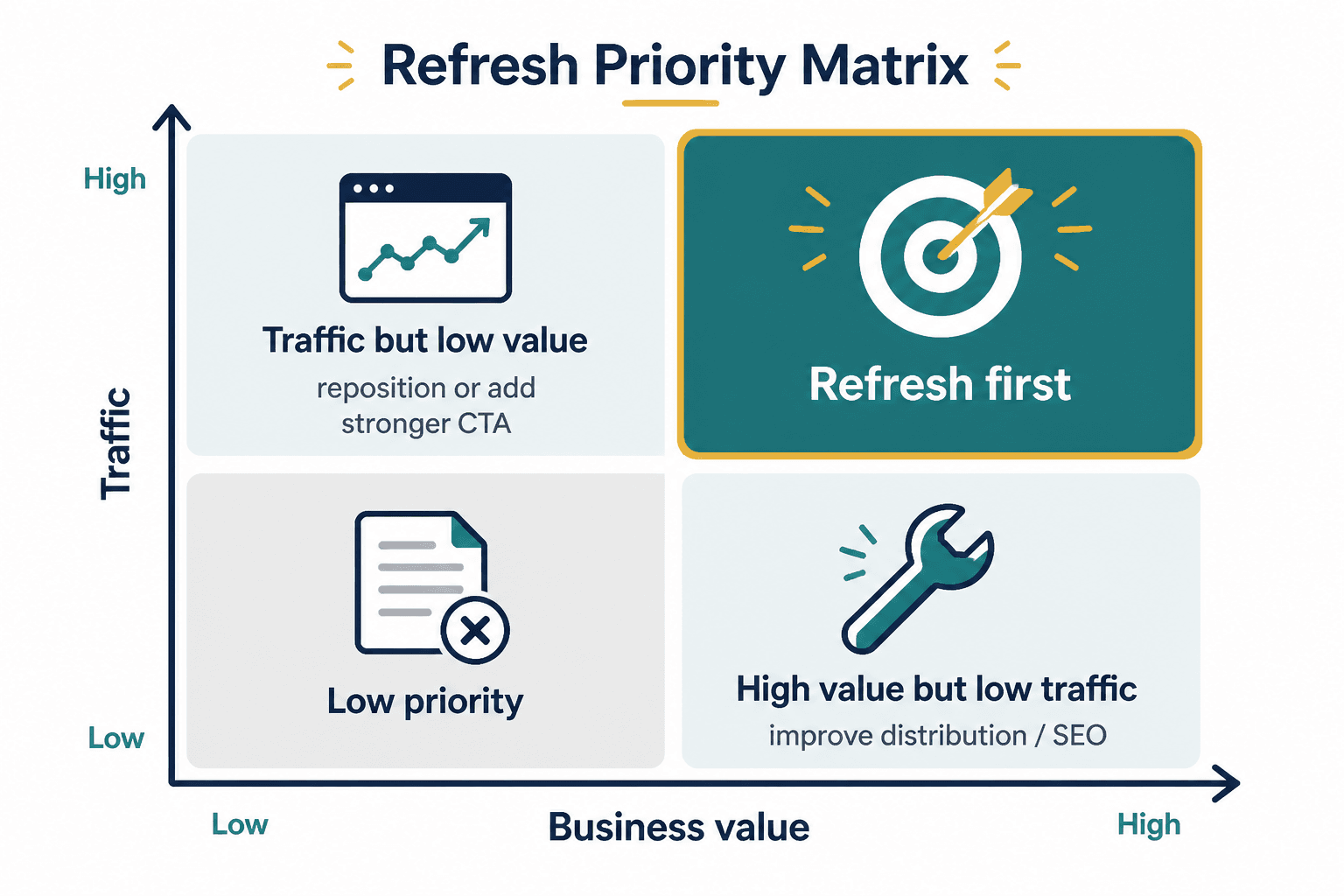
Start with posts that already show some signs of life or business value. You are looking for pages where improvement has a clear upside.
Good refresh candidates usually look like this
- The post ranks on page 2 or low page 1 for a relevant term
- Traffic has declined over time
- The topic still matters to your audience
- The article reflects outdated thinking, examples, or positioning
- The post gets impressions but weak clicks
- The page gets traffic but does not convert
- You have newer insight that makes the article much better now
That last one gets overlooked. A lot of personal brand content is created while the brand is still figuring itself out. Which means your old content may not be wrong exactly. Just foggy. If you can now explain the topic more clearly, more specifically, or with better proof, that is a strong reason to refresh it.
Posts that usually should not be your first priority
- Posts on topics your audience no longer cares about
- Thin posts with no real angle and no existing traction
- Pieces targeting keywords irrelevant to your offers
- Articles that would need a total topic change to matter
Those might need consolidation, redirection, or deletion instead. Refreshing a bad idea does not make it a good asset. It just gives the bad idea a haircut.
If you want help figuring out what to improve first, this related guide on how to turn old content into better blog rewrites and refreshes is a useful next read.
The five-part search refresh framework that actually works
Here is a practical way to approach better search refreshes for personal brands without turning it into a giant content archaeology project.
1. Check the current search intent
Before editing a word, ask: what does the searcher seem to want now?
Sometimes the answer has not changed much. Other times it has shifted from broad theory to practical examples, from informational to commercial, or from beginner advice to more specific workflows. Your article needs to match the kind of result searchers are rewarding with clicks.
For example, a post called “How to Improve Your Personal Brand Blog” may have been fine a few years ago. But if current results lean toward specific refresh workflows, examples, and audit methods, your broad motivational piece is not going to cut it.
Look at what is ranking now and study:
- The angle of the top results
- How specific they are
- What subtopics they cover
- Whether they use examples, frameworks, or templates
- How they structure the intro and headings
You are not copying. You are checking what the reader currently expects when they search that topic.
2. Improve the promise, not just the wording
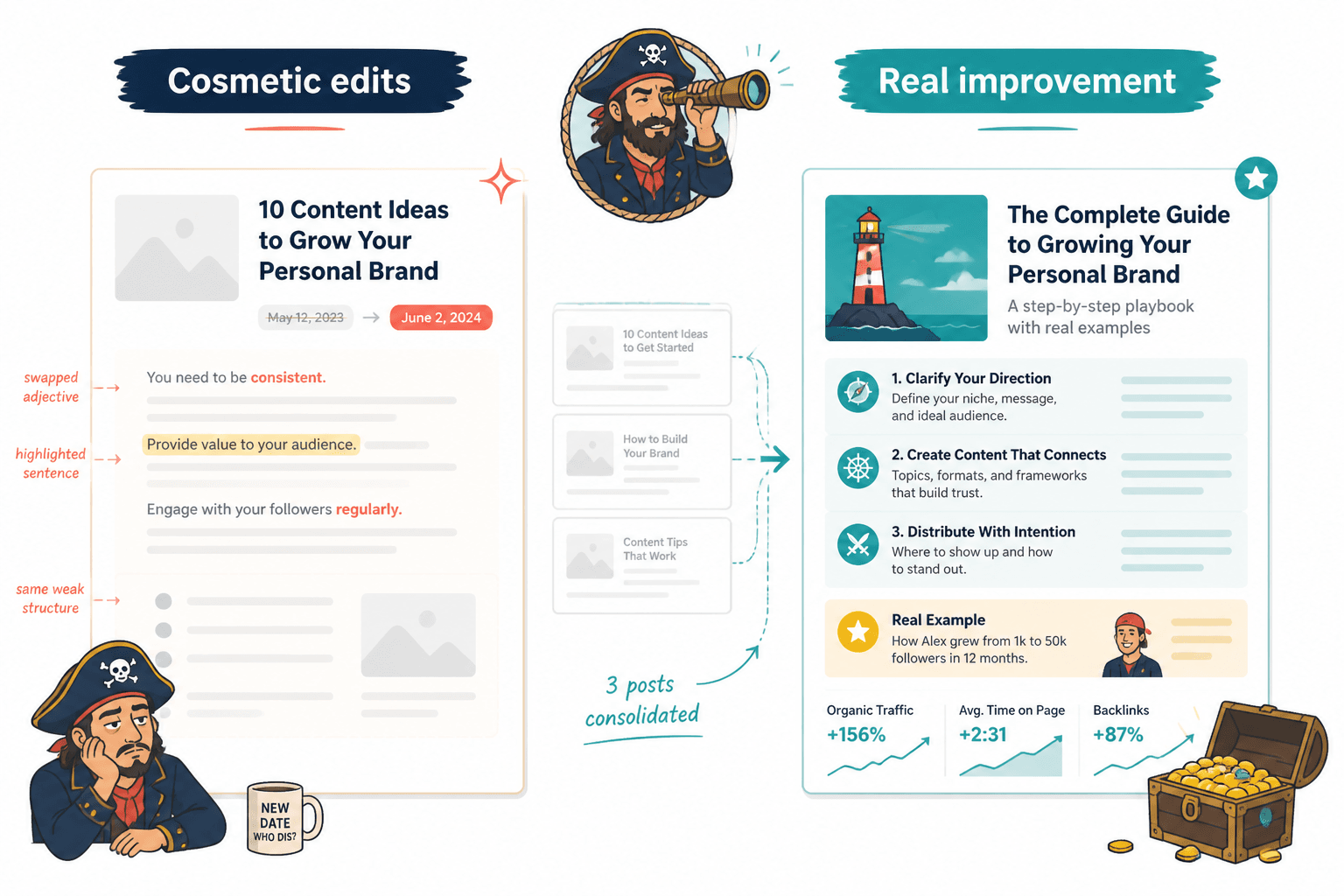
A lot of refreshes fail because they stay cosmetic. New title. New date. Same mush.
The core promise of the article needs to be stronger. Clearer. More useful. More aligned with the real problem the reader has.
Weak promise:
Learn how to refresh your blog content for better results.
Better promise:
Here is how to update old blog posts so they match current search intent, earn more clicks, and do a better job selling your expertise.
The second version tells the reader what kind of refresh, why it matters, and what outcome to expect. That is what your title, intro, headings, and CTA should all support.
3. Upgrade the substance
This is the part people love to skip because it takes actual thought.
If your older article is thin, vague, repetitive, or obvious, no amount of polishing will save it. You need to add material that makes the page materially better.
That might mean:
- Adding a better framework
- Including examples or before-and-after rewrites
- Answering obvious reader questions
- Explaining tradeoffs and common mistakes
- Updating screenshots or process details
- Clarifying who the advice is for and not for
Good refreshes often get more specific, not just longer. If a section is vague, do not pad it. Fix it. If a sentence sounds polished but says very little, cut it. Search visibility is nice. Being worth reading is still the job.
4. Fix structure and readability
Even useful content can underperform if the structure is sloppy.
Many older articles have one of two problems: giant blocks of text that repel human eyes, or bloated heading structures that make a simple idea feel like tax paperwork. You want clean sections, useful subheads, and enough rhythm that people can actually move through the page.
As you refresh, check for:
- Weak or generic H2s
- Long intros that take forever to get to the point
- Repeated ideas in different clothes
- Lists that should be paragraphs
- Paragraphs that should be lists
- Missing examples where abstraction gets slippery
This is also the right time to improve scannability. Personal brand readers are often busy and skeptical. Helpful structure signals competence. Messy structure signals “this probably could have been an email nobody wanted.”
5. Update links, context, and the next step
Refreshes should strengthen the article’s place inside your site, not just its wording on the page.
That means adding relevant internal links, tightening the CTA, and making sure the post connects naturally to your current content ecosystem.
For this topic, that could include linking readers to your broader content systems category, your rewrite guides, or practical examples. Useful related resources here include blog rewrites and refreshes, how to write better blog rewrites and refreshes, and a guide for creators who want better results.
If the article gets traffic, do not waste that attention with a dead-end ending. Give the reader a clear next step that fits the topic and your offer.
What to update first inside the article
If you open an old post and immediately feel mildly annoyed by your former self, that is normal. Start here.
| Element | What to check | What better looks like |
|---|---|---|
| Title | Too broad, dated, dull, or vague | Specific promise tied to current intent |
| Intro | Too much throat-clearing | Gets to the pain, mistake, or opportunity fast |
| Headings | Generic or repetitive | Useful and descriptive |
| Examples | Missing, old, or weak | Concrete and relevant to your audience |
| Proof | Claims with no support | Reasoning, examples, outcomes, or clear logic |
| CTA | Generic or outdated offer | Relevant next step based on reader intent |
| Internal links | Thin or random | Helpful pathways to related articles and offers |
Notice what is not on that list: changing a few adjectives and hoping Google gets emotional about your effort.
Common refresh mistakes that make posts look updated but not better
This part matters because a lot of content refresh advice is technically correct and practically useless.
Changing the date without changing the value
If the article still has the same weak substance, a newer timestamp does not make it fresh. It makes it newly disappointing.
Adding fluff to hit a longer word count
Longer is not fresher. Better is fresher. If the reader wanted six extra paragraphs of air, they could read most marketing blogs.
Ignoring the business goal
Your article should not just rank. It should support trust, relevance, and movement toward your offers. If you refresh a post and still leave it disconnected from your current positioning, you have improved a page while missing the point.
Keeping outdated framing because it once worked
Some older content uses language, assumptions, or examples that no longer fit the market or your audience. Refreshing means being willing to update the framing itself, not preserving old wording out of sentimentality.
Refreshing posts that should really be merged or replaced
If you have three weak posts on similar topics, one stronger consolidated article may serve you much better than three separate refreshes. This is especially true for personal brands with lots of overlap between service pages, thought leadership, and educational content.
For examples of how that can look in practice, see blog rewrites and refreshes examples for coaches, consultants and personal brands.
A practical refresh workflow for personal brands
If you want this to be repeatable, use a simple process. Not a 47-tab spreadsheet ritual that makes you hate your own website.
- Pick one article with clear upside. Look for rankings, impressions, business relevance, or conversion potential.
- Review the current SERP. Note what searchers appear to want now.
- Audit the article honestly. Where is it vague, outdated, underdeveloped, or structurally weak?
- Rewrite the title, intro, and headings first. This forces clarity before detail.
- Upgrade the body. Add examples, frameworks, proof, and specifics.
- Cut fluff aggressively. If a section says little, trim or replace it.
- Add internal links and a better CTA. Make the article useful inside your broader site journey.
- Republish and monitor. Watch impressions, clicks, rankings, engagement, and conversions over time.
This does not need to happen all at once for every post. Even refreshing one high-potential article per week can improve the quality and usefulness of your site surprisingly fast.
How personal brands should think about search intent differently
Here is where personal brand sites have a slight advantage, if they use it well.
You are not trying to sound like a faceless publication writing for everyone with a keyboard. You are trying to attract the right readers and make them trust how you think. That means your refresh should satisfy search intent and express a sharper point of view.
In practice, that means an article can be search-friendly without becoming generic. You can still:
- Take a clear stance on what is overrated
- Call out common mistakes your audience keeps making
- Use examples from creator, consultant, or coach workflows
- Recommend simpler processes instead of bloated “best practices”
- Make the article sound like a real expert, not a committee
This matters because trust does not come from ranking alone. It comes from sounding like someone worth listening to once the person lands on the page.
So yes, refresh for search. But do not wash out your voice in the process. Beige authority is still beige.
When to rewrite heavily, not lightly refresh
Some articles do not need a refresh. They need a rewrite wearing a refresh badge.
A heavier rewrite makes sense when:
- The article targets the right topic but the execution is weak
- Your expertise has evolved a lot since publishing
- The article structure is broken from the start
- The post ranks a bit, but the clickthrough or engagement is poor
- The current version does not reflect your audience or offers anymore
In those cases, trying to preserve too much of the original can be a mistake. Keep the useful core if there is one, but rebuild the article around a stronger promise and better structure.
If that is the kind of update you need, start with how to write better blog rewrites and refreshes. It is the difference between polishing an article and actually improving it.
How often should you refresh blog content?
There is no magic schedule, because your content is not produce and should not be treated like it expires on the same day.
That said, a useful rhythm for personal brands is to review important evergreen posts every 6 to 12 months, and sooner if:
- Traffic drops noticeably
- Rankings slip for relevant queries
- Your offer or positioning changes
- The market conversation shifts
- The article starts sending the wrong message about what you do
Evergreen does not mean untouchable. It means the topic keeps mattering. The execution still has to earn its keep.
Simple internal links that make refreshed content more useful
Once you update an article, connect it properly. Internal links help readers move, help search engines understand topical relationships, and help your site feel like a coherent body of work instead of a pile of disconnected blog posts.
For this topic, the most natural internal pathways include:
The bigger point is simple: clearer structure and clearer writing make the piece more useful. That is usually what makes the ending land better too.