Most newsletter subject line formulas do not fail because formulas are bad. They fail because people use them like copy-paste costumes.
You have seen the usual suspects: “3 lessons from…”, “A quick thought on…”, “You’re making this mistake”, “How to finally…” None of these are automatically terrible. They just become terrible when the writer swaps in a vague topic, adds zero tension, and expects curiosity to do all the heavy lifting. It won’t.
If you want to learn how to write better newsletter subject line formulas without sounding generic, the fix is not abandoning formulas. The fix is using formulas as structure, not personality. Good formulas give your subject line shape. They do not give it sharpness, specificity, or a point. That part is still your job.
Here’s how to make subject line formulas sound more human, more interesting, and much more worth opening without turning them into clickbait soup.
For the full path around this topic, head to the parent guide.
Why generic subject lines get ignored
People do not open emails because they admire your sentence structure. They open because the subject line creates one of three things fast:
- A clear benefit
- A sharp curiosity gap
- A feeling of relevance right now
Generic subject lines usually miss all three.
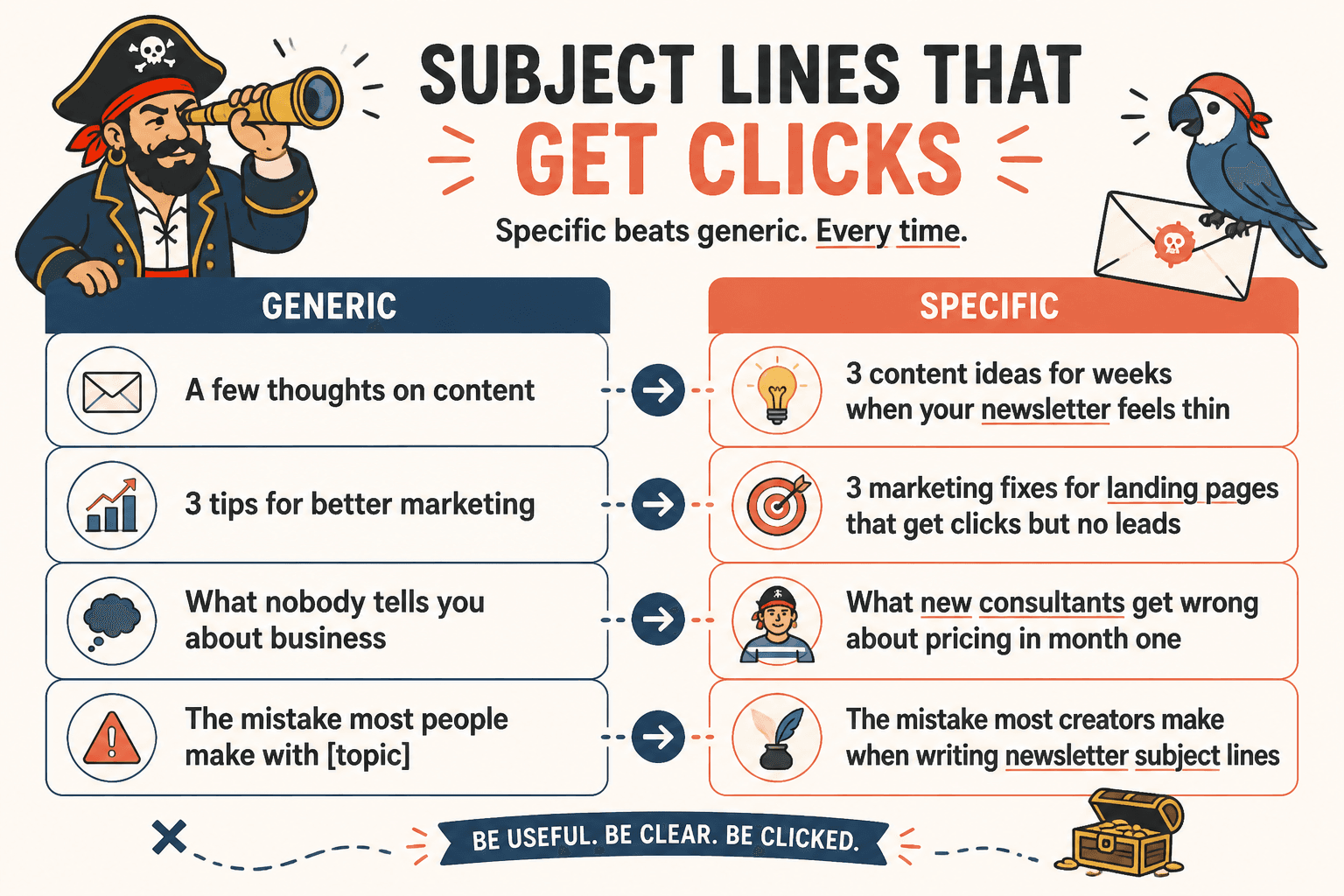
“A few thoughts on content” is not relevant enough. “3 tips for better marketing” is too broad to care about. “What nobody tells you about business” sounds like it escaped from a bad template vault.
The problem is not that the formula exists. The problem is that the line could have been written by anyone, for anyone, about almost anything.
And in an inbox, that is fatal. Not dramatic. Just true.
If you want a stronger foundation before you start testing formulas, it helps to understand the broader principles behind newsletter subject lines and the common mistakes that kill clarity in the first place.
What a subject line formula is actually for
A formula gives you a repeatable structure. That is useful because it speeds up writing and helps you avoid floppy, overthought subject lines.
But a formula is not the finished line. Think of it more like sentence scaffolding. It helps the line stand up. It does not make the line worth reading.
For example, this is a formula:
The mistake most people make with [topic]
Useful structure. Very reusable. Also dangerously easy to make boring.
Compare these:
- Generic: The mistake most people make with email marketing
- Better: The email marketing mistake that makes good newsletters feel skimmable
- Better still: The subject line mistake that makes useful emails look forgettable
Same skeleton. Better specificity. Better tension. Better fit for the actual email.
That is the real job: keep the formula, improve the inputs.
How to write better newsletter subject line formulas without sounding generic
If your formulas keep sounding stiff, broad, or suspiciously like everyone else’s, here’s what to change.
1. Replace broad topics with specific stakes
Broad topics flatten subject lines. Stakes sharpen them.
Instead of writing around giant nouns like “marketing,” “mindset,” “business,” or “productivity,” write around what the reader is actually trying to fix, avoid, earn, understand, or improve.
- Broad: A better way to think about content
- Specific: A better way to write content people do not scroll past
- Broad: 3 lessons about sales
- Specific: 3 sales lessons from offers people almost bought
Specific stakes create movement. Broad topics just sit there.
2. Stop using formulas that hide the point
A lot of subject lines try to sound intriguing while saying almost nothing.
- Something I have been thinking about
- A quick note
- This changed how I see everything
- You may need this
These are not clever. They are underwritten.
Curiosity works best when the reader can still tell what kind of value is inside. If the line is too foggy, it feels risky to open. And your reader already has 37 unread emails and a low tolerance for mystery.
Try this instead:
- Weak: Something I have been thinking about
- Better: Something I have been thinking about when a post gets attention but no leads
- Weak: This changed how I see content
- Better: The idea that changed how I write content for buyers, not browsers
You do not need to explain the whole email in the subject line. You do need to give the reader a reason that is not painfully vague.
3. Add contrast, not fluff
One of the fastest ways to improve a formula is to add contrast. Contrast creates tension, and tension creates interest.
Useful contrast often looks like this:
- What people think vs what actually works
- Good intention vs bad result
- Popular advice vs useful advice
- Easy action vs hidden cost
- More effort vs better result
Examples:
- Formula: Why [common tactic] does not work the way you think
- Example: Why “valuable content” often fails to earn trust
- Formula: [Good thing] is not the same as [better thing]
- Example: Being informative is not the same as being memorable
- Formula: The difference between [X] and [Y]
- Example: The difference between an interesting subject line and an open-worthy one
Contrast gives the line a point of view. That matters because neutral subject lines often feel disposable.
4. Use numbers carefully, not automatically
Numbers still work. They just are not magic, and they can make your subject line sound like every newsletter from 2019 if you use them lazily.
Bad number usage:
- 5 tips for writing better
- 7 ways to grow your brand
- 3 things I learned this week
Better number usage:
- 5 subject line tweaks that make newsletters sound less mass-produced
- 3 ways creators accidentally make smart emails feel skippable
- 7 editing habits that make newsletters easier to open and finish
The number is not the appeal. The specificity after it is.
5. Write for reader recognition, not writer self-expression
This one gets missed a lot. Especially by smart people who like elegant phrasing.
Your subject line is not there to showcase how interesting your brain is. It is there to help the right reader recognize that the email matters to them.
That means the best formulas usually point toward a reader problem, desire, tension, or curiosity they already have.
- Writer-centered: A thought on modern attention
- Reader-centered: Why useful emails still get ignored in crowded inboxes
- Writer-centered: Some nuance on consistency
- Reader-centered: The consistency mistake that makes newsletters easier to forget
There is nothing wrong with having style. But recognition beats style when opens are on the line.
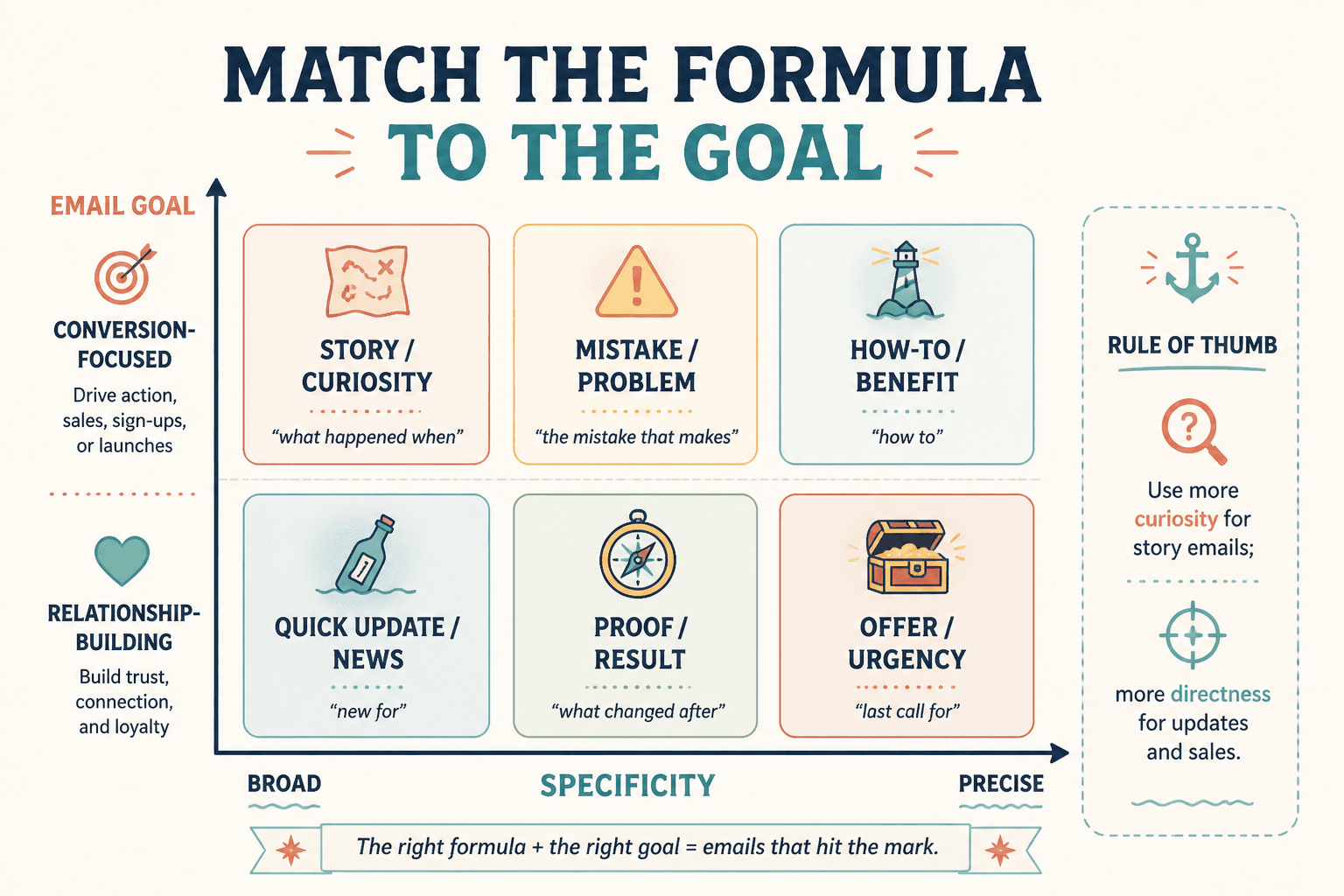
6. Match the formula to the email type
Not every email needs the same kind of subject line. This is where people accidentally make everything sound repetitive.
| Email type | What the subject line should emphasize | Good formula style |
|---|---|---|
| Educational email | Clear takeaway | How to, mistake, lesson, framework |
| Opinion email | Point of view | Why, unpopular take, the real problem with |
| Story email | Tension or curiosity | What happened when, I nearly, the moment I realized |
| Sales email | Outcome, urgency, fit | For people who want, if you are stuck with, last call for |
| Quick update | Direct relevance | A small update on, new for, this week’s |
If every email gets the same “3 things about…” treatment, the problem is not just the formula. It is the lack of range.
If you also tend to open weakly in the email itself, this pairs well with how to start newsletter subject lines without a weak opening, because weak first lines and weak subject lines usually come from the same fuzzy thinking.
7 subject line formulas that work better when you sharpen them
Here are some useful formulas, plus how to keep them from sounding like stock content.
1. The mistake formula
The mistake that makes [desired result] harder
Weak: The mistake people make with newsletters
Better: The mistake that makes thoughtful newsletters feel forgettable
Why it works: it connects the mistake to a consequence people care about.
2. The difference formula
The difference between [thing people confuse] and [thing that actually matters]
Weak: The difference between good and bad emails
Better: The difference between a decent subject line and one people actually open
Why it works: it promises clarity, not hype.
3. The why formula
Why [common action] still does not lead to [desired result]
Weak: Why your content is not working
Better: Why useful newsletter content still gets ignored at the inbox stage
Why it works: it names the frustrating gap between effort and outcome.
4. The lesson formula
[Number] lessons from [specific situation or pattern]
Weak: 3 lessons from writing emails
Better: 3 lessons from emails that got opened but did not get replies
Why it works: the situation adds texture and implied proof.
5. The anti-generic formula
[Useful thing] without [annoying thing people hate]
Weak: Better newsletter subject lines
Better: Better newsletter subject lines without fake urgency
Why it works: it reassures the reader that you are not about to serve up the usual nonsense.
6. The overlooked problem formula
The [thing] problem nobody notices until [bad result]
Weak: The email problem nobody talks about
Better: The subject line problem nobody notices until opens start sliding
Why it works: it points to an invisible issue with real stakes.
A usable formula should make the line clearer, not more interchangeable. If the result sounds like it could headline any email on earth, the formula is doing too much and the thinking is doing too little.